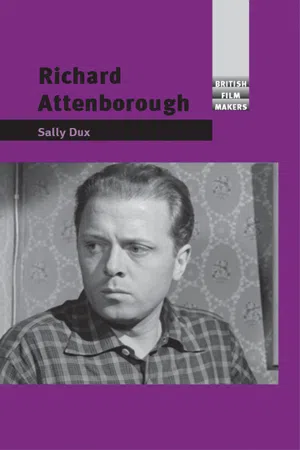
Richard Attenborough's film career has stretched across seven decades; surprisingly, Sally Dux's book is the first detailed scholarly analysis of his work as a filmmaker. Concentrating on his work behind the camera, she explores his initial role as a producer, including his partnerships with Bryan Forbes in Beaver Films (1959–64) and with Allied Film Makers (1960–64). As we know, Attenborough went on to direct twelve films, many of which achieved great acclaim, most notably Gandhi, which won eight Academy Awards in 1982
Attenborough is most renowned for his biographical films including Young Winston, Cry Freedom, Chaplin and Shadowlands, which helped to establish the genre within British cinema. Although his work has often attracted controversy, particularly regarding the representation of individuals and historical events, his films are noted for extracting acclaimed performances from unknown actors such as Ben Kingsley (Gandhi), while maintaining his moral and thematic concerns.
- 220 pages
- English
- ePUB (mobile friendly)
- Available on iOS & Android
eBook - ePub
Richard Attenborough
About this book
Information
Subtopic
Film & Video1
On-screen: Attenborough as actor
Richard Attenborough’s first appearance in the cinema, at the age of 18 in the Noël Coward and David Lean co-directed production, In Which We Serve (1942), was one that went almost unnoticed. The naval propaganda production which was loosely based on the bombing of HMS Kelly (renamed HMS Torrin in the film), under the command of Lord Mountbatten (played as Captain Kinross by Noël Coward), saw Attenborough playing the part of a frightened young stoker who leaves his post at a critical moment as his ship is undergoing attack. The young actor, proud of his film debut, and looking forward to seeing himself on-screen for the first time, attended the première formally attired and accompanied by his parents. His pride, however, was short-lived. When the end credits were played, the name of Richard Attenborough was missing, a production oversight, and a profound disappointment to the actor.1 The omission was felt more acutely as the name of Juliet Mills, the baby daughter of John Mills, who played Ordinary Seaman Shorty Blake, was included for her tiny cameo role as Blake’s daughter. Although Attenborough received immediate apologies from the film’s producer, Anthony Havelock-Allan, nothing, he was told, could be done to rectify the situation. Even in the subsequent VHS and DVD releases of the film, Attenborough’s role remains to this day uncredited. In many ways this early uncredited debut can also be seen as a metaphor for the similar lack of recognition that Attenborough was to receive as a future director, despite his notable successes.
Richard Samuel Attenborough was born on 29 August 1923 in Cambridge to Mary (née Clegg) and Frederick Attenborough. The family moved to Leicester when Frederick Attenborough became Principal of University College (later the University of Leicester). Although not academically gifted (unlike his two brothers David and John, who followed their father to the University of Cambridge), the young Richard yearned to act, an interest inherited from his mother who was actively involved with an amateur dramatic society, known as the Leicester Little Theatre. The theatre’s director, Moyra Hayward, coached Attenborough for his audition for the Royal Academy of Dramatic Art (RADA). The preparation was essential, as Frederick Attenborough stipulated that Richard had to win a scholarship to attend, as the family could not afford the fees. Attenborough’s determination to succeed and his ability were proved when he was awarded a Leverhulme Scholarship. To further prove his merit, Attenborough was awarded the Bancroft Silver Medal on leaving RADA in 1942.
Although Attenborough made many successful stage appearances, it was his film acting career, and particularly the associations that he made as a result, that were to be responsible for advancing his career as a filmmaker. The young stoker’s part in In Which We Serve was secured for Attenborough, while still at RADA, by his newly acquired agent, the American-born Al Parker, who persuaded Noël Coward to cast him. The role was also to prove a valuable platform for developing several significant friendships – the beginning of a lifelong association with Coward (who later became godfather to Attenborough’s son Michael), an introduction to Earl Mountbatten whose friendship and position as former Governor General of India would prove invaluable during negotiations with the Indian authorities for Gandhi, and with the actor John Mills, whom Attenborough later claimed as his greatest friend, and who was responsible for securing Attenborough his first role as director in Oh! What a Lovely War (1969).
Attenborough’s acting career was significantly affected and also influenced by the Second World War. After his debut, Attenborough played only two small film roles, in Schweik’s New Adventures (Carl Lamac, 1943) and The Hundred Pound Window (Brian Desmond Hurst, 1943), before being called up for service in the Royal Air Force with the intention of training as a pilot. While Attenborough’s film career was interrupted by his service commitments, these breaks were also to prove beneficial. Although Attenborough did not receive his wings, he was, instead, seconded to the RAF Film Unit, which was based at Pinewood Studios. Attenborough was given one of two leading roles in the propaganda film Journey Together (John Boulting, 1945), based on a script by Terence Rattigan, a part-documentary drama which focused on the training and fighting experience of a bomber crew. Attenborough plays the part of David Wilton who fails the grade in his training as a pilot and becomes a navigator instead, whereas John Aynesworth (Jack Watling) succeeds. Although intended as a training film, Journey Together was also released commercially to enthusiastic reviews. The News Chronicle, for instance, considered it as ‘one of the most realistic and brilliant films of the war in the air.’2 The film also included, as a guest star, the American actor Edward G. Robinson. It was Robinson (or Eddy G. as Attenborough preferred to call him) who provided the young actor with one-to-one film acting tuition and to whom Attenborough attributes as having ‘patiently taught me the act of acting for the screen.’3
A life-long friendship developed between Attenborough and John Boulting. Boulting’s manner of directing was clearly one that Attenborough admired and one that he was keen to follow. As he later claimed: ‘From him I came to understand that good directors do not shout and stamp around. The crew is an orchestra and the director is their conductor, setting the rhythm, bringing a soloist or a whole section to the fore, each at the appropriate moment, and always remaining firmly in command.’4 Journey Together also enabled Attenborough to receive advice from the documentary filmmaker Humphrey Jennings, who was working in the editing suite at the studios at the same time. Jennings was a willing teacher and encouraged the enthusiastic young Attenborough to learn the cinema skills of camerawork and editing. For Attenborough, Jennings was foremost in showing ‘what could be achieved with clever composition, dramatic intercutting and the judicious use of sound effects and music’.5
Another unexpected career opportunity came from a visit, while on leave, to the set of A Matter of Life and Death at Denham Studios in 1946. The film – part romance, part war, and part fantasy story – involves the story of Peter Carter (David Niven) a pilot who, incredibly, survives jumping out of a burning aircraft without a parachute. Carter’s rightful place in the other world is delayed by this error, and the situation becomes further complicated by his romance with an American radio operator, June (Kim Hunter). A heavenly court has to be summoned to decide his fate, which agrees to an extension of his life on earth, helped by the strength of the Anglo-American relationship. The filmmaking partnership of Michael Powell and Emeric Pressburger had earlier provided Attenborough’s new wife, Sheila Sim, with her first co-starring film role in A Canterbury Tale (Powell, 1944). On this occasion, however, it was Attenborough who was invited to perform a cameo role in the film, playing the credited role of an English pilot who is entering the other world after dying in the war. While it was Attenborough’s only acting role for Powell, the experience left him in awe of the man, declaring him as ‘easily the best’ of all British directors.6
After demobilisation, Attenborough signed a long-term contract with the Boulting brothers, John and his twin brother Roy. It was the Boultings who were responsible for giving Attenborough his first leading role as the psychopathic teenage killer Pinkie Brown, in Brighton Rock (John Boulting, 1947). A thriller made in the manner of an American gangster film, Brighton Rock focuses on two rival gangs who inhabited the town during the 1930s, one of which is led by Pinkie. After committing a murder, Pinkie decides to court and then to marry a young girl, Rose (Carol Marsh), to prevent her from giving evidence against him, according to the law at the time. When Pinkie fails to persuade Rose to commit suicide, his death, falling off the pier after being pursued, provides a chilling conclusion to the film. Attenborough had played the role of Pinkie in the theatre in his first major stage role, co-starring with Dulcie Gray, which had been well received. The chance for him to reprise his successful stage role was one he relished, despite the initial concerns of Graham Greene, author of the original book and co-author with Terence Rattigan of the screenplay. Greene had disliked the stage adaptation by Frank Hardy, and had asked for his own name to be removed from the credits. For the film, Greene was concerned that Attenborough would not be able to show the required evil of the character. These concerns were later echoed by the film critic, Ivan Mosley, who declared that Attenborough’s performance ‘is about as close to the real thing as Donald Duck is to Greta Garbo’.7 Greene, however, found Attenborough’s performance particularly pleasing, and endorsed this by sending him a copy of the novel of Brighton Rock which was inscribed: ‘To my dear Dick, my perfect Pinky [sic]’.8 A similar view was expressed by the Monthly Film Bulletin, who declared that ‘Richard Attenborough, as Pinkie, is all Pinkie should be, ruthless, craven, sinister and sadistic, and he looks and lives the part.’9
In the post-war crime drama Dancing with Crime (John Paddy Carstairs, 1947), husband and wife acted together with Attenborough playing Ted Peters, a former soldier, now working as a London taxi driver, and the boyfriend of Sheila Sim’s character (Joy Goodall), who unwittingly becomes involved with a criminal gang. In the comedy thriller, London Belongs to Me (Sidney Gilliat, 1948), based on the novel by Norman Collins, Attenborough plays Percy Boon, a motor mechanic who discovers a body in the back of a car. Although innocent of the crime, he is found guilty of murder and is sentenced to be hanged. The residents in the street where he lives gather support to help win him a reprieve. Armed with a signed petition, they march to Parliament, only to find that clemency has already been granted. London Belongs to Me was described by The Times as ‘an extremely entertaining film’, declaring that it ‘owes its prime distinction to a performance by Mr Richard Attenborough’.10 It also marks the actor’s first encounter with films exploring issues concerning the death penalty, a theme Attenborough was to return to on several occasions. While Attenborough was suitably convincing playing a 17–year-old at the age of 23 in Brighton Rock, he had to become even more youthful for the Boulting’s next production, The Guinea Pig (Roy Boulting, 1948) in which he plays a working-class schoolboy who is removed from his local state establishment and sent to a public school as part of an educational experiment. The absurd youthfulness of Attenborough’s early teenage role, when the actor was 24 (which required his bald patch to be covered up) was made all the more apparent as his wife, Sheila Sim, played his house mistress. The Times, too, picked up on this point when it observed: ‘The mind of Mr Richard Attenborough does all it can to overcome the handicap of the body and voice too old for the ...
Table of contents
- Cover
- Half Title Page
- Title Page
- Copyright Page
- Dedication Page
- Contents
- List of Plates
- Series Editors’ Foreword
- Acknowledgements
- Introduction
- 1 On-screen: Attenborough as actor
- 2 Attenborough as producer: Beaver Films and Allied Film Makers
- 3 New directions: Oh! What a Lovely War (1969)
- 4 Anglo-American alliances: Young Winston (1972), A Bridge Too Far (1977) and Magic
- 5 Race, nation and conflict: Gandhi (1982), A Chorus Line (1985) and Cry Freedom (1987)
- 6 Public and private identities: Chaplin (1992) and Grey Owl (1999)
- 7 Brief encounters: Shadowlands (1993), In Love and War (1996) and Closing the Ring (2007)
- Conclusion
- Filmography
- Bibliography
- Index
Trusted by 375,005 students
Access to over 1.5 million titles for a fair monthly price.
Study more efficiently using our study tools.
Frequently asked questions
Yes, you can cancel anytime from the Subscription tab in your account settings on the Perlego website. Your subscription will stay active until the end of your current billing period. Learn how to cancel your subscription
No, books cannot be downloaded as external files, such as PDFs, for use outside of Perlego. However, you can download books within the Perlego app for offline reading on mobile or tablet. Learn how to download books offline
We are an online textbook subscription service, where you can get access to an entire online library for less than the price of a single book per month. With over 1.5 million books across 990+ topics, we’ve got you covered! Learn about our mission
Look out for the read-aloud symbol on your next book to see if you can listen to it. The read-aloud tool reads text aloud for you, highlighting the text as it is being read. You can pause it, speed it up and slow it down. Learn more about Read Aloud
Yes! You can use the Perlego app on both iOS and Android devices to read anytime, anywhere — even offline. Perfect for commutes or when you’re on the go.
Please note we cannot support devices running on iOS 13 and Android 7 or earlier. Learn more about using the app
Please note we cannot support devices running on iOS 13 and Android 7 or earlier. Learn more about using the app
Yes, you can access Richard Attenborough by Sally Dux in PDF and/or ePUB format, as well as other popular books in Media & Performing Arts & Film & Video. We have over 1.5 million books available in our catalogue for you to explore.