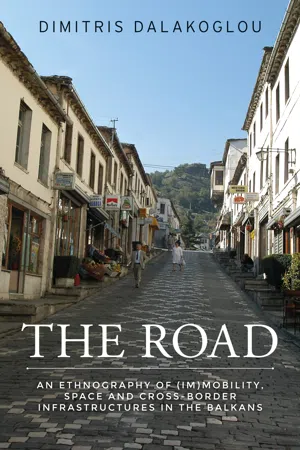
This book is an ethnographic and historical study of the main Albania-Greece highway. But more than an ethnography on the road, it is an anthropology of the road. Highways are part of an explicit cultural-material nexus that includes houses, urban architecture and vehicles. Complex socio-political phenomena such as EU border security, nationalist politics, post-Cold War capitalism and financial crises all leave their mark in the concrete. This book explores anew classical anthropological and sociological categories of analysis in direct reference to infrastructure, providing unique insights into the political and cultural processes that took place across Europe after the Cold War. More specifically, it sheds light on political and economic relationships in the Balkans during the socialist post-Cold War period, focusing especially on Albania, one of the most under-researched countries in the region.
eBook - ePub
The road
An ethnography of (im)mobility, space, and cross-border infrastructures in the Balkans
- 216 pages
- English
- ePUB (mobile friendly)
- Available on iOS & Android
eBook - ePub
The road
An ethnography of (im)mobility, space, and cross-border infrastructures in the Balkans
About this book
Trusted by 375,005 students
Access to over 1.5 million titles for a fair monthly price.
Study more efficiently using our study tools.
Information
1
From dromocracy toward a new critical dromology
As soon as it takes power the Nazi government offers the German proletariat sports and transport. No more riots, no need for much repression; to empty the streets it’s enough to promise everyone the highway. (Virilio 2006 [1977], 49)
Roads and anthropologists
Traditionally, most anthropological work has been devoted to studying populations that were portrayed as antithetical to the dominant trends in modern and capitalist society. Roads and automobility were considered Western and modern elements, far from the ethnographic Other. The widespread introduction of roads on a global level sparked distinct reactions within anthropology.
First, many classical disciplinary ancestors underestimated (rather ineloquently) the impact of highways on their ethnographic “objects.” Most typically, Evans-Pritchard suggested that although the Azande had changed their pattern of settlement by concentrating around the newly constructed roads—instead of streams, as they had before—he could not in fact ascribe to roads “any great change in the life of the Azande” (1932, 292). Highways, in the eyes of Evans-Pritchard, brought the imagined exotic a few steps nearer to the nonexotic world. Writing “a few steps nearer” was, in fact, quite literal, as it seems that his anthropological objects were constituted mainly of walkers, rather than drivers and passengers, with a preference for barefoot walkers. Walking barefoot implied an a priori hierarchical classification of people, as Tim Ingold (2004) explains in his discussion of cultures characterized by walking versus those with a culture of vehicle mobility. Thus, Sir Evans-Pritchard’s subjects were indeed walkers—and hence closer to nature. They were passive receivers of change, unaffected by highways:
I am not concerned here with those changes, which were mostly imposed on the Azande and are—when I use the present tense the reference is to the years 1926–30—not regarded by them as part of their way of life but something to be passively accepted or to be circumvented or ignored. To give one example: though the Administration compelled them to maintain wide roads it was noticeable that when a group of Azande walked down them they did so in single file as they were accustomed to do along their bush paths. (Evans-Pritchard 1960, 311)
Given the aforesaid trend toward remote ethnographic subjects, there was, in some respects, an unspoken competition between ethnologists to reach the most isolated and remote places, and as such the most primitive and exotic of peoples. Early anthropological accounts are full of references to isolated subjects accessed by poor-quality (mostly pre-automobile) roads. In 1884, Franz Boas observed that “the natives who had visited Padli in March had reported that the road was very bad; that the land was very nearly clear of snow and that the sledge would have to be carried over high rocks” (1884, 265). Levi-Strauss’s early ethnographic explorations in South America were equally explicit: “I occasionally took that step on horseback with some colleagues when we came to the end of one of the few roads available at the time” (Levi-Strauss and Kussell 1971, 45). Moreover, Edmund Leach, in an interview with Adam Kuper (1986, 375), recalled his first type of ethnographic excursion in China, while still a civil engineer: “Chungking itself was still a mediaeval city, all steps and sedan chairs. No roads or motor vehicles except the odd half-disintegrated bus.” Even Paul Rabinow (2007 [1977], 44), the most reflexive anthropologist, stated about his fieldwork that “the road for the first five miles is little more than a path—untarred, pitted, and winding and steep in places.” Even anthropologists who later focused their research on networked infrastructures such as Caroline Humphrey (1989, 6) have been explicit about the difficult roads in their place of research: “the road crosses a high mountain pass which is snowy even in midsummer, and plane tickets, unless booked months in advance, are obtainable only on a who-you-know basis.”
Nevertheless by the latter half of the twentieth century, ethnologists began to acknowledge that highways had marked the end of the semi-isolated, nonmodern people that comprised the discipline for most of its history. Thus, given the aforesaid enthusiasm for, and informal competition to reach, remote places, to a certain extent the implication is that generally many anthropologists somehow regret the disappearance of remote research subjects. As Levi-Strauss explained, by the 1960s, roads already implied the end of isolated ethnographic subjects: “Likewise, the establishment of the new federal capital of Brazil and the building of roads and aerodromes in remote parts of South America have led to the discovery of small tribes in areas where no native life was thought to exist” (1966, 125). Twenty years later, Michael Herzfeld (1985) was much more clear on the potential sources of anthropological roadphobia: highways “strangulate” the traditional practices of the ethnographic subject.
Finally, as with all things, the arrival of better roads and better access brought more positive assessments of the roads that were reaching the once-isolated ethnographic subject:
More than anything else, the completion of the jeep road opened up the Fore region, changing it almost overnight from an isolated region to one open to free travel and commerce and, more important, in contact with the outside world … The power of the road is hard to overestimate. It was a great artery where only restricted capillaries had existed before, and down this artery came a flood of new goods, new ideas, new peoples, and, above all, excitement… . It was to the Fore an opening to a new world. (Sorenson 1972, 366)
Roads and boundary crossing
Within this aforementioned context, Marc Augé’s suggestion (1995, 86) that “ethnologists mistrust the journey” is hardly a surprise. At the same time, anthropologists were professional strangers (Agar 1996) and the most typical students of nomadism and semi-nomadism (e.g. see Barth 1964; Campbell 1964; Rao 1987; Vainshtein 1980), and the ones who produced pioneering ethnographic works on migrants and their communities dating from several decades ago (e.g. see Lewis 1964; Watson 1977). Thus, the aforesaid mistrust of roads was not the same as a mistrust of the journey; in fact, it implied an anthropological avoidance of studying the crossing of certain spatial and cultural boundaries rather than the mistrust of the journey per se. This reflected the similar avoidance to cross the respective boundaries of the established epistemological paradigm. These spatial/cultural/epistemological boundaries have to be seen within the culturally relativistic (but simultaneously rationalist) Boasian separation of humanity into semi-sealed cultureareas. Arguably, the issue was what Akhil Gupta and James Ferguson called place-culture isomorphism (1997). Namely that cultures are considered attached to places. Thus, to rephrase Marc Augé, the issue was not the journey or mobility generally, but a dislike for the process of crossing a series of boundaries.
This is more or less to be expected from anthropology; an epistemological offspring of modernity which indeed had as its main focus clear-cut rational classifications and thus the negation of explicitly hybrid formations (Latour 1993) or that which would facilitate such cultural formations, in our case: roads. In the case of British anthropology, the methodological monism of small-scale groups further illustrates this fear of crossing sociospatial boundaries. For instance, while physical mobility, in reference to the Kula Ring of Trobriand islanders, was defining for British social anthropology (Malinowski 1922), the established spatiocultural boundaries of the Trobriand islands were not really crossed as part of the Kula exchange, and thus an ethnography of such mobility that remained within its spatiocultural position was, epistemologically, a safe bet. Perhaps, a potential encounter with the crossing of boundaries would lead to a disruption of the “order of [anthropological] things” (Foucault 2002 [1966]).
Following a Foucauldian line of argument, one could attribute such fear of boundary-crossing to the privileged class and ethnic background of most ancestors of the discipline and their self-determination, in antithetical terms, to the nonmodern and colonized ethnographic subject. This echoes the by now celebrated opposition—but also interdependence—between the nomadic and the settled that Gilles Deleuze and Felix Guattari (1986), among others, discuss, or indeed what in a more anthropological manner James Scott (1998) described as the opposition between state(d) (anthropologists in our case) and stateless/moving people. Or perhaps it even reflects the other famous division between hot and cold societies, if one prefers the more classical Levi-Straussian terminology. Indeed, we should not forget the metaphor encapsulated in this terminology: according to thermodynamics, cold bodies are characterized by slower molecular motility.
Late modernity as dromocracy
Anthropology is no longer able to neglect roads; together with other infrastructures, roads have become a central subject of anthropological inquiry. This should be seen in relation to other concepts, such as mobility (Cresswell and Merriman 2011; Urry 2007), flows (e.g. Appadurai 1990), network society (Castells 2010), or fluidity and liquidity (Bauman 2000), that have entered the standard lexicon of the social sciences in reference to current sociocultural conditions. In addition to allowing for theoretical speculations and heuristic models, the current sociocultural phenomena, described by the aforesaid concepts, refers both to novel forms of sociality and also to some very explicit and tangible materialities (Miller 2005). Thus, from the increased speed and flows to the fact that they are crucial spaces of flow for network society (Castells 2010), it can be argued that highways have become one of the most paradigmatic material infrastructures of the current sociocultural condition. This does not necessarily imply a materialist determinism: highways not only produce other modern materialities and socialities but also comprise the materialization of modernist ways of imagining the—once “utopian”—futures of a previous era.
We describe the modern world in terms of automobility (Featherstone et al. 2005; Miller 2001; Sheller 2004; Urry 2004), yet this generic term, which seems to prioritize the automobile conceptually, can be misleading. Historically, roads for automobility were developed and “produced” on a mass scale well before the mass production and mass use of vehicles (Mom 2005; Vahrenkamp 2002). As such, the priority of modern highways is not only a temporal matter—some of the most insightful students of modernity have been explicit about the “cosmogonical” value of highways for the late modern cosmos. For instance, in Speed and Politics, Paul Virilio (2006 [1977]) defined modern society precisely as a “dromocratic society” (from dromos, road, and cratos, state, power).
Roads of course are not a modern phenomenon; they are the most archetypal human-made networks. For example, James Snead et al. (2010) compiled a collection of archaeological perceptions of different roads and pathways. Moreover, if we consider the paths that animals make, then it becomes clear that humans do not have a monopoly on networks of inland mobility. Thus, a question which emerges at this point is what is meant by modern road-systems? A first, technical answer is that modern roads are roads made with fast, frequent, long-range mobility (of vehicles) in mind. They comprise the combination of two relatively different technologies. First, the hard-surfacing/drainage technology that, in the case of Europe, was initially found in cobbled Roman roads and later in other forms such as macadam, cement, brick, or (much later) asphalt concrete. Second, the technology of rapidly building large-scale, long and wide, hard-surfaced, linear highways with controlled and limited access. Although such infrastructure was sometimes built over older transport networks (even ancient ones), in the twentieth century it was primarily built from scratch. This technology is notoriously linked with the modernist and futurist imagination of the European far-right totalitarian states. After all, the highway built during the 1920s, the early days of Italian fascism, between Milan and the Lakes of the North, is considered to be the first example of a highway as we know it today.
Given that the two largest highway systems (built in Italy and Germany) of the interwar period were surfaced with cement, the two current technologies, asphalt concrete and large-scale, linear highway networks, came together and were standardized after WWII. According to Mom (2005) both highways exclusively for automobility and asphalt surfacing emerge after a long war between the competing technologies. In the first case was a war between mixed and car-only networks, which followed a previous war between automobility and canals, railways etc. In the area of surfacing the fight was equally complicated as it was amongst asphalt, bricks, cement, concrete etc. It can be argued that asphalt concrete dominated the surfacing of highways because the United States won WWII.1 Famously, Germany lacked the natural resources necessary for asphalt and sought to avoid becoming dependent on a scarce material for what was one of its key propaganda projects. As technology studies have taught us, however, there are complex politics behind the domination of one material over another. Thus, much more instrumental was the existence of a powerful asphalt lobby in the United States (Holley 2003; MacNichol 2005). Indeed, asphalt was far from the perfect material in the early era of the competition. Nevertheless, substantial amounts of capital were injected into the development of asphalt throughout the nineteenth and early twentieth century which led to its victory in that implicitly historical and explicitly economic competition with various other paving technologies. Asphalt triumphed due to the involvement of local and national governments under pressure from, and aided by, corporate agents and interests such as the owner of Trinidad’s pit lake, the US petrol industrialists, and the postwar boom in the car industry, to mention but a few (Holley 2003; MacNichol 2005; Mom and Kirsch 2001).
Highways were developed over the same period, marking another victory over alternative transport technologies such as canals and most especially railways (Mom and Kirsch 2001). On a macrohistorical level, colonialism and the exploitation of natural resources in diverse terrains all around the globe contributed to the spread of roads capable of automobility versus the railways and canals which dominated the relatively flat landscapes of Northern and Central Europe. During the twentieth century, newly built networks of unpaved...
Table of contents
- Cover
- Half Title
- Title Page
- Copyright
- Contents
- List of figures
- Preface
- Acknowledgements
- Map of Albania
- 1 From dromocracy toward a new critical dromology
- 2 The road to Albania
- 3 The state(s) of the road
- 4 The city and the road
- 5 Fear of the road and the accident of postsocialism
- 6 The road of/on transition
- 7 Domesticating the road
- 8 Infrastructures, borders, (im)mobility, or the material and social construction of new Europe
- Appendix 1 Notes on language, terminology, and pseudonyms
- Appendix 2 Population statistics
- Bibliography
- Index
Frequently asked questions
Yes, you can cancel anytime from the Subscription tab in your account settings on the Perlego website. Your subscription will stay active until the end of your current billing period. Learn how to cancel your subscription
No, books cannot be downloaded as external files, such as PDFs, for use outside of Perlego. However, you can download books within the Perlego app for offline reading on mobile or tablet. Learn how to download books offline
Perlego offers two plans: Essential and Complete
- Essential is ideal for learners and professionals who enjoy exploring a wide range of subjects. Access the Essential Library with 800,000+ trusted titles and best-sellers across business, personal growth, and the humanities. Includes unlimited reading time and Standard Read Aloud voice.
- Complete: Perfect for advanced learners and researchers needing full, unrestricted access. Unlock 1.5M+ books across hundreds of subjects, including academic and specialized titles. The Complete Plan also includes advanced features like Premium Read Aloud and Research Assistant.
We are an online textbook subscription service, where you can get access to an entire online library for less than the price of a single book per month. With over 1.5 million books across 990+ topics, we’ve got you covered! Learn about our mission
Look out for the read-aloud symbol on your next book to see if you can listen to it. The read-aloud tool reads text aloud for you, highlighting the text as it is being read. You can pause it, speed it up and slow it down. Learn more about Read Aloud
Yes! You can use the Perlego app on both iOS and Android devices to read anytime, anywhere — even offline. Perfect for commutes or when you’re on the go.
Please note we cannot support devices running on iOS 13 and Android 7 or earlier. Learn more about using the app
Please note we cannot support devices running on iOS 13 and Android 7 or earlier. Learn more about using the app
Yes, you can access The road by Dimitris Dalakoglou in PDF and/or ePUB format, as well as other popular books in Social Sciences & Anthropology. We have over 1.5 million books available in our catalogue for you to explore.