eBook - ePub
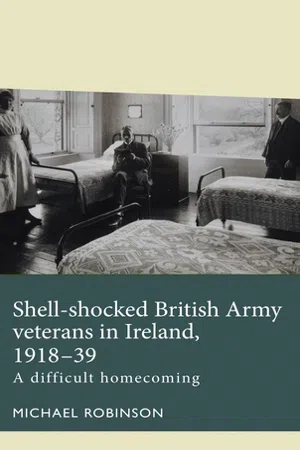
Shell-shocked British Army veterans in Ireland, 1918-39
A difficult homecoming
- 254 pages
- English
- ePUB (mobile friendly)
- Available on iOS & Android
eBook - ePub
About this book
With a focus on mental illness, Shell-shocked British Army veterans in Ireland provides the first in-depth investigation of disabled Great War veterans in Ireland. The book is a result of five years of researching previously untouched archival sources including psychiatric records of former patients otherwise closed to the public. The remit of the work contributes to various historiographical fields including disability history, the social history of medicine, the cultural history of modern war, the history of psychiatry and Irish studies. It also seeks to extend the scope of the First World War with an emphasis on how war-induced disability and trauma continued to affect large numbers of ex-servicemen beyond the official cessation of the conflict.
Information
Publisher
Manchester University PressYear
2020Print ISBN
9781526162496
9781526140050
eBook ISBN
9781526140074
1
‘A definitive neurasthenic temperament’? The Irish Tommy and veteran
Introduction
There was negligible medical provision for mental and nervous casualties before the First World War. The 955-bed Royal Victoria Military Hospital at Netley provided just 125 beds for such cases within its ‘D Block.’ The Lunacy Act of 1890 enabled discharge from the army, certification and a transferral to an asylum.1 During the Second Anglo-Boer War, 1899–1902, severely mentally ill troops in both South Ireland and Ulster were discharged from the army and admitted into their local district asylum. Irish servicemen subsequently shared the ignominy and stigma associated with pauper lunacy.2 The First World War would dramatically change the treatment of war-induced psychoneuroses. The War Office's official medical history of the conflict went so far as to write that shell-shock ‘raised the psychoneuroses to the dignity of a new war disease before which doctors seemed well-nigh helpless.’3
An investigation of mentally disabled Great War veterans will begin where the majority of such illnesses manifested: the Western Front. Two-thirds of Irish battalions spent the entire duration of the war in this theatre which was responsible for almost 31,000 war-dead from Irish Regiments equating to 82 percent of fatalities.4 The British military and medical authorities paid little heed to forewarnings that modern industrial warfare would contribute to a higher number of mental and nervous casualties. Mental and nervous casualties were treated on an ad-hoc basis during the early stages of the First World War. Casualties were cared for wherever they could be placed including military hospitals and wards in general hospitals.5 A basic network of treatment facilities was established for psychoneurotic casualties by 1915. This infrastructure included a treatment facility set up at the No. 26 General Hospital near Etaples with ‘insane’ cases segregated and housed in a small hut. Additional ‘mental blocks’ were placed at other base hospitals throughout the war.6 In 1916, coinciding with the Somme Campaign where the British Army haemorrhaged manpower, an attempt to combat losses was made with the British Army introducing the concept of ‘forward psychiatry.’ This intervention established specialised treatment centres behind trench front lines. These units worked towards the ‘PIE’ system which focused on three core objectives: Proximity of treatment to the area of service; Immediacy of response to symptoms; Expectation of recovery. The most chronic and acute cases were referred to the United Kingdom for further treatment. The Royal Victoria Hospital in Netley, the No. 4 London General Hospital in Britain and the King George V Hospital in Dublin would often act as clearing stations in the UK. Following an initial assessment, servicemen were transferred to suitable hospitals for further treatment including, for example, the Red Cross Military Hospital in Maghull or the National Hospital for Paralysed and Epileptic, Queen Square, London.7 Psychoneurotic men were also sent to newly established War Hospitals established on district asylum grounds. Approximately 4,470 asylum beds were available for the treatment of servicemen's mental and nervous injuries.8 This number included a thirty-two-bed segregated Richmond War Hospital adjunct to the Richmond District Lunatic Asylum and the Belfast War Hospital which displaced the entire population and grounds of the Belfast District Lunatic Asylum.
Varying responses to shell-shock were apparent across these medical and military establishments as practitioners sought to balance caregiving without depleting manpower. Each medical centre's treatment philosophy largely echoed the professional backgrounds of its senior medical staff, although it was not uncommon for different medical judgements and approaches to be evident within the same institution. Some military and medical officials favoured a somatic explanation, believing shell-shock to be the result of physical shock or concussion. Failing these causative agents, a more disciplinary approach emphasising faulty hereditary explanations or moral degeneracy were to blame. This method was arguably most infamously personified by Dr L. R. Yealland's treatment of shell-shocked soldiers via faradism or electrical shock therapy. There was also a continuation of the long-established Weir–Mitchell treatment for neurasthenia which administered bromide medication, a milk diet, rest, recuperation, massage and drugs to assist in a soldier's recuperation. By contrast, psychotherapeutic treatment encouraged patients to adjust their thought processes when suffering from ailments such as anxiety and depression, rationalising negative thoughts and increasing the regularity and magnitude of positive ones.9 R. G. Rows preferred this ethos of abreaction for staff at Red Cross Military Hospital in Maghull, Liverpool, as did W. H. R. Rivers at his comparative hospital reserved for the officer class at Craiglockhart War Hospital in Edinburgh.10 Edgar Jones assesses that the core change in ethos at Maghull was to reconvene diagnoses such as hysteria and neurasthenia not as ‘functional nervous’ disorders but as variants of ‘psychoneurosis.’ While some practitioners emphasised the pathological change in the nervous system of a soldier-patient, medical staff associated with Maghull disputed this claim underlining a mental or psychological reason. At its most basic level, these practitioners emphasised nurture over nature in explaining combat neurosis.11 With this outlook and associated treatment, Leese argues that these hospitals were ‘the most humane of the British centres’ for neurasthenic servicemen.12 The division between organic and psychological causation amongst the medical network was not total. Instead, individual facilities and staff often centred an emphasis on either outlook.13 Thomas Webb writes that these differing treatment philosophies constituted a ‘desperate and disparate set of responses to the problems posed by the reality of the shell-shock epidemic.’14
Irishmen experienced psychoneurotic afflictions alongside their British-born comrades during this evolution from a patchwork of military medical facilit...
Table of contents
- Cover
- Half-title page
- Series page
- Title page
- Copyright page
- Dedication
- Contents
- List of tables
- List of figures
- Series editors’ foreword
- Acknowledgements
- A note on language and anonymisation
- List of abbreviations
- Introduction
- 1 ‘A definitive neurasthenic temperament’? The Irish Tommy and veteran
- 2 Neurasthenic pensioners in revolutionary Ireland
- 3 Neurasthenic pensioners in the Irish Free State and Northern Ireland
- 4 The war hospital in Ireland
- 5 The Service Patient scheme in Ireland
- Conclusion
- Select bibliography
- Index
Trusted by 375,005 students
Access to over 1.5 million titles for a fair monthly price.
Study more efficiently using our study tools.
Frequently asked questions
Yes, you can cancel anytime from the Subscription tab in your account settings on the Perlego website. Your subscription will stay active until the end of your current billing period. Learn how to cancel your subscription
No, books cannot be downloaded as external files, such as PDFs, for use outside of Perlego. However, you can download books within the Perlego app for offline reading on mobile or tablet. Learn how to download books offline
Perlego offers two plans: Essential and Complete
- Essential is ideal for learners and professionals who enjoy exploring a wide range of subjects. Access the Essential Library with 800,000+ trusted titles and best-sellers across business, personal growth, and the humanities. Includes unlimited reading time and Standard Read Aloud voice.
- Complete: Perfect for advanced learners and researchers needing full, unrestricted access. Unlock 1.5M+ books across hundreds of subjects, including academic and specialized titles. The Complete Plan also includes advanced features like Premium Read Aloud and Research Assistant.
We are an online textbook subscription service, where you can get access to an entire online library for less than the price of a single book per month. With over 1.5 million books across 990+ topics, we’ve got you covered! Learn about our mission
Look out for the read-aloud symbol on your next book to see if you can listen to it. The read-aloud tool reads text aloud for you, highlighting the text as it is being read. You can pause it, speed it up and slow it down. Learn more about Read Aloud
Yes! You can use the Perlego app on both iOS and Android devices to read anytime, anywhere — even offline. Perfect for commutes or when you’re on the go.
Please note we cannot support devices running on iOS 13 and Android 7 or earlier. Learn more about using the app
Please note we cannot support devices running on iOS 13 and Android 7 or earlier. Learn more about using the app
Yes, you can access Shell-shocked British Army veterans in Ireland, 1918-39 by Michael Robinson in PDF and/or ePUB format, as well as other popular books in History & Irish History. We have over 1.5 million books available in our catalogue for you to explore.