What does it mean to be Irish? Are the predicates Catholic and Irish so inextricably linked that it is impossible to have one and not the other? Does the process of secularisation in modern times mean that Catholicism is no longer a touchstone of what it means to be Irish? Indeed was such a paradigm ever true? These are among the fundamental issues addressed in this work, which examines whether distinct identity formation can be traced over time.
The book delineates the course of historical developments which complicated the process of identity formation in the Irish context, when by turns Irish Catholics saw themselves as battling against English hegemony or the Protestant Reformation. Without doubt the Reformation era cast a long shadow over how Irish Catholics would see themselves. But the process of identity formation was of much longer duration.
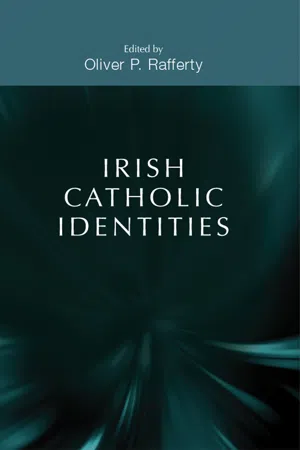
Newly available in paperback, this work traces the elements which have shaped how the Catholic Irish identified themselves, and explores the political, religious and cultural dimensions of the complex picture which is Irish Catholic identity. The essays represent a systematic attempt to explore the fluidity of the components that make up Catholic identity in Ireland.
- 386 pages
- English
- ePUB (mobile friendly)
- Available on iOS & Android
eBook - ePub
Irish Catholic identities
About this book
Information
Publisher
Manchester University PressYear
2015Print ISBN
9780719097317
9780719084959
eBook ISBN
9780719098369
Part I
The Celts, Catholicism and the middle ages
1
Gaelic and Catholic in the early middle ages
When we are asked to try to visualise Ireland’s material culture in what is commonly known as the early historic period, it is probably the remains of an explicitly Christian civilisation that immediately come to mind: ruins of churches and monasteries, round towers, high crosses, illuminated manuscripts, and precious metalwork serving an explicitly Christian liturgical purpose. In some instances, what we see today still looks very much as it did when it was first produced, whereas in other cases, either deliberate destruction or continuity of use and reinterpretation has all but obliterated the original appearance. When we are asked to try and visualise the people whom we know by name from Ireland’s early historic period, it is probably once more some leading representatives of the Christian church that come to mind – only that in this case our image of such figures as Patrick, Columba, Columbanus and John Scotus Eriugena is conditioned not so much by any contemporary evidence, but rather by idealising nineteenth- and twentieth-century depictions, illustrating not only the central role of early Christianity in shaping our consciousness of Irish history and identity, but also the extent to which decidedly modern modes of thought and preoccupations have contributed to forming our ideas about this distant period.
In what follows, I shall first of all give a historic overview of Christian Ireland in the early middle ages. I shall then try to evoke some salient features of early Irish Christianity, both in its material and in its spiritual aspects, working my way from the visible remains of architecture, metalwork and manuscripts to the invisible realm of concepts, values and ideas, to be culled from contemporary Latin and Irish texts. Having examined both the universal Catholic mould and the distinctively Gaelic stamp of early Irish Christianity, I shall conclude by looking at some of the ways in which it has dealt with the pre-Christian past and contributed to shaping the future.
The interaction of Gaelic and Catholic in the early middle ages has to be seen in the context of a dynamic history following the Celticisation of Ireland and the Romanisation of western Britain.1 The Christianisation of Ireland may be taken to have begun by the third century, presumably due to contacts with Christians within the boundaries of the Roman empire both in Britain and on the continent.2 According to the Chronicle of Prosper of Aquitaine (c.390–463), it was in 431 that Pope Celestine ordained Palladius, sending him to the Irish believers in Christ (ad Scottos in Christum credentes). This made later Irish writers assign the beginning of Patrick’s mission to the year 432, but nothing is known of Palladius’ activities in Ireland, and the little that we do know for certain of Patrick is based on inferences drawn from his Latin writings, hagiographical tradition about him beginning as late as the seventh century.3
Monasticism having developed in Egypt in the fourth century, it had come to be adapted in western Europe by the fifth century, profoundly influencing Irish Christianity from the sixth and seventh centuries. From that period onwards, monastic centres such as Bangor in Co. Down, Monasterboice in Co. Louth, Glendalough in Co. Wicklow, Clonard in Co. Meath and Clonmacnoise in Co. Offaly played an important part not only in Irish ecclesiastical organisation and the development of Christian civilisation, but also in economic terms, functioning as storehouses for local produce and valuables and as centres of crafts, art and trade.4 Side by side with monastic structures, an episcopal system continued to function, the church as a whole existing in close symbiosis with secular structures continuing pre-Christian traditions.5
A by-product of monasticism in Ireland was the ideal of a voluntary lifelong exile in the name of Christ (peregrinatio pro Christo), which led to widespread missionary activity both in Britain and on the continent.6 Thus Columba (c.520–597) founded both the monasteries of Derry and Durrow in Ireland and the monastery of Iona off the west coast of Scotland,7 while his namesake Columba the Younger or Columbanus (c.543–615) established the monasteries of Luxeuil in eastern France and Bobbio in northern Italy.8 Other Irish missionaries were Aidan (d.651), who was sent from Iona to Lindisfarne,9 Cillian (d.c.689) who was active in eastern Franconia,10 and Virgil (d.784), who became bishop of Salzburg. This early missionary activity was followed by a substantial Irish contribution to continental scholarship during the Carolingian period,11 most notably by Dicuil, Dungal, Sedulius Scottus and John Scottus Eriugena.12 This in turn was followed by a significant influx of Irish Benedictine monks to the continent from the late eleventh to the fifteenth century.13
An important factor in the development of the church in Ireland were the raids of the Vikings, which tended to affect the monasteries most severely due to their being among the most conspicuous and most easily accessible centres of affluence.14 Between 795 and 830, the Vikings raided the Irish coast in small bands, but afterwards in ever-larger raiding expeditions, establishing bases on the coast and on rivers and taking an active part in Irish political and economic affairs. However, if ecclesiastical structures were aversely affected by the Viking raids, the eight and ninth centuries also saw the rise of a new monastic movement associated with the stern ideals of the ‘companions of God’ (céli Dé, anglicised culdees), which was characterised by a rigorous asceticism, but also by a considerable literary activity.15
Viking ambitions in Ireland having been finally crushed in 1014 in the battle of Clontarf, the eleventh and twelfth centuries witnessed a series of reforms and innovations in the Irish church, which brought ecclesiastical structures in ever-closer line with developments in Britain and on the continent.16 As early as 1111, the Synod of Ráth Bhreasail established a national diocesan structure, divided into a northern and a southern province, comprising thirteen and twelve territorially defined dioceses respectively, with Armagh as the primatial church. At the Synod of Kells in 1152, it was decided to create the four archbishoprics of Armagh, Cashel, Dublin and Tuam, loosening the ties which until then had connected Dublin and Canterbury. By that time, the Cistercians had already founded their first Irish monastery at Mellifont in 1142, ushering in the reform of monasticism on continental models. In 1171, the arrival of the Normans was to open a new chapter in the history of the Irish church. But how are we to envisage the church in the centuries that went before, both in material and in spiritual terms?
Following traditional building techniques of the pre-Christian period, the earliest monasteries and churches would have been made of timber, roofed with wooden shingles or thatch. This is reflected by the use of the word dairthech ‘oak-house’ to designate a wooden church in the annals, stone churches making their first appearance around 800 and remaining largely confined to important sites until the tenth and eleventh centuries.17 A conspicuous and characteristic feature of many Irish ecclesiastical sites is the round tower, designated as cloigthech ‘bell-house’ in the annals. From the tenth to the thirteenth century, perhaps as many as a hundred round towers were built, usually at some distance to the west entrance of the church to which they belonged. Of these, more than seventy may still be seen, averaging in height from 20 to 30 metres.18 Equally well-known features of Irish monasteries are richly sculptured high crosses, dating mainly from the ninth and tenth centuries, illustrating scenes from the Bible and some non-biblical figures.19
Just as well known as the architectural and sculptural remains of the early medieval monasteries is the precious metalwork which was produced under their auspices, representing some of the finest specimens of what is commonly known as insular art.20 Among the best-known examples are the so-called Tara Brooch, discovered in 1850 at Bettystown, Co. Meath, the silver communion vessel known as the Ardagh Chalice, found near Ardagh, Co. Limerick, in 1868, and the silver chalice, paten (or communion plate) and strainer, which were discovered on the ancient monastic site of Derrynaflan, Co. Tipperary, in 1980, all of these objects now being in the National Museum of Ireland.
A corollary to the central position of the scriptures and the written tradition in early medieval Christianity was the importance of manuscripts and the art of writing, which led to the development of a peculiar ‘insular’ script, modelled on the continental uncial and half-uncial scripts.21 The earliest-known Irish manuscript is the so-called Codex Usserianus Primus, a Latin Gospel book (now in the library of Trinity College, Dublin) probably dating from the sixth or early seventh century, before the invention of the insular script. The earliest surviving insular illuminated gospel book is the Book of Durrow, dating from the late seventh century. Possibly written in Northumbria, this manuscript, consisting of 248 vellum leaves, was kept from at least the tenth century onwards in the monastery of Durrow, Co. Offaly, before it was finally presented to Trinity College, Dublin, in 1652. Closely related to the Book of Durrow, both in terms of date and provenance, are the Lindisfarne Gospels, now in the British Library, which are dated to the early eight century.22 The art of illuminated insular gospel books reached its zenith in the late eight century with the Book of Kells, which may have been produced at Iona, but was kept at Kells from the eleventh century onwards, being kept in the Library of Trinity College, Dublin, from the 1660s.23
Visually less spectacular, but also of paramount historic significance, is the earliest collection of Latin prayer-formulas and hymns, illustrating the encounter between native and Latin verse composition, known since its first publication in the eighteenth century as the Antiphonary of Bangor. This is a vellum manuscript of thirty-six leaves, written c.690 in the monastery of Bangor, but later taken to the monastery of Bobbio and now kept in the Ambrosian Library at Milan. The earliest complete text of the New Testament from Ireland is to be found in the Book of Armagh, written in 807–08 by the scribe Ferdomnach (d.846) for the abbot of Armagh and now kept in the Library of Trinity College, Dublin. Once ascribed to St Patrick himself (and hence known as Canóin Pátraic), the manuscript originally consisted of 222 vellum leaves, of which 215 are still extant, containing also two Lives of St Patrick, Patrick’s Confessio and the Life of St Martin of Tours by Sulpicius Severus. The earliest surviving example of an Irish liturgy is the Stowe Missal, a Mass-book written in the early ninth century, which was kept in the monastery of St Ruadan at Lorrha, Co. Tipperary, and is now in the Royal Irish Academy.
In many cases, valuable manuscripts were kept in so-called book shrines (Irish cumdach), rectangular boxes made of wood and metal, which sometimes came to be regarded as reliquaries. Well-known surviving examples dating from the pre-Norman period include the so-called Soiscél Molaise (Gospel-book of St Molaise), which was made in the early ninth century, but reworked in the eleventh and fifteenth centuries, the Stowe Missal book shrine, dating from the eleventh, but reworked in the fourteenth century, and the so-called Cathach (‘Battler’, because it is said to have been taken into battle to ensure victory), the shrine for a copy of the Latin psalter long believed to have been written by St Columba, dating from the eleventh century, but repaired and altered in the fourteenth and eighteenth centuries. A...
Table of contents
- Cover
- Half Title
- Title Page
- Copyright
- Contents
- Notes on contributors
- Acknowledgements
- Introduction Oliver P. Rafferty
- Part I The Celts, Catholicism and the middle ages
- Part II Early modern struggles
- Part III Identity formation in the seventeenth and eighteenth centuries
- Part IV Culture, women and the American diaspora
- Part V English Catholics and Irish identity
- Part VI Faith, wealth and Catholic Unionism
- Part VII Contemporary expressions of Catholic and Irish identity
- Index
Trusted by 375,005 students
Access to over 1.5 million titles for a fair monthly price.
Study more efficiently using our study tools.
Frequently asked questions
Yes, you can cancel anytime from the Subscription tab in your account settings on the Perlego website. Your subscription will stay active until the end of your current billing period. Learn how to cancel your subscription
No, books cannot be downloaded as external files, such as PDFs, for use outside of Perlego. However, you can download books within the Perlego app for offline reading on mobile or tablet. Learn how to download books offline
Perlego offers two plans: Essential and Complete
- Essential is ideal for learners and professionals who enjoy exploring a wide range of subjects. Access the Essential Library with 800,000+ trusted titles and best-sellers across business, personal growth, and the humanities. Includes unlimited reading time and Standard Read Aloud voice.
- Complete: Perfect for advanced learners and researchers needing full, unrestricted access. Unlock 1.5M+ books across hundreds of subjects, including academic and specialized titles. The Complete Plan also includes advanced features like Premium Read Aloud and Research Assistant.
We are an online textbook subscription service, where you can get access to an entire online library for less than the price of a single book per month. With over 1.5 million books across 990+ topics, we’ve got you covered! Learn about our mission
Look out for the read-aloud symbol on your next book to see if you can listen to it. The read-aloud tool reads text aloud for you, highlighting the text as it is being read. You can pause it, speed it up and slow it down. Learn more about Read Aloud
Yes! You can use the Perlego app on both iOS and Android devices to read anytime, anywhere — even offline. Perfect for commutes or when you’re on the go.
Please note we cannot support devices running on iOS 13 and Android 7 or earlier. Learn more about using the app
Please note we cannot support devices running on iOS 13 and Android 7 or earlier. Learn more about using the app
Yes, you can access Irish Catholic identities by Oliver P. Rafferty in PDF and/or ePUB format, as well as other popular books in History & French History. We have over 1.5 million books available in our catalogue for you to explore.