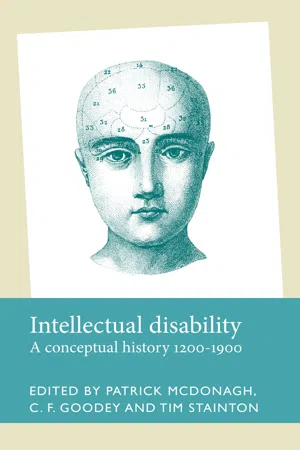
eBook - ePub
Intellectual disability
A conceptual history, 1200–1900
- 258 pages
- English
- ePUB (mobile friendly)
- Available on iOS & Android
eBook - ePub
Intellectual disability
A conceptual history, 1200–1900
About this book
This collection explores the historical origins of our modern concepts of intellectual or learning disability. The essays, from some of the leading historians of ideas of intellectual disability, focus on British and European material from the Middle Ages to the late-nineteenth century and extend across legal, educational, literary, religious, philosophical and psychiatric histories. They investigate how precursor concepts and discourses were shaped by and interacted with their particular social, cultural and intellectual environments, eventually giving rise to contemporary ideas. The collection is essential reading for scholars interested in the history of intelligence, intellectual disability and related concepts, as well as in disability history generally.
Information
Publisher
Manchester University PressYear
2018Print ISBN
9781526151643
9781526125316
eBook ISBN
9781526125330
Table of contents
- Cover
- Half Title
- Title Page
- Copyright
- Contents
- List of figures
- List of contributors
- Series editors’ foreword
- Acknowledgements
- 1 Introduction: the emergent critical history of intellectual disability – Patrick McDonagh, C. F. Goodey, and Tim Stainton
- 2 Conceptualization of intellectual disability in medieval English law – Wendy J. Turner
- 3 ‘Will-nots’ and ‘cannots’: tracing a trope in medieval thought – Irina Metzler
- 4 ‘Some have it from birth, some by disposition’: foolishness in medieval German literature – Janina Dillig
- 5 Exclusion from the eucharist: the re-shaping of idiocy in the seventeenth-century church – C. F. Goodey
- 6 ‘A defect in the mind’: cognitive ableism in Swift’s Gulliver’s Travels – D. Christopher Gabbard
- 7 Sensationalism and the construction of intellectual disability – Tim Stainton
- 8 Peter the ‘Wild Boy’: what Peter means to us – Katie Branch, Clemma Fleat, Nicola Grove, Tim Lumley Smith, and Robin Meader
- 9 ‘Belief’, ‘opinion’, and ‘knowledge’: the idiot in law in the long eighteenth century – Simon Jarrett
- 10 Idiocy and the conceptual economy of madness – Murray K. Simpson
- 11 Visiting Earlswood: the asylum travelogue and the shaping of ‘idiocy’ – Patrick McDonagh
- Select bibliography
- Index
Trusted by 375,005 students
Access to over 1.5 million titles for a fair monthly price.
Study more efficiently using our study tools.
Frequently asked questions
Yes, you can cancel anytime from the Subscription tab in your account settings on the Perlego website. Your subscription will stay active until the end of your current billing period. Learn how to cancel your subscription
No, books cannot be downloaded as external files, such as PDFs, for use outside of Perlego. However, you can download books within the Perlego app for offline reading on mobile or tablet. Learn how to download books offline
Perlego offers two plans: Essential and Complete
- Essential is ideal for learners and professionals who enjoy exploring a wide range of subjects. Access the Essential Library with 800,000+ trusted titles and best-sellers across business, personal growth, and the humanities. Includes unlimited reading time and Standard Read Aloud voice.
- Complete: Perfect for advanced learners and researchers needing full, unrestricted access. Unlock 1.5M+ books across hundreds of subjects, including academic and specialized titles. The Complete Plan also includes advanced features like Premium Read Aloud and Research Assistant.
We are an online textbook subscription service, where you can get access to an entire online library for less than the price of a single book per month. With over 1.5 million books across 990+ topics, we’ve got you covered! Learn about our mission
Look out for the read-aloud symbol on your next book to see if you can listen to it. The read-aloud tool reads text aloud for you, highlighting the text as it is being read. You can pause it, speed it up and slow it down. Learn more about Read Aloud
Yes! You can use the Perlego app on both iOS and Android devices to read anytime, anywhere — even offline. Perfect for commutes or when you’re on the go.
Please note we cannot support devices running on iOS 13 and Android 7 or earlier. Learn more about using the app
Please note we cannot support devices running on iOS 13 and Android 7 or earlier. Learn more about using the app
Yes, you can access Intellectual disability by Patrick McDonagh,C. F. Goodey,Tim Stainton, Patrick McDonagh in PDF and/or ePUB format, as well as other popular books in History & Social History. We have over 1.5 million books available in our catalogue for you to explore.