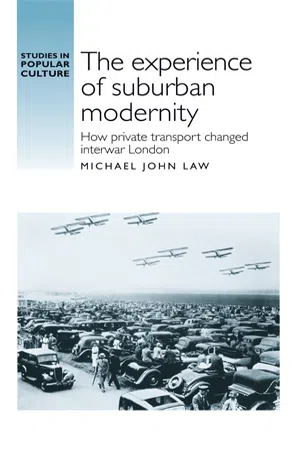
The experience of suburban modernity looks at the history of the London suburbs in the interwar years. It shows that, contrary to those accounts that portray suburbia as static and boring, these suburbs were in fact at the heart of the adoption of private transport and new mobilities. Wealthier middle-class suburbanites enjoyed driving at speed on new arterial roads, visiting roadhouses for a transgressive night out, taking five-shilling flights from the local airport, and joining cycling and motorcycle clubs. All this fun came at a price for some in the form of thousands of deaths in road accidents, plane crashes on suburban housing and in the despoiling of the countryside through road development.
This book will be welcomed by academics and students working in suburban studies, historical geography and interwar British history and can also be enjoyed by anyone interested in the history of London.
eBook - ePub
The experience of suburban modernity
How private transport changed interwar London
- 238 pages
- English
- ePUB (mobile friendly)
- Available on iOS & Android
eBook - ePub
The experience of suburban modernity
How private transport changed interwar London
About this book
Information
Part I
Introduction
1
Driving on the Kingston Bypass
This book came about through my looking out of a car window. I have lived in suburban south-west London for the last thirty-five years and getting around this part of the world obliges you, if you are a car driver, to use the Kingston Bypass. This is a worrying road, its lanes are too narrow and it carries a lot of traffic heading to and from town. It is mostly ribboned by semi-detached houses that seem far too close to the road for comfort of driver or resident. Speed limits and the occasional traffic camera have reduced its propensity for accidents, but you have to concentrate hard when driving.
My over-familiarity with this route was such that driving on it, ten years ago, my mind wandered and wondered and I found myself imagining what the road was like when it was first built in the 1920s. I did some research and looked at early photographs of the road and discovered that they were, for me, strangely affective. There was something about the high-contrast black-and-white images of the empty new road that I found both intriguing and aesthetically appealing. I get the same feeling when I look at modernist buildings from the same period; there is something so optimistic about them, they are both surprising and poignant. I think that this is because we know how the story ends; those in the photographs could not then guess what was in store for them at the conclusion of the 1930s.
The independent mobility of driving a car, something we take for granted, is an important starting point for me, both in my research and in this book. It moves my observations away from that static cliché of suburbia, the house, to the car, motorcycle, bicycle and, in a more distanced sense, the aeroplane. The purpose of this book is to study these mobilities to improve the understanding of London’s interwar suburbia. It intends to add to research that has increased our knowledge of suburban life by paying greater attention to this unusual time and space. This work finds unexpected interest and modernity in lives that had been considered, by some, as meaningless and dull. Looking for modernity in suburbia is an unconventional idea as its expected locus is the city. As Alan O’Shea puts it, ‘Many accounts of “modern times” both intellectual and popular, lay a central emphasis on the experience of city life’.1 This book investigates the modernity of suburbia by concentrating its attention on the nature of independent mobility in outer London, that is the mobility free from the constraints of public transport. London’s train, tram and bus services helped form new suburbs as early as the 1850s. By the 1930s, these arrangements were already eighty years old and their repetition did not amount to anything genuinely modern. What was new and exciting was the opportunity to travel at the drop of a hat.
Known suburbia
This book aims to reveal previously hidden aspects of life in London’s interwar suburbia that show it to be surprisingly varied and, at times, exciting. This contradicts the received view of the period, an idea of suburbia that was pre-eminent throughout the twentieth century. Where does this restricted understanding of interwar suburban life come from? Why was this type of life thought to be so boring, so static, with its mobility dominated by the train timetable?
The answer partly lies from within the period itself, in the intellectual discourse of the time on suburbia. One important theme of that discourse was incursion, and many commentators of the 1930s responded to it. In their thinking, there were two sorts of suburbia: the old sort, where they lived, large Victorian villas with extensive gardens, and the new sort, cheap repetitive housing built not on wooded hills but on fields of former market gardens and scruffy farmland. Here, the ladder was being pulled up pretty sharply. The scions of wealthy families established in the nineteenth century resented the blurring of class lines brought about by this new wave of suburbanisation. John Carey has written the definitive account of this mindset in The Intellectual and the Masses in which he shows how writers such as H. G. Wells and Evelyn Waugh responded to the supposed dangers of the new suburbs.2 John Betjeman can also be included in this group, and his poem ‘The Metropolitan Railway – Baker Street Station Buffet’, identifies the theme of a suburban idyll ruined by incomers.
Cancer has killed him. Heart is killing her.
The Trees are down. An Odeon flashes fire
Where stood their villa by the murmuring fir.3
The Trees are down. An Odeon flashes fire
Where stood their villa by the murmuring fir.3
This poem demonstrates the passing of one type of suburbia for another and announces, with the arrival of the neon-signed cinema, that this period was witnessing a signal change in British society that was both important and permanent, a new and Americanised form of suburban life. It is also significant that Betjeman’s nostalgia for Edwardian suburban life reinforced the relationship between the suburban home and the railway commuter.
Incursion was also at the heart of worries about this new suburbia in a group of activists whose concern was to preserve the countryside. In particular, they worried about the way that the binary of town/countryside was upset by suburbanisation, producing places that didn’t fit efficiently into either category. Planners and architects such as Patrick Abercrombie and Clough Williams-Ellis tried to save the British countryside from suburban growth. To these figures could be added C. E. M. Joad, a populist thinker of the interwar period, and others who rode this particular bandwagon. One of their preoccupations was the new arterial roads, such as the Kingston Bypass. They saw these roads as the means by which suburbia and the road combined together to produce ribbon development that pushed suburbia into the countryside. They thought it ugly and a betrayal of the efficient planning proposed by modernist road building. Joad questioned the arrival of new suburban housing:
Why are they there? Again I can only answer, because if some obscure impulse which causes them to feel dissatisfaction with life in towns without fitting them for life in the country … they spread like locusts over the land.4
Other interwar writers criticised suburbanites for how they thought and how they spent their lives. To the fore were J. B. Priestley, George Orwell and T. S. Eliot, who characterised suburban life as meaningless, consumerist, secular and tied to an empty fascination with American cultural sources with, as Orwell put it, more knowledge of the workings of a magneto than the Bible.5 In reality, their criticism was highly superficial and based, in Priestley’s case, largely on observations made from a chauffeur-driven car. Some of it was fair comment; the success of Hollywood in suburban cinemas and American music in suburban dance halls was very evident in interwar life. Suburbia was, indeed, consumerist, where high levels of disposable income allowed for the purchase of domestic appliances, radios and eventually cars. Secularism was a worry too, with both the Church of England and the Catholic Church concerned with the need to build missionary churches in suburbia. What all these commentators missed was the variety of interests and activities that filled suburban lives outside work, for example cycling, motoring and other leisure pursuits.
Finally, Britain’s new suburbia was criticised for its impoverished aesthetics. Much suburban housing was built at the lowest possible cost in a very competitive housing market. The result was a need to maximise housing density whilst still providing enough garden and trees to deliver on the promise of a rus in urbe life where, if you were not actually in the country, you could imagine that you were. The most efficient way of building houses with gardens and a side door where the butcher’s boy could call was the semi-detached house, laid out on parallel streets. Cost-saving required that any variation in house-design could be possible only in small details like porches and windows. It was a small step to connect the lack of variation and repetitiveness of suburban houses to similar concerns about their occupants. The semi-detached house was, in effect, a form of anti-modernism. Interest in new modernist architecture was at its height in the early 1930s, just at the point when these new housing estates were being laid out in a gauche mock-Tudor form. As a consequence, they were criticised and ridiculed as tawdry and sham. To choose one example, the critic and cartoonist Osbert Lancaster considered that suburban semi-detached houses ‘will inevitability become the slums of the future’.6 He was, of course, wrong.
By paying too much attention to the musings of these well-educated and privileged commentators, we miss the reality of interwar suburban life. This newly formed lower middle class did not have a powerful voice, so we were left for much of the twentieth century with the results of intellectual prejudice, a negative view of suburbia that was very evident in literature, popular music, radio and television. Hancock’s Half Hour, The Fall and Rise of Reginald Perrin and many others of lesser merit portrayed suburbia in the same light as the critics of the 1930s.7 It was mediocre, boring and/or pretentious. Later, J. G. Ballard took this formula and added to it danger and transgression.
In the fifty years that followed the intellectual criticisms of the 1930s, there was little academic study of suburbia. Where it was studied it was to explain the nature of its housing and public transport links. H. J. Dyos led this genre in his study of the development and history of Camberwell, a south London suburb.8 Alan Jackson, a transport historian, produced the still definitive work on interwar suburban London, Semi-detached London, in 1973.9 This was, at the time, such an unusual enterprise that his publisher described his interest in this topic as ‘perverse’.10 This important book concentrated its attention on the new lower middle classes and their houses and emphasised the way that railway development helped form suburbs. Later in this book, I take Jackson to task for his failure to notice car usage in suburban London, but I am a great admirer of the depth and quality of his research. His emphasis on the built environment does, however, obscure the reality of suburban life, its practices and stories. This presentation of suburbia as just the sum of its architecture can be seen in many otherwise excellent later works on London suburbia such as Dunroamin and London Suburbs.11
Reconfiguring interwar suburbia
Some academic writers have found the exercise of studying suburban life problematic; even those who wish to cast new light on suburbia cannot liberate themselves from a century of intellectual prejudice. The lower middle classes can be shown as modern and surprisingly variegated but their aspirations are nevertheless gently despised. This is a consequence of suburban class positioning. Neither oppressed by capitalism nor a dominating force within it, neither worthy nor powerful, their humble lives and empty culture are ripe for disdain. Some writers have succeeded in discarding these prejudices and, in doing so, reveal far more. Mark Clapson’s work comes to mind here; he has produced a history of suburbia in the twentieth century in a passionate and supportive manner.12 David Gilbert, as a geographer, takes a wider view, but in a similarly unprejudiced way.13 Both realise that suburban culture can be passive and reductive, but can also provide enormous insight into how we all live our lives today. I mention these two writers, both of whom I have worked with closely. Each, in his own way, has provided me with the direction for this book.
This book proposes that the received view of suburbia does not present a full or appropriate picture of outer London between the wars. It argues that new mobilities were fundamental to this life, which for many was nuanced, exciting, fast, fluid, dangerous and fun. In short, the newly mobile suburbanite experienced modernity. It is useful to state here what I mean when I use the term ‘modernity’; it is a contentious term and is hard to define. Miles Ogborn wisely considered that ‘its periodisation, geographies, characteristics and promise all remain elusive’.14 I use the term to signal the social experience of technological change. These experiences can be seen in the time-space compression brought about by new transport technologies and in the simultaneous encounter with order/chaos or possibility/peril brought about by new technology.15 It is significant for this book, that the most influential writer on modernity, Marshall Berman, used a suburban road-building project in Queens, New York, to exemplify a profound experience of modernity in his own life.16
Orwell’s observation on the suburban knowledge of the magneto is suggestive of the wider relationship between new suburbia and the adoption of technology. Another, better, example he might have chosen would be the effect of the radio on suburban life. It was in the suburbs that a more passive, domesticated life developed, fuelled, in the south-east of England, by disposable income that allowed for the adoption of new technologies. Using the early crystal set required a practical engagement with new technology to gain access to radio broadcasts. Here, the unsung suburb rather than the metropolis became a locus for modernity. This is an example of a rather static modernity; independent mobility provided even greater possibilities. I distinguish here between self-actuated movement and the type of mobility provided and restricted by public transport systems. Wider independent mobility was a defining modernity of interwar suburbia in its contribution to time-space compression and in the disturbances of new road-building to the suburban landscape which provided order through modernist engineering and chaos in its many road accidents. My thinking here is, of course, informed by the mobility turn in humanities in recent years. I use the work of John Urry and Tim Cresswell, amongst other leading names, to provide support to the way that I have linked mobility and mode...
Table of contents
- Cover
- Half Title
- Title Page
- Copyright
- Contents
- List of tables
- List of figures
- Introduction
- Acknowledgements
- List of abbreviations
- Part I Introduction Germany
- Part II Technologies
- Part III Roads
- Part IV Journeys
- Part V Conclusion
- Appendix
- Bibliography
- Index
Trusted by 375,005 students
Access to over 1.5 million titles for a fair monthly price.
Study more efficiently using our study tools.
Frequently asked questions
Yes, you can cancel anytime from the Subscription tab in your account settings on the Perlego website. Your subscription will stay active until the end of your current billing period. Learn how to cancel your subscription
No, books cannot be downloaded as external files, such as PDFs, for use outside of Perlego. However, you can download books within the Perlego app for offline reading on mobile or tablet. Learn how to download books offline
Perlego offers two plans: Essential and Complete
- Essential is ideal for learners and professionals who enjoy exploring a wide range of subjects. Access the Essential Library with 800,000+ trusted titles and best-sellers across business, personal growth, and the humanities. Includes unlimited reading time and Standard Read Aloud voice.
- Complete: Perfect for advanced learners and researchers needing full, unrestricted access. Unlock 1.5M+ books across hundreds of subjects, including academic and specialized titles. The Complete Plan also includes advanced features like Premium Read Aloud and Research Assistant.
We are an online textbook subscription service, where you can get access to an entire online library for less than the price of a single book per month. With over 1.5 million books across 990+ topics, we’ve got you covered! Learn about our mission
Look out for the read-aloud symbol on your next book to see if you can listen to it. The read-aloud tool reads text aloud for you, highlighting the text as it is being read. You can pause it, speed it up and slow it down. Learn more about Read Aloud
Yes! You can use the Perlego app on both iOS and Android devices to read anytime, anywhere — even offline. Perfect for commutes or when you’re on the go.
Please note we cannot support devices running on iOS 13 and Android 7 or earlier. Learn more about using the app
Please note we cannot support devices running on iOS 13 and Android 7 or earlier. Learn more about using the app
Yes, you can access The experience of suburban modernity by Michael Law,Michael John Law in PDF and/or ePUB format, as well as other popular books in History & Automobile Industry. We have over 1.5 million books available in our catalogue for you to explore.