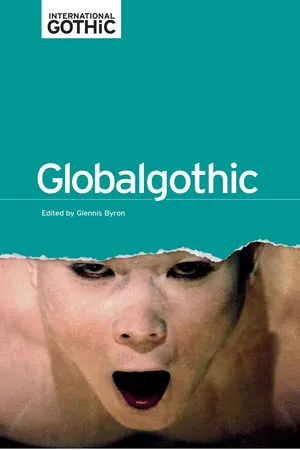
'The dead travel fast and, in our contemporary globalised world, so too does the gothic.' Examining how gothic has been globalised and globalisation made gothic, this collection of essays explores an emerging globalgothic that is simultaneously a continuation of the western tradition and a wholesale transformation of that tradition which expands the horizons of the gothic in diverse new and exciting ways.
Globalgothic contains essays from some of the leading scholars in gothic studies as well as offering insights from new scholars in the field. The contributors consider a wide range of different media, including literary texts, film, dance, music, cyberculture, computer games, and graphic novels.
This book will be essential reading for all students and academics interested in the gothic, in international literature, cinema, and cyberspace.
- 228 pages
- English
- ePUB (mobile friendly)
- Available on iOS & Android
eBook - ePub
Globalgothic
About this book
Information
Publisher
Manchester University PressYear
2015Print ISBN
9781526106902
9780719087950
eBook ISBN
9781526102980
1
Fred Botting and Justin D. Edwards
Theorising globalgothic
‘Die, die you witch. We can’t get work because of you’: in September 1998 a crowd returning from a march in Pretoria throw three migrant workers to their deaths (Comaroff, 2002: 788). Jean and John Comaroff cite this example as one in many of the recent reports that document a rise in cases connecting witches and zombies to class, inter-ethnic and economic tensions in southern Africa. Contemporary figures of dread are, they suggest, conjured out of the economic upheavals and shifts in immigration motivated by new labour practices. Witchcraft and zombification, then, are linked to African ‘immigrants from elsewhere on the continent, whose demonization is an equally prominent feature of the postcolonial scene. Together these proletarian pariahs make visible a phantom history, a local chapter in a global story of changing relations of labor to capital, of production and consumption’ (Comaroff, 2002: 783). Indeed, like so many postcolonies, post-apartheid South Africa has been dramatically changed by the social, cultural and economic impacts of globalisation. The rush of new commodities, consumption, products and money is tied to an increasingly illusive economic system that has been, at times, aligned with the sorcery of witches, zombies and disembodied, dispirited phantasms. Hence seemingly archaic figures for postmodern times – witches, zombies, monsters, ghosts and vampires – spring up in numerous and diverse locations, crossing geographic, cultural and medial divides. But these figures also adopt various guises: they are markers of otherness, articulations of the threatening changes of economic and imperial power, signifiers of techno-scientific innovations, as well as representations of personal and communal losses and traumas. By enunciating these changes through creatures of collective dread, this fixation with the living dead signals more than a figurative or symbolic response to the impacts of globalisation. It constitutes a tangible reaction to the distress and anxiety of a globalised system that erupts within or from public cultures across the world. Globalisation, then, has led to a new way of thinking about gothic production: globalgothic.
But what is globalgothic? And how might it be theorised? One starting point for addressing these questions is to acknowledge that, despite huge variations in cultural-historical factors, spatial and temporal modes and the significances tied to locality and specificity, there are certain continuities and commonalities between imaginary supernatural, spectral and monstrous forms in fiction, film, fashion, media, music and culture. But even this recognition raises further queries. What do these forms represent, if they represent anything? What do they do? What are their effects? And what might they have in common? These are tricky questions, particularly when we consider that figures from the gothic genre are imaginary and metaphorical, revenants, often vague in form, shifting of shape, and have for centuries screened and screened out otherness and fear. Yet a shared sense, itself dark, uncertain, of the world can be located through the diverse uses of gothic tropes disseminated widely in media networks: in print, on screens, online, over airwaves and satellite systems. Exported Western images move across the world, manifesting a global market in which cultures produce, consume, appropriate, and transform stories, images and characters. Dance forms in Japan mesh local customs and concerns regarding death with traditional and imported aesthetic and cultural theories, hybrid challenges to form and sense that raise political anxieties about imperialism; mergings of myth and media in New Zealand acknowledge the permeability of borders while the interfections of media forms embody the clashing and inmixing of social realities and cultural crossings. Global events, the collapse of blocs and borders, the emergence of transnational and economic unions, spectres of superstates, transform the West from within, such events, moreover, having large-scale political effects as well as small-scale subcultural ramifications. The traffic in images and tropes is not unidirectional given the scale and audiences for media and cinematic production across the world. The varieties of Asian cinema offer abundant examples of different forms and figures of haunting and spectrality, different axes of media, tradition, embodiment and anxiety that are exported, appropriated, remade. The multidirectional traffic exposes the limitation to ideas of Western cultural hegemony in the face of competing and globally dispersed patterns of consumption. Here, always mobile, travelling with migrations and through the flows of global media, boundaries between life and death, real and unreal, self and other, normality and deviance become defamiliarised as they are shifted across geographical, virtual and cultural planes, global and local at the same time.
The global market of signs, images and commodities energises globalgothic interactions. As a result globalgothic operates as a locus, frequently an obscure locus, of world exchanges, and also points to the context in which messages, meanings, responses and reactions take shape. For the rapidly changing and highly mobile network called globalisation presses upon the security and stability of all cultural, political, national systems and structures. This new market is, in our thinking, a new world order that can no longer be simply aligned with the consumerist and homogenising pressures of modern – Western or US – capitalism. Transnational capitalism, for so long associated with Western or US imperialism, respects no national border in its pursuit of profits and markets. Changing patterns of ownership, investment and corporate structure over the last forty years – and now the growth of new economic superpowers and new global financial crises – situate the nation in a subordinate, even subaltern, position, at the mercy, rather than at the centre, of fluctuations of capital. As a decentred and deterritorialising apparatus of governance, capitalism progressively transforms, reshapes and incorporates the entire global realm within its open, expanding frontiers (Hardt and Negri, 2001: xii). Such decentring turns modern ways of thinking, believing, being, and narrating inside-out and upside-down, generating a new sense of anxiety about borders, identities and futures. This anxiety is, perhaps, one of the bases for the reappearance of gothic and supernatural motifs and tropes. But it is an anxiety that selects its metaphors, reading figures of disturbance, haunting and liminality, ephemeral figures of strangeness, as well as violence and death, in a range of cultural productions, from contemporary Japanese dance to American zombie narratives, music and online bloodsucking. Global manifestations of the gothic, we suggest, touch on the sense of the unnerving, unpredictable and uncontrollable scale of world changes that impinge diversely and relentlessly on different locales and peoples. The darkness of real and imagined ecological disasters, overproduction, pollution, climate change, is rendered both sublimely unthinkable and culturally and emotionally specific in its devastations. In attempting to broach the scale of change, the globalgothic mode registers an ill-formed grasp of the consequences attendant on the dissolution of old securities, clear-cut jurisdictions, stable structures and comforting boundaries, be they national, social, cultural, scientific or subjective.
The rise of recent reports of zombies and witchcraft in southern Africa is connected to the ‘implosion of neoliberal capitalism’ and a ‘global crisis’ that engenders anxieties about immigration and unemployment (Comaroff, 2002: 779). Violence between citizens of neighbouring postcolonial nations, then, is not merely the byproduct of local tension. It also stems from the ‘structural adjustments’ that have imposed global market forces on developing nations and enforced a dependency on economic fluctuations (prices, investments) and the resulting shifts in employment and migration. Following the Comaroffs, Michael Hardt and Antonio Negri cite a growing number of reports of ritual murder, occult practices, witchcraft, monsters and zombies from Africa to Indonesia, Russia to South America. From a European perspective these events may be dismissed as a resurgence of primitive premodern practices. Hardt and Negri, however, caution against such a response, arguing that these reports are manifestations of contemporary forces and effects, postmodern more than premodern or primitive. They seem to share a common element: supernatural sightings often appear when ‘new dreams of wealth in the global capitalist economy have for the first time been plunged into the icy realities of imperial hierarchies’ (Hardt and Negri, 2001: 126). Such reports offer, for Hardt and Negri, a way of understanding how ‘each of these contexts’ shares a ‘contradictory social situation’: singularity at a local level finds ‘global commonality’ in the fluxes and flows of a new Empire (126). Pushing at the constraints of a residually Enlightenment ontology that reproduces a master logic and places Europe at the centre of thought, history and being, Hardt and Negri importantly try to articulate the effects of what they call the new world order at economic, political and cultural levels. They identify a changing global habitus, a transnational digitally enhanced network which transforms spaces, times and, significantly, ways of thinking, demanding a greater and more effective understanding of globalisation’s complex and fluid relationships. Articulating these phenomena with numerous reiterations of gothic figures, they observe the interpenetration of the local and global, self and other, while avoiding the static models of binary opposition and hierarchical difference that have been challenged so effectively in postcolonial reversals of Western subalternisation. It is here, among and across the liminal spaces of a new world order, that gothic figures are articulated as immaterial presences with physical effects and the globalgothic grasps and connects antitheses by engaging with doubles, ambivalences and multiplicities.
In Specters of Marx Jacques Derrida envisions this new economic order as monstrous, techno-scientific, quasi-messianic: it is seen to be introducing a ‘new disturbance’ and an ‘unprecedented form of hegemony’ to which older modern categories no longer apply except in spectral misrecognitions (1994: 50). Fredric Jameson’s more measured – economically speaking – Marxist account plots a similar trajectory towards something systemically inhuman. For him finance capitalism’s general and cannibalistic tendency to exploit crises enables it to move from failing economic practices (such as industrial production) to absorb ‘ever greater zones of social life (including individual subjectivity)’ (Jameson, 2000: 264). Abandoning the national industrial competition of an imperial stage, capital discovers profit beyond material goods in financial transactions alone to become ‘free-floating’, separated ‘from the concrete context of its productive geography’ (259). Its dematerialisation parallels the operations of virtuality, informatics and posthumanism and transforms the globe in the light of its digital abstractions. Objects and things are rendered secondary to flows of information, signs and services. Here globalisation is envisaged as ‘a kind of cyberspace in which money capital has reached its ultimate dematerialization, as messages that pass instantaneously from one nodal point to another across the former globe, the former material world’ (268). The other side of such abstracted yet immanent connectedness is perhaps a very different sense of hauntedness. New ghosts, separated from material contexts and monetary realities, appear to redefine financial exchanges. Speculation becomes a spectral force: ‘specters of value’ vie ‘against each other in a vast, world-wide, disembodied phantasmagoria’. A different, dark and dominating shape orchestrates the flows and movements of global capital: ‘a play of monetary entities’, abstracted, immaterial, that ‘can live on their own internal metabolism and accrete without any reference to an older type of content’ (273). In its ghostly form, capital moves outside of what we once might have considered a real world. Its disembodied and spectral presence now signals something other than an invisible hand conferring or withholding wealth. The new monster operates autonomously, in an inhuman way, disconnected from any relation that might once have benefited humanity.
Fredric Jameson’s description of an indomitable capitalist monster machine revives the Marxist nightmare of a vampiric capitalism feeding off the living labour of the world’s workers. Jameson’s capitalist monster is, like the vampire-capital of Hardt and Negri’s Empire, less reliant on the material life and vital bodies of Marx’s metanarrative. Still, Jameson’s writing is haunted by the revenant of modern oppositions – particularly class conflict – and thus romanticises resistance in terms of heroic collectives, indigenous cultures or individuals struggling against a callous and dominating system. But this assumes that modernity is stable and successful in always maintaining its divisions and hierarchies. Such a vision fails to acknowledge that modernity’s enlightened, progressive, rational, scientific and productive forces were always double and haunted by the past, strangeness and otherness. For modernity has always been dependent on the antitheses it invoked and suppressed, on the subjects it constructed and excluded through the demonisations of class, gender and racial difference.
Modernity’s formation works on the basis of doublets: empirical and transcendental, liberty and discipline, spirit and spectre, self and other, norm and monster, consciousness and unconscious, progress and regression, mind and body, light and dark, surface and depth, sameness and difference. It was, as such, formed on the basis of an originary division-elision, a hybrid-uncanny structuring, which Homi Bhabha relates to the hegemonies of European imperialisms. For Bhabha it is the very ambivalence and undecidability within modernity that reveals its plurality, its interstitial, transnational and translational shiftings, its doubleness and strangeness. A ‘contentious internal liminality’, he writes, can be located in the ‘antagonistic and ambivalent moments within the “rationalizations” of modernity’ (1994: 171). Thus, if modern culture is heimlich in its disciplinary generalisations, its mimetic narratives, its homologous empty time, its seriality, its progress, its customs and its apparent coherence, then it is also unheimlich in its encounters with heterogeneities, otherness, discontinuities and differences that are, for all its occlusions, its own. For in order for modernity to distinguish itself and to signify, it must be translated, disseminated, differentiatiated, and hence it must become ‘interdisciplinary, intertextual, international, inter-racial’ (136). By extension ‘cultural globality is’, for Bhabha, ‘figured in the in-between spaces of double-frames: its historical originality marked by a cognitive obscurity; its “decentred subject” signified in the nervous temporality of the transitional, or the emergent provisionality of the “present”’ (216). Gone are the fixed meanings of binary structures, clear borders, cultural coherence or causes and effects. In their place we find flows and disjunctions in the ‘stubborn chunks’ of cultural identification, as well as a reiteration of migrations, displacements, translations, deterritorialisations and reterritorialisations. Unsurprisingly, it is in modernity that gothic is invented, signs of Western culture’s ‘internal liminality’ and its increasingly futile attempts at holding otherness at a distance.
In recognition of modernity’s failed suppressions, haunting has been used throughout postcolonial theory to bring an awareness of colonial history to the present while also revising the conceptions of contemporary regional, national and cultural relations. Spectral coloniality often figures the relation of otherness, of occlusions, of limitations, and of desires to acknowledge, see and hear others, the marginalised, the silenced. Indeed haunting is persistent within the postcolonial consciousness precisely because of its affective feature, a feature that conjures a sense of looming importance that is both present and unsettling. And a spectre is also conjured in the imagined origins of a ‘pure’ tradition killed off in the incursion of colonial forces. Though haunting can signal the return in spectral forms of cultures and pasts that have been pushed aside, those revenant pasts return often as sites of loss, nostalgia, guilt or betrayal. More importantly, postcolonial hauntings reveal powerlessness when faced with the possibility of resistance. Memories are not always mobilised and insurgencies are often written over by an ever increasing transnational condition that denies or obfuscates situated or positioned resistance. And this is where globalgothic is significant. For the use of haunting in postcolonial theory also signals a placeless yet always present mode of resistance that betrays an underlying fear about how disputes and encounters are diffused within the often elusive character of new transnational realities and postcolonial forms of oppression. Seen from a globalgothic perspective, then, the use of haunting in postcolonial theory reflects a suspended condition, in-between because it is indicative of an era hovering between the traces of a defeated colonial history and vague transnational structures of hierarchy and subjugation. With the rise of new forms of empire and transnational capital, the active imperialisms witnessed in tangible and positioned structures of conflict related to natio...
Table of contents
- Cover
- Half Title
- Title Page
- Copyright
- Contents
- List of contributors
- Acknowledgements
- Introduction
- 1 Theorising globalgothic
- 2 Butoh: The dance of global darkness
- 3 Maori tales of the unexpected: The New Zealand television series Mataku as Indigenous gothic
- 4 ‘She saw a soucouyant’: Locating the globalgothic
- 5 Globalgothic at the top of the world: Michel Faber’s ‘The Fahrenheit Twins’
- 6 Online vampire communities: Towards a globalised notion of vampire identity
- 7 Globalgoth? Unlocatedness in the musical home
- 8 Uncanny games: Michael Haneke’s Funny Games and globalisation’s new uncanny
- 9 Pan-Asian gothic
- 10 Cannibal culture: Serving the people in Fruit Chan’s Dumplings
- 11 Ghost skins: Globalising the supernatural in contemporary Thai horror film
- 12 From Sleepy Hollow to Silent Hill: American gothic to globalgothic
- 13 The Dark Knight: Fear, the law and liquid modernity
- 14 Globalzombie: From White Zombie to World War Z
- 15 Globalgothic: Unburying Japanese figurality
- Index
Trusted by 375,005 students
Access to over 1.5 million titles for a fair monthly price.
Study more efficiently using our study tools.
Frequently asked questions
Yes, you can cancel anytime from the Subscription tab in your account settings on the Perlego website. Your subscription will stay active until the end of your current billing period. Learn how to cancel your subscription
No, books cannot be downloaded as external files, such as PDFs, for use outside of Perlego. However, you can download books within the Perlego app for offline reading on mobile or tablet. Learn how to download books offline
Perlego offers two plans: Essential and Complete
- Essential is ideal for learners and professionals who enjoy exploring a wide range of subjects. Access the Essential Library with 800,000+ trusted titles and best-sellers across business, personal growth, and the humanities. Includes unlimited reading time and Standard Read Aloud voice.
- Complete: Perfect for advanced learners and researchers needing full, unrestricted access. Unlock 1.5M+ books across hundreds of subjects, including academic and specialized titles. The Complete Plan also includes advanced features like Premium Read Aloud and Research Assistant.
We are an online textbook subscription service, where you can get access to an entire online library for less than the price of a single book per month. With over 1.5 million books across 990+ topics, we’ve got you covered! Learn about our mission
Look out for the read-aloud symbol on your next book to see if you can listen to it. The read-aloud tool reads text aloud for you, highlighting the text as it is being read. You can pause it, speed it up and slow it down. Learn more about Read Aloud
Yes! You can use the Perlego app on both iOS and Android devices to read anytime, anywhere — even offline. Perfect for commutes or when you’re on the go.
Please note we cannot support devices running on iOS 13 and Android 7 or earlier. Learn more about using the app
Please note we cannot support devices running on iOS 13 and Android 7 or earlier. Learn more about using the app
Yes, you can access Globalgothic by Glennis Byron in PDF and/or ePUB format, as well as other popular books in Politics & International Relations & Social History. We have over 1.5 million books available in our catalogue for you to explore.