How do leading Labour figures strive to communicate with and influence the electorate? Why have some proven more successful than others in advancing their ideological arguments? How do orators seek to connect with different audiences in different settings such as parliament, party conference and through the media? This thoroughly researched and highly readable collection comprehensively evaluates these questions as well as providing an extensive interrogation of the political and intellectual significance of oratory and rhetoric in the post-war Labour Party.
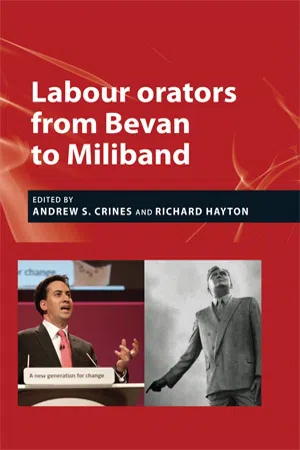
This collection evaluates the oratory and rhetoric of twelve leading figures from Labour politics: Aneurin Bevan, Hugh Gaitskell, Harold Wilson, Barbara Castle, James Callaghan, Michael Foot, Tony Benn, Neil Kinnock, John Smith, Tony Blair, Gordon Brown and Ed Miliband. Each chapter explores how its subject attempted to use oratory to advance their agenda within the party and beyond.
Students of British politics, Labour history and communication studies will find this volume essential reading.
eBook - ePub
Labour orators from Bevan to Miliband
- 229 pages
- English
- ePUB (mobile friendly)
- Available on iOS & Android
eBook - ePub
Labour orators from Bevan to Miliband
About this book
Information
1
The oratory of Aneurin Bevan
Andrew S. Crines and Keith Laybourn
Introduction
We have been the dreamers … we have been the sufferers … now we are the builders.
(Bevan, 1945)
(Bevan, 1945)
As fundamentals, the mastery of effective political communication derives from both rhetoric and oratory. These are inextricably linked, thus a consideration of both is a necessity for efficacious analyses of political communication by politicians. As shown in the short extract above, like most effective orators, Aneurin Bevan possessed a communicative ardour for rhetorical imagery. In his case, he utilised this capacity to demonstrate aspiration, pain and ultimately the triumph of his conception of social democratic socialism. The question remains – how ?
Bevan’s more noteworthy rhetorical orations straddle a twenty-year period between 1940 and 1960. These include memorable speeches made in the Commons, at public meetings, and to the party conference. Consequently these are the focus of this chapter. In order to fully demonstrate his communicative impact during these more prominent years of his career, this chapter will evaluate eight indicative speeches from the three arenas spanning this period. By adopting this approach, it becomes possible to appreciate how Bevan’s communicative significance can be measured over the course of his post-war career. In terms of the theoretical basis established by the Introduction, Bevan’s appeals to pathos, whilst tying in a certain logos to his rhetoric, enabled him to deploy ethos - driven deliberative oratory. This emerged as the dominating characteristic of his oratorical style, and is the focus of this chapter. It is important to acknowledge, however, that his background was highly significant in extending his oratorical ethos.
Bevan’s oratorical character derived from the values and beliefs gifted upon him by his upbringing in Wales. He had a strong ‘support for Wales, the Welsh language, Welsh culture and Welsh identity’ (Andrews, 2008). His values, based on ethical socialism and social justice, enabled him to oratorically confront the complacency of the conservative establishment by drawing upon these beliefs in his rhetoric. Moreover, Wales stood apart from the rest of the UK because ‘she has a language of her own, an art and a culture’ which Bevan articulated through passionate oratory and a strong belief in social justice and equality (Andrews, 2008). He drew from this conception of Welsh identity to frame his oratory, whilst also using it as a means of promoting those hard-working values his father taught him. His identity also framed his political character, enabling him to distinctively argue for socialist values with a manner to which only Neil Kinnock and David Lloyd George can be justly compared. David S. Moon scrutinises a particular mode of Welshness as an oratorical form in Chapter 8, developing hwyl as a linguistic characteristic of Welsh Labour politics which can justly be ascribed to Bevan also. This national identity helped set him apart from most other Labour orators, ensuring his speeches attracted attention from political friends and foes alike. Across the arenas Bevan’s Welshness textured his orations, enhanced his credibility as a speaker, providing his arguments with a forceful delivery that either enlivened or enraged his audiences.
The first arena for consideration is the Commons, where Bevan’s reputation for effective oratory was consolidated by his ability to deliberate and ignite controversy where required. The second arena represents his engagements with the broader electorate through public meetings. Here, he utilised a range of rhetorical emphases to inform and influence the party activists of the rightness of Labour’s claim to social democratic reform. Importantly, these gatherings enabled Bevan to extend his message to the broader electoral audience, given the reporting of such meetings in the national press provided a more extensive assemblage. The final arena for consideration is the conference, where Bevan is most noted for two particularly memorable speeches. The first on renouncing unilateralism, the second on the role of public ownership and the need for unity. This chapter will conclude that Bevan’s rhetoric and oratory largely reflected audience expectations in each specific arena, however his advocacy for party unity behind broadly defined egalitarian values was ever present.
Parliamentary performance
Bevan’s effectiveness as a parliamentary orator can be illustrated by three examples, which demonstrate how he utilised his communicative skills towards advancing positions and perspectives that he regarded as requisites. The first of these speeches concerned issues regarding Winston Churchill’s strategic competence in his conduct of the Second World War. The second concerned Bevan’s legitimising arguments for the formation of a National Health Service (NHS), whilst the third example evaluates his strong hostility to Anthony Eden’s position on the Suez Crisis. These speeches demonstrate Bevan’s performance in the Commons, enabling an appreciation of his parliamentary engagements to emerge, linked to forms of oratorical delivery and rhetorical content.
Partly as a result of his position on the back benches, Bevan’s ethos as a leading figure grew during the Second World War. Often this is a position which ambitious individuals seek to leave as a matter of some urgency in favour of the front bench, however for Bevan it afforded him an opportunity. Moreover, at a time when the Labour Party had joined the wartime coalition government, national unity was key, although, in terms of parliamentary engagement, he advanced challenges to the national government.
Bevan kept up his role of Parliamentary rebel throughout the war, never ceasing to attack the government’s sometimes shaky direction of the war effort even after Labour entered the national government in 1940. (BBC, 1998b)
It would be facile to suggest Bevan sought to challenge the life of Churchill’s government, given he recognised the need for consensus against the foes threatening Britain’s survival. Indeed, in this regard Bevan complimented the wartime prime minister as ‘the unchallenged leader and spokesman of the British people’ (Wrigley, 2002: 60). However despite this clear necessity, Bevan endeavoured to ensure the convention of constructive opposition to the national government was retained. By retaining a degree of distance from the leadership of his own party, Bevan was able to enhance his ethos as a de facto opposing force to the seeming monopolistic leviathan of parties that constituted the government. He was also able to draw upon his distinctive Welsh identity as the outsider, to challenge the English Westminster elite across the ideological divide and to ensure his opposition to the national government included challenging those in his own party, where required.
Throughout the war, Bevan advanced the charge that Churchill was ineffective as a leader, whilst inversely proving more effective as simply a propagandist. This point was advanced by Bevan for an article written for the left-wing organ Tribune. Entitled ‘The Problem of Mr Churchill’, his article critiqued Churchill for his propensity for grandiose speeches, arguing ‘if speeches could win a war then we have as good as won’ (Foot, 1962: 323–324). Consequently Bevan’s oppositional stances in the Commons led to Churchill describing him as ‘a squalid nuisance’ for providing an unwelcome thorn in the side of the wartime leader. This helped to inversely grow Bevan’s reputation amongst parliamentary colleagues as an ethos-driven agitator. It is this capacity which defined Bevan’s parliamentary contributions in the war years.
Bevan’s critique against the wartime government centred on its ineffectiveness in providing necessary resources for the front-lines. Advancing these arguments, Bevan drew passionately upon his Welsh character, enhancing his credibility both as a critic and an orator. As an example, Bevan delivered a highly effective yet damaging performance on the conduct of the war to the Commons on 2 July 1942. In this speech, Bevan highlighted the apparent inability of the government to provide the armed forces with the necessary weaponry.
It seems to me that there are three things wrong. First, the main strategy of the war has been wrong; second, the wrong weapons have been produced; and third, those weapons are being managed by men who are not trained in the use of them and who have not studied the use of modern weapons. As I understand it, it is strategy that dictates the weapon and tactics that dictate the use of the weapon. The Government have conceived the war wrongly from the very beginning, and no one has more misconceived it than the Prime Minister himself. (Hansard, 1942)
Bevan’s use of logos aimed to inspire pathos; to draw out an injustice against the forces by highlighting three key failures of the execution of the war. The necessity to appeal to an emotional injustice aims to prompt an outrage, striving towards forcing a logos-driven change of policy. Importantly, Bevan directs the thrust of his critique firmly towards Churchill himself, thereby laying the central charge of incompetence at the door of the prime minister and not the armed forces themselves. This enables Bevan to attribute these failures to Churchill’s decisions, presenting the prime minister with a clear expectation of a shift of policy, whilst demonstrating support for the defensive military action.
Furthermore, by framing his analysis of the war as a loyal critic, Bevan was able to communicate what he saw as his realistic appraisal of how Churchill was conducting the war, using emotional and logical arguments to ensure his arguments were both credible and effective. Bevan’s use of logos can be located in these practical issues facing the armed forces. For example, the absence of appropriate weapons presents a clear and logical case for a change of policy, whilst also appealing to pathos through an allusion to ‘something wrong’; a moral judgement designed to stir an emotion, striving to create an impetus for change from all sides of the Commons. Combined, these enabled Bevan to communicate an effective critique. To advance this critique, it was necessary for him to draw from his distinctive ethos by presenting himself as an alternative perspective, whilst simultaneously presenting the case that more effective fighting tools were required by the armed forces. Bevan’s deliberative (considered) oratorical style was also tied to an epideictic (performative) approach, ensuring his rhetorical ethos was advanced further. Indeed, by communicating his critique in this manner, his audience may better understand the full brevity of Bevan’s argument, enhancing the possibility of a change of policy.
Beyond this role as a wartime critic, Bevan’s social democratic values framed his peacetime rhetorical content and oratorical delivery. His subsequent parliamentary engagements enabled him to advance these ideological positions as a maturing member of Clement Attlee’s government. These attitudes underscored his epideictic oratory with an emotional propensity that alluded to the wrongness of social evils, whilst simultaneously texturing his rhetoric with a strong logos-based belief in equality, egalitarianism and social justice. These carried with them an ethos derived from his own experiences of the inverse vis-à-vis social inequality.
Following the war and Labour’s subsequent electoral victory in 1945, Bevan was granted an opportunity to advance these ideological perspectives as a member of Attlee’s government. As Minister for Health, he was able to enact sweeping reforms towards progressing social justice. Bevan most memorably advanced this desire for equality in the sphere of healthcare and the subsequent formation of an NHS.
For Bevan, the argument for a nationalised health service was rooted in pathos. It was an emotional struggle for an equal healthcare system that derived from the death of his father from a preventable disease. Although it must be acknowledged that Bevan’s drive had this emotional undercurrent, he framed his arguments in the Commons logically, making it harder for those opposing his positions to dismiss them. Bevan argued against the ‘abstract principles’ of political philosophy, preferring to focus more upon ‘the concrete requirements of the actual situation as it exists’ (Hansard, 1946a). This ensured he was able to emphasise the logos of an equality-focused system of healthcare drawn from real world manifestations of perceived social injustice. This also ensured he was able to avoid accusations of being a moral crusader. Linking his logos with pathos, Bevan argued:
the first reason why a health scheme of this sort is necessary at all is because it has been the firm conclusion of all parties that money ought not to be permitted to stand in the way of obtaining an efficient health service. (Hansard, 1946a)
Given money had frequently acted as an obstacle for the poor accessing efficient healthcare, the logos of making access free appeared designed to guarantee greater encapsulation of all the population. Bevan also emphasised the broad consensus in the Commons on this key point, thereby aiming to capitalise on the largely agreed logos of this approach. As a first standard of practice, Bevan also argued this would ensure ‘a person ought to be able to receive medical and hospital help without being involved in financial anxiety’ (Hansard, 1946a). Critiquing the status quo, Bevan sought to illustrate the incompatibility between connecting an individual’s ability to pay with the delivery of healthcare. Since the death of his father was partly the result of financial impediments, this logos incorporates a high degree of pathos, which when combined grew his ethos as a social democratic reformer.
Moreover, the justification for the nationalisation of the health service stems from Bevan’s logos-based rhetoric that care in preceding years had been ‘unevenly distributed over the country and indeed it is one of the tragedies of the situation, that very often the best hospital facilities are available where they are least needed’ (Hansard, 1946a). Taking into account these inequalities, Bevan’s core argument for nationalisation stemmed from the belief that healthcare should be equally provided regardless of regional variation. His logos, therefore, for a state-led provision derives from his critique of these regional variations, which for Bevan could only be alleviated by state management, given it was the only structure available to administer such a scheme on the scale required.
Furthermore, Bevan highlighted the absence of appropriate care for those with mental health difficulties, inadequate dentistry, opticians, and hearing difficulties. By bringing these together within the NHS, Bevan argued: ‘there shall be no limitation on the kind of assistance given – the general practitioner service, the specialist, the hospitals, eye treatment, spectacles, dental treatment, hearing facilities, all these are to be made available free’ (Hansard, 1946a).
Bevan’s core argument was for complete consolidation of healthcare provision under the administrative authority of the state. It was partly possible for Bevan to advance this argument because of the wartime socialism Michael Foot identified (Crines, 2011) and the ethos the state had gained through the national mobilisation. Given the state had proven effective in organising the war effort, the premise and expectation emerged that it could prove equally effective as a social reformer. As a result, this contextualised Bevan’s case for a nationalised health service, free at the point of use, and equally provided across the UK.
Yet it would be superficial to argue Bevan’s argument benefitted from united support from across the Commons. Indeed, the Joint Chairman of the Conservative Housing and Health Committee, Richard Law, led the opposition to the proposed scheme, arguing that ‘the workers, the poor people of this country, have an enormous affection for their own hospitals and they are very proud and glad to be able to contribute’ through charity (Crines, 2011: 45). This more conservative conception of healthcare sought to demonstrate the cogency of a hospital system supported by those who exploited its services. However, since the mood of the Com...
Table of contents
- Cover
- Title Page
- Copyright Page
- Contents
- Notes on contributors page
- Foreword by the Rt Hon Hilary Benn MP
- Acknowledgements
- List of abbreviations
- Introduction: analysing oratory in Labour politics
- 1 The oratory of Aneurin Bevan
- 2 The oratory of Hugh Gaitskell
- 3 The oratory of Harold Wilson
- 4 The oratory of Barbara Castle
- 5 The oratory of James Callaghan
- 6 The oratory of Michael Foot
- 7 The oratory of Tony Benn
- 8 The oratory of Neil Kinnock
- 9 The oratory of John Smith
- 10 The oratory of Tony Blair
- 11 The oratory of Gordon Brown
- 12 The oratory of Ed Miliband
- Conclusion: the changing face of Labour oratory
- Bibliography
- Index
Trusted by 375,005 students
Access to over 1.5 million titles for a fair monthly price.
Study more efficiently using our study tools.
Frequently asked questions
Yes, you can cancel anytime from the Subscription tab in your account settings on the Perlego website. Your subscription will stay active until the end of your current billing period. Learn how to cancel your subscription
No, books cannot be downloaded as external files, such as PDFs, for use outside of Perlego. However, you can download books within the Perlego app for offline reading on mobile or tablet. Learn how to download books offline
Perlego offers two plans: Essential and Complete
- Essential is ideal for learners and professionals who enjoy exploring a wide range of subjects. Access the Essential Library with 800,000+ trusted titles and best-sellers across business, personal growth, and the humanities. Includes unlimited reading time and Standard Read Aloud voice.
- Complete: Perfect for advanced learners and researchers needing full, unrestricted access. Unlock 1.5M+ books across hundreds of subjects, including academic and specialized titles. The Complete Plan also includes advanced features like Premium Read Aloud and Research Assistant.
We are an online textbook subscription service, where you can get access to an entire online library for less than the price of a single book per month. With over 1.5 million books across 990+ topics, we’ve got you covered! Learn about our mission
Look out for the read-aloud symbol on your next book to see if you can listen to it. The read-aloud tool reads text aloud for you, highlighting the text as it is being read. You can pause it, speed it up and slow it down. Learn more about Read Aloud
Yes! You can use the Perlego app on both iOS and Android devices to read anytime, anywhere — even offline. Perfect for commutes or when you’re on the go.
Please note we cannot support devices running on iOS 13 and Android 7 or earlier. Learn more about using the app
Please note we cannot support devices running on iOS 13 and Android 7 or earlier. Learn more about using the app
Yes, you can access Labour orators from Bevan to Miliband by Andrew S. Crines,Richard Hayton,Andrew S. Roe-Crines,Richard Hayton, Andrew S. Crines, Richard Hayton in PDF and/or ePUB format, as well as other popular books in Politics & International Relations & Political Biographies. We have over 1.5 million books available in our catalogue for you to explore.