- 335 pages
- English
- ePUB (mobile friendly)
- Available on iOS & Android
eBook - ePub
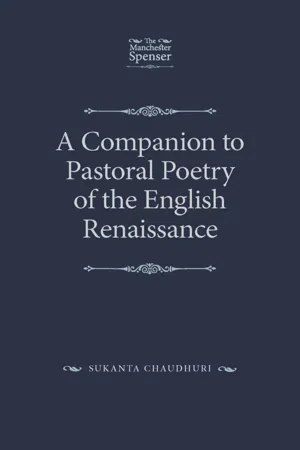
A Companion to Pastoral Poetry of the English Renaissance
About this book
This volume is an essential supplement to Pastoral poetry of the English Renaissance: An anthology (2016). The full-length Introduction examines English Renaissance pastoral against the history of the mode from antiquity to the present, with its multifarious themes and social affinities. The study covers many genres – eclogue, lyric, georgic, country-house poem, ballad, romantic epic, prose romance – and major practitioners – Theocritus, Virgil, Sidney, Spenser, Drayton and Milton. It also charts the circulation of pastoral texts, with implications for all early modern poetry. All poems in the Anthology were edited from the original texts; the Companion documents the sources and variant readings in unprecedented detail for a cross-section of early modern poetry. Includes notes on the poets and analytical indices. The Companion is indispensable not only to users of the Anthology but to all students and advanced scholars of Renaissance poetry.
Information
Textual notes
Unless otherwise stated, the control text is the first printed version of the poem. All substantive variants in other versions have been noted, unless stated to the contrary. Variants in lineation, spelling and punctuation, and some unquestionable misprints, have not been noted except in special cases. A detailed account of the choice of texts and other editorial decisions is given under ‘Practices and Conventions’ in the Anthology (pp.xiii–xiv).
Variant readings of the same word(s)/line(s) are separated by semicolons. (The semi-colon never forms part of the reading.) Entries on different headwords from the same line are separated by a gap of five spaces.
A reading enclosed in second brackets { } indicates a substantive reading but not the exact spelling. This device is commonly used to indicate the same substantive reading in different spellings in different versions.
A number preceded by # indicates a poem number in the Anthology.
Expansions of printers’ and publishers’ initials, and ascriptions of place, date and publishers’ names not documented in the work itself, are enclosed in brackets [ ] and generally taken from the English Short-Title Catalogue.
Abbreviations:
BL: British Library, London
Bod: Bodleian Library, Oxford
Helicon: Englands Helicon, London: I[?ames] R[?oberts]1 for John Flasket, 1600. Where a poem occurs in Helicon,its text has usually been followed in preference to that of earlier versions, as being in closest accord with Elizabethan pastoral convention. Departures are noted below.
1. Theocritus, Idyll VIII
Text based on Sixe Idillia that is, Sixe Small, or Petty Poems, or Æglogves, chosen out of the right famous Sicilian Poet THEOCRITVS, Oxford: Joseph Barnes, 1588, sig. A2 (misprinted H2)r–A3v.
2. Theocritus, Idyll XI
Text based on Sixe Idillia that is, Sixe Small, or Petty Poems, or Æglogves, chosen out of the right famous Sicilian Poet THEOCRITVS, Oxford: Joseph Barnes, 1588, sigs A3v–A4v.
3. Theocritus(?), ‘The Pastoral Wooing’, trans. Edward Sherburne
Text based on Edward Sherburne, Poems and Translations Amorous, Lusory, Morall, Divine, London: W. Hunt for Thomas Dring, 1651, pp. 118–21 (sigs H4v–H6r).
69 The original inserts the speech-heading Shepheardess here, obviously in error by analogy with its previous use.
4. Theocritus and Virgil, Fragments
Text based on T.B., A Ritch Storehouse or Treasurie for Nobilitye and Gentlemen, London: Henry Denham, 1570 (a translation of Johann Sturm’s Nobilitas Literata), sigs G8r–H1r.
7 In the original, line-division after soyle
5. Moschus(?), ‘Epitaph on Bion’, trans. Thomas Stanley
Text based on Thomas Stanley, Poems [London: Roger Norton], 1651, the second section Anacreon. Bion. Moschus. [etc.] with separate pagination and collation, pp. 45–9 (sigs C8r–D2r).
6. Virgil, Eclogue I, trans. William Webbe
Text based on William Webbe, A Discourse of English Poetrie, London: John Charlewood for Robert Walley, 1586, sigs H2r–H3v.
7. Virgil, Eclogue II, trans. Abraham Fraunce
Text based on Abraham Fraunce, The Lawiers Logike, London: William How, 1588, fols 121v–122v (sigs 2K2v–2K3v).
8. Virgil, Eclogue IV, trans. Abraham Fleming
Text based on Abraham Fleming, The Bucoliks of Publius Virgilius Maro …Together with his Georgiks or Ruralls … All newly translated into English verse by A.F., London: T[homas] O[rwin] for Thomas Woodcocke, 1589, sigs C1v–C2v. These unrhymed translations are entirely different from the 1575 versions in rhymed verse, from which #9 below is taken.
13 any] emending my in original
23 bearefoot] emending beatfoot in original
9. Virgil, Eclogue X, trans. Abraham Fleming
Text based on Abraham Fleming, The Bucolikes of Publius Virgilius Maro, London: John Charlewood for Thomas Woodcocke, 1575, pp. 29–32 (sigs F3r–F4v). See note on #8.
27 wallwort] In a list of ‘Sundry readings of divers words and clauses contained in the x. Eclogues’ (i.e., alternative readings or translations) at the end of the volume, an alternative reading hawethorne is given for wallwort, and red yearth for vermelon.
74 springtime doth awake] In the list of ‘Sundry readings’, these words have an alternative reading, the spring a show doth make.
10. Virgil, Georgic II.458–542, trans. Abraham Cowley
Text based on Cowley’s essay ‘Of Agriculture...
Table of contents
- Cover
- Half Title
- Title Page
- Copyright
- Contents
- Acknowledgements
- Introduction
- Textual notes
- Notes on authors
- Analytical indices
- General index
Trusted by 375,005 students
Access to over 1.5 million titles for a fair monthly price.
Study more efficiently using our study tools.
Frequently asked questions
Yes, you can cancel anytime from the Subscription tab in your account settings on the Perlego website. Your subscription will stay active until the end of your current billing period. Learn how to cancel your subscription
No, books cannot be downloaded as external files, such as PDFs, for use outside of Perlego. However, you can download books within the Perlego app for offline reading on mobile or tablet. Learn how to download books offline
Perlego offers two plans: Essential and Complete
- Essential is ideal for learners and professionals who enjoy exploring a wide range of subjects. Access the Essential Library with 800,000+ trusted titles and best-sellers across business, personal growth, and the humanities. Includes unlimited reading time and Standard Read Aloud voice.
- Complete: Perfect for advanced learners and researchers needing full, unrestricted access. Unlock 1.5M+ books across hundreds of subjects, including academic and specialized titles. The Complete Plan also includes advanced features like Premium Read Aloud and Research Assistant.
We are an online textbook subscription service, where you can get access to an entire online library for less than the price of a single book per month. With over 1.5 million books across 990+ topics, we’ve got you covered! Learn about our mission
Look out for the read-aloud symbol on your next book to see if you can listen to it. The read-aloud tool reads text aloud for you, highlighting the text as it is being read. You can pause it, speed it up and slow it down. Learn more about Read Aloud
Yes! You can use the Perlego app on both iOS and Android devices to read anytime, anywhere — even offline. Perfect for commutes or when you’re on the go.
Please note we cannot support devices running on iOS 13 and Android 7 or earlier. Learn more about using the app
Please note we cannot support devices running on iOS 13 and Android 7 or earlier. Learn more about using the app
Yes, you can access A Companion to Pastoral Poetry of the English Renaissance by Sukanta Chaudhuri in PDF and/or ePUB format, as well as other popular books in Literature & English Literary Criticism. We have over 1.5 million books available in our catalogue for you to explore.