China's rise from the poverty, isolation and stagnation of the 1970s to the world's second largest economy is a transformative event perhaps unequalled in human history. The world today pays more attention to China, looks to it with more admiration than perhaps any other time. Yet, this rise also hides many deep-rooted problems and competing ideologies. Economically, socially and politically China has transformed itself but there is much that
remains uncertain. This book aims to give an insight into China by exploring everyday life for her citizens, in their own voices.
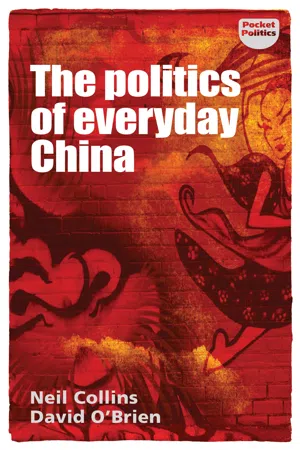
Providing both an overview of the political situation and context in China with ethnographic insights, The Politics of Everyday China aims to give both the new student of China and those who have encountered the subject before an insight that goes beyond the usual cliché and surface description.
- 100 pages
- English
- ePUB (mobile friendly)
- Available on iOS & Android
eBook - ePub
The politics of everyday China
About this book
Information
1
‘It doesn’t matter if the cat is black or white as long as it catches the mouse’: the role of ideology in Communist China
On a bright and freezing cold Saturday morning in Qingcheng Park (请城公园) in the centre of Hohhot, the provincial capital of the Inner Mongolia Autonomous Region, a crowd of roughly sixty pensioners has gathered for communal singing. Laughing and smiling and shuffling both in time with the music and to keep themselves warm in the icy temperatures, they belt out old revolutionary classics like ‘Osmanthus Flowers Blooming Everywhere in August’ and ‘The East is Red’. This communal singing is fun, boisterous and clearly pleasantly nostalgic for the participants, but it also has a more profound relevance and meaning to the participants, as sixty-six-year-old Mr Wang, one of the singers, explains:
We come here every Saturday even when it is very cold. It is always good to see friends and to sing the songs that we enjoy and remember from when we were younger. Most of the people you see here came to Hohhot a long time ago; they came to develop the borderlands and believed that they were doing the work of the Party, following the orders of Chairman Mao. We are proud of what we did then. It was tough. Hohhot was not like it is now with comfortable buildings and shops; back when I came here it was very poor. Life was very difficult, but now I live in great comfort. These songs are not just about the past. They are about showing our loyalty and our support for the Party and our gratitude for what it has done for us.
There is an almost religious aspect to it, although the participants would probably be horrified by such a comparison. Talking to the singers, one is struck not just by their energy and good humour but also by their faith. This is not some empty nostalgia or harking back to the old days, this seems more a celebration of their beliefs. Yet it is a celebration of an ideology which seems so utterly contradictory to the hyper-consumerism of today’s China. Just outside the park gates are shopping malls and designer stores, while expensive cars clog the streets in Hohhot’s terrible traffic jams. It all seems so paradoxical; how can China celebrate such overt capitalism and yet remain so loyal to the ideology of socialism?
‘No CCP, no New China’
The CCP puts enormous efforts into crafting its ideological message and this is testified by the network of Party Schools across the country where officials are trained in ideological work.1 This is much more than paying lip-service – cadres in China must engage in this type of training throughout their careers and must be able to show that they clearly understand the ideological line. These Party Schools are hugely influential and powerful in China, serving not only as centres for cadre training but also, in the words of Holbig, as a ‘networking mechanism to enhance the chances of obtaining a higher office and a locus of a “cult of elitism”2 from which the charisma of the Party emanates but also as a cradle for the ongoing innovation of Party theory’.3
Box 1.1Joining the Party
‘Jordan’ Wang, a twenty-six-year-old postgraduate student who takes his English name from US basketball player Michael Jordan, was recently accepted into the Party.
‘The whole process takes so long’, he says, ‘we have to pass difficult exams on Marxism and the history of the CCP. There is so much to study for this and it is really difficult. You must use the correct terminology and there is so much to remember’.
They also interview your classmates, teachers, people who know you, even my girlfriend, to make sure that you are a good person and will be a good fit. It is very strict; my friend was turned down because he gambles too much. They found out from interviewing his classmates.
They also look at your exam results and what organisations you have been involved in, sport, volunteering that sort of thing. Then there is a very tough interview, and finally, I was accepted.
My family was very proud. Both my father and my grandfather are members, and now I join them. It will be beneficial for my career, of course, but also, I do love the Party. It is the guiding light of our China, and by being a member, I will serve the people to continue its development.
I think of the Communist Party as being like my family. My mother and father supported me and love me and do all they can for me. The Party is also like this and now that I am an adult, like with my parents, I have responsibilities to look after them and to serve them. All the Chinese people think of the Party as being their family.
The CCP had a total of approximately 89.5 million members at the end of 2016. Its membership increased by 688,000 from 2015, up 0.8 per cent. Of those, 23 million are women, accounting for just 25.7 per cent of the total membership, while 6.3 million members are from ethnic minority groups, making up 7 per cent of total membership.4 Chairman Mao famously said that ‘women hold up half the sky’, yet in today’s China they hold up just a quarter of the Party. They are also significantly underrepresented at the top of the leadership pyramid. No woman has ever beena member of the Standing Committee of the Politburo, the most powerful body in China, while they rarely make up more than one or two members of the Politburo, the next level down.5
To become a Party member is to join the Chinese elite. Potential members must pass many tests and demonstrate political correctness, moral integrity and, as Holbig puts it, ‘spiritual loftiness through the skilful use of formal language’ (see Box 1.1). Joining is only the first step, to advance a cadre must demonstrate their familiarity with ideology by putting it correctly into practice.6 To the outsider, the term ‘socialist’ may seem an empty signifier, but inside the fold, it is vital to demonstrate adherence to and deep understanding of ‘Socialism with Chinese Characteristics’.
In Xi Jinping’s China, ideology is perhaps more critical now than at any time since the ideological campaigns of the 1960s and 1970s. ‘We must uphold Marxism, firm up and further build the ideal of Communism and a shared ideal of socialism with Chinese characteristics, and nurture and practise core socialist values’, Xi told the opening of the 19th NPC in November 2017. It is a prevalent theme for Xi. As Wang has shown in his analysis of ideology in President Xi’s discourses, Xi frames the CCP’s political ideologies as moral values with an authoritative nature that guides both the State and society, values that are at once stable but also are continually being adapted and Sinicised.7 The ever-present double-negative propaganda slogan, ‘No CCP, No New China’ (没有共产党就没有新中国), succulently proclaims the Party’s role.
The 2017 Congress saw ‘Xi Jinping Thought on Socialism with Chinese Characteristics for a New Era’ enshrined as a guiding principle of the Communist Party. This put Xi alongside only Chairman Mao in terms of his impact on Party ideology and ahead of his predecessors Hu Jintao, Jiang Zemin (江泽民) and Deng Xiaoping (邓小平), whose ideological teachings were never granted the term ‘thought’, only being referred to as ‘theories’. For Yu Zhengsheng (俞正声), one of China’s top leaders, Xi Jinping’s Thought ‘represents the latest achievement in adapting Marxism to the Chinese context, and is an important component of the system of theories of socialism with Chinese characteristics’. While for fellow Standing Committee member Zhang Dejiang (张德江), ‘[t]he Thought is the biggest highlight of the 19th National Congress of the Communist Party of China and a historic contribution to the Party’s development’.8
Ideology and legitimacy
For Michael Freeden, ideology is a ‘wide-ranging structural arrangement that attributes decontested meaning to a range of mutually defining political concepts’.9 Where there is competition between ideologies, this competition is conducted largely over the control of political language. In China, the CCP has almost total control over political language. However, that does not mean that competition does not take place within the Party. As Holbig points out:
In the authoritarian context of Communist one-party regimes, this competition is highly restricted as the Party claims hegemony in the ideological realm. Nevertheless, the (re)production of Party ideology remains a highly fluid framing process, where Marxist-Leninist and other traditional tenets of socialist ideology are constantly recombined with new political concepts such as nationalism, populism, the revitalisation of traditional culture etc.10
The oft-quoted Deng Xiaoping maxim, 黑 猫 白 猫, 能 捉 到 老 鼠 就 是 好 (‘it doesn’t matter if the cat is white or black as long as it catches the mouse’), is often given as an example of his and China’s subsequent ideological pragmatism which followed the end of the Mao era in 1976. The legitimacy of the CCP has, since Deng, become dependent on its ability to deliver economic progress and the assertion that China could modernise only under a strong one-party system.11 Yet political ideology is also driven by the need for all political forces to legitimise their strategies and programmes by creating an appropriate intellectual narrative; it is this ‘story’ that is needed to justify their dominance.12 In Xi Jinping’s China, in which the Party plays the central role in all aspects of political life, ensuring political legitimacy is the crucial task. While to outside observers China’s leaders may pay only lip-service to socialism, in reality, adhering to this ideology is vital to ensure their legitimacy and survival. For the CCP, socialism provides the normative justification for the rightful source of political authority.13
Steve Tsang has put forward the concept of ‘consultative Leninism’ to describe the political system that has taken shape in China since the death of Deng Xiaoping. Consultative Leninism, he argues, has five defining characteristics: an obsessive focus on staying in power; continuous governance reform designed to pre-empt public demands for democratisation; sustained efforts to enhance the Party’s capacity to elicit, respond to and direct changing public opinion; pragmatism in economic and financial management; and the promotion of nationalism in place of communism.14 Under Xi Jinping, there has been a noticeable increase in the Party’s activities in all of these areas. Ideology is its weapon in this vital battle and those who end up on the losing side face ruin.
Tigers and flies
One of the defining features of Xi Jinping’s period in office has been a massive anti-corruption campai...
Table of contents
- Cover
- Half Title
- Series Information
- Title Page
- Copyright Page
- Dedication
- Contents
- List of Boxes
- Preface
- List of abbreviations
- Introduction
- 1 ‘It doesn’t matter if the cat is black or white as long as it catches the mouse’: the role of ideology in Communist China
- 2 The road to revival
- 3 People and place in the civilisation State
- 4 Harmony and the self: rights and responsibilities
- 5 To get rich is glorious
- Conclusion
- Further reading
- Bibliography
- Index
Trusted by 375,005 students
Access to over 1.5 million titles for a fair monthly price.
Study more efficiently using our study tools.
Frequently asked questions
Yes, you can cancel anytime from the Subscription tab in your account settings on the Perlego website. Your subscription will stay active until the end of your current billing period. Learn how to cancel your subscription
No, books cannot be downloaded as external files, such as PDFs, for use outside of Perlego. However, you can download books within the Perlego app for offline reading on mobile or tablet. Learn how to download books offline
Perlego offers two plans: Essential and Complete
- Essential is ideal for learners and professionals who enjoy exploring a wide range of subjects. Access the Essential Library with 800,000+ trusted titles and best-sellers across business, personal growth, and the humanities. Includes unlimited reading time and Standard Read Aloud voice.
- Complete: Perfect for advanced learners and researchers needing full, unrestricted access. Unlock 1.5M+ books across hundreds of subjects, including academic and specialized titles. The Complete Plan also includes advanced features like Premium Read Aloud and Research Assistant.
We are an online textbook subscription service, where you can get access to an entire online library for less than the price of a single book per month. With over 1.5 million books across 990+ topics, we’ve got you covered! Learn about our mission
Look out for the read-aloud symbol on your next book to see if you can listen to it. The read-aloud tool reads text aloud for you, highlighting the text as it is being read. You can pause it, speed it up and slow it down. Learn more about Read Aloud
Yes! You can use the Perlego app on both iOS and Android devices to read anytime, anywhere — even offline. Perfect for commutes or when you’re on the go.
Please note we cannot support devices running on iOS 13 and Android 7 or earlier. Learn more about using the app
Please note we cannot support devices running on iOS 13 and Android 7 or earlier. Learn more about using the app
Yes, you can access The politics of everyday China by Neil Collins,David O'Brien in PDF and/or ePUB format, as well as other popular books in Politics & International Relations & Asian Politics. We have over 1.5 million books available in our catalogue for you to explore.