Through a study of the British Empire's largest women's patriotic organization, formed in 1900, this book examines the relationship between female imperialism and national identity. It sheds light on women's involvement in imperialism, and on the history of 'conservative' women's organizations.
eBook - ePub
Female imperialism and national identity
Imperial Order Daughters of the Empire
- 209 pages
- English
- ePUB (mobile friendly)
- Available on iOS & Android
eBook - ePub
About this book
Information
CHAPTER ONE
Genealogy of an imperial and nationalistic Order
The IODE began as it would continue: on a footing of attack and defence, amid a climate of patriotism fuelled by the South Africa War (1899–1901). Margaret Clark Murray, a sometime journalist, philanthropist and wife of an influential McGill professor, returned to Montreal from London, where she had experienced much pro-war jingoism, and decided to act on the public outpourings of Anglo-Canadian patriotism that she sensed around her. Her intentions were to seek an opportunity to strengthen Canadian national ties as well as imperial connections, her imperialist outlook stemming, in part, from her upbringing in Scotland. Murray had ambitious plans to form an empire-wide Federation of Daughters of the British Empire and Children of the Empire. She would start the organization in Canada, where she resided, and fan outwards to the other parts of the Empire, including Britain.
After a period of fervent writing of national histories, scholars are now exploring the connections, tensions and ironies between national and imperial identities. Benedict Anderson’s work has been instrumental in destabilizing the absolute power ascribed to empires by suggesting that they were ‘imagined’. Anderson has drawn attention to cases of colonized peoples ‘who have every reason to feel hatred for their imperialist rulers’ instead being inspired by the power of patriotism and racism to ‘love and often profoundly self-sacrificing love’.1 In the case of the formation of the IODE, it was Anglo-Celtic ‘colonials’ who did not feel hatred for their rulers, as they were ‘white settlers’, attempting to create a ‘British’ Canada. In this vein Clark Murray’s gutsy enthusiasm was simultaneously nationalistic and imperial. She began her task by methodically sending out telegrams to the mayor of the capital city of each province, asking them to call together women to form regional chapters of her proposed organization. She asserted that it was time to ‘stand by our Queen at all costs, to shake our fists if necessary, in the face of the whole of Europe, and show them what we are made of’.2 A contemporary member explains the IODE’s patriotism: ‘It all made perfect sense in 1900. We are a patriotic organization who love Canada and are patriotic to Canada. We have been accused for years of being patriotic to Britain, which is not true. It’s always been a Canadian organization’.3 In recalling 1900, she evokes the co-dependence of national and imperial identities, and the need for Canadian nationalism to grow out of an imperial attachment. This, indeed, is the essence of Carl Berger’s work on how Anglo-Canada gained a ‘sense of power’.4 Along with Berger’s blindness to the IODE in his work on Canada and the South Africa War, Carman Miller similarly finds little place for the IODE’s initial work or sentiments.5 Yet, as Julia Bush’s work on Edwardian ladies and imperial power argues, a ‘spiritual creed of Empire was as attractive to many British women as it was to their male counterparts’.6 I argue that, along with patriotic women in other countries, such as the members of the Victoria League and of the South African Guild of Loyal Women, the women of the IODE displayed their own enthusiastic patriotism. As Clark Murray declared: ‘do not forget that the destiny of our Empire lies in the hands of our women and our children, more than in politics and in parliaments’.7 Thus, Clark Murray and other patriotic women around the British Empire expressed a female imperialism, that placed great importance in, and was justified by, an appeal to women’s perceived maternal capabilities.
Patriotic clubs and imperialism
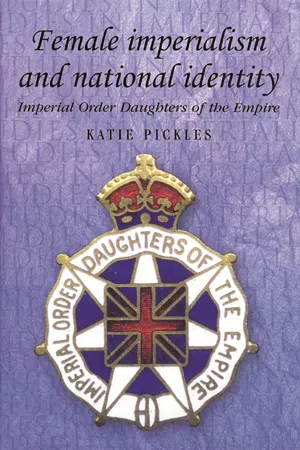
In its activities, initial class composition and political affiliations, the IODE fitted very closely with the imperial propaganda clubs, a number of which were founded at the end of the nineteenth century in Canada and other parts of the Empire.8 These were conservative movements that sought to foster imperial patriotism. Utilizing textbooks, exhibitions and entertainments to promote their ideas, their varied constitutions and their defensive and cultural concerns all came together in the theme of imperial unity.9 The Navy League, the Victoria League, and the Girl and Boy Scout Movements epitomised such organizations. The IODE was clearly a part of this historical moment, enjoying strong links to imperial defence and collaboration with the Navy League.10 The symbols of the IODE’s organization also reflected empire unity. The motto was ‘one flag (the Union Jack), one throne (the British Monarchy), one Empire (the British Empire)’. Likewise, the badge cast imperial foundations in metal, with the crown symbolizing the British monarchy, the Union Jack for Britain and the Empire, surrounded by a seven-pointed outward-radiating star, one point for each of the major territories of the Empire.
Clark Murray’s way of going about organizing her Order involved tapping into an élite network of individuals representative of the Canadian establishment, her connections spanning outwards from affluent Anglo-Celtic Montreal society. Fredericton was the first place to assemble a group of women at a meeting, on 15 January 1900, where the mayor read Clark Murray’s telegram: ‘Will the women of Fredericton unite with the women of Montreal in federating as “Daughters of the Empire” and inviting the women of Australia and New Zealand to unite with them in sending to the Queen an expression of our devotion to the Empire and an emergency war fund to be expended as Her Majesty shall deem fit?’11 As well as involving Britain’s antipodean Empire in unity, Clark Murray’s empire-wide ambitions included plans to set up an imperial chapter in London as soon as possible.12 That ambition, however, tested the limits of ‘Empire unity’ for a Britain that still considered itself the superior core of that Empire. Clark Murray’s ambitions of empire-wide membership were soon crushed, blocked by the rival British women’s patriotic organization, formed in 1901 and taking its name from the matriarch of imperialism herself, the Victoria League.
With an aim similar to the IODE’s, of promoting closer union between British subjects living in different parts of the Empire, the Victoria League took strong objection to Clark Murray’s plans for an imperial chapter of her organization in London, seeing the Canadian counterpart as competition. In a letter to Canada, the Victoria League demanded that Clark Murray hand over to them the contacts that she had made in London. Much to Clark Murray’s dismay, self-interested and perhaps meek Toronto members sided with the Victoria League, took ‘Federation’ out of the name, and made Toronto the national centre of a re-named Imperial Order Daughters of the Empire.13 Clark Murray’s health suffered, and it was a long time before the deeply upsetting events of formation were smoothed over and she came to be celebrated as the IODE’s foundress.
Out of such beginnings, the IODE has itself often treated other women’s organizations as the competition. While there has been considerable cooperation between the IODE and other organizaions, especially during wartime, the Order has attempted to maintain control over the activities that it has chosen to participate in. But being considered inferior by the Victoria League and the SOSBW is a theme that recurs through this book. The clashes over control and respect highlight the unique position of the IODE, as a Canadian organization that promoted imperial ideals. While it was staunch in voicing its opposition to other Canadian women’s organizations, when it came to groups based in Britain the IODE always deferred – indeed such were the hierarchies of the Empire that it had no choice but to fall in with the intentions of the Victoria League and the SOSBW. Here the IODE was trapped by the reverence in which it held all things British.
Clark Murray envisioned a large international membership eventually, to be run along fairly egalitarian lines. In a written retrospective she held that she had founded her ‘Daughters on a new principle, namely, to prove what could be done without asking for high patronage’, but capitulated when those working with her demanded a patroness.14 Known for her own patriotic and charitable work, Lady Minto became the first honorary president. The first president of the IODE, from 1901 to 1910, was Edith Nordheimer. A well-connected member of the Canadian upper-classes, Nordheimer set the standard for presidents to come. As Margaret Gillett’s work on Edith Nordheimer reveals, her grandfather, D’Arcy Boulton, was attorney-general of Upper Canada, an uncle was governor-general of Nova Scotia and later governor of Ceylon, while her father, James Boulton, was a wellestablished barrister. At the age of 24, she married the extremely wealthy 42-year-old businessman Samuel Nordheimer. Moving in élite Toronto circles, Edith Nordheimer was a member of a variety of charitable organizations, from the Working Boys’ Home, and the Children’s Aid Society, to the Victorian Order of Nurses and the Red Cross Society.15 With Edith Nordheimer’s presidency came an assurance to the Victoria League that the IODE would not compete for members in Britain or in other places where the Victoria League existed.
Over the course of the twentieth century, the possibility of expansion outside of Canada sporadically re-emerged for the IODE, each time to be met with cold defensive opposition from the Victoria League. With the exception of small and tenuous satellite chapters in pre-confederation Newfoundland, the USA, Bermuda, the Bahamas and India, the IODE was restricted to Canada. In the USA the Daughters of the British Empire consisted of a small number of loyal chapters on the eastern seaboard. In common with women involved in Bermuda and the Bahamas, they were largely British ex-patriates.16 Alternatively, in India in 1905 Miss Susie Sorabji, a Parsee Christian teacher, organized the Kaiser-I-Hind Chapter in the Bombay district of Poona. She and her group of ‘Empire-thinking Indian women’ worked mainly in education.17 The IODE in Canada raised funds for St Helena’s School, of which Sorabji was the principal. In 1930 money was pledged to complete the building of the science block, named ‘Canada Wing’.18 Such work, however, was very small in scale. The frosty reception that Clark Murray’s and subsequent Canadian initiative to enact ‘Empire unity’ met with in Britain served to highlight hierarchies of the Empire that were not supposed to be breached. And, despite being shunned, the IODE continued to celebrate an imagined Br...
Table of contents
- Cover Page
- Title Page
- Copyright Page
- Contents
- List of figures and tables
- List of abbreviations
- General editor’s introduction
- Acknowledgements
- Dedication
- Introduction
- 1 Genealogy of an imperial and nationalistic Order
- 2 Female imperialism at the periphery: organizing principles, 1900–19
- 3 Women, race and assimilation: the canadianizing 1920s
- 4 Exhibiting Canada: Empire, migration and the 1928 English Schoolgirl Tour
- 5 Britishness and Canadian nationalism: Daughters of the Empire, mothers in their own homes, 1929–45
- 6 ’Other than stone and mortar’: war memorials, memory and imperial knowledge
- 7 Conservative women and democracy: defending Cold War Canada
- 8 Modernizing the north: women, internal colonization and indigenous peoples
- Conclusion
- Note on sources
- Bibliography
- Index
Trusted by 375,005 students
Access to over 1.5 million titles for a fair monthly price.
Study more efficiently using our study tools.
Frequently asked questions
Yes, you can cancel anytime from the Subscription tab in your account settings on the Perlego website. Your subscription will stay active until the end of your current billing period. Learn how to cancel your subscription
No, books cannot be downloaded as external files, such as PDFs, for use outside of Perlego. However, you can download books within the Perlego app for offline reading on mobile or tablet. Learn how to download books offline
Perlego offers two plans: Essential and Complete
- Essential is ideal for learners and professionals who enjoy exploring a wide range of subjects. Access the Essential Library with 800,000+ trusted titles and best-sellers across business, personal growth, and the humanities. Includes unlimited reading time and Standard Read Aloud voice.
- Complete: Perfect for advanced learners and researchers needing full, unrestricted access. Unlock 1.5M+ books across hundreds of subjects, including academic and specialized titles. The Complete Plan also includes advanced features like Premium Read Aloud and Research Assistant.
We are an online textbook subscription service, where you can get access to an entire online library for less than the price of a single book per month. With over 1.5 million books across 990+ topics, we’ve got you covered! Learn about our mission
Look out for the read-aloud symbol on your next book to see if you can listen to it. The read-aloud tool reads text aloud for you, highlighting the text as it is being read. You can pause it, speed it up and slow it down. Learn more about Read Aloud
Yes! You can use the Perlego app on both iOS and Android devices to read anytime, anywhere — even offline. Perfect for commutes or when you’re on the go.
Please note we cannot support devices running on iOS 13 and Android 7 or earlier. Learn more about using the app
Please note we cannot support devices running on iOS 13 and Android 7 or earlier. Learn more about using the app
Yes, you can access Female imperialism and national identity by Katie Pickles in PDF and/or ePUB format, as well as other popular books in Social Sciences & Sociology. We have over 1.5 million books available in our catalogue for you to explore.