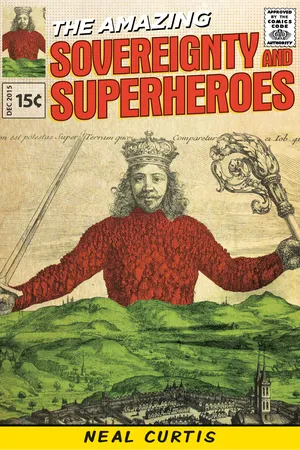
Sovereignty and superheroes marks a major new contribution to the emerging field of comic studies and the growing literature on superheroes. Using a range of critical theorists, the book examines superheroes as sovereigns, addressing amongst other things the complex treatment of law and violence, legitimacy and authority. It examines all the main characters including Superman, Batman, Captain America, Wonder Woman and Iron Man along with a host of other heroes and heroines within the Marvel and DC universes.
The book will be of interest to academics and students interested in the intersection between superhero comics, culture and politics. In a century thus far dominated by the war on terror, superheroes offer us the perfect opportunity to think through the nature of sovereignty in such times of emergency. The book not only guides the reader through some of the major story arcs in superhero comics, but also serves as an excellent introduction to a range of writings on the nature of sovereignty.
- 202 pages
- English
- ePUB (mobile friendly)
- Available on iOS & Android
eBook - ePub
Sovereignty and superheroes
About this book
Information
1
Legitimacy and the Good
In his introduction to the superhero genre, entitled Superman on the Couch, Danny Fingeroth notes how ‘the superhero – more than even the ordinary fictional hero – has to represent the values of the society that produces him. This means that what, say, Superman symbolises changes over time. In the 1950s, he may be hunting Commies. In the 1970s, he may have been clearing a framed peace activist against a corrupt judicial system’ (2005: 17). Aside from these cultural variations in which superheroes respond to ‘external’ changes in social attitudes, there have also been what might be called ‘internal’ changes, in which the very nature of the superhero has been revised. One of the most radical shifts in this regard is said to have taken place in the second half of the 1980s, when the genre as a whole was subject to a certain revisionism, making the comics more ‘adult-oriented’ in terms of content and subjecting them to significant ‘retcon’ (retroactive continuity) through which back stories were rewritten to permit new conceptual and narrative possibilities, while also creating new vehicles for commercial exploitation. Notable amongst these so-called mature revisions were Frank Miller’s The Dark Knight Returns (discussed in Chapter 3) and Alan Moore’s Watchmen (discussed in Chapter 7). The point to make, however, is that although social attitudes have affected the evolution of the genre, it is not true that these changes were forced on an inherently limited and conservative concept. Change was built in right from the start. This is the reason that they are so open to creative development and remain so popular today. As Henry Jenkins has argued, calling changes to a superhero’s character revisionist ‘makes no sense because there is not a moment in the history of the genre when the superhero is not under active revision’ (2009: 29).
To illustrate this there is nothing better than the first run of Superman stories. In over seventy-five years of continuous storytelling, Superman has come to be perceived as the ultimate ‘boy scout’, a super-man of outstanding virtue, whose code of ethics just happens to coincide with the central tenets of the American civil religion. He is a virtuous, conservative archetype and defender of America as the defender of human freedom. It is therefore surprising to find that in the original stories Superman is announced to the world as ‘a champion of the oppressed’ (Siegel and Shuster, 2006: 4) and appears to be far more socially liberal than we have come to expect. Although perhaps not quite a socialist, he was certainly a means ‘to call for interventionist government on the side of the common citizen’ (Coogan, 2006: 235), and demonstrated few qualms about killing, destroying private property, kidnapping or disregarding the authority of the police (reasons for which he was considered a threat to the young by Frederic Wertham). Given the dominance of superman’s right-wing iconography, it is therefore surprising to find that in Action Comics #3 he starts a one-man campaign to improve working conditions for miners, while in Action Comics #8 we find Clark Kent reporting from a juvenile court and agreeing with the defendant’s mother who pleads with the judge to understand that a poor social environment is the cause of crime. In Action Comics #10, he engages in prison reform, while in issue 12 he is shown ‘gleefully’ (Siegel and Shuster, 2006: 161) destroying a factory in a manner that Ben Saunders likens to the Communist aspiration to take over the means of production (Saunders, 2011: 23).
Does this mean the 1950s Cold War Superman was a revision that supports the argument for periodic changes to a character in line with audiences and markets? To some extent, but this is not sufficient: the concept of Superman was a work in progress from the beginning. Although the superhero emerged out of the popular heroics of pulp action and science fiction or fantasy characters that Peter Coogan describes as the ‘antediluvian age’ (2006: 126), the Superman stories written and drawn by Jerry Siegel and Joe Shuster were a new popular form because they broke with the traditional limitations of heroic settings and powers to offer the new concept of the superhero and an especially fertile template for future creativity. In an important way, this challenges Coogan’s argument that earlier manifestations of fantastical heroes meant ‘the superhero genre was born full-fledged in 1938’ (126). I would rather argue that in a creatively important way Siegel and Shuster didn’t know what they were doing or rather they were presenting an audience with something they didn’t yet know there was an audience for. Superman would have been a shocking concept to the sensibilities of the time and the creative team would have been uncertain as to how far they could take it, which is why ‘revision’ is built in from the start. The first run, up to and including the first issue of Superman in 1939 where the Kents are introduced in the first piece of Superman ‘retcon’, the creators are working with an idea so fresh that they are shaping it as they go.
When reading Action Comics #1 from 1938, we find Superman’s powers listed as the (very precise) ability to ‘leap ⅛ of a mile; hurdle a twenty-story building; raise tremendous weights; run faster than an express train; and that nothing less than a bursting shell could penetrate his skin’. By issue 2, however, we find that he now has impenetrable skin (bullets just bounce off him) and that his leaping seems to be closer to flying. In #6 he can crush steel in his bare hands; by issue 7 he is able to race a bullet (a feat significantly more astounding than racing a train), while in issue 11 we find Superman has gained ‘x-ray eyesight and super-acute hearing’. In Action Comics #13, we are also first introduced to “the Ultra-Humanite”, a man who controls the other bad guys that have appeared in previous stories and whose crippled body marks him as the opposite of Superman although he shares his thinly disguised name.1 This dark, mirror figure is yet another defining concept of these early stories (and, indeed, all future superhero storytelling), and yet it is quite possible to imagine his appearance also emerging out of the quickly evolving creative process, rather than being there from the start, so to speak. This is not to deny the need for stories to make sense in a cultural context or in relation to the effect of commercial pressures; it is to argue that the superhero was a pretty flexible concept from the beginning and that this flexibility continues to be part of its success.
In addition, it is important to note that superheroes don’t simply pander to cultural tastes. Even within a particular age, these are often so diverse and differentiated as to make the task almost impossible. It would also radically undermine the coherence of a character over time and undermine the continuity upon which the meaning of the superhero had been established. In this regard, the superhero as a concept – and this is especially true for heroes such as Superman and Captain America, who stand as authority figures within their own universes – must appeal to something beyond the relativism and vicissitudes of the Zeitgeist, and point towards something transcendent and archetypal, if not universal. This doesn’t mean that different writers within the same historical period can’t offer their own interpretation of that transcendent moment. It is simply to state that the most authoritative characters in their respective universes must appeal to something beyond the immediate cultural context. In many respects, this is akin to a central problem with the constitution of democratic sovereignty which must appeal to a specific demos – a particular people, living in a particular historical moment, who determine the nature of the law based on what they feel is right and best preserves what they feel is good – and yet at the same time it must claim a connection to a deeper sense of legitimacy, rooting those laws in a more substantial foundation that exceeds them. This is the first reason why superheroes so readily lend themselves to a consideration of sovereignty, which is also not alien to a little bit of ‘retcon’ itself. We may have thought that legitimacy came from God, but secular humanist philosophy has argued that the origin story of our sovereign legitimacy in fact lay with a curious, previously unknown entity called the People, which, of course, is never reducible to a people, a particular group of people here and now, but it is a concept regularly invoked to legitimise their laws. The point about sovereignty’s origin story is that despite the difference between God and the People, they both stand in as the source of law and bestower of meaning. They are first cause, prime mover, beginning and end. And already, just writing that sentence, I feel that I have started a Kirby-style epic along the lines of the Fourth World cycle.
Although any theory of sovereignty will necessarily address the relationship between the law and its legitimacy, it was Carl Schmitt who explored it most consistently. In Legality and Legitimacy, published just prior to the rise of National Socialism in his native Germany, Schmitt wrote about the inadequacies of a ‘legislative state’ (Schmitt, 2004: 3) where nothing is considered higher or more superior than the will of a community as represented in its impersonal laws. He regarded such a state to be relativistic and open to abuse by the group in power (30) because nothing more authoritative commands them. In opposition to this, he favoured a state founded on personal authority, which he claimed produced a ‘system of meaning’ (47) and resulted in a more ‘substantive order’ (94). As a conservative and a Catholic, his concerns about the evils of disorder that the supposedly value-neutral, relativistic, liberal and ultimately weak Weimar Republic was permitting saw him side with National Socialism in 1933, but this decision should not let us lose sight of the fact that Schmitt was wrestling with a very real problem in the philosophy of sovereignty.
In Political Theology, a book first published in 1922, Schmitt argued that sovereignty was alien to the laws of ‘positive jurisprudence’, going on to claim that the sovereign’s decision-making capacity emanated ‘from nothingness’ (2005: 32) and is ‘analogous to the miracle in theology’ (36). Although Schmitt preferred a legal model based on a sovereign personality, in keeping with his own devout religious beliefs, he argued that modern, democratic accounts of sovereignty still had no account for this miraculous moment that nevertheless seemed to haunt it. As far as he was concerned, the modern claim that the constitutional state ‘banished the miracle from the world’ (36) was an illusion, and he argued that the miracle-like intervention of a sovereign personality still acts as a deus ex machina within the positive legalistic system. ‘There always exists’, he writes, ‘the same inexplicable identity: lawgiver, executive power, police, pardoner … in which the state acts … as the same invisible person’ (38). In many respects, superheroes, especially the most authoritative ones like Superman and Captain America, are this invisible person made visible. They represent the continuation of this super-executive, quasi-theological, transcendent moment that persists in modern conceptions of sovereignty and their claims to legitimacy. It is this transcendence that gives them the greatest authority. It is a power that no physical mutation, chemical transformation or technological augmentation can achieve, and yet it is the ‘invisible’ element that every superhero must be made from to varying degrees.
In this and the following chapter, I would like to look at the persistence of this transcendent element in the figures of Superman and Captain America. Superman clearly bears the marks of a divine, absolutist sovereignty, whereas Captain America exemplifies the modern view of sovereignty immanent to the will of the People. Either way, both figures represent the foundation of what is deemed good and yet these heroes are required precisely because this goodness has not yet been fulfilled. Their goodness is our potential or the horizon we move towards. While the secular messianism of Captain America will be analysed in the next chapter, here I will address the Superman mythology via Plato’s analysis of ideas and what he called the sovereignty or supremacy of the Good. As will be shown, both Superman and the Platonic Good share a relation to the sun that helps us understand the transcendent element in both the sovereign’s legitimacy and the superheroes’ authority. Ordinarily, a Platonic view of transcendence is seen to be inherently conservative and would therefore suggest the right-wing Superman that emerged in the 1950s is closer to the essence of this quasi-divine character. In contrast to this, I will offer a different reading of Plato to show that Superman’s transcendence and his legitimacy are perfectly in keeping with the original characterisation of him as a radical social agent rooted in struggle and historical change.
The Platonic form of the superhero
It is safe to say that there have been many Supermen, having been written about continuously since 1938, but I am not referring to the other Superman of Earth 2 or the four new ones that appeared after Superman’s death – there are and have been numerous Supermen across the DC multiverse – I mean the many Supermen in the sense that Will Brooker spoke about the many Batmen (2005: 235). Superman continues to be many things to many people. The meaning of Superman is thus a highly contested issue and often one that a new creative team will try to address directly in order to shape their ‘take’ on the icon. In recent times, for example, Brian Azzarello evoked the Christian aspect of the Superman mythos, showing him to be motivated by a profound love for humanity (Azzarello and Lee, 2005a, 2005b). Yet, however Superman is presented, be it the socialist ‘champion of the oppressed’ or the nationalist defender of ‘truth, justice and the American way’ (even the liberal, cosmopolitan, internationalist defender of difference, as the meaning of ‘American’ morphs in turn), Superman is nothing if he is not good. When applied to Superman, however, this concept should be capitalised. While different attributes might be highlighted – courage, humility, fairness, loyalty, honesty, self-sacrifice – he is always Good. This capitalisation means that however we might define goodness, whatever the movement of history might do to our understanding of what goodness entails, Superman represents something universal and substantial. For this reason, the Good for which Superman stands might also be said to be transcendent, that is, irreducible to any of the culturally derived attributes mentioned above or any predetermined code of behaviour. While the Good certainly demands action that has concrete, ‘real-world’ implications, it also remains an ideal towards which we strive without ever being grasped or claimed as our own. One, if not the greatest, of Superman’s powers is precisely his sense for the Good. In this regard, as Batman tells him in Infinite Crisis, his role is ‘about setting an example’ (Johns and Jimenez, 2006: 38); not controlling people, not telling people what to do, not behaving like a god. This is especially telling precisely because the crisis in that story is precipitated by others who do act like gods and pursue an ultimate and fully realisable ‘good’ world, a perfect Earth, a topic to which I will return later in the chapter.
To speak of Superman in relation to Plato, however, requires a prefatory note on the philosopher most readily associated with Superman: Friedrich Nietzsche, whose concept of the Übermensch, translated as either the Overman or more commonly the Superman is believed to have been a major influence on Siegel and Shuster. While there is evi...
Table of contents
- Cover
- Half Title
- Title Page
- Copyright Page
- Dedication
- Table of Contents
- Acknowledgements
- Introduction: sovereignty and superheroes
- 1 Legitimacy and the Good
- 2 Defending freedom
- 3 Law and violence
- 4 Friend and enemy
- 5 Emergency and bare life
- 6 Symbolic authority and kinship
- 7 Sovereignty at the limit
- Postscript
- Bibliography
- Index
Trusted by 375,005 students
Access to over 1.5 million titles for a fair monthly price.
Study more efficiently using our study tools.
Frequently asked questions
Yes, you can cancel anytime from the Subscription tab in your account settings on the Perlego website. Your subscription will stay active until the end of your current billing period. Learn how to cancel your subscription
No, books cannot be downloaded as external files, such as PDFs, for use outside of Perlego. However, you can download books within the Perlego app for offline reading on mobile or tablet. Learn how to download books offline
Perlego offers two plans: Essential and Complete
- Essential is ideal for learners and professionals who enjoy exploring a wide range of subjects. Access the Essential Library with 800,000+ trusted titles and best-sellers across business, personal growth, and the humanities. Includes unlimited reading time and Standard Read Aloud voice.
- Complete: Perfect for advanced learners and researchers needing full, unrestricted access. Unlock 1.5M+ books across hundreds of subjects, including academic and specialized titles. The Complete Plan also includes advanced features like Premium Read Aloud and Research Assistant.
We are an online textbook subscription service, where you can get access to an entire online library for less than the price of a single book per month. With over 1.5 million books across 990+ topics, we’ve got you covered! Learn about our mission
Look out for the read-aloud symbol on your next book to see if you can listen to it. The read-aloud tool reads text aloud for you, highlighting the text as it is being read. You can pause it, speed it up and slow it down. Learn more about Read Aloud
Yes! You can use the Perlego app on both iOS and Android devices to read anytime, anywhere — even offline. Perfect for commutes or when you’re on the go.
Please note we cannot support devices running on iOS 13 and Android 7 or earlier. Learn more about using the app
Please note we cannot support devices running on iOS 13 and Android 7 or earlier. Learn more about using the app
Yes, you can access Sovereignty and superheroes by Neal Curtis in PDF and/or ePUB format, as well as other popular books in Politics & International Relations & American Government. We have over 1.5 million books available in our catalogue for you to explore.