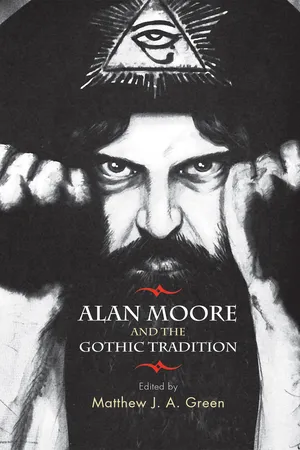
The first book-length study to address Moore's significance to the Gothic, this volume is also the first to provide in-depth analyses of his spoken-word performances, poetry and prose, as well as his comics and graphic novels.
The essays collected here identify the Gothic tradition as perhaps the most significant cultural context for understanding Moore's work, providing unique insight into its wider social and political dimensions as well as addressing key theoretical issues in Gothic Studies, Comics Studies and Adaptation Studies.
Scholars, students and general readers alike will find fresh insights into Moore's use of horror and terror, homage and parody, plus allusion and adaptation. The international list of contributors includes leading researchers in the field and the studies presented here enhance the understanding of Moore's works while at the same time exploring the ways in which these serve to advance a broader appreciation of Gothic aesthetics.
- 306 pages
- English
- ePUB (mobile friendly)
- Available on iOS & Android
eBook - ePub
Alan Moore and the Gothic tradition
About this book
Information
Part I
Monstrous politics
1
Alan Moore and the Gothic tradition
Matthew J.A. Green
It’s about the vital message that the stiff lips of decapitated men still shape; the testament of black and spectral dogs written in piss across our bad dreams. It’s about raising the dead to tell us what they know. It is a bridge, a crossing-point, a worn spot in the curtain between our world and the underworld, between the mortar and the myth, fact and fiction, a threadbare gauze no thicker than a page. It’s about the powerful glossalia of witches and their magical revisions of the texts we live in. None of this is speakable.
Alan Moore, Voice of the Fire1
Stories shape the world. They exist independently of people, and in places quite devoid of man, there may yet be mythologies.
The glaciers have their legends. The ocean bed entertains its own romances. Alan Moore, Swamp Thing2
Alan Moore’s comics, performance and prose works abound with Gothic tropes and beings. Alongside archetypal vampires, zombies, werewolves and witches lurk creatures extracted from the personal bestiaries of writers such as Robert Louis Stevenson, H.G. Wells and H.P. Lovecraft. And while the ancient beasts and pagan gods of British myth who appear in the novel, Voice of the Fire, do not exactly rub shoulders with the swamp monster created by Len Wein and Berni Wrightson, Moore’s syncretic imagination erects bridges and opens byways that facilitate traffic between territories as seemingly distinct as pulp fiction and fading folklore, quantum science and anarchist politics, underground comics and the literary canon. His position within the Gothic tradition stems from the ability of his writing to tap into what Fred Botting identifies as the ‘darker undercurrent to the literary tradition’3 coursing through the culture of modernity. In staging the world-shaping capabilities of writing, his work enhances our understanding of the uncanny and the abject while further illustrating David Punter’s sense that the Gothic ‘serves to demonstrate […] the perverse in the very ground of being’.4 Uniting works as diverse as Voice of the Fire, From Hell and Swamp Thing is an unwavering belief in the intercourse between the fictional and the real. And underpinning Moore’s understanding of these exchanges and communications is his longstanding interest in the occult and language, which reached a new stage in 1993 when, on the occasion of his fortieth birthday, he proclaimed himself a magician, giving tangible expression to his reflections on the craft of writing: ‘There is something very magical at the heart of writing, and language, and storytelling. The gods of magic in the ancient cultures, such as Hermes and Thoth, are also the gods of writing.’5
Viewing Moore’s work in relation to the Gothic tradition focuses attention on significant similarities across his diverse body of work, highlighting the political import of a variety of spectral or marginal continuities. The relevance of this tradition to Moore’s oeuvre beyond the relatively small number of works that explicitly invoke the Gothic is connected to a shared preoccupation with the intersection of the popular and the literary, as well as with the problems of textuality which unfold into wider cultural anxieties over the heterogeneity and instability inherent to the self and its world(s). These concerns are, in other words, tied to what Moore identifies as the magic at the heart of writing which imbues fiction with its creative and destructive capabilities. This occult dimension of writing, so often disavowed in the narrowly defined economics and instrumentalism of contemporary culture, is expressed overtly in the Gothic’s obsession with the supernatural; that is, with beings or occurrences that disrupt hegemonic structurings of everyday experience.
While the efficacy of storytelling is illustrated – often coercively, in Moore’s view – by religion, the potential of writing to alter human consciousness also provides a link between magic and politics, offering a way of ‘giving something back’.6 Punter’s remark that ‘Gothic is the paradigm of all fiction, all textuality’ itself suggests that the rupturing effects of Gothic writing make it particularly well placed to intervene in the wider social discourses that produce our experiences of self and of the world.7 While such discussions of Gothic textuality draw overtly on poststructuralist critical theory, they are also commensurate with Voice of the Fire’s self-presentation, in which fiction is constitutive of nonfiction and writing gives a textual form to this interplay between the speakable and the unspeakable. But they also recall Swamp Thing’s evocative proposition that the non-human also has its stories to tell, and that the telling of them can be a magical intervention that recodes the discursive worlds we inhabit.
Representations of the sublime and of the abject – together with the staging of the inability of semiotic and legal systems to accommodate that which exceeds, precedes or otherwise annihilates the codifying capacities of language – motion outward to a ‘relation between writing and the animal’ that incorporates ‘the mess, the shit, the refusal of confinement, the pacing tiger and its face of fury’.8 Moore’s work, from Miracleman onwards,9 repeatedly depicts encounters with figures that disrupt hegemonic and self-aggrandising claims about what it means to be human. This is not the place to explore parallels between the sorcerer, whose memories are evoked by Deleuze and Guattari’s A Thousand Plateaus, and the voice of the magus that reverberates throughout Moore’s corpus; however, it is worth noting that the link between writing and the animal discussed by the sorcerer and the use of writing to present a world beyond illusory myths of human mastery that we find in works like Swamp Thing both owe something to the Gothic’s propensity for unsettling boundaries and destabilising hierarchies. Thus, in their account of becoming animal, Deleuze and Guattari quote Lovecraft, whose works provide the jumping-off point for Moore’s most overtly Gothic work in recent years, Neonomicon: ‘Lovecraft recounts the story of Randolph Carter, who feels his “self ” reel and who experiences a fear worse than that of annihilation: “Carters of forms both human and nonhuman, vertebrate and invertebrate, conscious and mindless, animal and vegetable.”’10 Lovecraft’s passage indicates another way in which the Gothic in general, and Moore’s work in particular, moves beyond the becoming-animal to include all those modes of existence that Deleuze and Guattari associate with the plane of nature: ‘what if one became animal or plant through literature, which certainly does not mean literally?’11
Political ecologies
The transformative capacity of literature as a device for reconnecting the human with the non-human is a central aspect of Moore’s work on Swamp Thing, which communicates an environmental politics that registers across his texts. Compare, for example, the guest story for Eclipse Comics’ Mr. Monster, in which the protagonist, himself part vampire, must save a city being savaged by a monster composed from garbage. Staging a literal, if lightly depicted, return of repressed waste, ‘The Riddle of the Recalcitrant Refuse’ draws explicitly on the Freudian conception of the death drive in its articulation of environmentalism: ‘No greater monster faces man than that which he has inadvertently created himself: Garbage! /[…] [I]n his wanton squanderings, man displays an unconscious tendency towards destruction / Surely, this repressed Thanatic curse is the greatest menace of them all!’12 Though not widely discussed, this story experiments with ideas that would be further developed 12 months later in Swamp Thing, 53 (Oct. 1986), ‘The Garden of Earthly Delights’. Recalling this issue, Moore underscores the way it foregrounds humanity’s disavowed dependence on nature:
we had an entire tropical rainforest […] smothering the city in vegetation. In the resulting chaos and carnage all of the animals escaped from the local zoo so that you have […] escaped tigers padding through the cosmetics department of the local chain store. […] [E]ven though mankind can cover nature, and smother the wilderness with a layer of concrete […] underneath our feet […] the wilderness is still there. And though man might boast of having conquered nature that’s not the case, for if nature were to shrug or to merely raise its eyebrow then we should all be gone.13
As Maggie Gray demonstrates in Chapter 3 below, the series as a whole deploys Gothic devices to engender a new environmental sensibility by moving beyond the instrumental attitude towards nature fostered by Enlightenment thought. Moreover, as Gray argues, Moore’s revision of Swamp Thing’s character destabilises distinctions between self and environment, animal and plant, human and non-human.
This sense of ecological interconnectedness is, moreover, subject to a doubling effect whereby Moore’s commitment to environmentalism intersects with his longstanding engagements in the areas of gender and sexuality. The irruption of the wilderness in Gotham City occurs in a story arc that stretches across issues 51–4 (Aug.–Nov. 1986) and represents Swamp Thing’s attempt to force Batman and Gotham City to release his lover, Abigail Cable, who, as a result of their relationship, is facing extradition to Louisiana for ‘crimes against nature’.14 Batman here becomes an unthinking agent of law, describing the eruption of the wilderness as ‘terrorism’ and insisting that Abby will not be released ‘until she’s been through the judicial process’ (‘Garden’, 13.ii). The issue develops into a conflict between an urban, sci-fi Gothic – displaying the terrifying aspect of law and technocracy embodied in Batman and his monstrous technologies – and a Green Gothic that, as Batman is compelled to acknowledge, is on the side of ‘love and justice’ (‘Garden’, 27.iii). The confrontation between the wilderness and the city thus expresses not only Moore’s own environmental politics but also his opposition to discrimination on the basis of sexual orientation or practice evident in ‘The Mirror of Love’, included in Moore’s self-published anthology, Artists Against Rampant Government Homophobia.15 This political dimension positioned Swamp Thing at the vanguard of a renewed engagement between comics and society, which developed in part out of the growing visibility of creators associated with the underground press.16 While the interventionist stances adopted by such projects efface the boundary between the text and its social context, as Michael Bradshaw discusses in Chapter 7, Swamp Thing specifically utilises a series of intertextual connections to foster a deep sense of a cultural context stretching back over centuries.
The political uncanny and the human abject
To the extent that Moore’s writing accelerates the experience of the text overflowing its own boundaries, it is constituted by the uncanny, which, Nicholas Royle observes, ‘overruns, disordering any field supposedly extraneous to it’.17 Here too, the magical dimension of writing makes its presence felt – as Sigmund Freud suggests in his seminal ess...
Table of contents
- Cover
- Half Title Page
- Title Page
- Copyright Page
- Contents
- List of illustrations
- A note on references and quotations
- Notes on contributors
- Preface
- Acknowledgements
- Part I: Monstrous Politics
- Part II: Gothic Tropes
- Part III: Inheritance and Adaptation
- Part IV: Art, Magic, Sex, Other
- Bibliography
- Index
Trusted by 375,005 students
Access to over 1.5 million titles for a fair monthly price.
Study more efficiently using our study tools.
Frequently asked questions
Yes, you can cancel anytime from the Subscription tab in your account settings on the Perlego website. Your subscription will stay active until the end of your current billing period. Learn how to cancel your subscription
No, books cannot be downloaded as external files, such as PDFs, for use outside of Perlego. However, you can download books within the Perlego app for offline reading on mobile or tablet. Learn how to download books offline
Perlego offers two plans: Essential and Complete
- Essential is ideal for learners and professionals who enjoy exploring a wide range of subjects. Access the Essential Library with 800,000+ trusted titles and best-sellers across business, personal growth, and the humanities. Includes unlimited reading time and Standard Read Aloud voice.
- Complete: Perfect for advanced learners and researchers needing full, unrestricted access. Unlock 1.5M+ books across hundreds of subjects, including academic and specialized titles. The Complete Plan also includes advanced features like Premium Read Aloud and Research Assistant.
We are an online textbook subscription service, where you can get access to an entire online library for less than the price of a single book per month. With over 1.5 million books across 990+ topics, we’ve got you covered! Learn about our mission
Look out for the read-aloud symbol on your next book to see if you can listen to it. The read-aloud tool reads text aloud for you, highlighting the text as it is being read. You can pause it, speed it up and slow it down. Learn more about Read Aloud
Yes! You can use the Perlego app on both iOS and Android devices to read anytime, anywhere — even offline. Perfect for commutes or when you’re on the go.
Please note we cannot support devices running on iOS 13 and Android 7 or earlier. Learn more about using the app
Please note we cannot support devices running on iOS 13 and Android 7 or earlier. Learn more about using the app
Yes, you can access Alan Moore and the Gothic tradition by Matthew J. A. Green, Matthew Green in PDF and/or ePUB format, as well as other popular books in Literature & Comics & Graphic Novels Literary Criticism. We have over 1.5 million books available in our catalogue for you to explore.