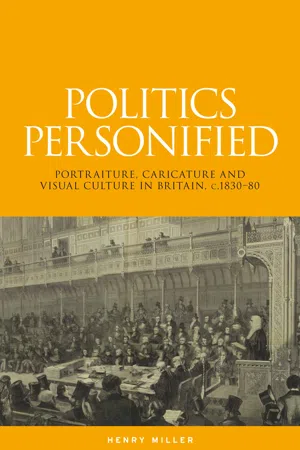
The remarkable popularity of political likenesses in the Victorian period is the central theme of this book, which explores how politicians and publishers exploited new visual technology to appeal to a broad public. The first study of the role of commercial imagery in nineteenth-century politics, Politics personified shows how visual images projected a favourable public image of politics and politicians. Drawing on a vast and diverse range of sources, this book highlights how and why politics was visualised.
Beginning with an examination of the visual culture of reform, the book goes on to study how Liberals, Conservatives and Radicals used portraiture to connect with supporters, the role of group portraiture, and representations of Victorian MPs. The final part of the book examines how major politicians, including Palmerston, Gladstone and Disraeli, interacted with mass commercial imagery.
The book will appeal to a broad range of scholars and students across political, social and cultural history, art history and visual studies, cultural and media studies and literature.
eBook - ePub
Politics personified
Portraiture, caricature and visual culture in Britain, c.1830–80
- 242 pages
- English
- ePUB (mobile friendly)
- Available on iOS & Android
eBook - ePub
About this book
Information
Topic
ArteSubtopic
Storia dell'arte1
The visual culture of reform, 1830–32
This chapter examines the visual culture stimulated by the popular fervour for reform, and sheds new light on the making of the 1832 Reform Act and how it was perceived at the time. Prints and other forms of material culture presented reform as revitalising and restoring balance to a moribund constitution. Just as significantly, reform of the electoral system was linked to long-demanded calls for retrenchment in the state and reduced taxation. Reform would lead to the breaking up of the ‘Old Corruption’, the web of state patronage, place and sinecures funded by the long-suffering and heavily burdened taxpayer, by transforming the representative system that had underpinned it. This was to be achieved through electoral redistribution, especially the disenfranchisement of the rotten boroughs controlled by the hated borough-mongers. Studying the visual culture of reform offers fresh insights into popular understandings of reform, and explains the apparent anomaly of huge popular support for a measure that was, in many respects, moderate, conservative and limited. Furthermore, this popular understanding of reform not only explains the massive public support but also the iconic status of the reform leaders, the lack of public debate about the franchise clauses and the huge disappointment that followed so soon after its passing. While this chapter focuses on the extraordinarily diverse range of material and visual commodities, including prints, caricatures, ceramics, medals and banners, stimulated by reform, there was not unanimous or uncritical approval. A significant minority, including the lithographic artist HB (John Doyle), argued that reform would fatally undermine the constitution.
With its focus on caricature and political satire, this chapter may appear to be slightly removed from the central theme of this book: the political likeness. However, this chapter provides an essential context for what follows and it is worth briefly stating what it is and is not intended to do. This chapter does not intend to be the last word on the decline and transformation of caricature in the 1830s, a subject to which Brian Maidment offers a much more comprehensive guide.1 Rather, it aims, firstly, to highlight important changes in visual media that began in this period, which provide a technological context for the rest of the study. Secondly, it provides an overview of the Reform Act and the reformed political system, which forms the political context to the rest of the book. Thirdly, it offers a short overview of the extensive literature on Georgian caricature.
The Georgian legacy and the decline of the single-sheet print
The cultural legacy of late eighteenth- and early nineteenth-century graphic satire and the technological changes that led to the decline of the single-sheet print form the necessary context to any consideration of the visual culture of reform between 1830 and 1832. The visual print culture of the long eighteenth century was an extraordinarily diverse phenomenon that has been the subject of a number of distinguished studies.2 It is not the intention to offer a lengthy recapitulation of that work here. Rather, the aim is to briefly consider the cultural legacy of Georgian political print, while also questioning some of the teleologies about the ‘Golden Age’ of the political print, conventionally dated from 1760 to the 1830s. This will provide a brief overview of the techniques and styles used, the popularity or audience for these prints and the question of the decline of this tradition of satire and caricature. The technological changes that undermined the single-sheet print format will then be considered.
Firstly, it is important to note that even after 1760, not everyone employed caricature, humour or satire to make their point, some preferring emblematic or iconographic designs. Instead of seeing a linear progression from the emblematic tradition to one based on physical caricature it is probably best to see them both as part of the visual repertoire available to artists in the long eighteenth century.3 That said, excessive physical distortion, particularly of the facial features, was a strong component of the graphic satire of artists such as James Gillray and George Cruikshank. Another important feature was the personifications of national identities, both of Britain or England in the form of Britannia and John Bull, and of rival powers, above all revolutionary and Napoleonic France.4 Gillray contrasted the poverty of ‘French liberty’ with ‘English slavery’, a plump John Bull eating a hearty joint of beef while grumbling about taxes.5
Secondly, the audience for the prints remains hotly debated. They have been described as ‘both a reflector and shaper of public opinion’, but Eirwen Nicholson has criticised the assumption that prints were inherently a popular medium.6 The increasingly sophisticated prints of James Gillray and others appealed to the aristocratic clientele of the West End print shops, not least because the prints were expensive and required a high level of ‘political intelligence and knowledge’.7 The use of copper plate also meant that the print runs were limited. Nicholson has drawn a distinction between the consumers of prints, who were mostly upper class, and a wider audience of spectators, who had limited opportunities to view the prints in shop windows or elsewhere.8 Other scholars have argued that the prints were widely disseminated among all classes and were ‘a regularly encountered and widely discussed product of urban culture’, experienced in print-shop windows, coffee houses and taverns, displayed in exhibitions and posted to collectors and shops outside London.9 There has been an over-reliance on the print-shop window as evidence for prints’ ‘popularity’ and further illumination will probably only be provided by more focused research into specific periods rather generalising across the whole ‘Golden Age’.10 For example, Vic Gatrell has shown that the growth of print shops in the City of London after 1800 created a new market for caricatures among a middle-class and lower middle-class audience distinct from the aristocratic consumers of the West End, a market that was more receptive to radical or reforming imagery.11 Regardless of how visible down the social spectrum such prints were, it is fair to say that all the evidence points to them being an essentially metropolitan phenomenon, with the overwhelming majority published and consumed in the capital.
Finally, the extent to which prints were inherently radical or subversive remains a key question. There was no shortage of anti-radical and conservative defences of the political system, particularly in the 1790s when contrasts were regularly drawn between the English constitution and the revolutionary regime in France. The British constitution was represented as an oak, a natural, organic, sturdy edifice with deep roots in the nation’s past, a metaphor that echoed the ideas of Edmund Burke’s Reflections on the Revolution in France (1790).12 The French constitution, supposedly based on abstract reasoning and natural rights, was an inflexible, dogmatic system, or a rigid corset.13 However, prints could be ambiguous in their political message and this was embodied in the figure of John Bull. In representing the national character, John Bull allowed artists to maintain their loyal and anti-French credentials while criticising the government for infringing English liberties, excessive taxation and corruption. His latent radical potential became more apparent after 1800 and coincided with the growth of the city print shops.14 In the radical iconography of George Cruikshank and others, John Bull was drawn as a gaunt individual, with his padlocked mouth symbolising the repression of freedom of expression, assembly and the press.15
Gatrell has argued that the rise of Evangelical and secular notions of ‘improvement’ was fundamentally opposed to the principles of the old tradition of caricature and reflected a wider cultural shift in which moral reformation became increasingly important in public and private life.16 Instead of physical caricature and personal attacks there was a tendency towards respectability and more gentlemanly depictions of public figures in graphic satire. However, caricature as a visual technique did not disappear, as will be shown in chapter 3, and this undoubted shift in cultural attitudes needs to be separated from the decline of the single-sheet print.
As discussed in the Introduction, between the 1820s and the 1840s, new graphic technologies such as lithography and wood engraving superseded copper-plate etching and engraving as the medium for topical pictorial satire. The same period was also one of experimentation in new graphic formats and a shift from political caricature to socio-comic prints and visual culture. The context for this was not only a change in tastes, but also the opening up of a new mass market for comic art, one which publishers were eager to exploit.17 A wider, more popular market for comic art created opportunities for graphic artists, providing new avenues for their talents that allowed them to diversify and shift away from political caricature.18 At the same time, however, the economic position of graphic artists was precarious, dependent upon the success or failure of experimental formats in a ferociously competitive publishing environment. This precariousness and insecurity was why employment for Punch (founded in 1841) was so attractive for illustrators and graphic artists like John Leech: the periodical’s success and profitability meant that it provided regular income and job security that was rare at this time.19 Another consequence of these technological changes, the rise of seriality and the creation of a new, mass market for comic art was that the independence and autonomy of graphic artists was eroded as they became more reliant on commissions or employment from publishers and periodicals. Robert Seymour, like many of his peers, forged a career as a jobbing artist, with the diversity of his work – including single-sheet prints, work for lithographic magazines, wood engravings for Figaro in London, sporting prints and book illustrations – not only testifying to his inventiveness but also financial necessity.20
Returning to political satires, the shift from copper-plate to new visual media was remarkably rapid. Most of the flood of prints about Catholic emancipation in 1829 were engraved or etched on copper plates, that is to say, using intaglio techniques. However, lithography and wood engraving proved increasingly attractive media ...
Table of contents
- Cover
- Half Title Page
- Title Page
- Copyright Page
- Contents
- List of tables and figures
- Acknowledgements
- Abbreviations
- Introduction
- 1 The visual culture of reform, 1830–32
- 2 Party politics and portraiture, 1832–46
- 3 Radical visual culture: from caricature to portraiture
- 4 Reforming pantheons: political group portraiture and history painting
- 5 Representing the representatives: MPs and portraiture
- 6 Palmerston and his rivals
- 7 Disraeli, Gladstone and the personification of party, 1868–80
- Conclusion
- Select bibliography
- Index
Trusted by 375,005 students
Access to over 1.5 million titles for a fair monthly price.
Study more efficiently using our study tools.
Frequently asked questions
Yes, you can cancel anytime from the Subscription tab in your account settings on the Perlego website. Your subscription will stay active until the end of your current billing period. Learn how to cancel your subscription
No, books cannot be downloaded as external files, such as PDFs, for use outside of Perlego. However, you can download books within the Perlego app for offline reading on mobile or tablet. Learn how to download books offline
Perlego offers two plans: Essential and Complete
- Essential is ideal for learners and professionals who enjoy exploring a wide range of subjects. Access the Essential Library with 800,000+ trusted titles and best-sellers across business, personal growth, and the humanities. Includes unlimited reading time and Standard Read Aloud voice.
- Complete: Perfect for advanced learners and researchers needing full, unrestricted access. Unlock 1.5M+ books across hundreds of subjects, including academic and specialized titles. The Complete Plan also includes advanced features like Premium Read Aloud and Research Assistant.
We are an online textbook subscription service, where you can get access to an entire online library for less than the price of a single book per month. With over 1.5 million books across 990+ topics, we’ve got you covered! Learn about our mission
Look out for the read-aloud symbol on your next book to see if you can listen to it. The read-aloud tool reads text aloud for you, highlighting the text as it is being read. You can pause it, speed it up and slow it down. Learn more about Read Aloud
Yes! You can use the Perlego app on both iOS and Android devices to read anytime, anywhere — even offline. Perfect for commutes or when you’re on the go.
Please note we cannot support devices running on iOS 13 and Android 7 or earlier. Learn more about using the app
Please note we cannot support devices running on iOS 13 and Android 7 or earlier. Learn more about using the app
Yes, you can access Politics personified by Henry Miller in PDF and/or ePUB format, as well as other popular books in Arte & Storia dell'arte. We have over 1.5 million books available in our catalogue for you to explore.