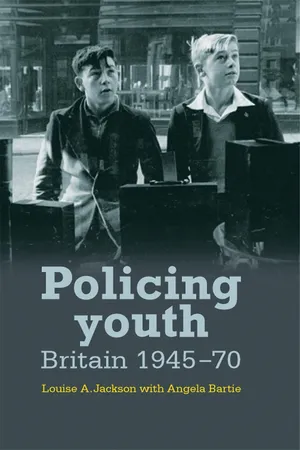
Policing youth probes beneath the media sensationalism surrounding youth crime in order to evaluate the workings of juvenile justice and the relationship between young people and practitioners in a key era of social change. The work of state representatives – the police, magistrates and probation officers – is mapped alongside discipline within families, neighbourhoods, schools and churches as well as the growing commercial sector of retail and leisure. Youth culture is considered alongside the social and moral regulation of everyday life.
The book offers an important comparison of England and Scotland, uses a wide variety of sources (including criminal statistics, media, film and autobiography), and combines quantitative research methods with textual and spatial analysis.
Individual chapters focus on police officers, the court system, violence, home and community, sexuality, commercial leisure and reform. This significant study will appeal to scholars and students of history, criminology, cultural studies, social policy and sociology.
- 240 pages
- English
- ePUB (mobile friendly)
- Available on iOS & Android
eBook - ePub
About this book
Information
1
Introduction: welfare and justice
The 1944 documentary film Children of the City, which aimed to educate parents, teachers, and all those involved in social work, criminal justice or local government about the work of the Scottish juvenile courts, made stark connections between urban living and youth crime. Overcrowding and poverty meant that the street, with all its temptations, was the only playground outside of school hours:
There are rides to be stolen on trams and lorries. There are the shopping centres, with miles of inviting windows. There are the big chain stores to wander through. There is noise and colour and bustle, and they can listen to people’s conversations. They get to know where everything is and how much it costs. They see that money is the key to all this, to the cinema, and to the billiard saloon, and Dixon Hawke (pie and beans). In this careless world of adults, who is to tell children where to draw the line, where excitement ends and crime begins?1
The film was a response to local and national concerns about ‘juvenile delinquency’ in wartime, reflecting increased reports of burglary, housebreaking and vandalism by boys of 12 or 13 years of age.2 Whilst the absent father, ‘the feckless mother’ and dislocation caused by evacuation were cited as factors leading to the breakdown of discipline in England and Wales, attention was also given in Scotland to economic conditions, lack of appropriate housing, amenities and leisure opportunities. Children of the City was researched, directed and scripted by 31-year-old Budge (Bridged) Cooper, with urban tenement scenes filmed largely in Dundee by émigré photographer Wolfgang Suschitzky, who described them as ‘the worst slums I had ever seen’.3 It depicts the three fictional cases of Alec aged 13, Duncan aged 12, and Robbie aged 10, caught by a policeman breaking into a clothes shop. The juvenile court is shown weighing up their character, educational ability and home background (including parental culpability) before deciding on a different treatment for each: Robbie (who has learning difficulties) is to be treated at a Child Guidance Clinic, Duncan (from a ‘respectable’ but fatherless home) is to be befriended by a probation officer, whilst Alec (whose father is a ‘drunkard’ and mother ‘apathetic’) is sent away to a residential Approved School. Children of the City presented the work of the juvenile courts in terms of scientific intervention, with the socio-psychological profiling of young offenders informing decisions about individualised forms of rehabilitation. It also called on Scotland’s broader community – churches, youth organisations and schools – to join together to provide moral leadership and education for citizenship. It was confident that the problem of youth offending could be fixed through a combination of prevention, therapy and training in a time of crisis.
The film was a product of a particular period, most obviously in its optimistic belief in ‘penal welfarism’: an approach that sought to combine justice with education and social care to produce self-disciplined, well-adjusted and dutiful citizens.4 Significantly, the film presented youth offending as a normal or natural element of children’s development in deprived urban areas; it did not seek to identify one specific pariah group. Yet it did reinforce gendered perceptions of a distinction between the ‘respectable’ and ‘undeserving’ poor. Moreover, there are striking resonances across the decades since its making, in terms of the formulation of a social problem. Broader discussions about the causes of youth crime have continued to focus on young people’s misuse of both urban space and leisure time, on the corrupting effects of consumerism, and on inappropriate parenting (with the ‘feckless mother’ relabelled as the ‘single mother’).
Since the Second World War there has been an almost perpetual wave of public anxiety, rhetoric and debate about youth and crime in Britain. This has been inflected through the stereotyping of a series of ‘folk devils’: the ‘cosh boy’ and ‘teddy boy’ in the 1950s; rioting ‘mods and rockers’ as well as knife-wielding Glasgow ‘gangs’ in the 1960s; ‘football hooligans’, ‘skinheads’ and ‘muggers’ in the early 1970s.5 From the mid-1950s, too, the theme of the ‘blackboard jungle’ relating to a perceived lack of discipline in state secondary schools has fired press headlines; the origins of these concerns can be linked to the expansion of ‘free’ education through the welfare state and the raising of the school leaving age (to 15 in 1947 and 16 in 1973). More recently, the spectre of the ‘hoodie’ or ‘chav’ (England) and the ‘ned’ (Scotland) framed discussions about the introduction of anti social behaviour orders for young people (in England from 1998 to 2010 and in Scotland since 2004), whilst young people’s involvement in protest against the raising of university tuition fees in December 2010 and in the ‘riots’ of August 2012 led to the labelling, by members of national and municipal government, of an underclass of ‘feral youth’.6 Historical research has much to contribute to current debates in reminding politicians and policy-makers that the problem of youth and crime is not in itself ‘new’; it is not an indicator of a society that has suddenly, or even gradually, ‘broken’ or gone off the rails. The relationship between law, order and young people cannot be reduced to the simplistic descriptions and categories that have all too frequently been invoked to talk about it.
This book joins a wealth of historical studies that have focused on the late-eighteenth, nineteenth and early twentieth centuries. The term ‘juvenile delinquency’ was first deployed around 1815 and was used to comment on the problem of the ‘street arab’ of the 1860s and the ‘hooligan’ of the 1890s.7 The more recent past has been substantially neglected, assumed to be the terrain of sociologists, criminologists, and the interdisciplinary area of cultural studies.8 Policing Youth not only seeks to fill this historical gap, but to offer a significant antidote to prevalent myths about ‘the Fifties’ and ‘the Sixties’ that have been formed through nostalgia and popular memory. Television series from Dixon of Dock Green to Heartbeat have helped construct a narrative of policing in the 1950s and early 1960s as a ‘golden age’ and of a society that was benign, safer and more deferential to authority. Similarly, the ‘teddy boy’, the ‘mod’ and the ‘rocker’ are now often affectionately remembered. Stripped of the ‘threat’ that shaped initial public reaction to them, they are used to signify whole decades without questioning their provenance. This book aims to probe beneath the sensationalism and stereotypes that have surrounded youth crime, to examine the everyday regulation of young people under 17 by police officers, magistrates, social workers and other practitioners during a key period of social change.
Young people as a social group were strikingly more visible by the late 1950s than in the late 1930s. An immediate postwar baby boom saw the number of live births rise substantially in 1945–47, with these ‘babies’ inhabiting their teens between 1958 and 1966.9 Whilst it is possible to talk of the existence of interwar youth culture, the end of rationing, opening up of markets and arrival of rock and roll music in the 1950s led to the delineation of specifically youthful styles of dress and of taste.10 The term ‘the teenager’, first used in the USA in the 1940s, was widely adopted in Britain from the early 1950s to describe a cultural identity, distinct from that of older children or, indeed, young adults. ‘Teenagers’ expected to spend time outside of school and work on leisure and recreation. They also increasingly saw themselves as a ‘generation’ distinct from parents and other figures of authority; this sense of being ‘young’ and of age as a great divide was popularised through song lyrics that spoke of generational identity.11 As a number of recent studies have shown, many parents were often supportive of teenage leisure and culture, encouraging sons and daughters to participate in these expanded opportunities.12 Nevertheless, some adults who were keen to defend an existing social order, value system and way of life against a new ‘permissiveness’ viewed the ‘teenager’ as a moral challenge or disruptive ‘other’. Intergenerational tensions were apparent across modern western and European states, while concerns about postwar delinquency and youth crime were international phenomena. Yet the specificities of policy and practice at national and local levels require unpacking. It is hoped that this book, in analysing regions and nations of the UK, will enable further international comparative discussion of the postwar years.
Since the 1707 Act of Union with England, Scotland had retained its own legal and educational systems. Indeed, when it came to the distribution plans for the film Children of the City, differences between English and Scots laws as well as juvenile justice provision became an area of contention. While the Scottish Office (which had sponsored the film) took considerable pride in the finished product, civil servants at the Home Office were of the view that it should not be shown south of the border because ‘the juvenile court, the probation office and the approved school scenes were over prim and not up to the best English standards’; instead they commissioned their own film, Children on Trial, released in 1946.13 The juvenile courts, which originated in 1908, followed different models in Scotland compared to England and Wales. Moreover, youth justice diverged significantly in 1968 with the introduction in Scotland of children’s hearings – non-judicial proceedings with a solely welfare orientation that did not involve formal criminalisation – while the juvenile courts were retained in England and Wales.14 This book explores the particularities of England and Scotland, arguing that, while similarities outweighed differences, important nuances are detectable. These were shaped by differences in structures, in resourcing, and also by the desire to protect local autonomy and discretion within Scotland against external centralising tendencies.
Historical sociology has demonstrated that the concepts of ‘childhood’ and ‘youth’ (and related terms that invoke age, development and maturity) are social and cultural constructs whose meanings shift across time.15 If ‘childhood’ in modern western societies had come to be associated with innocence, then ‘adolescence’ raised concerns about successful emotional transition to the state of knowledge and experience associated with adulthood, including the potential that this held for corruption.16 As Harry Hendrick has persuasively argued, this meant that young people were positioned symbolically as either innocent ‘victims’ to be pitied or contaminating ‘threats’ to be feared.17 This book makes use of the legal terminologies that contemporary practitioners used to talk about age bands in the postwar period since these ascribed status and agency (or their lack) in the eyes of the law. Thus the term ‘child’ is used to refer to those under 14 and ‘young person’ to those aged 14–17 as laid out in the Children and Young Persons Acts of 1933 (England/Wales) and 1937 (Scotland). The terms ‘boys’ and ‘girls’ are also used throughout to refer to male and female juveniles although it is recognised that this can be problematic in infantilising those on the cusp of adulthood. Given that the age of criminal responsibility was set at 8 in 1933 (raised to 10 in England/ Wales – although not in Scotland – in 1963), it focuses on young people aged 8–17.
The book as a whole examines ‘policing’ in its widest sense: as the range of practices concerned with the regulation of social behaviour within the modern state.18 This includes the specific bureaucratic institutions of the police service and criminal justice (including the juvenile courts) which are a central focus. However, it also deals with a series of related agencies – public, private and voluntary (including the churches, schools and also the family) – that were engaged in the social regulation and welfare of young people. The book is concerned with those who came to the attention of official agencies, as either possible perpetrators of criminal offences or as ‘victims’ in need of care or protection, but also with young people who were objects of the regulatory gaze but not of any formal intervention. This book evaluates the challenges that social change presented for practitioners, the range of mediations and responses that were developed, and the relationship between youth culture and the occupational cultures of practitioners. It investigates the negotiation of a social work ethic within the police service as well as synergies and tensions between police officers, social workers, probation officers, magistrates, teachers, and also parents.19 Whilst it is often claimed that ‘multi-agency’ approaches and ‘partnerships’ are innovative aspects of current policy, Policing Youth demonstrates that they were important components (formal and informal) of the preventative strategies developed in the earlier part of the twentieth century to reduce the likelihood of juvenile delinquency. The book identifies significant antecedents, most obviously Juvenile Liaison Schemes, initiated within a number of police forces from 1949 onwards. Indeed, ‘juvenile delinquency’ was presented as a collective responsibility requiring the involvement of a broad range of civil society associations and institutions working alongside the police and official state agencies.
Constructing and deconstructing the ‘juvenile delinquent’
Between 1945 and 1970 the primary object of this surveillance and intervention was the white working-class adolescent male, a striking continuity with the Victorian past. Discussing her influences for the film Children of the City, Budge Cooper referred back to her own childhood: ‘We did all the things that “delinquents” do, but of cours...
Table of contents
- Cover
- Half Title Page
- Title Page
- Copyright Page
- Contents
- List of figures and tables
- Acknowledgements
- List of abbreviations
- 1 Introduction: welfare and justice
- 2 The police
- 3 The juvenile court: property, place and play
- 4 Violence
- 5 Sexuality
- 6 Home, neighbourhood and community
- 7 Commercial leisure
- 8 Reform
- Afterword
- Select bibliography
- Index
Trusted by 375,005 students
Access to over 1.5 million titles for a fair monthly price.
Study more efficiently using our study tools.
Frequently asked questions
Yes, you can cancel anytime from the Subscription tab in your account settings on the Perlego website. Your subscription will stay active until the end of your current billing period. Learn how to cancel your subscription
No, books cannot be downloaded as external files, such as PDFs, for use outside of Perlego. However, you can download books within the Perlego app for offline reading on mobile or tablet. Learn how to download books offline
We are an online textbook subscription service, where you can get access to an entire online library for less than the price of a single book per month. With over 1.5 million books across 990+ topics, we’ve got you covered! Learn about our mission
Look out for the read-aloud symbol on your next book to see if you can listen to it. The read-aloud tool reads text aloud for you, highlighting the text as it is being read. You can pause it, speed it up and slow it down. Learn more about Read Aloud
Yes! You can use the Perlego app on both iOS and Android devices to read anytime, anywhere — even offline. Perfect for commutes or when you’re on the go.
Please note we cannot support devices running on iOS 13 and Android 7 or earlier. Learn more about using the app
Please note we cannot support devices running on iOS 13 and Android 7 or earlier. Learn more about using the app
Yes, you can access Policing youth by Louise Jackson,Angela Bartie in PDF and/or ePUB format, as well as other popular books in History & British History. We have over 1.5 million books available in our catalogue for you to explore.