- 198 pages
- English
- ePUB (mobile friendly)
- Available on iOS & Android
eBook - ePub
About this book
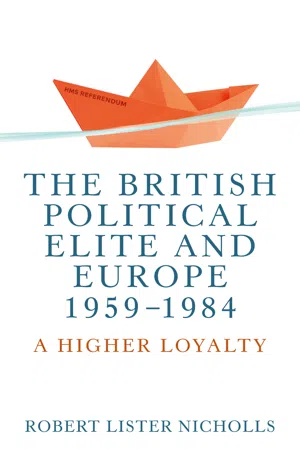
This book offers an original interpretation of Britain's relationship with Europe over a 25 year period: 1959-84 and advances the argument that the current problems over EU membership resulted from much earlier political machinations. This evidence based account of the seminal period analyses the applications for EEC membership, the 1975 referendum, and the role of the press. Was the British public misled over the true aims of the European project? How significant was the role of the press in changing public opinion from anti, to pro Common Market membership? Why, after over 40 years since Britain became a member of the European community, does the issue continue to deeply divide not only the political elite, but also the British public? These, and other pertinent questions are answered in this timely book on a subject that remains topical and highly controversial.
Information
Publisher
Manchester University PressYear
2019Print ISBN
9781526148063
9781526124777
eBook ISBN
9781526124791
1
Political elites
As Europe was used by elements within the elite on both sides of the issue to secure electoral and political advantage, it is advantageous to define the character of the political elite. The definition of the political elite for the purpose of this book is Members of Parliament. This is because it was they who were directly involved in the political decision-making on Britain's membership of the Common Market, and so the evidence of their behaviour is readily available. Whilst this definition is utilised, however, it is apparent that there is also an inner core of formal decision-makers drawn from within the executive. The inner core and other key actors alike are both influenced by wider economic and social groups who would be included in a broader definition of the elite. These wider groups are excluded from the working definition because evidence of the activity of these groups is both intangible and inaccessible.
In recognition that elite theory is complex and diverse, the chapter draws selectively from elite theory, and includes a number of classic studies given that these sources often have a greater pertinence to the period covered. It explores various themes including the interaction between business and politics, and considers whether the British political elite exists in a cohesive and permanent form as asserted by Mosca (1939). Whilst not arguing that the United Kingdom had an ideal representative democracy, there are insights from pluralist democratic theory which support the argument of this chapter. These insights explain that the masses can play a role in influencing elite decision-making, or at least in requiring the elite to pursue vigorous forms of political manipulation and propaganda to achieve its objectives.
As politics is highly influenced by transient events, a temporal perspective is required, because the power of the political elite and its responsiveness to public opinion changes over time. This is particularly the case with Britain's membership of the Common Market, because the issue of Britain in Europe presents itself as a political issue differently in each of the decades from the 1950s to the present time. This book, however, merely discusses a twenty-five year period. Throughout the period 1959 to 1984 there were dynamic interactions. These were within the political elite, between the political elite and the wider elite, the elite and the electorate as mediated by the press, and in Britain's relationship with Europe. These interactions are considered in turn.
An evidence-based example of the dynamic interaction between the political elite is provided by Aspinwall (2004) who shows that ‘centrist ideology is supportive of integration, while support declines as one moves to the extremes of the political spectrum’ (Aspinwall, 2004: 4). This helps explain why in broad terms (albeit for different reasons), it was the left of the Labour Party and the right of the Conservative Party that were mainly opposed to Britain's membership of the EEC. Furthermore within the major political parties in Britain there was a strong tendency for the concentration of power within the leadership.
A consequence of discipline, centralisation and cohesion being more developed in the Labour Party than in the Conservative Party is that ‘there is greater concentration of powers when Labour has a majority than when the Conservatives are in the majority’ (Duverger, 1976: 398). This view supports the evidence contained in the trajectory (Table 8) which shows that when in office, Labour was almost always in favour of Britain's membership of the EEC.
In the case of the Conservative Party there is less doubt about the dominance of the party leadership. As evidenced by the trajectory (Table 7), the Conservative leadership and Cabinet/Shadow Cabinet were in favour of Britain's membership whether they were in or out of office: this was in part as a result of the Conservative Party's inherent tribal loyalty to the leader. It was also as a consequence of the enormous power held by the leader. As McKenzie noted, ‘the Conservative Leader, whether in power or in opposition, has the sole ultimate responsibility for the formulation of the policy and the electoral programme of his party’ (McKenzie, 1964: 21). Similarly, Michels argued that control of parties tends to fall into the hands of a combination of parliamentary leaders and party bureaucrats. Large scale organisations such as the major political parties and trade unions develop a bureaucratic, hierarchically organised structure. The leaders ‘possess many resources which give them an almost insurmountable advantage over members who try to change policies’ (Michels, 1966: 16). The price of this type of bureaucracy is that the influence of rank and file members is reduced; with the concentration of power being held by those at the head of the structure.
This is hugely significant for Britain's political parties, and in particular the Labour Party whose original purpose was to provide representation for the British working class. It was the established parliamentary leaderships that were responsible for determining policy, despite the efforts of more democratic, extra-parliamentary bodies such as Labour's National Executive Committee (NEC) and the trade union movement (Parry, 1971). There has been a constant trend for the Labour Party to adapt to the parliamentary system, ‘shedding its fundamental view of Conference sovereignty and ending with a power structure virtually indistinguishable from that of the Party's political opponents’ (Minkin, 1978: 11). In respect of Labour's policy-making process, ‘the leaders of the Parliamentary Labour Party (PLP) became the most important policy-making group in the Party’ (Minkin, 1978: 11). Indeed, despite the strong influence of predominantly left-wing trade union block votes at Labour Party Conferences, it was the leadership of the party which continued to retain control.
To illustrate the interaction between the political elite and the wider elite, the parliamentary elite charged with determining Britain's relationship with the Common Market would, according to writers such as Aaronovitch (1961) and Miliband (1969), be influenced by the power of Britain's finance capital. For example, in his discussion on the economic power of the finance capitalists in Britain, Aaronovitch concluded by arguing that decisions which affect the welfare and lives of millions of people result from this group controlling the state, and that these decisions are taken ‘without public discussion or effective popular control’ (Aaronovitch, 1961: 134). This argument is supported by Miliband who states that ‘Western democracies are regimes in which an economically dominant class rules through democratic institutions’ (Miliband, 1969: 22). In respect of Britain and Europe, the Marxist arguments of Aaronovitch and Miliband provide a compelling reason to believe that the decision to take Britain into the Common Market was strongly influenced by the power of the economic elite. This need not be incompatible, however, with the view that the elite considered it was acting in what it considered to be the wider national interest.
The enormous scale of inequality of resources utilised by opposing factions in the 1975 referendum on Britain's continued membership of the Common Market is evidenced by Butler and Kitzinger (1976). For example, the total expenditure for Britain in Europe (BIE), which campaigned in favour of Britain remaining in the Common Market, was £1,481,583. This amount was largely funded by leading British and American businesses including ICI, Shell, Ford Motor Company and Sun Alliance. In stark contrast, the expenditure for the National Referendum Campaign (NRC) which sought Britain's withdrawal from the Common Market was just £135,630, provided mainly by trade unions sympathetic to Britain's withdrawal (Butler and Kitzinger, 1976). The evidence of the 1975 referendum on EEC membership clearly demonstrates that without doubt, political outcomes are influenced considerably by inequalities in the distribution of resources.
With the exception of the trade unions that were split on the issue, all the large interest groups, particularly those of business, were almost entirely pro-Market (Butler and Kitzinger, 1976). The support of big business for membership during the 1960s and 1970s and its fear of exclusion from the European market became ‘the overriding factor in the minds of British political elites, and translated into a consistent pro-European policy’ (Gifford, 2007: 463). Amongst the groups in favour of Britain remaining in Europe was the Consumers Association and the National Farmers Union (NFU). Indeed, the CBI ‘devoted large resources to the cause and businessmen and companies were revealed in several surveys to be over 90 per cent pro-Market’ (Butler and Kitzinger, 1976: 171). The example of the British referendum on Europe in 1975 strongly suggests that any division within business on the issue of Europe was negligible.
In virtually all institutions of society, it is the middle class that forms the ‘bridge’ or acts as the agent to the ruling elite and in many cases becomes part of the elite themselves. As education is a requirement for entry into the civil service, and as a good education is far more easily obtained by the middle class, the civil service thus becomes ‘impregnated with the values of the ruling class, thereby strengthening the grip this class has upon the state machine’ (Parry, 1971: 34). Decision-makers in Parliament were also influenced by such institutions as courts of law, the armed forces, educational establishments and the civil service.
The civil service in Britain is a particularly pertinent example of what Mosca (1939) describes as the bridge between the ruling elite and the rest of society. From the 1950s to the 1970s the upper echelons of the civil service were comprised almost entirely of middle-class people educated at Oxford and Cambridge rather than products of the predominantly Clarendon group of British public schools which includes Eton, Winchester and Harrow (Sampson, 1966). Evidence to support Sampson's claim is provided by Perkin whose study over a ninety-year period found that ‘the major public school element in the high civil service has declined steeply from 71 per cent to 25 per cent, and Etonians and Harrovians from 48 per cent to 9 per cent’ (Perkin, 1978: 231). This was particularly true of the Foreign Office and the Treasury. These senior government departments have undertaken serious work on the technical and practical issues involved with EEC membership (Bennett, 2013). As a result of the expanding economies of the six EEC countries in the late 1950s and early 1960s, the Foreign Office and the Treasury, along with British industrialists and politicians, increasingly found ‘membership technically feasible and assumed that Britain could play a prominent or leading role in Europe’ (Lieber, 1970: 138). It is not without significance that the civil service was one of the institutions that wielded influence on the Conservative government's decision to seek membership of the Common Market in 1961.
Through greater knowledge of the political process there becomes an ever widening gulf between the representatives and those they represent. It is only therefore a matter of time before those leaders lose their sense of solidarity with their original class and there ensues ‘a new class-division between ex-proletarian captains and proletarian common soldiers’ (Michels, 1966: 109). The elite therefore are able to co-opt leading figures of the labour movement into the spheres of the elite world for the purpose of allowing the elites to ‘relate themselves and the classes which they represent to those over whom they exercise hegemony’ (Rex, 1974: 216). One such example of this would be that of trade union leader Vic Feather. From being a working-class union official, Feather attained the position of General Secretary of the Trades Union Congress (TUC) in 1969 and in 1974 was made a life peer.
The acceptance by the Labour Party of all the conventions in respect of the office of Prime Minister and Cabinet government ‘ensured that effective power within the Party would be concentrated in the hands of the leadership of the PLP’ (McKenzie, 1964: 639). According to Rex, the political wing of the labour movement had now been effectively taken over by the elites, including those ‘who had been through the elite educational institutions to look to the Labour Party as the means by which they will further their parliamentary careers’ (Rex, 1974: 217). Naturally, Rex's strictures would carry as much force had the parties insisted in Britain remaining outside the Common Market. Whilst being mostly applicable to the Labour Party, Michels’ (1966) theory adds further weight to Aspinwall's (2004) judgement that the centrist leaderships of the major political parties have largely been supportive of Britain be...
Table of contents
- Cover
- Title page
- Copyright page
- Dedication
- Contents
- Acknowledgements
- Abbreviations
- Introduction
- 1 Political elites
- 2 Sovereignty
- 3 The first application
- 4 The second application
- 5 Taken in by Heath
- 6 The 1975 referendum on EEC membership
- 7 Post referendum
- 8 Positions taken on Europe, 1959–1984
- Conclusion
- Appendix 1 Labour Parliamentary Private Secretaries sacked by Wilson – May 1967
- Appendix 2 The 33 Labour rebels – May 1967
- Appendix 3 The full terms
- Appendix 4 The 69 Labour rebels – October 1971
- Appendix 5 House of Commons three-day debate – April 1975
- Appendix 6 Conservative and Labour trajectories
- Bibliography
- Index
Trusted by 375,005 students
Access to over 1.5 million titles for a fair monthly price.
Study more efficiently using our study tools.
Frequently asked questions
Yes, you can cancel anytime from the Subscription tab in your account settings on the Perlego website. Your subscription will stay active until the end of your current billing period. Learn how to cancel your subscription
No, books cannot be downloaded as external files, such as PDFs, for use outside of Perlego. However, you can download books within the Perlego app for offline reading on mobile or tablet. Learn how to download books offline
Perlego offers two plans: Essential and Complete
- Essential is ideal for learners and professionals who enjoy exploring a wide range of subjects. Access the Essential Library with 800,000+ trusted titles and best-sellers across business, personal growth, and the humanities. Includes unlimited reading time and Standard Read Aloud voice.
- Complete: Perfect for advanced learners and researchers needing full, unrestricted access. Unlock 1.5M+ books across hundreds of subjects, including academic and specialized titles. The Complete Plan also includes advanced features like Premium Read Aloud and Research Assistant.
We are an online textbook subscription service, where you can get access to an entire online library for less than the price of a single book per month. With over 1.5 million books across 990+ topics, we’ve got you covered! Learn about our mission
Look out for the read-aloud symbol on your next book to see if you can listen to it. The read-aloud tool reads text aloud for you, highlighting the text as it is being read. You can pause it, speed it up and slow it down. Learn more about Read Aloud
Yes! You can use the Perlego app on both iOS and Android devices to read anytime, anywhere — even offline. Perfect for commutes or when you’re on the go.
Please note we cannot support devices running on iOS 13 and Android 7 or earlier. Learn more about using the app
Please note we cannot support devices running on iOS 13 and Android 7 or earlier. Learn more about using the app
Yes, you can access The British political elite and Europe, 1959-1984 by Bob Nicholls in PDF and/or ePUB format, as well as other popular books in Politics & International Relations & Comparative Politics. We have over 1.5 million books available in our catalogue for you to explore.