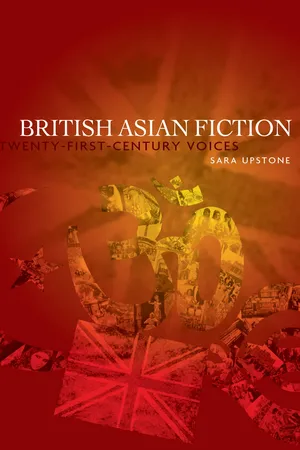
This is the first text to focus solely on the writing of British writers of South Asian descent born or raised in Britain. Exploring the unique contribution of these writers, it positions their work within debates surrounding black British, diasporic, migrant, and postcolonial literature in order to foreground both the continuities and tensions embedded in their relationship to such terms, engaging in particular with the ways in which this 'new' generation has been denied the right to a distinctive theoretical framework through absorption into pre-existing frames of reference.
Focusing on the diversity of contemporary British Asian experience, the book engages with themes including gender, national and religious identity, the reality of post-9/11 Britain, the post-ethnic self, urban belonging, generational difference and youth identities, as well as indicating how these writers manipulate genre and the novel form in support of their thematic concerns.
- 250 pages
- English
- ePUB (mobile friendly)
- Available on iOS & Android
eBook - ePub
About this book
Information
Publisher
Manchester University PressYear
2013Print ISBN
9780719078330
9780719078323
eBook ISBN
9781847797230
1
Salman Rushdie and V. S. Naipaul
Diaspora that we were, we became static and in this stasis relapsed into mythology, initially through epic remembrance of the Indian past and subsequently through Bombay cinema. Nor did our lives in the end find an alternative vitality through the postcolonial celebration of the hybrid; rather we remained half and half.1
Visit the University of London Library located at Senate House, Bloomsbury, and the problem of classifying authors by ethnicity becomes immediately apparent. A researcher wanting to consult work on Salman Rushdie finds this material – and indeed Rushdie’s fiction – in the English Literature section. Yet you are directed within this section not to the British authors, but rather to a separate section on World Literature including postcolonial authors such as Chinua Achebe, Wole Soyinka and Arundhati Roy. Look for the work of V. S. Naipaul, and related critical writings, and you encounter an even more perplexing scenario. These works are not located on the fifth floor of the library with the English Literature books at all. Instead, you must take the winding stairs up to the seventh floor – the final public floor, and one not served by lift – to the ‘Latin American Studies’ section: an interdisciplinary collection where you find (undoubtedly because of the location) the largely untouched works of writers including not just Naipaul, but also his brother Shiva, Wilson Harris and Derek Walcott, in a special section devoted to ‘West Indian Literature’.
Classification of Rushdie’s and Naipaul’s works in this way is not a failing of the library. Rather, it points to these writers’ problematic status. Are they postcolonial authors, important principally for their relationship to ideas of empire? Are they national authors, whose relevance lies most in their relationship to their countries of birth? Or, indeed, are they British authors, needing to be read within the context of an increasingly multicultural British literature?
The latter possibility is the one denied by both library classifications. Rushdie and Naipaul, it seems, are ‘expatriates’: they ‘belong’ elsewhere.2 Their accolades seemingly acknowledge not British success, but the success of those ‘English-language authors living in Britain whose origins were not British’.3 Having been born in Bombay, India, in 1947 (the year of Indian independence and the creation of Pakistan), Rushdie first came to Britain in 1961 as a 13-year-old to attend Rugby public school, going on to read History at Cambridge University. Similarly, Naipaul – who was born to parents of Indian origin in the Caribbean colony of Trinidad in 1932 – arrived in England on a scholarship to Oxford University to read English Literature as an 18-year-old in 1950. Yet despite spending all of their adult lives in Britain, Rushdie and Naipaul are rarely read as British authors. As Graham Huggan notes:
It is rare for either to be designated as a British writer. Even some of the most culturally sensitive of critics have been known to persist in the view that Naipaul and Rushdie originally come from ‘other’ places – to suggest that in some deep-rooted, atavistic sense, they are immigrant writers who ‘really’ belong somewhere else. Are these two obviously well-known writers still marginal on account of their ethnicity? Or because they choose in their work to fictionalise their own experiences of displacement? Or because they are seen, in spite of themselves, as First World informants for their native Third World cultures?4
Naipaul, for example, is largely related primarily to ‘Third-World subjects’, seen to be of relevance in Caribbean and postcolonial contexts.5 Fawzia Mustafa places Naipaul’s first ‘English’ novel, Mr Stone and the Knights Companion (1963), in a section entitled ‘abroad’, and chooses to discuss him in terms of ‘contemporary writing in English’ rather than as a British author.6 Elsewhere, it is declared that ‘Naipaul is a Caribbean writer and will never be a British/English writer’.7 The circumstances of his birth in Trinidad as a consequence of the colonial practice of indentured labour that took Indian migrants to the Caribbean in the nineteenth century illuminates in these terms the complexity of designations such as ‘black’ or ‘Asian’, and the potential for shared points of reference, but also the possible tensions resulting from the complex racial politics of the Caribbean. Rushdie, equally, is seen because of his focus on the migrant as a postcolonial writer: he inspired the title of the ‘founding’ work of postcolonial criticism, The Empire Writes Back (1989), and The Satanic Verses (1988) has been interpreted as indicative of his feelings of being a ‘foreigner in England’.8 Both Midnight’s Children (1981) and Satanic Verses have been read as being directed at Indian audiences, rather than British readers, leading to reviews describing Rushdie’s work as ‘very Indian’.9 For Ruvani Ranasinha, Rushdie’s work differs ‘from the British-born generation that came after … in significant ways’.10 He is not British, but ‘South Asian Anglophone’.11
Yet, despite this, a converse movement reads both authors as British and even – more narrowly – as English. In Naipaul’s case this begins as early as the 1960s, as V. S. Pritchett refers to him as one of ‘the younger English novelists’,12 while in the 1970s William Walsh credits Naipaul’s Mr Stone on the grounds that ‘the Englishry … is solid and accurate’, and the ‘English’ stories in A Flag on the Island (1967) because ‘the British reader cannot but be struck by the clear authenticity’.13 Later authors, such as Aijaz Ahmad and Gamini Salgado have identified him as an ‘English novelist’;14 British broadcaster Melvyn Bragg refers to him as ‘one of our most distinguished novelists’.15 Rushdie, equally, is seen by some critics as ‘un-Indian’.16 His early work has been criticised as representing the ‘exotic fantasia’ of British fiction.17 Conversely, it is celebrated for its connection to the English literary tradition, and Rushdie has been called ‘the best known contemporary English writer’.18 Critical work frequently associates him not with migrant authors, but with later writers such as Hanif Kureishi.19 More recently, both authors have been featured in a host of anthologies dealing with ‘British Literature’.
For themselves, Naipaul has at times refused all national identification in favour of simply ‘Writer’.20 In doing so, he foreshadows debates surrounding the burden of representation that have consumed black British literature: the question as to what extent writers from ethnic backgrounds should be held responsible for how their communities are perceived. At other points he has identified himself with India and Britain, and as someone who ‘can’t think of myself as being displaced’.21 He has until recently explicitly disassociated himself from Trinidad, stressing the ‘accident’ of his birth.22 In contrast, despite his valorisation of the migrant, and his narrator’s declaration in Satanic Verses of the ‘hollowness’ of concepts of land, belonging, and home,23 Rushdie has far more often associated himself with his place of birth, identifying himself on a number of occasions as Indian, or as an ‘Indian writer’,24 and discussing ‘the British’ as a term from which he is excluded as a ‘foreigner’.25
Naipaul and Rushdie are not alone in being based for the majority of their lives in Britain but being born elsewhere: one could equally focus on Sam Selvon, who shares the complexity of Naipaul’s Caribbean background, or Farrukh Dhondy who, like Rushdie, came to Britain from India for his university education. Settling when they were slightly older, however, these authors do not in quite the same way straddle definitions of postcolonial and British literature. Moreover, they have not achieved the same notoriety that has made Naipaul and Rushdie the two most significant voices in the establishment of a tradition of Asian writing in Britain. Naipaul has won probably every major literary prize, including the 2001 Nobel Prize for Literature, and, in 1993, the first David Cohen British Literature Prize: he was also knighted in 1990. Rushdie, likewise, has won numerous prizes, including the ‘Booker of Bookers’ in 1993 and he, too, was knighted in 2007. Both have been immured in controversy: Rushdie most notably for the fatwa – a death sentence passed by the Iranian Ayatollah Khomeini in 1989 for supposed blasphemy against Islam in Satanic Verses – and Naipaul for his alleged ‘racism’ in his negative portrayal of the developing world in both his novels and travel writing.26
What is neglected in a large amount of the vast literature on Naipaul and Rushdie is how their writings are concerned with the construction of a specifically British Asian identity. As Mustafa points out, writers such as Naipaul are part of the first generation to feel the absence of an ‘imperial theme’; they cannot posit themselves as ‘anti-colonial’ in the same way as their predecessors writing under the oppressive cultural influence of colonialism.27 Naipaul ‘is part of, yet not part of the English world’;28 he ‘moves between the stance of insider and outsider’ in a ‘transitional space’.29 Even those texts identified as locating him as English are more complicated than they first appear. For example, in his critique of Naipaul, Selwyn R. Cudjoe cites Patrick Swinden as indic...
Table of contents
- Cover Page
- Title Page
- Copyright Page
- Contents
- Acknowledgments
- Introduction
- 1 Salman Rushdie and V. S. Naipaul
- 2 Hanif Kureishi
- 3 Ravinder Randhawa
- 4 Atima Srivastava
- 5 Nadeem Aslam
- 6 Meera Syal
- 7 Hari Kunzru
- 8 Monica Ali
- 9 Suhayl Saadi
- Conclusion
- Bibliography
- Index
Trusted by 375,005 students
Access to over 1.5 million titles for a fair monthly price.
Study more efficiently using our study tools.
Frequently asked questions
Yes, you can cancel anytime from the Subscription tab in your account settings on the Perlego website. Your subscription will stay active until the end of your current billing period. Learn how to cancel your subscription
No, books cannot be downloaded as external files, such as PDFs, for use outside of Perlego. However, you can download books within the Perlego app for offline reading on mobile or tablet. Learn how to download books offline
We are an online textbook subscription service, where you can get access to an entire online library for less than the price of a single book per month. With over 1.5 million books across 990+ topics, we’ve got you covered! Learn about our mission
Look out for the read-aloud symbol on your next book to see if you can listen to it. The read-aloud tool reads text aloud for you, highlighting the text as it is being read. You can pause it, speed it up and slow it down. Learn more about Read Aloud
Yes! You can use the Perlego app on both iOS and Android devices to read anytime, anywhere — even offline. Perfect for commutes or when you’re on the go.
Please note we cannot support devices running on iOS 13 and Android 7 or earlier. Learn more about using the app
Please note we cannot support devices running on iOS 13 and Android 7 or earlier. Learn more about using the app
Yes, you can access British Asian fiction by Sara Upstone in PDF and/or ePUB format, as well as other popular books in Literature & Asian Literary Criticism. We have over 1.5 million books available in our catalogue for you to explore.