- 132 pages
- English
- ePUB (mobile friendly)
- Available on iOS & Android
eBook - ePub
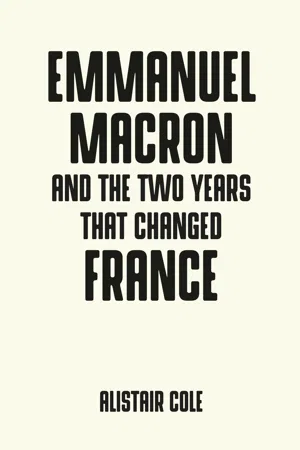
Emmanuel Macron and the two years that changed France
About this book
This book looks at the period 2015–18 in French politics, a turbulent time that witnessed the apparent collapse of the old party system, the taming of populist and left-wing challenges to the Republic and the emergence of a new political order centred on President Emmanuel Macron. The election of Macron was greeted with relief in European chancelleries and appeared to give a new impetus to European integration, even accomplishing the feat of making France attractive after a long period of French bashing and reflexive decline. But what is the real significance of the Macron presidency? Is it as transformative as it appears? Emmanuel Macron and the two years that changed France provides a balanced answer to this pressing question. It is written to appeal to a general readership with an interest in French and European politics, as well as to students and scholars of French politics.
Information
Out with the old
1
2016: François Hollande's annus horribilis
François Hollande was elected as France's second Socialist president in May 2012. By his mid-term in office, his presidency had broken all records in terms of unpopularity, and there was a widely diffused public perception of the individual being a poor fit for the accepted institutional role. The key to understanding Hollande's fall lay in the nature of his positioning as a ‘normal’ candidate and president (see below) and in his actions in the very early days of the presidency. The seventh president of the Fifth Republic exhausted his political resources almost from day one. His behaviour seemed rather reminiscent of that of the Third Republic radical politician Henri Queuille, whose legendary motto was ‘it is urgent to wait’. Hollande celebrated his election by taking three weeks’ holiday immediately after the election campaign, in an ostensible effort to slow down the presidency.
The consensus view on the first three years of the Hollande presidency was a negative one. The president proved incapable of controlling the divisions within his governments, or of exercising the authoritative behaviour that has come to be expected of French presidents (by dismissing opponents, notably). The president's inability to see off the revolt by the frondeurs – with as many as fifty PS deputies willing to vote against the government – was an obvious weakness. More fundamental still was the ambiguity of the political project, sustained – but also undermined – by the radical promises made during his campaign speech at Le Bourget in January 2012. The Hollande presidency became equated with a sense of drift, of weak government and of PS internal dynamics continuing to play themselves out within the government. I have argued elsewhere (Cole, 2014) that there was a psychologically devastating gap between campaign promises and policy platforms on the one hand and actions within government on the other. From early 2015 onwards, however, Hollande experienced a new phase in his presidency, a revival in public opinion against the background of war and terrorist attacks. In early and late 2015, indeed, Hollande appeared as the embodiment of national unity against the internal and external terrorist threat. The right tone was struck, in the mass rallies of 11 January 2015 in defence of the Republic after the attacks on Charlie-Hebdo and in the convoking of Congress in Versailles, just days after the 13 November 2015 outrage (the murders at the Bataclan nightclub). At the end of December 2015 Hollande obtained some of his best poll ratings since taking office. In an IFOP–Fiducial poll for Paris Match and Sud Radio of 27–8 November 2015, Hollande obtained 50% of positive opinions (cited in Le Monde, 2–4 January 2016).
Such a resurrection was short-lived. By 26 April 2016, Hollande was credited with only 17% of favourable opinions (83% were unfavourable) in an Odoxa survey for L’Express. 2016 turned out to be President Hollande's annus horribilis. The incumbent president's misfortunes in 2016 appeared to be compounded by the quickening pace of political decline as the 2017 presidential election approached. In mid-2016, Hollande appeared to face an impossible dilemma: to be the first president not to stand for re-election, or to stand as candidate with the danger of not reaching the second round. In the third wave of the barometer of the CEVIPOF (Centre pour l’Étude de la Vie Politique Française) in March 2016, for example, by far the largest rolling survey with over 20,000 respondents, Hollande was in third position behind Marine Le Pen and the Republican candidate, whether represented by Alain Juppé (14%) or Nicolas Sarkozy (16%) (IPSOS–CEVIPOF–Le Monde, 2016). Hence the incumbent president would be eliminated on the first round. The announcement in December 2016 that he would not be standing for re-election was without precedent in the Fifth Republic, testament to weight of political forces aligned against him.
Hollande's predicament might be interpreted in terms of a series of inappropriate responses to specific events, in which case the Socialist president was a victim of the normal rhythms of extraordinary times. There were any number of key events to choose from: the aborted constitutional reform of 2016 is considered below. Hollande's descent might also be interpreted as the culmination of a series of design faults: the original sin of the mode of election in 2012; the result of a particular style and discourse; the unintended consequences of the political responses to the terrorist attacks of 2015; the longer-term impact of economic crisis and the failure to bring down unemployment. All of these factors recall the weak political, partisan and sociological basis of Hollande's support from the outset. To understand Hollande's predicament we need thereby to mix levels of analysis: to capture the structural, partisan and political bases of his persistent presidential weakness.
Hollande's original sin
Hollande's original sin lay in the manner of his election in 2012. His 2012 presidential campaign was fought in large part as an anti-Sarkozy referendum, designed to preserve an early opinion poll lead that was mainly built upon a popular rejection of Sarkozy. A majority of second-round voters (51%, compared with 31% in 2007) declared that they had voted negatively (for the candidate best placed to prevent the less preferred candidate from being elected), and only a minority declared they had voted positively for their candidate (49%, compared with 69% in 2007) (Jaffré, 2012). Hollande's candidacy was based on his strategic political positioning as a ‘normal’ candidate and president, a style that he deliberately adopted so as to be the counterpart of the flamboyant Sarkozy. Once elected, however, Hollande experienced a rapid descent from popularity, one much faster and more thorough than that of any previous president. The failure to act during the first 100 days represented a lost opportunity. He was trapped by the frame of normality during a period of economic crisis; the attraction of a ‘normal’ president who ignored the economic tempest in a wave of enforced optimism soon wore off (Davet and Lhomme, 2016). For the 2012 electoral series was fought in a context of economic crisis; voters were almost as pessimistic about the ability of Hollande to ‘improve the situation of the country’ (26%) as they were about Sarkozy (25%) (Jaffré, 2012).
There is an argument that normality was an inadequate frame for the French presidency – an exceptional office faced with exceptionally difficult times. Worse, Hollande failed to live up to the norms he had advocated. During the campaign, normality was presented as an ethical standard even more than as a way of conceiving presidential practice. Hollande's claim to normality involved a commitment to keep his private life out of the public domain, but the public jealously displayed by Valérie Trierweiler, his erstwhile partner, destroyed this aspiration very early on. Hollande's personal judgement was then called into question by a succession of scandals involving leading figures of the Socialist-led government (Amar, 2014). By far the most important scandal was that of Jérôme Cahouzec, the budget minister whose reputation for integrity was destroyed by evidence of a secret bank account in Switzerland (despite his repeated denials).
I have argued elsewhere that the Hollande presidency was undermined by the weakness of a consistent legitimising discourse (Cole, 2014). It was unclear to many what Hollande represented. There was a weakness of story-telling, the construction of a coherent narrative to describe and justify governmental action. Was Hollande a traditional social democrat? There was certainly a sustained effort during the Ayrault premiership (2012–14) to revive a social-democratic discourse, and to give substance to this by using social-democratic instruments such as the annual social conference between the government, the business associations and the trade unions; the principle of negotiated solutions to labour laws and training; and the State's involvement in attempting to reduce unemployment by creating subsidised jobs for young people. The core problem lay in the inability to resolve the most intractable policy issue of them all, unemployment. Hollande's commitment in late 2012 to ‘reverse’ the rising level of unemployment provided a hostage to fortune. By early 2016, however, no major decline of the unemployment rate had occurred, with France comparing unfavourably with its main EU partners and competitors. Hollande did not convince as a social-democratic president, not least because of his inability to resolve this most intractable problem of domestic policy. Was he more successful as a ‘social liberal’? Hollande began the ‘social liberal’ turn in 2013, when the government introduced a tax credit for businesses (crédit d’impôt pour la compétitivité et l’emploi or CICE, Tax Credit for Competitiveness and Employment). The CICE laid the basis for the Responsibility Pact announced in January 2014, whereby fifty billion euros of reductions in business taxes were announced, with the expectation that firms would invest and employ more labour (though without any formally constraining conditions). If the social liberal orientation was determined by Hollande's choices, the responsibility for validation lay with Prime Minister Valls (from April 2014) and increasingly with the ambitious economy minister, Macron, who steered his own liberalisation programme in 2015.
As president, Hollande enjoyed the most success with a Republican narrative centred on education, citizenship, the role of France in the international arena and the nation. Even more than his predecessors, Hollande took solace in European and foreign affairs, the traditional ‘reserved domain’ of the French president (Howorth, 2013). Hollande grew into the role of president in part as war leader: from 2012 to 2017 France intervened in Mali and the Central African Republic and participated in air strikes in Iraq and Syria. The French intervention in Mali in 2013, to dislodge Islamic militants from the north of this strategically important African country and safeguard the capital Bamako, was successful. France was active, if not particularly effective, in Syria and Iraq, from the failed attempt to impose air strikes on Syria's Assad in 2013 to the bombing campaign against so-called Islamic State after the 13 November 2015 Paris massacres. In terms of its soft power, Hollande's team successfully managed a global environment conference, the COP 21, which brought leaders across the world to Paris in December 2015 to pledge their commitments to control global warming and save the planet.
At the European level, Hollande fought his 2012 presidential campaign as a compromise candidate between the various families of the French left; personally strongly pro-European and social democratic, he was deeply conscious of the need to reach out to the France du non that had captured a majority of PS voters in the 2005 referendum.1 His attempts to reorient the EU in a less ‘liberal’ direction, however, and to assert an alternative, more growth inspired path did not amount to much. Though as candidate Hollande had insisted he would not ratify the Treaty on Stability, Governance and Growth (TSGG) without its fundamental overhaul, this commitment did not survive the first few months of the presidency, the TSGG being ratified by the French parliament on 11 October 2012 (Drake, 2013). Having ratified this key European treaty, France was then treated in a rather indulgent fashion by the European Commission, which revised the country's deficit and debt targets on three occasions (to insist that it meet the Maastricht Stability Pact criteria by 2014, then 2015, and finally by 2017). Hollande was helped by new allies, such as Matteo Renzi's Italy, and above all by the president of the European Central Bank (ECB), Mario Draghi, who declared in 2012 that he would do ‘whatever it takes’ to defend the euro and began a programme of quantitative easing to keep interest rates low.
Hollande counted some European successes. He was the driving force behind imposing the European Banking Union upon a reluctant Germany. His key aim was to speed up the establishment of the new banking regime, conferring upon the ECB the overall regulatory authority of the euro-zone's banks and allowing ECB support for threatened banks (which might include French ones in due course). Hollande also played an important role in pulling Europe back from the brink in 2015, as he facilitated an agreement that avoided the exclusion of Greece from the euro-zone. Hollande also demonstrated a proactive presence in the international arena, notably in attempting to find a solution to the Ukrainian crisis (launching the so-called G4 process with German Chancellor Angela Merkel, Russian President Vladimir Putin and Ukrainian President Oleksij Poroshenko); this resulted in the 2015 Minsk agreement, which temporarily froze Russia's territorial ambitions in its near neighbourhood.
Towards the end of the Hollande presidency, however, the decline in French influence appeared more manifest than under Sarkozy. The traditionally central Franco-German relationship was undermined by dissensions on economic policy, the growing imbalances between the French and German economies, controversies over fiscal policy (the support from France and Italy for monetary easing put into place by the ECB at the height of the euro crises of 2012 and 2015) and attitudes towards the euro crisis in general and Greece in particular. Then the refugee and migrant crisis appeared to sweep all before it from summer 2015 onwards, combining with terrorist attacks in France, Germany and Belgium to threaten the future of the Schengen zone. Prime Minister Valls's public criticism of Germany's refugee policy as laxist was deeply resented in Berlin. The new French president would have his work cut out to restore trust.
The fall
In his November 2015 address to the Congress, Hollande received a standing ovation. He also made a dual commitment: to reform the 1958 constitution in order to provide a firmer footing for the state of urgency;2 and to deprive terrorists (initially those with dual nationality, later all French nationals) of French nationality. These two related but distinct articles were imagined in order to provide a firm response to terrorist attacks, but also to embarrass the political right into supporting constitutional reform.
Once the dust of the Versailles speech had settled, the dual offensive was doubly offensive to the ‘usual suspects’ (the rebel Socialist deputies known as the frondeurs, Martine Aubry, the Socialist mayor of Lille, and the ‘left of the left’ in general), but also more generally to Socialist deputies, if not to broader public opinion (which supported the position adopted by the executive on both counts). The proposal to refer...
Table of contents
- Cover
- Half-title page
- Series page
- Title page
- Copyright page
- Contents
- Tables
- Foreword
- Preface
- Acknowledgements
- Abbreviations
- Introduction: two years that changed France
- Part I: Out with the old
- Part II: A spring revolution
- References
- Index
Trusted by 375,005 students
Access to over 1.5 million titles for a fair monthly price.
Study more efficiently using our study tools.
Frequently asked questions
Yes, you can cancel anytime from the Subscription tab in your account settings on the Perlego website. Your subscription will stay active until the end of your current billing period. Learn how to cancel your subscription
No, books cannot be downloaded as external files, such as PDFs, for use outside of Perlego. However, you can download books within the Perlego app for offline reading on mobile or tablet. Learn how to download books offline
Perlego offers two plans: Essential and Complete
- Essential is ideal for learners and professionals who enjoy exploring a wide range of subjects. Access the Essential Library with 800,000+ trusted titles and best-sellers across business, personal growth, and the humanities. Includes unlimited reading time and Standard Read Aloud voice.
- Complete: Perfect for advanced learners and researchers needing full, unrestricted access. Unlock 1.5M+ books across hundreds of subjects, including academic and specialized titles. The Complete Plan also includes advanced features like Premium Read Aloud and Research Assistant.
We are an online textbook subscription service, where you can get access to an entire online library for less than the price of a single book per month. With over 1.5 million books across 990+ topics, we’ve got you covered! Learn about our mission
Look out for the read-aloud symbol on your next book to see if you can listen to it. The read-aloud tool reads text aloud for you, highlighting the text as it is being read. You can pause it, speed it up and slow it down. Learn more about Read Aloud
Yes! You can use the Perlego app on both iOS and Android devices to read anytime, anywhere — even offline. Perfect for commutes or when you’re on the go.
Please note we cannot support devices running on iOS 13 and Android 7 or earlier. Learn more about using the app
Please note we cannot support devices running on iOS 13 and Android 7 or earlier. Learn more about using the app
Yes, you can access Emmanuel Macron and the two years that changed France by Alistair Cole in PDF and/or ePUB format, as well as other popular books in History & Political Biographies. We have over 1.5 million books available in our catalogue for you to explore.