eBook - ePub
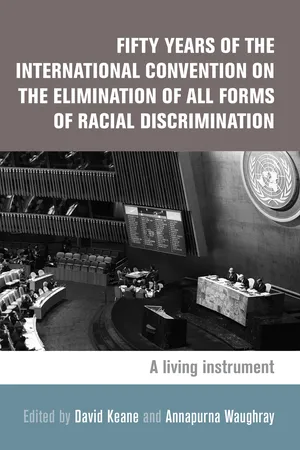
Fifty years of the International Convention on the Elimination of All Forms of Racial Discrimination
A living instrument
- 314 pages
- English
- ePUB (mobile friendly)
- Available on iOS & Android
eBook - ePub
Fifty years of the International Convention on the Elimination of All Forms of Racial Discrimination
A living instrument
About this book
This is the very first edited collection on International Convention on the Elimination of All Forms of Racial Discrimination (ICERD), the oldest of the UN international human rights treaties. It draws together a range of commentators including current or former members of the Committee on the Elimination of Racial Discrimination (CERD), along with academic and other experts, to discuss the meaning and relevance of the treaty on its fiftieth anniversary. The contributions examine the shift from a narrow understanding of racial discrimination in the 1960s, premised on countering colonialism and apartheid, to a wider meaning today drawing in a range of groups such as minorities, indigenous peoples, caste groups, and Afro-descendants. In its unique combination of CERD and expert analysis, the collection acts as an essential guide to the international understanding of racial discrimination and the pathway towards its elimination.
Information
Topic
Ciencias sociales Part I
ICERD: cross-cutting themes
Chapter 1
Extending the rule of law
Michael Banton
Adoption of the International Convention on the Elimination of All Forms of Racial Discrimination (ICERD/the Convention) was a significant forward step in the extension of the rule of law. That process had begun in classical antiquity with the recognition of ius gentium, the law of peoples, as a step above the laws of particular peoples. It also featured in the conception of natural law, according to which the State must respect a lawfulness that is not of its own creation. So the story of human rights law is a story of how issues that could be made subject to legal regulation were identified, and how States were persuaded to make this possible by ceding some of their authority.
After the Second World War, new opportunities opened with the adoption in 1945 of the Charter of the United Nations. The Statute of the International Court of Justice is an integral part of the Charter. UN actions have been divided between those that are based on the Charter (mainly political) and those that are treaty-based (where legal remedies have been developed). So UN action to combat racial discrimination has followed a twin-track approach. The Committee on the Elimination of Racial Discrimination (CERD/the Committee) was the first human rights treaty monitoring body. ICERD provided, in Article 22, that if two or more States parties disputed the interpretation of the Convention, the matter might be referred to the International Court of Justice.
Fifty years after the adoption of the Convention another nine similar treaty bodies had started work. These bodies and the dates of their first meeting or, in the later cases, the date when they came into operation, are listed in Table 1.1.
Table 1.1 UN treaty bodies: year of first meeting
| CERD | Committee on the Elimination of Racial Discrimination | 1970 |
| HRC | Human Rights Committee | 1977 |
| CEDAW | Committee on the Elimination of Discrimination Against Women | 1982 |
| CESCR | Committee on Economic, Social and Cultural Rights | 1987 |
| CAT | Committee Against Torture | 1988 |
| CRC | Committee on the Rights of the Child | 1991 |
| CMW | Committee on the Rights of Migrant Workers | 2004 |
| SPT | Subcommittee on Prevention of Torture | 2007 |
| CRPD | Committee on the Rights of Persons with Disabilities | 2009 |
| CED | Committee on Enforced Disappearances | 2010 |
In addition, it is necessary to take account of the monitoring by the Committee on the Rights of the Child (CRC) of optional protocols on the involvement of children in armed conflict (OPAC) and that on the sale of children, child prostitution and child pornography (OPSC).
The treaty bodies operate in a political and legal environment recently dramatised by the establishment of an International Criminal Court, by war crimes trials and by the indictment of heads or former heads of state. The work of the European Court of Human Rights and that of the Inter-American Court of Human Rights has become more prominent. The African Court on Human and Peoples’ Rights came into being in 2004 though there has been little progress towards the adoption of a corresponding human rights convention for the Asia-Pacific region. All these moves come together in the struggle to extend the rule of law.
The treaty body system is now complex and difficult for anyone but a specialist to grasp its nature and potentialities. The contention of this chapter is that the system can best be understood as part of the history of the extension of the rule of law. It is a story of struggle.
The origins of the Convention
ICERD was the pioneer in showing what might be possible. The initiative that made it possible started at the end of the 1950s in the fear of a revival of Nazism in western Germany. It was first expressed by a Charter-based body, the Sub-Commission for the Prevention of Discrimination and the Protection of Minorities. Since Jews were thought to be differentiated both by their race and by their religion, the Sub-Commission coupled the two. It drew attention to ‘manifestations of anti-Semitism and other religious or so-called racial prejudices’. Its report attracted widespread notice because of the Arab–Israeli dispute and because of opposition to apartheid.
The prospect of UN action along the legal track gathered support in the General Assembly because, amid the tensions of the so-called Cold War, States within the UN’s East European group saw in it opportunities to attack the colonial powers, Belgium, France, Portugal and the United Kingdom, and to put themselves forward as the protectors of the new States created by decolonisation. In the General Assembly debate the delegate of the United Arab Republic claimed that it was noteworthy that colonialism was responsible for all the cases of racial discrimination that he had mentioned, except that of the United States. The delegate of the Soviet Union averred that racism and racial discrimination were ‘shameful and odious products of imperialism and colonialism’, and that in 1917 the Soviet people were the first ‘to put an end to discrimination’. For him, as for others, it could be completely eliminated. The Arab States saw it as a weapon to use against Israel. The size of the African group of States increased dramatically; one priority they shared was the desire for action against the apartheid policies of the then Government of South Africa. In the General Assembly, the campaign for a convention was led by the Ghanaian ambassador, Mr George Lamptey. As black Africans were widely perceived to be the main victims of racial discrimination, leadership in UN action to combat action against it came to be seen as the prerogative of the African group.1 The perception of racial discrimination as an African interest led some diplomats to regard it as regional issue that bore solely upon their foreign policies. Some of their governments later said that they had ratified the Convention out of ‘solidarity’; they had not appreciated that they were assuming onerous domestic obligations. The publication at an early stage of Guidelines for the Preparation of Reports helped clear some of these misconceptions.
Why an increasing number of States chose to ratify the Convention is an interesting question. The United States was a relative latecomer; there, the Senate was told in 1994:
First, by ratifying the Convention, we will be better able to hold other signatories to their commitments … Second, we could be a more effective part of the discussion now taking place over evolving international norms in the world … Third, this would be part of our effort to inject new American energy into the UN human rights system.2
Today, 177 States (including the Holy See) have become parties to the ICERD.
Innovations
ICERD followed a familiar form in being divided into preambular and operative paragraphs. The former linked the Convention to the political track by explaining why it had been prepared; the latter detailed the legal obligations.
Article 9 marked a major advance upon the Convention on the Crime and Punishment of Genocide, in that by accession to ICERD, States accepted an obligation to report to the UN on their implementation of the Convention’s provisions, and that a monitoring body (composed of experts elected by the States themselves) was to report to the General Assembly the results of their examination of these reports. CERD was to report to the General Assembly rather than to the States parties because racial discrimination was seen as a worldwide problem, not only for those States (which might be few in number) that might choose to ratify the treaty.
Article 8 provided that CERD should consist of eighteen experts. That States in the General Assembly saw racial discrimination as posing a political problem may explain why, when specifying the qualifications necessary for election to the committee of experts, they did not refer to ‘the usefulness of the participation of some persons having legal experience’, as they did when constituting the committee to monitor implementation of obligations under the International Covenant on Civil and Political Rights. The legal expertise of that body, the Human Rights Committee, enabled it to acquire an especial authority.
Another innovation was the provision in Article 14 of what later became the Optional Protocol procedure, whereby a state party could declare that it recognized the competence of the Committee to receive and issue opinions on complaints from individuals or groups within their jurisdiction claiming that the State party had violated any of their rights as detailed in the Convention.
When CERD first assembled, some members thought it should work like the UN Trusteeship Council. It was proposed that States parties should be invited to send representatives to present their reports. The following year, the delegation of Pakistan to the UN in New York made a similar request that was also denied. It was objected that the Convention gave the Committee no right to ask questions of a State representative. After the same proposal was made in the General Assembly, however, the objections were set aside; soon afterwards it was celebrated as ‘perhaps the greatest success of the Committee’.3
The establishment of a treaty monitoring body was itself a remarkable innovation, viewed with suspicion by States that wanted no oversight of their policies and actions. It was not to be a court. So, calling it a ‘committee’ made its very limited powers appear less threatening to the independence of States.
Dialogue
Though a treaty body is not a court, it may exercise a judicial function, particularly if, like CERD, it is empowered to publish legal opinions in response to individual complaints. Only recently has it begun to create a jurisprudence built up from this response. For its first fifty years CERD’s main function was one nowhere identified in the drafting process or named in the Convention. It is exemplified in dialogue. In a two-way exchange with a reporting State, CERD has elaborated on the obligations incurred by accession to the Convention. At the same time, CERD members have also learned much from studying State party reports and from the replies of State representatives to their questions. A reading of the records suggests that the approach of Committee members changed greatly once State delegations attended to present reports. Through dialogue, both the States parties and the Committee members have learned more about the nature of racial discrimination and the means by which it might, one day, be eliminated.
The character of dialogue varies. Drawing upon my personal recollections, I recall an occasion when an Arab State was represented by a lawyer for whom the use of law to prevent racial discrimination was a completely novel consideration. An Arabic-speaking Committee member, himself a diplomat, understood the State representative’s difficulties and, speaking in Arabic, took him through the main points like a tutor; the State representative was very appreciative. This was a constructive experience. By contrast, on one occasion the representative of a reporting State acted like a trial lawyer engaged to defend a client. He argued very vigorously that his State’s laws were sufficient and brushed aside the arguments of some Committee members about desirable improvements. The exchanges continued, and came to a halt only...
Table of contents
- Cover
- Half Title
- Title Page
- Copyright Page
- Contents
- Notes on Contributors
- Foreword by Patrick Thornberry
- Acknowledgements
- List of abbreviations
- Introduction
- Part I ICERD: cross-cutting themes
- Part II Groups and general recommendations
- Part III Conflict and resolution
- Part IV Present and future of ICERD
- Conclusion
- Select bibliography
- Index
Trusted by 375,005 students
Access to over 1.5 million titles for a fair monthly price.
Study more efficiently using our study tools.
Frequently asked questions
Yes, you can cancel anytime from the Subscription tab in your account settings on the Perlego website. Your subscription will stay active until the end of your current billing period. Learn how to cancel your subscription
No, books cannot be downloaded as external files, such as PDFs, for use outside of Perlego. However, you can download books within the Perlego app for offline reading on mobile or tablet. Learn how to download books offline
Perlego offers two plans: Essential and Complete
- Essential is ideal for learners and professionals who enjoy exploring a wide range of subjects. Access the Essential Library with 800,000+ trusted titles and best-sellers across business, personal growth, and the humanities. Includes unlimited reading time and Standard Read Aloud voice.
- Complete: Perfect for advanced learners and researchers needing full, unrestricted access. Unlock 1.5M+ books across hundreds of subjects, including academic and specialized titles. The Complete Plan also includes advanced features like Premium Read Aloud and Research Assistant.
We are an online textbook subscription service, where you can get access to an entire online library for less than the price of a single book per month. With over 1.5 million books across 990+ topics, we’ve got you covered! Learn about our mission
Look out for the read-aloud symbol on your next book to see if you can listen to it. The read-aloud tool reads text aloud for you, highlighting the text as it is being read. You can pause it, speed it up and slow it down. Learn more about Read Aloud
Yes! You can use the Perlego app on both iOS and Android devices to read anytime, anywhere — even offline. Perfect for commutes or when you’re on the go.
Please note we cannot support devices running on iOS 13 and Android 7 or earlier. Learn more about using the app
Please note we cannot support devices running on iOS 13 and Android 7 or earlier. Learn more about using the app
Yes, you can access Fifty years of the International Convention on the Elimination of All Forms of Racial Discrimination by David Keane,Annapurna Waughray, David Keane, Annapurna Waughray in PDF and/or ePUB format, as well as other popular books in Ciencias sociales & Derechos civiles en la legislación. We have over 1.5 million books available in our catalogue for you to explore.