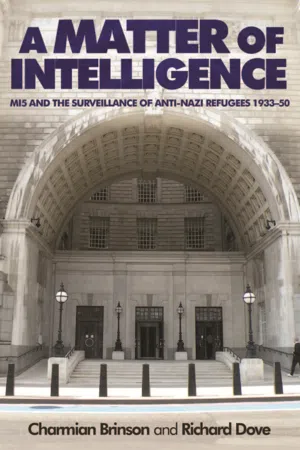
eBook - ePub
A matter of intelligence
MI5 and the surveillance of anti–Nazi refugees, 1933–50
- 256 pages
- English
- ePUB (mobile friendly)
- Available on iOS & Android
eBook - ePub
A matter of intelligence
MI5 and the surveillance of anti–Nazi refugees, 1933–50
About this book
This is an unusual book, telling a story which has hitherto remained hidden from history: the surveillance by the British security service MI5 of anti-Nazi refugees who came to Britain fleeing political persecution in Germany and Austria. Based on the personal and organisational files that MI5 kept on political refugees during the 1930s and 1940s – which have only recently been released into the public domain – this study also fills a considerable gap in historical research. Telling a story of absorbing interest, which at times reads more like spy fiction, it is both a study of MI5 and of the political refugees themselves. The book will interest academics in the fields of history, politics, intelligence studies, Jewish studies, German studies and migration studies; but it is also accessible to the general reader interested in Britain before, during and after the Second World War.
Information
Publisher
Manchester University PressYear
2016Print ISBN
9780719099809
9780719090790
eBook ISBN
9781526110466
Part I
I spy 1933–39
1
Defending the realm: MI5 in the making
MI5’s mission statement is displayed in its heraldic motto: ‘To Defend the Realm’. The Service has been described by intelligence expert Nigel West as ‘Britain’s premier counter-intelligence agency’. However, it grew from modest beginnings. First established as the Secret Service Bureau in 1909 to coordinate intelligence against the perceived threat of German espionage, it was staffed by a thirty-six-year-old army captain, Vernon Kell, and a former naval Commander, fourteen years his senior, called Mansfield Cumming. At an early stage, it was agreed to divide the work of the Bureau into two parts: a Home Section, responsible for investigating and countering foreign (notably German) espionage in the United Kingdom, and a Foreign Section, responsible for gathering intelligence abroad on Britain’s enemies. The former, under the direction of Kell, became MI5; the latter, under Cumming, evolved into the Secret Intelligence Service (SIS), better known as MI6.
The origins and early development of MI5 reveal much about the later organisation, illuminating its world view, ethos and modus operandi, particularly during the historical period spanned by this study. It was during the First World War that MI5 first became MI5. In 1914, the Home Section of the Secret Service Bureau became a part of the War Office. As a subsection of the War Office’s Directorate of Military Operations, it was designated MO5 (Military Operations, Section 5), changing in 1916 to MI5 (Military Intelligence, Section 5). For much of its early life, MI5 was a part of the War Office; up to the reorganisation of intelligence services in 1931, Kell’s immediate superior was the Secretary of State for War. Throughout these early years, the quasi-military ethos of MI5 was pervasive, most of its recruits coming, like Vernon Kell himself, from a military background. This ethos was echoed in the Service’s structure, in which intelligence officers were assigned military rank, whether or not they were entitled to it on the basis of military service.
The military ethos of MI5 remained pervasive during the 1920s and 1930s. In the jargon of the Service, only those who worked in the ‘Office’ were referred to as ‘officers’ and enjoyed officer rank; those outside were referred to as ‘agents’. No insider, the intelligence expert Nigel West assures us, ever used the word ‘spy’1 – though spying is of course what they were engaged in.
MI5 operated as a clandestine department of government. All officers signed an agreement not to reveal their employment or duties within MI5. The secrecy surrounding its operations gradually gave rise to a self-sustaining mystique that became virtually an end in itself. Officers were instructed to say that they ‘worked for a rather dull department in the War Office’.2 According to John le Carré, every secret service invents its own mythology. In the case of MI5, the mystery surrounding its operations has fostered its popular image as a glamorous and dashing organisation: a perception which the facts of its history scarcely justify.
The initial division of work between Kell and Cumming reflected their disagreement about their respective responsibilities; it also presaged a rivalry which persisted for many years, resulting in frequent territorial disputes between MI5 and MI6.
MI5 was established to combat the threat of German espionage. The focus on Germany as a potential and real enemy remained a major concern of the organisation until 1945, though during the inter-war period it was matched by concern about the ‘red menace’. These twin preoccupations help to explain the surveillance of so many German ‘political’ refugees after 1933, most of whom were targeted as ‘Communists and suspected Communists’. The Security Service only rather belatedly recognised the threat to British security represented by Nazi activity in Britain.
If the years of the First World War were years of exponential growth for MI5, staff numbers dwindled rapidly in peacetime, as other priorities appeared. At the Armistice in 1918, MI5 had boasted a complement of over 130 officers (of whom 84 were at London HQ), but a decade later (1929) this number had fallen to only 13.
In fact, the 1920s was a decade of decline and retrenchment for the Security Service. Kell even had to reassert its role as an independent agency, fighting off moves to merge it with other intelligence organisations or even to wind it up altogether. Kell’s defence of MI5 was partly necessitated by the ongoing turf wars between MI5, MI6 and Special Branch, but was also a consequence of drastically reduced post-war levels of expenditure on intelligence.
MI5’s prime responsibility lay in gathering information on subversive, and potentially subversive, organisations and individuals. It was only one of the agencies charged with preserving Britain’s security: others included the Secret Intelligence Service (SIS), which came under the jurisdiction of the Foreign Office, and the Metropolitan Police Special Branch, responsible to the Home Office.3
The boundaries between these various organisations were a frequent source of friction and even rivalry. In its early days, MI5 had begun by collating and coordinating information gathered in the field by other security organisations. Despite its popular reputation, it had only limited power and influence and enjoyed only slender resources. Whatever the licence it enjoyed in certain activities, it was obliged to work within well-defined operational boundaries. It had, for example, no powers of arrest or prosecution, being obliged to work through Special Branch. Financial constraints also meant that it had only limited powers of investigation.
Christopher Andrew, the official chronicler of MI5, confirms that ‘Between the wars more MI5 resources were devoted to the surveillance and investigation of the Communist Party than of any other target’.4 MI6 had engaged in anti-Soviet operations since the 1917 Bolshevik revolution. Moreover, the Communist Party of Great Britain (CPGB) had been subject to Special Branch surveillance since its formation in 1920; cases had been brought against its members on charges such as sedition and breach of the peace. MI5 too began to address the perceived threat of communism which, for the next decade and a half, became its overriding concern.
During the 1920s, MI5 began to compile numerous ‘personal files’ on known and suspected Communists, as well as other ‘political extremists’. It focused specifically on the CPGB, reflecting the world view that every party member was a foot soldier of the Communist International (Comintern) and therefore a potential spy for the Soviet Union. Its surveillance of Communists included both leading activists and rank and file Party members. MI5 paid considerable attention to the Soviet Trade Delegation, many of whose members were engaged in subversive activities. In March 1927, it launched its first anti-Soviet operation, directed against the Trade Delegation, the so-called ‘Arcos operation’. Since MI5 had no powers of arrest, the operation was carried out together with Scotland Yard.5
The methods of surveillance available to MI5 were of course crude in comparison to those available today. It relied heavily on its Central Registry. Even before the First World War, MI5 had compiled (largely from police sources) a Register of Aliens, held in the form of a card index. By the spring of 1917, Central Registry had held 250,000 cards and 27,000 ‘personal files’ covering its chief suspects.
The agency’s main external weapon was the postal intercept. To intercept a suspect’s post, it was necessary to have a Home Office Warrant (HOW), signed by a Secretary of State, in practice usually the Home Secretary. Many of the files released to the National Archives open with a warrant signed by ‘one of His Majesty’s Principal Secretaries of State’ and contain numerous photographic copies of intercept letters. The widespread reliance on the HOW was largely dictated by MI5’s shortage of staff, which also made it reliant on other agencies to carry out some aspects of its investigations.
Both postal and telephone intercepts were carried out by the Investigation Branch of the GPO, the Postmaster-General receiving authorisation to ‘detain, open and produce for my inspection all postal packets and telegrams addressed to [suspect].’ As private use of the telephone increased, there was a growing requirement for telephone intercepts. This often proved problematic, however, since recording phone conversations was possible only by hand, a task made harder if suspects did not converse in English. Phone check records increasingly included the comment: ‘Conversation in a foreign language – not understood.’ The Dictaphone Company eventually came to the rescue, producing a device to record telephone conversations. Christopher Andrew notes that until 1937 it was not thought necessary to seek an HOW for a phone tap; he does not say why.6
During the 1920s, MI5 was a service of slender means, corresponding to its diminished responsibilities. While it had no powers of arrest, its powers of investigation were also severely limited by ongoing financial constraints. An ever-decreasing number of HOWs was recorded and there must also have been a drastic pruning of the number of ‘personal files’ (and therefore suspects). Moreover, ‘B’ Division, responsible for counterespionage operations, lacked the capacity to run agents, being limited to the use of informants.
The year 1931 proved a turning point in the fortunes of MI5, enlarging the scope of its operations over the next decade and marking the recruitment of some of the key individuals involved in them. In that year, the government’s Secret Service committee was reconvened in order to discuss serious differences which had arisen between the SIS and Scotland Yard. The committee decided that responsibility for investigating and combating ‘Communist subversion’ should be transferred from Special Branch to MI5. This meant that MI5 became responsible for all intelligence concerning the CPGB, and therefore also concerning the activities of the Comintern in Britain, a new responsibility which partly dictated MI5’s later interest in anti-Nazi German refugees. At the same time, MI5 acquired the services of Scotland Yard’s leading experts on counter-subversion, Hugh Miller and Guy Liddell. Miller was killed in an accident in 1934; Liddell became Deputy-Director of ‘B’ Division,7 overseeing its counter-espionage operations.
A further proposal by the committee which had far-reaching consequences was that the SIS should confine its activities to countries outside the United Kingdom and the Empire. By the end of the 1920s, SIS had started to encroach on MI5’s sphere of influence: it began running a string of agents on British soil, justifying its action by reference to MI5’s inability to do so. SIS’s agents were controlled by a young man called Maxwell Knight. In the light of the committee’s decision to limit SIS’s field of operations, Knight – and his agents – also joined MI5 at this time.
At this point, MI5 was also divorced from the War Office8 and was designated an inter-departmental service, supplying intelligence to (among others) the Home Office, the Foreign Office and the Committee of Imperial Defence. This reassignment of responsibility brought one considerable benefit for MI5. Under the reorganisation, SIS was to establish a new section – Section V (Counter-intelligence) under Valentine Vivian (later deputy Head of SIS) – which was to liaise with MI5. This measure introduced ‘a period of close and fruitful collaboration’ between the two agencies.9
Following the reorganisation of 1931, MI5 had just two divisions: A Division, covering administration, personnel and Registry, and B Division, responsible for counter-espionage and counter-subversion, whose Director throughout the 1930s was Brigadier A.W.A. Harker (known to his friends and associates as ‘Jasper’). On joining MI5 in 1931, Guy Liddell became Harker’s deputy, eventually succeeding him as Director in June 1940.
Liddell came from a classic MI5 background. He had served with distinction in the army in the First World War, having won the Military Cross, a background which fitted perfectly into the q...
Table of contents
- Cover
- Half Title Page
- Title Page
- Copyright Page
- Contents
- Acknowledgements
- Introduction
- Part I I spy 1933–39
- Part II Secrets, lies and misinterpretations
- Part III Preparing for the Cold War
- Conclusion
- A note on sources
- Select bibliography
- Index
Trusted by 375,005 students
Access to over 1.5 million titles for a fair monthly price.
Study more efficiently using our study tools.
Frequently asked questions
Yes, you can cancel anytime from the Subscription tab in your account settings on the Perlego website. Your subscription will stay active until the end of your current billing period. Learn how to cancel your subscription
No, books cannot be downloaded as external files, such as PDFs, for use outside of Perlego. However, you can download books within the Perlego app for offline reading on mobile or tablet. Learn how to download books offline
Perlego offers two plans: Essential and Complete
- Essential is ideal for learners and professionals who enjoy exploring a wide range of subjects. Access the Essential Library with 800,000+ trusted titles and best-sellers across business, personal growth, and the humanities. Includes unlimited reading time and Standard Read Aloud voice.
- Complete: Perfect for advanced learners and researchers needing full, unrestricted access. Unlock 1.5M+ books across hundreds of subjects, including academic and specialized titles. The Complete Plan also includes advanced features like Premium Read Aloud and Research Assistant.
We are an online textbook subscription service, where you can get access to an entire online library for less than the price of a single book per month. With over 1.5 million books across 990+ topics, we’ve got you covered! Learn about our mission
Look out for the read-aloud symbol on your next book to see if you can listen to it. The read-aloud tool reads text aloud for you, highlighting the text as it is being read. You can pause it, speed it up and slow it down. Learn more about Read Aloud
Yes! You can use the Perlego app on both iOS and Android devices to read anytime, anywhere — even offline. Perfect for commutes or when you’re on the go.
Please note we cannot support devices running on iOS 13 and Android 7 or earlier. Learn more about using the app
Please note we cannot support devices running on iOS 13 and Android 7 or earlier. Learn more about using the app
Yes, you can access A matter of intelligence by Charmian Brinson,Richard Dove,Richard Dove in PDF and/or ePUB format, as well as other popular books in Politica e relazioni internazionali & Intelligence e spionaggio. We have over 1.5 million books available in our catalogue for you to explore.