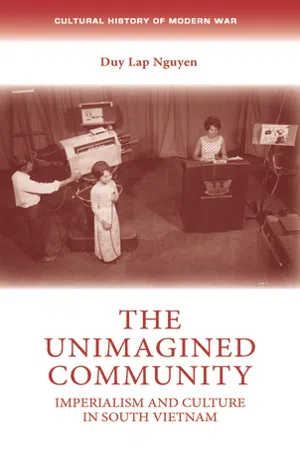
The unimagined community proposes a reexamination of the Vietnam War from a perspective that has been largely excluded from historical accounts of the conflict, that of the South Vietnamese. Challenging the conventional view that the war was a struggle between the Vietnamese people and US imperialism, the study presents a wide-ranging investigation of South Vietnamese culture, from political philosophy and psychological warfare to popular culture and film. Beginning with a genealogy of the concept of a Vietnamese "culture," as the latter emerged during the colonial period, the book concludes with a reflection on the rise of popular culture during the American intervention. Reexamining the war from the South Vietnamese perspective, The unimagined community pursues the provocative thesis that the conflict, in this early stage, was not an anti-communist crusade, but a struggle between two competing versions of anticolonial communism.
And the whole triumphant history of culture can be understood as the history of the revelation of culture’s insufficiency, as a march toward culture’s self-abolition. Culture is the locus of the search for lost unity. In the course of this search, culture as a separate sphere is obliged to negate itself.
Guy Debord
In a 1928 speech, Nguyễn An Ninh, one of the most prominent Vietnamese intellectuals and activists during the colonial era, condemned the French administration for its arrogant attempt to “civilize” a population that already “possessed a rich civilization … when the French were still living in caves.”1 For Ninh, the mission to civilize was in reality a project promoted by the colonial government in order to dissolve the “national culture” (văn hoá dân tộc), depriving the Vietnamese people of the “spiritual inheritance” contained in its long national history. Insofar as this national culture constituted the “soul of the nation” itself (văn hoá là tâm h
n của dân tộc), the imposition of French civilization amounted to a systematic attempt to destroy the very identity of the Vietnamese people.2
Ninh’s efforts to preserve this identity against the imperial mission to civilize correspond to what Frantz Fanon described as the attempt “to secure a national culture … against the universal condemnation of the colonizer.”3 In response to the “colonialist theory of a precolonial barbarism,” used to convince the colonial subject of its lack of civilization, intellectuals throughout the colonial world engaged in the “quest for a national culture prior to the colonial era.”4
As Fanon cautioned, however, it would be a mistake to identify this national culture with the “mummified fragments” of a fixed or unchanging tradition. Such a reified conception of culture fails to consider the way in which new “modes of thought, language [and] … modern techniques of communication … have dialectically reorganized the mind of the people.”5 As such, it “is not enough to reunite with the people in a past where they no longer exist.”6 Rather, the people require a national history that can be appropriated creatively in response to the needs of the present, a present defined by European imperialism. The “colonized intellectual,” therefore, must use “the past … with the intention of opening up the future, of spurring [the people] into action and fostering hope” in the future, a future in which the people recover their national sovereignty.7 Without a national culture, tied to a past that can open itself to the future, the people exist only as “individuals without an anchorage, without borders, colorless, stateless, rootless, a body of angels.”8
As Ninh argued, similarly, the national culture of the Vietnamese people should not be conceived as a civilization that is fixed for eternity. Rather, culture, according to Ninh, consists of “all the potential [tiềm năng] that the nation has left … in the course of its history,” a potential that can be actualized by the people in response to its present condition. The national culture, therefore, is not an unchanging tradition. Rather, it is “eternal” only insofar as it can be appropriated continually as a living tradition by those who inherit it in the present: “To speak of the eternity [sự trường t
n] of a … culture … is to speak of the vitality of a people … And the Vietnamese people have had the vitality to create such a culture.”9
Civilization and culture
But if the civilizing mission, according to Ninh, was an attempt to subjugate the Vietnamese people by erasing the national history, this history, nevertheless, was a product of European imperialism. As Dương Quảng Hàm pointed out in a pedagogical text that was widely circulated in colonial schools, the Vietnamese people did not possess a national history prior to the introduction of French civilization:
[N]ational history must be considered among the most important of subjects taught in … school. This pedagogical truth, so evident all on its own, was nevertheless unknown to Annamites before the arrival of the French. In the traditional Annamite curriculum, in fact, pupils only study the Chinese chronicles: the history of Annam was not mentioned …10
In spite of its self-evidence, then, the existence of an eternal Vietnamese culture was completely unknown to Annamites prior to the colonial period. Indeed, as Ninh admitted in an earlier speech, delivered in 1923, the very concept of culture was one that could not be conveyed in the “Annamite language,” a language that, at the time, possessed no equivalent to the word culture in French. In order to speak, therefore, of a Vietnamese culture, Ninh, despite rejecting the claim that the French possessed a superior civilization, was compelled to communicate in the more civilized language of the colonizer:
I must promise you that it is not for me a matter of pride that I speak with Annamites in French. The Annamite language is still so backward and is far from the level of European languages, of the languages of East Asia. I have tried … to translate into Annamite the word culture and have not succeeded in finding a word … The words c
m kỳ thi họa gives us an idea of culture, but an inadequate idea and one at risk of erroneous interpretation. C
m is music, kỳ intellectual speculation, thi is literature, and họa, painting. We would be forced into adopting the composite word chúng đọc học thức. Those who can find the correct word might be kind enough to show me forbearance on this previous point.11
If the Vietnamese, therefore, had already developed a civilization when the French were living in caves, their language, nevertheless, compared with that of the colonizer, was “still so backwards,” insofar as it had not yet developed an expression for culture.
The concept of culture, however, which Ninh perceived as the sign of a superior civilization, was a relatively recent invention in the languages spoken in Europe. According to Theodor Adorno, the use of the word “culture” to refer to “so many things lacking a common denominator … such as philosophy … religion, science and art … conduct and mores … and finally … the objective spirit of an age … is scarcely older than Kant.” Derived from the Latin cultura, which denoted the cultivation of land, the word “culture,” beginning in the eighteenth century, would be used “to connote the idea of niveau and cultivation … in contrast to the sphere of entertainment.”12 In German, the term Kultur came to refer to both the education (or Bildung) of the individual, as well as to a society’s state of the development, a usage that would later inform the meaning of “culture” in English and French.13
In the...
Table of contents
Cover
Half Title
Title Page
Copyright
Dedication
Contents
List of figures
Acknowledgments
Introduction
1 Colonialism and national culture
2 Vietnamese anti-colonialism and the Personalist critique of capitalism and liberal democracy
3 The other Vietnamese revolution: The Strategic Hamlet Campaign and US imperialism
4 Psychological warfare, counterinsurgency and the society of spectacle in South Vietnam
5 Mass culture in the later Republic
6 Surveillance and spectacle in Bùi Anh Tuấn’s Z.28 novels
7 Image-making and US imperialism: Sovereignty, surveillance and spectacle in the Vietnam War
Conclusion
Index
Trusted by 375,005 students
Access to over 1.5 million titles for a fair monthly price.
Study more efficiently using our study tools.
Frequently asked questions
Yes, you can cancel anytime from the Subscription tab in your account settings on the Perlego website. Your subscription will stay active until the end of your current billing period. Learn how to cancel your subscription
No, books cannot be downloaded as external files, such as PDFs, for use outside of Perlego. However, you can download books within the Perlego app for offline reading on mobile or tablet. Learn how to download books offline
Perlego offers two plans: Essential and Complete
Essential is ideal for learners and professionals who enjoy exploring a wide range of subjects. Access the Essential Library with 800,000+ trusted titles and best-sellers across business, personal growth, and the humanities. Includes unlimited reading time and Standard Read Aloud voice.
Complete: Perfect for advanced learners and researchers needing full, unrestricted access. Unlock 1.5M+ books across hundreds of subjects, including academic and specialized titles. The Complete Plan also includes advanced features like Premium Read Aloud and Research Assistant.
Both plans are available with monthly, semester, or annual billing cycles.
We are an online textbook subscription service, where you can get access to an entire online library for less than the price of a single book per month. With over 1.5 million books across 990+ topics, we’ve got you covered! Learn about our mission
Look out for the read-aloud symbol on your next book to see if you can listen to it. The read-aloud tool reads text aloud for you, highlighting the text as it is being read. You can pause it, speed it up and slow it down. Learn more about Read Aloud
Yes! You can use the Perlego app on both iOS and Android devices to read anytime, anywhere — even offline. Perfect for commutes or when you’re on the go. Please note we cannot support devices running on iOS 13 and Android 7 or earlier. Learn more about using the app
Yes, you can access The unimagined community by Duy Lap Nguyen in PDF and/or ePUB format, as well as other popular books in History & Indian & South Asian History. We have over 1.5 million books available in our catalogue for you to explore.