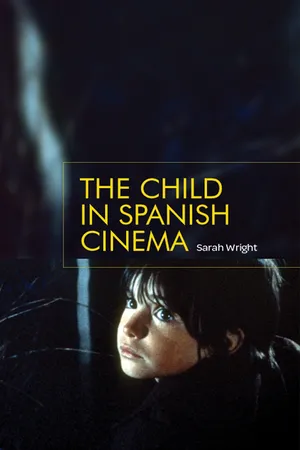
In this, the first full-length treatment of the child in Spanish cinema, Sarah Wright explores the ways that the cinematic child comes to represent 'prosthetic memory'. The central theme of the child and the monster is used to examine the relationship of the self to the past, and to cinema.
Concentrating on films from the 1950s to the present day, the book explores religious films, musicals, 'art-house horror', science-fiction, social realism and fantasy. It includes reference to Erice's The Spirit of The Beehive, del Toro's Pan's Labyrinth, Mañas's El Bola and the Marisol films. The book also draws on a century of filmmaking in Spain and intersects with recent revelations concerning the horrors of the Spanish past. The child is a potent motif for the loss of historical memory and for its recuperation through cinema.
This book is suitable for scholars and undergraduates working in the areas of Spanish cinema, Spanish cultural studies and cinema studies.
- 189 pages
- English
- ePUB (mobile friendly)
- Available on iOS & Android
eBook - ePub
The child in Spanish cinema
About this book
Information
Publisher
Manchester University PressYear
2015Print ISBN
9781784993795
9780719090523
eBook ISBN
9781526103208
1
Auratic encounters with the child of the cine religioso
Marcelino, pan y vino (The Miracle of Marcelino, Ladislao Vajda), a pious feature about an orphan who finds a statue of Christ in an attic and takes it some bread and wine, was the surprise hit of 1955. It was based on the best-seller by José María Sánchez-Silva which had sold one hundred editions in three years and had been serialised in the publication Ya as well as on radio.1 Nevertheless, when Hungarian émigré Ladislao Vajda started production on a film version no one quite predicted the runaway success it would prove to be: the film’s artistic and technical teams were offered a small salary in exchange for a cut of the profits (Arconada and Velayos, 2006: 12).2 In fact, the film was a global phenomenon, hugely popular at home and abroad, winning acclaim at the Berlin, Venice and Cannes film festivals.3 Pablito Calvo, its child star, shot to instant fame and created the craze for what became known as the película con niño in which child stars became hot property to be ‘fabricated, exploited or revered’ (the musicals of the 1960s featuring Marisol and Joselito are the most spectacular examples of this phenomenon) (Pavlovi´, 2011: 118). In 1991 Marcelino, pan y vino inspired an Italian/Spanish remake by Luigi Comencini and a Japanese/ Spanish/French anime version (scripted by Jaime de Armiñán) was released in 2000 and a version set against the Mexican Revolution in 2010 (José Luis Gutiérrez). Vajda’s film now enjoys a healthy afterlife on Spanish and Spanish-language television at Easter (Prout, 2005: 71).
In the film, Marcelino (Pablito Calvo) is brought up in rural Spain in the mid-nineteenth century by twelve friars who find him as a baby on the friary steps. The friars make some half-hearted attempts to find a family to look after the child, but in the end decide to care for him themselves. One day, aged about five, Marcelino finds a life-size effigy of Christ and, deciding it looks hungry, takes it some bread and wine. The statue materialises into a flesh and blood Christ who comes off the cross and sits with the boy. When asked what he wishes for, Marcelino expresses a desire to be reunited with his dead mother. At the end of the film one of the friars finds him dead, in a wooden chair at the foot of the statue, presumably having joined his mother in Heaven. As an outer frame to the narrative, the story of Saint Marcelino is told by a friar (Fernando Rey) to a sick girl to comfort her anxious parents.
In her excellent book on the film, Anne-Marie Jolivet suggests that international interest in child-centred films after World War II (examples include Rossellini’s Rome, Open City, 1945; de Sica’s Shoeshine, 1946; Radvanyi’s Somewhere in Europe, 1947 and Rossellini’s Germany Year Zero, 1948) might have inspired Vajda to choose a child protagonist for his film (Jolivet, 2004: 26–27). These neo-realist films about the fall-out of war had transnational appeal and created a niche for films of artistic merit featuring child protagonists. Marcelino, pan y vino used filmic techniques (chiaroscuro tonalities, crane shots, dollies and deep focus) which were technically more advanced than other Spanish films of the era. But far from the social commitment of European neo-realism, Vajda’s film fits easily with the mawkish sentimentality that defined the Spanish cine religioso of the 1950s. These were melodramas with religious themes which often featured child protagonists. In these films, boys (for they were always boys) were often longing for their absent or dead mothers (El maestro (The Teacher, Eduardo Manzanos and Aldo Fabrizi, 1957); Cerca de la ciudad (Close to the City, Luis Lucia, 1952) and Un traje blanco (The Miracle of the White Suit, Rafael Gil, 1956) follow this model) in a genre largely designed for female cinema-goers and their children. But Marcelino, pan y vino, the most successful of these films, was unique in its celebration of child death. In this film, the death of a child is not purported to be the tragedy that is feared by the parents of the sick girl in the story that frames the narrative proper, but rather, ‘a triumphant experience for the individual and an affirmation for the community’ (Avery and Reynolds, 2000: 7). Marcelino’s miraculous tale survives through the generations, drawing the community together (even if, as the narrator informs us, the locals have forgotten the reason for their festivities). The Franco regime loved to institute commemorations, as ‘a way to install a sense of tradition for their ideologies, and to reinforce the identity of a community through the re-enactment of master narratives’ (Connerton, 1989: 70), in this case, death as a sacred and regenerative act.4 In early Francoism, death was construed, at least for those on the winning side of the Spanish Civil War, as a glorious sacrifice against Republican barbarians (Vincent, 1999; Anderson, 2011). The orphaned children of those who had died in the war were ‘often cited as symbolising the pride of the “race” and the saving of Christianity and civilisation’ (Anderson, 2011: 558). Marcelino’s story makes no reference to the Spanish Civil War which had ended in 1939 (in fact its cyclical view of history returns the viewer to the aftermath of the War of Independence). But the close relationship it depicts between Church and state has more to do with the 1950s than the nineteenth century. In 1953 a Concordat had been signed by the Vatican to make Spain into a ‘confessional state’. If the child is central to Catholic belief,5 it was also central to Francoist ideology, which aimed for longevity through the education of its children. By 1955 the orphan was no longer a socio-historical reality, but the rhetoric of the child orphan and child martyr continued to hold sway. Child death featured prominently in children’s reading matter in the 1950s – not only were children exposed to the lives of child saints in didactic material, but such stories featured regularly in comics of the time (Harvey, 2004: 63). Books such as Gros and Raguer’s Niños santos: siluetas de vidas edificantes para la infancia y la juventud (1954), whose frontispiece has an illustration of crowds the children being guided by child angels on their way up a celestial staircase, were standard fare. Marcelino, pan y vino not only fits into this context but might be said to enhance and perpetuate this worldview.
Ladislao Vajda was the son of Hungarian scriptwriter Lazlo Vajda, whose most famous collaboration had been Pabst’s Pandora’s Box (1929). But if Vajda’s choice of a child protagonist concerned his efforts to emulate the artistic merit of the neo-realists of the time (such as, for example, Rosselini’s Germany, Year Zero and Rome, Open City), it appears that he would not have wished to recreate the controversy inspired by, for example, Rossellini’s Il Miracolo (The Miracle, co-scripted by Fellini, 1948) about a man calling himself Saint Francis (played by Federico Fellini) who villainously impregnates Nanni (Anna Magnani) who then believes that the baby she is carrying is Christ – the film was highly controversial internationally with accusations of blasphemy, although the Vatican saw it as a modern version of the miracle of the Virgin (Johnson, 2009: 249).6 But Román Gubern posits the success of Maurice Cloche and Ralph Smart’s Anglo-Italian co-production Peppino e Violetta (Never Take No for an Answer, 1951) as a possible inspiration for Vajda.7 This film might provide a bridge between the socially committed neo-realist films and Marcelino, pan y vino in that the protagonist, Peppino (Vittorio Manunta) has been orphaned by the war and his loneliness means that he idolises his donkey (Violetta). When the donkey falls ill, he takes her to see Saint Francis, but when the authorities refuse to allow him access to the Saint he takes the donkey to the Vatican to see the Pope. Cloche’s previous film, Monsieur Vincent (1947), a chronicle of the life of St Vincent de Paul, had won an Oscar for Best Foreign Film. Vajda once declared that his decision to make Marcelino, pan y vino derived from his desire not to aggravate the censors. State endorsement brought preferential distribution opportunities and financial prizes. But where Jolivet hints that the religious ideology behind this film might not have been shared by its director, Valeria Camporesi has revealed that Vajda had suffered from anti-Jewish legislation in Italy, after fleeing Hungary at the start of World War II – it was quite possible that Vajda wanted to produce films which would allow him to become smoothly integrated into the contemporary Spanish context where Catholic censors adjudicated on each film (article 4 of the Boletín Oficial de Estado of 19 July 1946 had declared ecclesiastical presence on censorship boards established in the same year and moreover these were the only members of the board to enjoy complete veto [Gutiérrez Lanza, 2011: 307).8 Catholic ideologues at the time pronounced on the perceived possibilities of cinema to promote religion – as I have noted elsewhere (Wright, 2005).9
In Marcelino, pan y vino, Christ comes to life and Marcelino’s life is taken away. The death-bound Marcelino and the resurrected Jesus present an eloquent dialectic of animate and inanimate, of becoming alive and leaving life, of motion and stillness. On one level, the spectator is returned to the childhood delight in animating dolls and Marcelino, a lonely orphan, is cast as the child with a big imagination who brings the effigy to life through fantasy (indeed the story suggests that the Christ figure might be seen on a par with Marcelino’s other imaginary friends, the goat and Manuel (Sánchez-Silva, 1969: 44). This is a game with scale in reverse: dolls are usually miniatures but here the statue is much larger than Marcelino and he has to stand on a table and reach up to the statue in order to offer it food. As a life-size toy, Winnicott would call the effigy a transitional object (and the attic a transitional space) whose function is to manage the absence of Marcelino’s mother (Winnicott, 1980). The film leaves the question of whether Marcelino is imagining things or whether he really is experiencing a miracle open until the end. But, conversely, children who saw visions were often accused of having over-active imaginations and here the miraculous is confirmed. The sense that Vajda might know the story of the moving crucifix at Limpias near Santander is suggested by the scene where Marcelino opens the window of the dusty attic and light streams through onto the face of the crucifix, illuminating its features. In a series of visions beginning in 1918, at Limpias, a crucifix was seen to move its eyes and even an arm – the first visions were by girls, aged thirteen and twelve respectively. Later, Father Antonio López, who, in a parallel to Rosellini’s film, was a teacher at the local St Vincent de Paul school, was changing an electric light and was at eye-level with the crucifix, light streaming onto its face, when he saw the crucifix close its eyes (Christian, 1992: 38, 44).10 Thus, the film might be seen as a parable encouraging devotion to material objects. Caroline Walker Bynum has shown how in the history of Christianity pilgrims visited places where material objects – paintings, statues, relics – allegedly erupted into life by such activities as bleeding, weeping and walking about. Christians were later challenged both to seek ever more frequent encounter with miraculous matter and to turn to inward piety that rejected material objects of devotion (Walker Bynum, 2011). But Franco’s Spain had few such qualms about ‘idolatry’: Franco himself had an ‘amulet’: the arm of Saint Teresa which he kept on his bedside table (when he died he was surrounded by the arm of Saint Teresa, the cloak of the Virgen del Pilar and other reliquaries).
The shifting polysemy which turns in Marcelino, pan y vino between the secular tale of a child’s fantasy and the sacred devotion to an idol establishes the magical life of things (Kuznets, 1994). Just as the love of a child is what animates the doll, it is Christ’s ‘divine love’ that takes away the life of Marcelino. This is the Grimm view of the fairy tale: wish-fulfilment as the granting of desire to give the subject exactly what it asks for, in spite of the dire consequences. Or, conversely, the glorious display of divine power. This is also the metaphor of cinema itself: film’s ability to animate stillness and to create an aura (Benjamin, 1968a).
This chapter will concentrate on the ways that Marcelino, pan y vino brings the child to life on screen. The film creates an aura around the child which is very much in keeping with National Catholic ideology but, as we shall see, also prepares the nation for the commodity fetishism of the emerging period of consumerism which was ‘desarrollismo’ (developmentalism), known as the ‘miracle years’. The child emerges here as an automaton tailor-made to activate the desires of female cinema goers and their children. In the second part of this chapter I will develop the idea of the child of the cine religioso as automaton by focusing on the dubbing practices which saw the child voiced by an adult female actress. The mysterious blend of the eerie in the familiar ushered in by voice is seen to corroborate recent subversive readings of Marcelino, pan y vino which view its aesthetics as more in keeping with the horror genre than with religious cinema – indeed this may account for the immense popularity of the film for a nation bored by the clichéd iconography of National Catholicism. The film returns us not just to childhood fear of the dark and the monsters that emerge from the shadows, but also to the game of ‘Grandmother’s Footsteps’ or ‘What’s the Time Mr Wolf’, which in Spanish is known as ‘que viene el Coco’.11 Marcelino’s visits to the effigy draw him closer to the ‘monster’ before being ‘caught’ by him at the end of the film. As a corroboration of this subversion of the film’s ‘official’ meanings, the voice, then, might open up a small space from which to negotiate alternative readings to the apparently seamless face of Francoism’s totalitarian kitsch aesthetics.
The child’s face on screen
Walking along the Gran Vía, Madrid’s main cinema strip, huge billboards announced the Marcelino, pan y vino: one extracted Marcelino’s head and had it floating in the air, suspended, rather like the image of Franco’s head above the crowds in the photo-composition, ‘Franco y la muchedumbre’ (Franco Above the Crowds).12 Inside the Coliseum cinema, watching the screen, the scale of the billboards was matched by the enormous close-ups of the child’s face that the film employs, what Anne-Marie Jolivet has referred to as the ‘epifanía de un rostro en la pantalla’ (epiphany of a face on the screen) (Jolivet, 2004: 179).13 Charle...
Table of contents
- Cover
- Half Title
- Title Page
- Copyright
- Contents
- Illustrations
- Acknowledgement
- Introduction
- 1 Auratic encounters with the child of the cine religioso
- 2 Coming of age with Marisol
- 3 Memory and the child witness in ‘art-house horror’
- 4 Angels and devils: embodiment and adolescence in recent Spanish films
- Conclusion
- Bibiliography
- Index
Trusted by 375,005 students
Access to over 1.5 million titles for a fair monthly price.
Study more efficiently using our study tools.
Frequently asked questions
Yes, you can cancel anytime from the Subscription tab in your account settings on the Perlego website. Your subscription will stay active until the end of your current billing period. Learn how to cancel your subscription
No, books cannot be downloaded as external files, such as PDFs, for use outside of Perlego. However, you can download books within the Perlego app for offline reading on mobile or tablet. Learn how to download books offline
Perlego offers two plans: Essential and Complete
- Essential is ideal for learners and professionals who enjoy exploring a wide range of subjects. Access the Essential Library with 800,000+ trusted titles and best-sellers across business, personal growth, and the humanities. Includes unlimited reading time and Standard Read Aloud voice.
- Complete: Perfect for advanced learners and researchers needing full, unrestricted access. Unlock 1.5M+ books across hundreds of subjects, including academic and specialized titles. The Complete Plan also includes advanced features like Premium Read Aloud and Research Assistant.
We are an online textbook subscription service, where you can get access to an entire online library for less than the price of a single book per month. With over 1.5 million books across 990+ topics, we’ve got you covered! Learn about our mission
Look out for the read-aloud symbol on your next book to see if you can listen to it. The read-aloud tool reads text aloud for you, highlighting the text as it is being read. You can pause it, speed it up and slow it down. Learn more about Read Aloud
Yes! You can use the Perlego app on both iOS and Android devices to read anytime, anywhere — even offline. Perfect for commutes or when you’re on the go.
Please note we cannot support devices running on iOS 13 and Android 7 or earlier. Learn more about using the app
Please note we cannot support devices running on iOS 13 and Android 7 or earlier. Learn more about using the app
Yes, you can access The child in Spanish cinema by Sarah Wright in PDF and/or ePUB format, as well as other popular books in Mezzi di comunicazione e arti performative & Film e video. We have over 1.5 million books available in our catalogue for you to explore.