East Manchester has been the site of one of the most substantial regeneration projects internationally. The initiative in east Manchester confirmed the tag that the city is the 'regeneration capital' of the United Kingdom.
While the book focuses on a single project, it has wider relevance to national and international regeneration initiatives. The book assesses the outcomes of the regeneration, although it demonstrates the difficulties in producing a definitive evaluation. It has a political focus and illuminates and challenges many assumptions underpinning three major current academic debates: governance, participatory democracy and ideology.
The book is relevant to students of politics, geography, sociology, public administration and recent history but will also interest practitioners, academics and general readers interested in urban regeneration. Mancunians will also be fascinated by the rapidly changing face and character of their city as will those with an interest in Manchester's football, the Commonwealth Games and Sportcity.
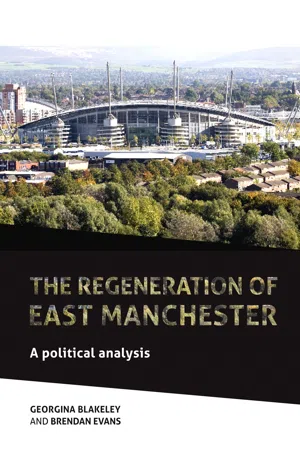
eBook - ePub
The regeneration of east Manchester
A political analysis
- 222 pages
- English
- ePUB (mobile friendly)
- Available on iOS & Android
eBook - ePub
The regeneration of east Manchester
A political analysis
About this book
Information
Publisher
Manchester University PressYear
2015Print ISBN
9781526107190
9780719084409
eBook ISBN
9781526102881
1
Introduction
The regeneration of east Manchester is one of the largest projects of urban regeneration internationally. It provides one of the best possibilities for examining the character of Area Based Initiatives (ABIs) for addressing urban decline and the related social and economic problems. We examine the specific case study of east Manchester in depth. While each such initiative is sui generis, neither is regeneration entirely localist but is set in the context of a wider political economy.
The purpose of this case study is to examine the east Manchester initiative which it has been argued is the most ‘policy thick’ area in Britain (Ward, 2003: 123). The narrative of how east Manchester became such an extreme case of deprivation, and of the various attempts to respond to the problem, is itself a purpose of the book and we describe the way in which the initiative emerged and explain how it developed. The revival of a substantial area of a great city, which began in a major way with the new Labour Government after 1997, is a task that is never completed. The global recession, the election of the Coalition Government and subsequent cuts in public spending significantly altered the course and extent of regeneration, but some projects continue.
Urban regeneration in Britain has always been broadly defined and included physical, economic and social regeneration. It has tended to combine an attack on decline together with a vision of an urban renaissance, although in practice there is a gap between the two. Problems of urban decline were first acted upon in Britain with the urban programme of 1968 but since then ABIs have proliferated both nationally and internationally. Yet the problems in Britain were more marked by the 1970s than in comparable countries and the term ‘urban regeneration’ appears to have developed from British metropolitan planning. The oil crisis of 1973 advanced economic decline and similar policy responses have emerged internationally. Since many of the forces which have created urban problems are themselves international in character, and many of the policies are similar, it is tempting to describe urban regeneration as global. Yet there are varying local approaches and adaptations in response to specific circumstances. In some cases urban regeneration is about adapting the existing built environment while in others this combines with an attention to social problems, with varying degrees of state direction. The case of east Manchester is distinguished by its holistic approach, which seeks to cover economic, social and cultural regeneration.
It is important to describe the regeneration of east Manchester, but the narrative itself is insufficient without attempting to evaluate its success. There is no attempt here to offer a definitive evaluation of the initiative and still less to offer one of the success of ABIs in general. Instead, we present the results of some specific evaluations which have been undertaken, as well as considering the pitfalls in the evaluation process itself. Despite the difficulties of presenting an overall assessment, we suggest a number of achievements and limitations in the case of east Manchester.
Yet our purpose goes beyond simply describing, analysing and evaluating the regeneration of east Manchester since 1997. While we do describe the actors involved, and offer an overview of what they have accomplished, we consider further relevant issues. The agencies and structures which are involved in the process form a complex and diverse network. This raises the question of whether the project can be regarded as one of traditional government, or whether it is rather a case of fragmented governance. Also, given the extent to which a complicated partnership has been engaged in regeneration, it is necessary to enquire how far there has been a successful co-ordination of the project. The inclusion of a diverse range of statutory and non-statutory bodies in the initiative has been an advantage by virtue of the range of interests it expresses, while potentially posing a problem because of the resulting managerial challenge.
The regeneration of this particular area, its selection as a problematical segment of British urban life, the aims which have been established for it and the methods adopted are not value-free. It is necessary to interrogate the motives and intentions of policy-makers and to elicit the ideology, implicit or explicit, which underpinned the project under New Labour and led to its weakening under the Coalition Government. This relates closely to the debate about who have been the beneficiaries. Much is made by the proponents of the aim of engaging residents and responding to their aspirations in the process and outcome of regeneration. We investigate what has actually happened towards fulfilling this aim and seek to determine the extent and nature of resident participation in the project.
We are sensitive to the actual realities of the context of east Manchester and so aim to present an account which appreciates the experiences of people who are trying to conduct their lives in often trying circumstances. Equally, while we criticise the work undertaken by the institutions involved in the regeneration project we also note that many individuals have strained every sinew to make the project a success in order to improve the prospects for an impoverished part of Manchester. Accordingly, we pay attention to agency.
The specificities of time as well as of place are crucial in analysing a major urban regeneration programme. While we note that urban regeneration is a ubiquitous activity we address a specific spatial question, that of the particular needs and solutions which have emerged in east Manchester. If there are common issues confronting cities across the world, and even similar pressure resulting from the trend towards globalisation, we argue that the interactions between global economic pressures, national political forces and specifically local issues are particularly important.
Of equal importance to the spatial specificities of east Manchester is the temporal dimension. Whether the issue is how the project is governed, how policy is made and implemented, its ideological imperatives or the degree to which genuine participation has been accomplished, the answer is not static in character. Specific ‘snapshots’ of these issues at various stages between 1997 and 2012 will yield quite different responses. Over the duration of the initiative, governing arrangements have altered, central government’s involvement has varied, policies have been tried and abandoned, objectives have been modified and participation has been spasmodic, so a time-sensitive perspective is required.
There are sociological, cultural, geographical and economic aspects in the case of east Manchester, but the primary focus here is political. Ultimately, the establishment, maintenance and survival of this type of initiative is a political issue regardless of the social, cultural and economic impacts of the programme. It remains a political project despite the role of private monies, and public money has a major role to play. Governance, ideology and participation are political concepts but politics is vital in two other respects. First, the analysis here explores the policies of the Thatcher and Major Governments, and focuses especially on the impact of New Labour and the election of the Coalition Government in 2010, which have been major landmarks in the manner in which urban regeneration has been taken forward. We analyse the public policies involved in the programme which highlights the fact that a temporal perspective is essential. There are continuities, but also discontinuities in policy, when central governments change. Second, we are critical of the idea of there being a single public interest. Political decisions benefit some and harm others. ‘Power’ here is understood as a zero-sum game. In the judgements that we advance, therefore, we recognise that some people have gained and others have lost, or perceive themselves to have gained or lost. In other words the various stakeholders in the east Manchester initiative will have different views about the overall efficacy of the programme.
We have avoided the word ‘community’ thus far. The term is plagued by a multiplicity of definitions, some of which are normative and even romantic in nature, and others simply geographical descriptions. Further, the dispersed nature of east Manchester raises serious doubts about the possibility of cohesiveness at either a descriptive level or in terms of a common identity. Nor can the area be described as a single neighbourhood, but rather as an agglomeration of neighbourhoods which are sometimes in competition with each other for attention and the deployment of resources. Where the term ‘community’ is used in the book it is to reflect the language of those actors who use the term as both a passive and an active entity. The term ‘community’ is also used because it has an ideological resonance for some of the participants in the regeneration process.
The focus of this book goes beyond a detailed case study of regeneration in east Manchester to have wider relevance by using practice to analyse a series of theoretical topics. The first part of the book describes and evaluates various aspects of the initiative. We begin with a brief historical introduction which emphasises the importance of the temporal and highlights change and continuity in urban regeneration. A description of the structures engaged, either temporarily or permanently, in the regeneration of east Manchester is provided in Chapter 3. They range from formal structures with an elite genesis such as MCC, NEM, New Deal for Communities (NDC/Beacons), Regional Government Office (GO), North West Development Agency (NWDA), and English Partnerships (EP), now renamed as the Homes and Communities Agency (HCA), through voluntary bodies such as Four Communities Together (4CT) to groups of local activists such as Communities for Stability (C4S). Some of these bodies have a sole focus on the regeneration of east Manchester while others have it as only a part of their functions. Chapter 4 provides a description of the key projects which comprised the regeneration initiative and also suggests a periodisation of the process which demonstrates the significance of temporality. While our objective is not to provide a definitive evaluation of the initiative’s success, in Chapter 5, we discuss the major evaluation reports which have been produced and highlight positive and negative elements of the initiative.
The second part of the book uses practice in east Manchester to analyse a series of theoretical topics. While the first part of the book began with the historical context of urban regeneration and of Manchester’s experience in this area, we provide context for the second part of the book with an analysis of the ideological roots of regeneration policy with a view to examining how national and local ideology interact. Since we argue that policy decisions are rooted in political values, Chapter 6 seeks to tease out the ideological principles behind New Labour’s establishment of the initiative and its future under the Coalition Government.
Chapter 7 addresses the the co-ordination of these diverse institutions and uses this evidence to interrogate the concept of governance. This chapter on governing arrangements provides a corrective to recent publications which diminish the role of local government and is wary of replacing existing approaches to local politics with imported interpretations from such different political and economic systems as the United States. We argue on the basis of east Manchester that the idea of traditional government with a powerful central and local state still carries validity. Finally, one of the recurring themes in the analysis of urban regeneration is the extent to which residents have been involved in the process. Chapter 8 evaluates resident participation against the specific circumstances of east Manchester rather than against any normative ideal of what constitutes ‘genuine’ participation. In the Conclusion, we reiterate the book’s main arguments (Figure 1.1, 1.2).
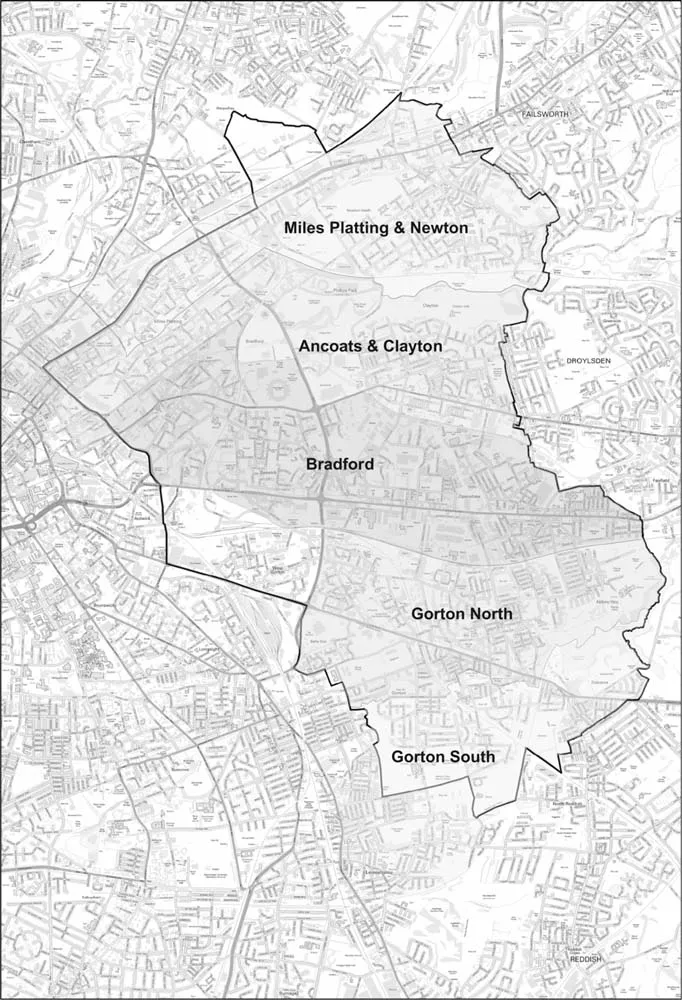
1.1 Map of east Manchester’s regeneration area with ward boundaries
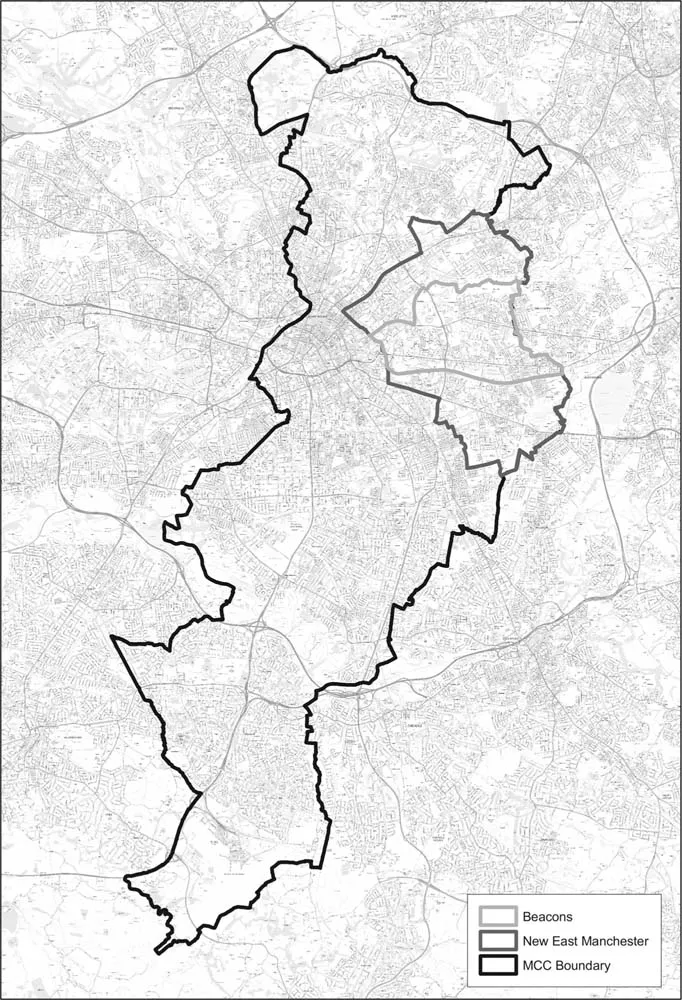
1.2 Map of east Manchester’s regeneration area with Beacons, NEM and MCC boundaries
2
The past and present of east Manchester
An appreciation of contemporary urban issues requires an understanding of the historical context. Historical amnesia is to be avoided. It is easy to discard the ahistorical claim that the present situation is not comparable with anything from the past because many of the ‘underlying problems’ continue. As Marcus argues, however (1974: 253), there is scope to debate what those ‘underlying problems’ actually are. Yet the view of MCC leader Richard Leese is understandable from the perspective of improving east Manchester’s image. He asserted the need ‘to draw a line on using the history of east Manchester when describing the area’ because he believed a focus on its history was unhelpful (NEM Board Minutes, 30/11/2004). Yet many of those involved in the regeneration of the area emphasise the historical roots of east Manchester’s contemporary problems in describing ‘the basket case’ that it had become by the late 1990s. A historical focus also demonstrates the importance of a temporal approach to understanding urban regeneration.
The comparability of aspects of the past in Manchester with the current situation is suggested by the aspiration of those presently engaged in east Manchester’s regeneration to return the area to the position which it occupied in the nineteenth century as the wealth-generating part of the city. In the nineteenth century wealth was created by the mining, textiles and engineering industries and while currently the aim is to create the city’s wealth through different means, the comparison between the two eras is apparent (Interviews, 30/03/2010). A historical understanding also assists an appreciation of the problems and possible solutions to the malaise of east Manchester and guards against the error of thinking that everything which is occurring is novel.
The issues of economic change, social deprivation, the spatial and socially dispersed nature of the population, the initiatives undertaken by local elites to improve the quality of life, the interventionist tradition of the local Council, the styles of popular culture and particularly the focus on housing problems have long resonated in the city, and particularly in the eastern neighbourhoods. Nor is the importance of understanding the processes of change and continuity confined to the distant past. To understand the emergence of the focus on regenerating east Manchester it is vital to understand the politics and economics of Manchester from the 1970s to the arrival of the New Labour Government of 1997. The deprivation inflicted upon the working classes by the rapidity of nineteenth-century industrialisation was reflected in the consequences of the equally rapid deindustrialisation of east Manchester after the 1970s. Temporal issues also surface when we consider that the deprivation of east Manchester ‘is also the result of the United Kingdom being the first industrial nation [so] that its infrastructure has become more outworn than that of other countries which have also engaged in regeneration in recent years’ (Crouch, Fraser and Percy, 2003: 1).
Parallels in history
The activities of the ‘Manchester men’ in the nineteenth century have their counterparts in the individuals who seek to address contemporary problems. Alongside the new exploitative mill and factory owners of the Industrial Revolution were men, or in the case of the novelist Mrs Elizabeth Gaskell, a woman, who sought improvements. These individuals described the social conditions of the working classes. Dr James Kay, for example, who worked at the Ancoats Dispensary in a shoddy building in an area of factories and tenements, wrote a report on sanitary conditions which confirmed the link between ill health and a squalid environment (Messinger, 1985: 37). In the novels of Mrs Gaskell, the divergence between rich and poor was a central theme. On...
Table of contents
- Cover
- Half Title
- Title Page
- Copyright
- Contents
- List of tables and figures
- Acknowledgements
- Foreword by Sir Howard Bernstein, Chief Executive, MCC
- List of acronyms and abbreviations
- 1 Introduction
- 2 The past and present of east Manchester
- 3 Partners in regeneration
- 4 A New Town in the City: the narrative of east Manchester
- 5 What works in east Manchester? Evaluation in theory and in practice
- 6 The ideology of urban regeneration initiatives
- 7 Who governs east Manchester?
- 8 Who participates in regeneration?
- 9 Conclusion
- Bibliography
- Index
Trusted by 375,005 students
Access to over 1.5 million titles for a fair monthly price.
Study more efficiently using our study tools.
Frequently asked questions
Yes, you can cancel anytime from the Subscription tab in your account settings on the Perlego website. Your subscription will stay active until the end of your current billing period. Learn how to cancel your subscription
No, books cannot be downloaded as external files, such as PDFs, for use outside of Perlego. However, you can download books within the Perlego app for offline reading on mobile or tablet. Learn how to download books offline
We are an online textbook subscription service, where you can get access to an entire online library for less than the price of a single book per month. With over 1.5 million books across 990+ topics, we’ve got you covered! Learn about our mission
Look out for the read-aloud symbol on your next book to see if you can listen to it. The read-aloud tool reads text aloud for you, highlighting the text as it is being read. You can pause it, speed it up and slow it down. Learn more about Read Aloud
Yes! You can use the Perlego app on both iOS and Android devices to read anytime, anywhere — even offline. Perfect for commutes or when you’re on the go.
Please note we cannot support devices running on iOS 13 and Android 7 or earlier. Learn more about using the app
Please note we cannot support devices running on iOS 13 and Android 7 or earlier. Learn more about using the app
Yes, you can access The regeneration of east Manchester by Georgina Blakeley,Brendan Evans,Brendan Evans in PDF and/or ePUB format, as well as other popular books in Politics & International Relations & City Planning & Urban Development. We have over 1.5 million books available in our catalogue for you to explore.