eBook - ePub
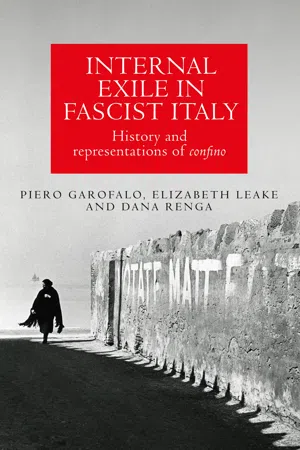
Internal exile in Fascist Italy
History and representations of <i>confino</i>
- 217 pages
- English
- ePUB (mobile friendly)
- Available on iOS & Android
eBook - ePub
Internal exile in Fascist Italy
History and representations of <i>confino</i>
About this book
This study offers a clear, concise introduction to the Fascist-era practice, know as confino, of exiling antifascist dissidents to parts of Italy far from the dissidents' homes, often on islands or in tiny inland villages. The book is organised in two sections. Part one provides a case study of the political colony on the island of Lipari and a historical overview of internal exile. Part two focuses on representations of confinement in literature and film. It examines the varieties of self-expression (e.g. memoirs, letters and literature) used by prisoners to describe their experiences, investigates how filmmakers interpret these events, places and people, and explores how film portrays the repression of homosexuality. A timely examination of the birthplace of European federalism, the book also contributes to our understanding of the legacy of confinement from both national and European perspectives.
Trusted by 375,005 students
Access to over 1.5 million titles for a fair monthly price.
Study more efficiently using our study tools.
Information
Publisher
Manchester University PressYear
2019Print ISBN
9781526163875
9780719090592
eBook ISBN
9781526133892
PART I
Context and history of internal exile
1
The Lipari colony: paradiso/inferno
Lipari
Lipari. To Sicilianise Compton Mackenzie’s Highlands, ‘inadequate indeed would be the guidebook or traveller’s tale that did not accord to Lipari a place of honour in the very forefront of Italian scenery and romance’.1 Benito Mussolini and his Chief of Police, Arturo Bocchini, professed similarly grandiose sentiments to dismiss denunciations of confino, Fascism’s extrajudiciary practice of internal exile. In fact, Bocchini went so far as to argue that bucolic settings were necessary to confinement because their very beauty served to ‘sfatare la leggenda tanto cara ai fuoriusciti italiani e alla stampa estera ostile al Regime, circa il presunto inumano trattamento ai confinati politici’.2 ([D]ebunk the legend so dear to exiled Italians and to the foreign press hostile to the Regime, that the political exiles are supposedly ill-treated.) They countered political outrage with feigned naiveté: how could such Mediterranean wonders be sites of human despair? Rather than address the material conditions of sequestration, these apologists engaged in an axiological short con that rhetorically conflated the island’s stirring landscape with the detention experiences of its prisoners.3
For those stripped of their civil liberties and confined to a liminal legal state in a secluded colony, the stark contrast between the beauty of the setting and the brutality of the conditions permitted no such delusive conflation. The juxtaposition between weal and woe is a constant in narratives that relate the confino experience. For example, Ettore Franceschini, one of Lipari’s first detainees, has a double take reaction:
Entrando a Lipari ci parve di entrare in un paradiso. Piante di rose si notavano a profusione e l’aria era profumata di zagare. Aspetto del paese come quello di una cittadina del continente sia pure piccolissima. Vedevamo qualche ‘politico’ parlare con i paesani, mentre a Favignana non era possibile conversare con nessuno del luogo, perché le donne stavano quasi sempre chiuse in casa, gli uomini, quasi tutti pescatori, non erano in paese nelle ore della nostra libertà. Poco dopo incominciammo a scoprire i rovesci della medaglia. Un paese infestato di spie, fatte venire appositamente per questo concentramento di coatti politici, spesso sotto spoglie di condannati politici, di finti fascisti dissidenti.4
(Entering Lipari it seemed as though we were entering paradise. Rose plants abounded and the scent of orange blossoms filled the air. The town was similar to little cities on the continent, even if quite small. We saw some ‘political prisoners’ talking to villagers, whereas in Favignana we couldn’t speak with any of the locals because the women were almost always shuttered in their homes and the men, almost all of them fishermen, weren’t in town during the hours we could circulate. Shortly thereafter we began to see the flip side of the coin: a town infested with spies, expressly brought among the political detainees, often under the guise of being political prisoners, of fake Fascist dissidents.)
Franceschini’s rapturous impression of Lipari soon ruptures as the imaginary paradiso succumbs to the reality of the inferno. The shattered illusions he describes are recurring motifs in the memoirs of these political prisoners.
The Regime sought to stifle such laments by classifying the colonies as essentially extraterritorial areas, shadow zones beyond the jurisdiction of national and international laws and to negate complaints by propagating its own idyllic narrative of island paradise. An improbable event, however, brought Lipari and confino to the attention of the world: Carlo Rosselli, Emilio Lussu, and Francesco Fausto Nitti’s audacious escape from the colony, on 27 July 1929.5 Thanks to the fugitives’ stirring accounts of both the oppressive conditions and their intrepid flight, the foreign press dubbed Lipari the ‘Devil’s Island’ or ‘Mussolini’s Siberia’.6 Stoking the outrage, Nitti’s American publisher, the future Mr Amelia Earhart, George Putnam, claimed to have received, on Fascist letterhead no less, death threats should he proceed with the book’s release. Even though it was a promotional ruse, this publicity stunt reinforced Anglo-Americans’ negative perceptions of both Mussolini and confino.7 Ultimately, such unwelcome scrutiny of the government’s detention practices contributed to the Ministry of the Interior’s decision to shutter the political colony after six years of operation.8 Closure was not immediate: bureaucratic morass and administrative exigencies sustained the site until 10 January 1933. During its period of activity, however, the Lipari colony held over 1,400 political prisoners: approximately 9 per cent of the national total. Its organisational and financial logistics made it the most complex colony of the confino system. Although each internal exile experience was unique, Lipari’s comparatively well-documented history elucidates the implementation and conditions of this extrajudiciary punishment as it was conceived and enacted.
The lay of the island
When the Interior Ministry began to sentence political undesirables, confinati politici, to Lipari in December 1926, the Regime was reintroducing a tradition dating back millennia to when Republican Rome had neatly coupled pleasure and penitence by utilising the isle as both a therapeutic retreat and an exile site. Largest of the Aeolian Islands both as land mass (37.29 km2) and population (14,276),9 Lipari’s proximity to the Sicilian shores (some 30 km north) ensured both separation from and accessibility to terra firma: an isolation that facilitated the Ministry’s ability to control access to the colony.
Throughout its history of continual invasions and rampant piracy, Lipari subsisted on agriculture, fishing, and pumice mining. Annexation by the Kingdom of Italy limited rather than expanded any efforts to diversify the local economy because the nascent national government designated the island as a detention site for criminals. The relegation to colonial penitentiary resulted from the promulgation of the 1863 Pica law, which imposed domicilio coatto, a policy of forced residence, on those deemed undesirable by the State.10 For the inhabitants, the presence of coatti was onerous both physically and financially. Moreover, as the scope of security legislation became increasingly aggressive in its clampdown on dissidents, the number of those interned swelled. By the turn of the century, the inefficacy and brutality of the practice led critics to launch a campaign to end it.11 The political activist Ettore Croce wrote two books criticising domicilio coatto while serving his sentence on Lipari.12 Inspired by Croce’s exposé, the writer Irma Melany Scodnik followed up with her own denunciation of detention on the Aeolian Islands.13 Eight years later, the living conditions for coatti had not improved as evinced by Zina Centa Tartarini’s account published in the Corriere della Sera’s monthly La Lettura in 1908.14
Although the colony officially closed in 1916, Lipari continued to serve as an internment site for political dissidents during the Great War. Following the Paris Peace Conference, however, the opportunity to refashion the island into a tourist destination seemed both desirable and possible. City councillor Francesco De Mauro emphasised this point on 11 October 1920:
[L]a nostra città murata potrebbe essere il sito per ospitarvi altri ospiti da noi ben voluti e da noi molto più cari. Tutto lo spazio della città murata ben sistemato, dopo sgombrate di tutte quelle vecchie cadenti luride casupole, potrebbe essere destinato a costruzione di nuove case, di qualche bello albergo e perciò utile per stimolare qui in Lipari il movimento dei forestieri.15
(Our walled city could be a place to host other guests, more welcome and important to us. After clearing out the old dirty broken down hovels, the entire walled city area, all fixed up, could be used for new houses and some nice hotels to encourage visitors here to Lipari.)
Tourism was an untapped revenue stream of which the island was in dire need. The Great War had strapped the municipality’s finances. Its nearly exclusive reliance on pumice as a funding source led to fiscal insolvency when budgetary expenses almost quadrupled while tax revenues decreased by over 70 per cent – from pre-war levels of ₤300,000 to post-war levels of ₤80,000.16 Thus De Mauro’s proposal was as much an economic development effort to diversify the tax base as it was a civic impetus to improve the living conditions on Lipari. Moreover, the de facto collapse of the Latin Monetary Union exacerbated the economic crisis, which in turn fostered civil discontent.17 Rather than address the needs and demands of the populace, the political response was an unwavering commitment to sustaining the status quo by stymying efforts to effect change. New administrative reforms, such as transferring control from local officials to a podestà, an external appointment in lieu of an elected mayor, effectively suppressed grassroots initiatives.18 In the spring of 1926, instead of the construction projects De Mauro had envisioned, the new administration began to expand the castle’s barracks and its environs (in the space that the Archaeological Museum occupies today) for discouragingly familiar purposes well before the enactment of the so-called Leggi eccezionali del fascismo. In July, a citizens’ committee sought to prevent the rehabilitation of the colony. It launched a campaign, which included soliciting the support of public figures.19 Amongst these was consummate self-aggrandiser Gabriele D’Annunzio, who sent a telegram expressing a singular solidarity with the population: ‘Siate sicuro che sosterrò col più alto fervore l’aspirazione della più bella fra le isole eolie dove io vorrei essere felicemente relegato per polire con la pomice cutulliana [sic] il mio ultimo libro’.20 (Be assured that I support with the greatest fervour the aspiration of the most beautiful of the Aeoliean islands where I would happily like to be confined to polish my latest book with Catullian pumice.) Such ambivalent empathy failed to dissuade the authorities. Tensions continued to escalate culminating in a violent anti-colony protest that caused significant property damage. In response to the civil unrest, the Commissioner of Public Security, Attilio Stagni, called for military reinforcements from Messina on 29 August 1926. Stagni had Francesco De Mauro as well as other civic leaders and protestors arrested, but Lipari’s resistance perhaps did have some effect: rather than intern criminals, the island became a political colony.21 The Prefect of Messina spun this strategic modification by reassuring the population that ‘coloro che arriveranno non sono criminali comuni né persone pericolose, ma sono persone rispettabilissime: professori, avvocati, professionisti, che anzi daranno lustro a...
Table of contents
- Cover
- Half Title
- Title Page
- Copyright Page
- Contents
- Acknowledgements
- Abbreviations
- Introduction
- Part I Context and history of internal exile
- Part II Representations of internal exile in literature and film
- Conclusion
- Select bibliography
- Index
Frequently asked questions
Yes, you can cancel anytime from the Subscription tab in your account settings on the Perlego website. Your subscription will stay active until the end of your current billing period. Learn how to cancel your subscription
No, books cannot be downloaded as external files, such as PDFs, for use outside of Perlego. However, you can download books within the Perlego app for offline reading on mobile or tablet. Learn how to download books offline
Perlego offers two plans: Essential and Complete
- Essential is ideal for learners and professionals who enjoy exploring a wide range of subjects. Access the Essential Library with 800,000+ trusted titles and best-sellers across business, personal growth, and the humanities. Includes unlimited reading time and Standard Read Aloud voice.
- Complete: Perfect for advanced learners and researchers needing full, unrestricted access. Unlock 1.5M+ books across hundreds of subjects, including academic and specialized titles. The Complete Plan also includes advanced features like Premium Read Aloud and Research Assistant.
We are an online textbook subscription service, where you can get access to an entire online library for less than the price of a single book per month. With over 1.5 million books across 990+ topics, we’ve got you covered! Learn about our mission
Look out for the read-aloud symbol on your next book to see if you can listen to it. The read-aloud tool reads text aloud for you, highlighting the text as it is being read. You can pause it, speed it up and slow it down. Learn more about Read Aloud
Yes! You can use the Perlego app on both iOS and Android devices to read anytime, anywhere — even offline. Perfect for commutes or when you’re on the go.
Please note we cannot support devices running on iOS 13 and Android 7 or earlier. Learn more about using the app
Please note we cannot support devices running on iOS 13 and Android 7 or earlier. Learn more about using the app
Yes, you can access Internal exile in Fascist Italy by Piero Garofalo,Elizabeth Leake,Dana Renga in PDF and/or ePUB format, as well as other popular books in Politics & International Relations & Italian History. We have over 1.5 million books available in our catalogue for you to explore.