Drawing on over 150 interviews with former IRA, INLA, UVF and UFF prisoners, this is a major analysis of why Northern Ireland has seen a transition from war to peace. Most accounts of the peace process are 'top-down', relying upon the views of political elites. This book is 'bottom-up', analysing the voices of those who actually 'fought the war'. What made them fight, why did they stop and what are the lessons for other conflict zones?
Using unrivalled access to members of the armed groups, the book, available for the first time in paperback, offers a critical appraisal of one-dimensional accounts of the onset of peace, grounded in 'mutually hurting stalemate' and 'ripeness', which downgrade the political and economic aspects of conflict. Military stalemate had been evident since the early 1970s and offers little in explaining the timing of the peace process. Moreover, republicans and loyalists based their ceasefires upon very different perceptions of transformation or victory.
Based on a Leverhulme Trust project and written by an expert team, Abandoning Conflict offers a new analysis, based on subtle interplays of military, political, economic and personal changes and experiences.
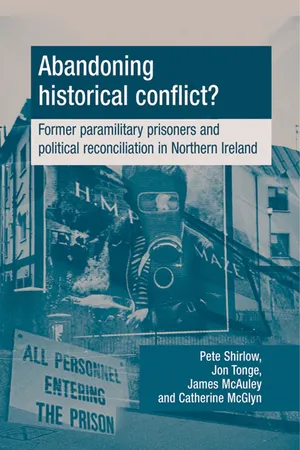
eBook - ePub
Abandoning historical conflict?
Former political prisoners and reconciliation in Northern Ireland
- 195 pages
- English
- ePUB (mobile friendly)
- Available on iOS & Android
eBook - ePub
Abandoning historical conflict?
Former political prisoners and reconciliation in Northern Ireland
About this book
Information
Publisher
Manchester University PressYear
2013Print ISBN
9780719087448
9780719080111
eBook ISBN
9781847797537
1 Politically motivated prisoners in Northern Ireland
Long after the signing of the 1998 Good Friday Agreement – hereafter the Agreement – in Northern Ireland, the far-reaching consequences envisaged in the consociation of the competing political groupings of Ulster unionism and Irish nationalism became manifest. A long and tortuous path led to the formation of an inclusive coalition government headed by the supposed political extremes of the Democratic Unionist Party (DUP), representing the Unionist-British position, and Sinn Fein (SF), part of the wider Irish republican movement.
The formation of a DUP-Sinn Fein dominated coalition followed a long-term decline in politically motivated violence, with cessations and virtual disbandment from the main combatant groups. The Provisional Irish Republican Army (IRA) destroyed its arsenal and formally ended its armed campaign in 2005; the Ulster Volunteer Force (UVF) formally renounced violence and dissolved its military structures. Even the most reticent of the major groupings, the Ulster Defence Association (UDA), has engaged in processes of conflict transformation and disbanded the Ulster Freedom Fighters (UFF), its overtly military wing. The Irish National Liberation Army (INLA), although opposed to the Agreement, has also disengaged from politically motivated violence.
In the light of such dramatic change there has been a general focus upon formal party political leaderships as the agents of transformation. Analysis at the elite level obscures an appreciation of the efforts, structures and approaches taken at grassroots level to uphold and sustain conflict transformation and a reduction in violence (Shirlow and McEvoy 2008). Yet, as we argue in Chapter 2, via an analysis of other conflictual arenas, the delivery, impact and prospects of transformation are best aided when the issue of political prisoners and the evaluation of them as peace-builders are prominent within peace negotiations. Moreover, a failure to fully comprehend and explain the political and peace processes in Northern Ireland without adequate evaluation of the role played by former prisoners, amounts to an incomplete analysis.
In assessing the role played by former non-state combatants in conflict transformation we have obtained significant access to those former prisoners, many of whom are engaged in processes of societal transition. These former combatants have provided evidence regarding their own political and combatant biographies, the reasons for their involvement in conflict and their roles in transforming war into peace. In both personal and structural terms there is evidence of former combatants working to diminish the political tensions that remain as a result of the long-term inter-communal hostility developed across decades of violence. However, the evidence produced indicates that former combatants involved in personal and group transformation do so without discarding key ideological goals and interpretations. Moreover, we suggest that ideological antipathy remains intact and in this respect the past has ‘not’ been abandoned. Nonetheless a more pragmatic approach to the articulation and advancement of ideological goals has been adopted.
Analysis of post-conflict violence generally examines renewed conflict between enemies, the rise of dissidents opposed to peace-making initiatives and those who morph into criminal gangs (Keen 2001; Moran 2004). In South Africa and Serbia some paramilitaries sought the maintenance of status through ‘punishment’ violence, revenge or extensive criminality. Dowdney (2005) argues that such violence maintained lost status, while Stedman (1997) and Boyce (2002) assert that dissenters aim to ‘spoil’ what they view as unjust peace accords. In the condemnation of former prisoners in Northern Ireland, via media sources and the legal structures of criminalisation, there is insufficient space dedicated to how these former combatants have smoothed and guided the transition to conflict transformation and not acted in the deleterious manner found in other conflicts. No one doubts that there are elements within the former prisoner community who dissent from peace and practice criminal activity but the constant reference to the ‘ruthlessness’ of former prisoners and the presentation of them as ‘psychotic’ or ‘deluded’ depoliticises the meaning of conflict and its transformation in Northern Ireland (Arena and Arrigo 2006).
In making such an assertion, we do not naively eulogise non-state combatant actions, nor are we ‘ivory tower’ academics removed from the harsh realities of conflict. Instead, we argue that it is important to study conflict transition in an inclusive manner that includes those who were involved in violence. There is also a responsibility among academics to lift the cover off uncomfortable realities and in so doing challenge the fiction of blamelessness that is part of the general body politic.
In the fascination with violence and victims much of what is understood about conflict and former political prisoners is purposely intangible. Loyalism, for example, has been presented as an ‘idiocy that comes with a fragmented culture that has lost both memory and meaning’ (Howe 2005: 2). In other readings, republicanism is capable and loyalism is deemed as ‘lacking’. As noted by Alison (2004: 447) ‘liberatory’ forms (Irish republicanism) also usually incorporate fairly wide-ranging goals of social transformation as part of their political programmes, while state and pro-state nationalisms (loyalism) do not.
Those who reject loyalism and republicanism see both as having failed to promote the positive in terms of their identity and actions. The realities of former prisoner groups challenging interface violence, building social capital, defying criminality and racism and removing those opposed to peaceful accord are hidden behind a plethora of negativity. In challenging such negative portrayals it is important to locate the arenas within which former prisoner groups have led conflict-transformation initiatives, have done much to quell elements intent upon a return to conflict, have created networks that encourage dialogue with former adversaries, have undermined the efficacy of violence as a rational practice and have developed links with statutory agencies in order to encourage social justice and accountability (Shirlow and McEvoy 2008). Such a transitional role, as discussed in Chapter 7, is under-explored despite these transitions being crucial with regard to ending victimisation, encouraging citizenship and removing threat.
As argued in Chapters 3 and 6, the capacity to shift loyalism and republicanism into the realm of transition has generally come from among adherents to those ideologies and has not been based upon an imposition of state or wider political authority. Transitional attitudes and models are being advanced by former political prisoner groups, effecting a shift from a destabilising past. However, the internal and organic nature of conflict transformation and the models being advanced by former prisoners, which have an international appeal and resonance, remain obscured by the unconstructive representation of former prisoners, who are often deemed as ‘all that is wrong’ with Northern Ireland.
The outplaying of conflict transformation also, as shown within this book, is not based upon simplistic ideas that concern a ‘mutually hurting stalemate’, in which combatants fought each other to a standstill before ‘coming to their senses’, but instead is led by those formerly engaged in conflict, who are taking responsibility in the design and rolling out of post-conflict solutions. This is achieved without acceding to an alternative ideology or accepting the past as ‘illegitimate’, but instead is fused around maintaining core values of social inclusion, human rights and inter- and intra-community challenge. Former prisoner groups are dealing with the issues that caused and reproduced conflict through identifying the healing of society via inclusion. Attitudes towards the peace process do not relate directly to academic determinations of conflict and peace-building, as they remain grounded in much closer experiences of conflict. The interpretation of moving out of violence is not understood as a process of ideological ‘ditching’ or the emergence of a ‘mutually hurting stalemate’ (Zartman 2003a) but of the development of tactics and the impact of conflict upon opening up means to promote republican and loyalist discourse.
For IRA respondents, violence engendered the peace process in two ways. First, it had forced the British state into adopting anti-discrimination legislation and second, the IRA had elicited an acceptance by the British state that they were a political organisation rather than common criminals, a perception epitomised by early releases under the provisions of the Agreement. Loyalist respondents argued that their violence had stalled republicans and upheld the constitutional link. Ironically these differing perspectives, rather than an acceptance of a mutually hurting stalemate, achieved the capacity to move beyond violence. In sum, the use of violence was not rejected via a primarily moral concern, although that was for many respondents important, but instead conditioned by a sense that it had bolstered negotiating entry ‘rights’, as evidenced by the Manchester bombing in 1996, the largest bomb ever used by the IRA. This legitimacy had been ‘proven’ as opposed to ‘defeated’.
Conflict transformation and the maintenance of ideology
This study considers the extent to which former political prisoners ‘abandoned’ the ideological compass, which ‘legitimised’ violence. Much has been written concerning the ‘ditching’ of ideological beliefs in the pursuit of peace. For example, in Gunsmoke and Mirrors (2008) the journalist Henry McDonald writes of the IRA as those engaged in a 360 degree turn in mainstream republican ideology, one which has been associated elsewhere with cunning and deception exercised by the Sinn Fein leadership, against hapless members of the IRA and the Sinn Fein grassroots, to a level which would make Machiavelli look like an amateur (McIntyre 2008; Moloney 2002: see also Alonso 2006; McIntyre 1995, 2001; Patterson 1997; White 2006).
Among the extensive range of interviews conducted there is was a near complete rejection that the peace process and demilitarisation was either a rejection of violence as being terrorist-inspired and that previous military activity lacked ideological reason (Alonso 2006) or that the discursive value of loyalism or republicanism had been abandoned (McInytre 1995, 2001, 2008). Among republicans there was an acceptance of Bean’s argument that the nature of demilitarisation was paralleled by the socio-economic shaping of contemporary Northern Ireland and the ‘complexities of this relationship between movement and community’ (Bean, 2007: 13). For loyalists the sense that republicanism was defeated militarily is presented as having endorsed both violent enactment and a cessation of that violence. It is worth noting that those who have claimed that the IRA has ditched their ideological beliefs usually produce evidence to support this argument from those dissatisfied with, or dismissive of, ‘transitional’ tactics (McIntyre 2008; Moloney 2002; Rolston 1989; Ryan 1994; Shirlow and McGovern 1998). The account presented within this book pertains to a wider array of voices and includes ideas and opinions that are not necessarily scripted by the leadership of respective movements (see also English 2003, 2006). This volume produces a more heterogeneous account that highlights the broad range of ideas and perspectives located among former loyalist and republican prisoners.
In examining the nature and intent of loyalism and republicanism, the differing electoral fortunes of each movement provides a dichotomy of achievement in wider political terms. Republican consciousness, as it pertained to demilitarisation and demobilisation of the IRA, has been closely allied to the fortunes of Sinn Fein, although not all former IRA prisoners are supportive of that particular political party. For loyalism, the comparably low level of political representation, confined to Progressive Unionist Party (PUP) and independent councillors, plus a solitary Assembly member (Dawn Purvis) means that the role played by former loyalist prisoners is located mostly in conflict transformation work.
Among former IRA prisoners the rejection of ideological ditching is accompanied by a presentation of tactical shifts as key to a wider explanation of transition and transformation. Thus tactical awareness, whether that has involved the use of violence, serving in the Northern Ireland Assembly (in a still-partitioned Ireland) or campaigning for the promotion of equality, is mutually inclusive and seen as part of a long-term strategy that will gain Irish unification. These attitudes form part of a broader teleology associated with republicanism in which the end of history – a united Ireland – remains achievable even if military impulses disappear for periods (Smith, 1995). Republican belief in ultimate success does not deny the complexities of post-conflict political, cultural and social practice, nor does in dismiss the unevenness of the struggle at times, but there were constant reminders during interviews with former IRA prisoners, that present strategies are tied to an unambiguous, verifiable and long-term ideological intent. In sum, former IRA prisoners contend that it is not the constitution of republican ideology that has shifted, but the practice of ideology and alternative methods that have been allied to what is a potentially more ‘successful’ political and community strategy (Adams 1995; Maillot 2004).
Conflict transformation is interpreted within loyalism as a process of contestation within and beyond loyalism. Conflict is understood as not only removing violence but also challenging the wider social arenas of ethno-sectarian disputation linked to suspicion, mistrust and the need to develop human rights agendas for working-class communities. Transformation is generally about establishing relationships that challenge inequitable social, cultural and political definitions and categories and in so doing promoting Protestant working-class identities that stretch beyond sectarian renditions and practices. As with republicans the goal of contemporary activism has not been based upon ideological ditching, but instead the enveloping of loyalist ideas into changing conditions and solutions. This is an important point in that it undermines the idea of former prisoners as merely ‘criminals’ and helps construct a more accurate understanding of how tactics and ideas are shaped by conflict, wider social changes and through the reasoning that the deliverance of democratic accountability requires the consent and approval of adversaries both within and beyond each respective community. As noted by Shirlow and Monaghan (2006: 3):
The desire to prevent future occurrences of violent disunity has been divided into two general perspectives. Firstly, a conflict transformation perspective encourages an analysis of the antecedents of conflict as a way out of disagreement. Secondly, seeking out better ways to represent loyalism within a process of capacity building has also emerged. Additional features include lifting loyalism out of insularity and into a host of civic and inter-community based relationships; developing better relationships with government and statutory agencies; promoting restorative justice schemes; creating alternative community narratives which link loyalism into a post-ceasefire process; and challenging the mythic status of violence and in so doing diverting youth attention away from paramilitaries and sectarian violence.
An important factor in the promotion of non-violence is the extent to which post-conflict approaches are found to be credible among the rank and file. Credibility has been important with regard to dissuading a return to violence, as it provides legitimacy to anti-violence discourse, but operates as a further example of the internally generated transition. Given the internalised nature of transition and the dominance of narratives that have examined peace-building in Northern Ireland, at the elite level, this book is based upon developing and accounting for personal experiences of former prisoners in order to determine more about the nature of non-state combatant violence and the endorsement of peaceful former prisoner activity. The interview work undertaken aimed to determine; the reasons for joining a paramilitary organisation; the influence of imprisonment in terms of abandoning, developing or acquiring ideological beliefs; examining if support for past actions has been diminished, reinvented or remains constructed around contested interpretations of ‘truth’ and legitimacy; determining the post-imprisonment support base for - or rejection of - former political prisoners and how this has shaped the capacity and meaning of post-conflict transformation and appreciating and explaining the development of political and community leadership strategies by former political prisoners.
Two further objectives are developed. First, as discussed in Chapters 2, 6 and 7, the development of former prisoner groups was tied to promoting ideological beliefs via community activism and the role of former political prisoners as ‘organic intellectuals’ (Cassidy 2005, 2008). Second, as shown in Chapter 3, the presentation of loyalist and republican discourses relates to wider interpretations of conflict and peace-building, in terms of countering ‘traditional’ models of conflict cessation, the relationship with political elites and the balance between endogenous and exogenous factors in achieving conflict transformation.
Studying former politically motivated prisoners
This is the largest study of republican and loyalist former prisoners undertaken via qualitative analysis. Former prisoner groups who provided a gatekeeping role to access groups and individuals greatly aided the study. Using gatekeeper organisations ensured that all respondents were former prisoners. Moreover, the views expressed by respondents did not merely mimic group interpretations as a range of different experiences, criticisms and viewpoints emerged. We did not seek approving or disapproving voices regarding the development of the peace process, but instead aimed to cover a range of perspectives and viewpoints from within these groups. The approach undertaken sought to determine if ideas regarding legitimacy and the past amounted to ideological change, adaptation or political pragmatism. Evidently, there has been insufficient work on this regarding former combatants and we reached 147 respondents to maximise the number of prisoner voices on which to construct academic analysis.
The first phase of contact was based upon developing and explaining the research themes to the following prisoner groups: Coiste na Ichimi (Provisional IRA); EPIC (UVF/Red Hand Commando); Charter (UDA/UFF) and Teach na Failte (INLA). The second phase of analysis involved a range of semi-structured interviews and focus group work. In sum, eighty-seven republicans and sixty loyalists were involved in interviews and of these around three-quarters of all interviews and meetings were recorded. Interviews and focus groups also included women and had a geographical spread, including fourteen focus groups in South Derry, Derry City, South Armagh, Belfast and Armagh City. Other focus groups and interviews were conducted with serving IRA prisoners in Roscrea, members of Sinn Fein and that organisation’s ard chomairle (executive) and the PUP and its executive.
The study centred on an inductive approach, which examined the nature of narrative and ideology among former prisoners. We aimed to test the experiences and narratives of being former combatants with regard to the complexities of the shifting out of violence and whether such a shift was tied to ideological ‘ditching’, or the use of ideology to confirm the movement away from armed violence. Research themes were initially agreed and debated with former prisoners groups so that the emergent narratives would guide the research objectives beyond those already set.
A semi-structured schedule of questions was utilised in order to permit each respondent’s voice to emerge. This study contributes to an awareness of the meaning of belief and experiences from the perspective of combatants who are considered as individuals. The primary means of research involved interviews with individuals in order to ensure that they express freely given attitudes. These interviews were centred upon the respondent’s responses to a known situation (conflict/imprisonment/post-conflict) and how they perceived concepts of narrative and ownership so vital in interpreting violence and the post-conflict situation. The research undertaken was exploratory in nature and not an attempt to provide definite truths, but instead to explore the motivations, significance and consequences of a transition from armed conflict to non-violence and the maintenance or rejection of key political goals.
In terms of acquiring specific information on the geographical spread of former prisoners and information on gender and age there was, perhaps surprisingly, a dearth of information from official sources and the precise number of prisoners jailed for ‘political’ offences during the conflict is unknown. The prisoner groups themselves do not have exact records. The use of a qualitative approach aimed to not only fill a void in academic discussion of former prisoners from within both loyalism and republicanism but to also evaluate how language constructs social relations and the consti...
Table of contents
- Cover Page
- Title Page
- Copyright Page
- Contents
- Acknowledgements
- List of abbreviations
- Introduction
- 1 Politically motivated prisoners in Northern Ireland
- 2 Former prisoners in a global context
- 3 Political views and understandings
- 4 Imprisonment, ideological development and change
- 5 Political and tactical change among former prisoners
- 6 Conflict transformation and changing perceptions of the ‘other’
- 7 Former prisoners and societal reconstruction
- Conclusion
- Bibliography
- Index
Trusted by 375,005 students
Access to over 1.5 million titles for a fair monthly price.
Study more efficiently using our study tools.
Frequently asked questions
Yes, you can cancel anytime from the Subscription tab in your account settings on the Perlego website. Your subscription will stay active until the end of your current billing period. Learn how to cancel your subscription
No, books cannot be downloaded as external files, such as PDFs, for use outside of Perlego. However, you can download books within the Perlego app for offline reading on mobile or tablet. Learn how to download books offline
We are an online textbook subscription service, where you can get access to an entire online library for less than the price of a single book per month. With over 1.5 million books across 990+ topics, we’ve got you covered! Learn about our mission
Look out for the read-aloud symbol on your next book to see if you can listen to it. The read-aloud tool reads text aloud for you, highlighting the text as it is being read. You can pause it, speed it up and slow it down. Learn more about Read Aloud
Yes! You can use the Perlego app on both iOS and Android devices to read anytime, anywhere — even offline. Perfect for commutes or when you’re on the go.
Please note we cannot support devices running on iOS 13 and Android 7 or earlier. Learn more about using the app
Please note we cannot support devices running on iOS 13 and Android 7 or earlier. Learn more about using the app
Yes, you can access Abandoning historical conflict? by Peter Shirlow,Jon Tonge,James McAuley,Catherine McGlynn,James W. McAuley in PDF and/or ePUB format, as well as other popular books in Politics & International Relations & Comparative Politics. We have over 1.5 million books available in our catalogue for you to explore.