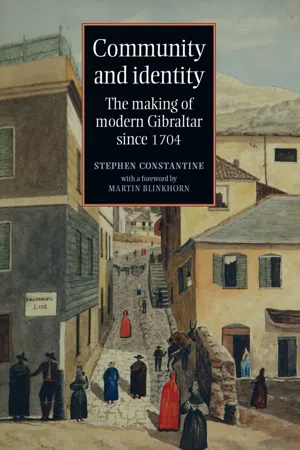
This fluent, accessible and richly informed study, based on much previously unexplored archival material, concerns the history of Gibraltar following its military conquest in 1704, after which sovereignty of the territory was transferred from Spain to Britain and it became a British fortress and colony.
Unlike virtually all other studies of Gibraltar, this book focuses on the civilian population. It shows how a substantial multi-ethnic Roman Catholic and Jewish population derived mainly from the littorals and islands of the Mediterranean became settled in British Gibraltar, much of it in defiance of British efforts to control entry and restrict residence.
With Gibraltar's political future still today contested this is a matter of considerable political importance. Community and identity: The making of modern Gibraltar since 1704 will appeal to both a scholarly and a lay readership interested particularly in the 'Rock' or more generally in nationality and identity formation, colonial administration, decolonisation and the Iberian peninsula.
- 450 pages
- English
- ePUB (mobile friendly)
- Available on iOS & Android
eBook - ePub
About this book
Information
Publisher
Manchester University PressYear
2013Print ISBN
9780719080548
9780719076350
eBook ISBN
9781847796943
1
The demographic roots of Gibraltarian identity, 1704–1819
The majority of those currently living in Gibraltar, and many of the Gibraltar-born who live outside, regard themselves as Gibraltarians, with a culture and identity sufficiently distinctive in their eyes to qualify Gibraltar as a nation. This is today repeatedly asserted, and it is a main aim of this book to explore and explain the origins of this self-perception. Undoubtedly its roots and nature are plural, but among its most important origins and character lies the ethnic make-up of the population. It is a convention among Gibraltarians and many outside commentators to stress the multiple origins of the population, and to indicate that one distinguishing characteristic is therefore its mix of ethnicities. Gibraltarians, it is said, are or were by origins, among others, British, Spanish, Genoese, Minorcan, Maltese, Portuguese, Jewish and more recently Indian and Moroccan, and they are distinguished either by the blend consequent on intermarriage or at least by mutual respect and toleration.
It is not the intention of the demographic chapters of this book to dispute this outcome. Rather, they seek to question the assumption implicit in some explanations that this result has just been the happy result of the propinquity in a confined space of a population of immigrants over the past three centuries. The argument will be advanced that much which explains the demographic roots of Gibraltarian identity has been a consequence, until lately largely unintended, of managerial practices by governments.
The analysis offered is divided into three chronological chapters, 1704–1819, 1815–1890s, and from the 1890s to the present.1 It will be argued, perhaps unexpectedly, that the most important phase for the emergence of the distinctive contribution of demography to Gibraltarian identity was the first century or so of British political control. It was then that the transfer of territorial sovereignty to Britain was secured and, just as important, confirmed, and in the same period substantial numbers of people from several places of origin sought to enter and settle. As a consequence, the first fumbling attempts were made by government to control entry into Gibraltar and to determine and manage rights of permanent and temporary residence. The discriminatory practices then figured out were to be reviewed and revised, very importantly, in subsequent stages, but it was during this first phase of British political control that actions were taken to address the issues which were to determine all subsequent amendments. In sum, it was in this period that the basic demographic prompts for a Gibraltar identity were largely laid down – a population of multiple origins coping with government policies which distinguished between ethnicities and yet treated more or less all civilians as subordinates under military and colonial surveillance.
War and the partition of Gibraltar, 1704–5
The first prompt to a distinctive Gibraltar identity was the failure – not success – of the military expedition of 1704. It needs to be remembered that the European war which broke out in 1702 was a war to determine the succession to the Spanish throne following the death without direct heir of King Charles II. The Bourbon domination of Western Europe and of the Mediterranean seemed to other European nations the likely outcome if Louis XIV of France secured the succession for his grandson, Philip, Duke of Anjou. Hence the traditional enemies of the Bourbons formed an alliance in support of the alternative claimant, the Habsburg Archduke Charles. In August 1704 and as part of a strategy to rouse Spanish backing for the Habsburg succession, an allied army, mainly Dutch and English troops led by Prince George of Hesse-Darmstadt as the Archduke’s representative, in conjunction with an Anglo-Dutch fleet under the command of Admiral Sir George Rooke, laid siege to the Spanish fortress on the north-west corner of the Spanish peninsula of Gibraltar. Once the fort and harbour were secured in the name of ‘King Charles III’ of Spain, the intention was to leave Gibraltar behind and move inland from that base into Andalusía, obtain Spanish popular backing and place Charles on the Spanish throne.2
However, many Spaniards were alienated from the Habsburgs and sided with the Bourbons, not least because their Catholic sentiments were offended by the strong Protestant element in the allied forces and by news from Gibraltar (and earlier from Cádiz) of their disorderly behaviour and degradation of Catholic shrines.3 Moreover, reinforced Bourbon forces were robust enough to counter-attack and threaten allied control of Gibraltar. While not strong enough to recapture the fortress in the winter and spring of 1704–5, they were sufficiently powerful to confine allied forces to the peninsula. In these circumstances, making the best of a bad job, the British (no longer just the English after the political union with Scotland took effect on 1 May 1707) revived an old ambition and began to reconceive of Gibraltar not as the launch pad for the allied ‘liberation’ of Spain but as a more particular British base for controlling the western end of the Mediterranean. Whereas the first governors of the fortress were Habsburg appointments chosen by Hesse, those from 1707 were selected by the British to serve their interests. Moreover, the allies became more ambivalent about the Habsburg cause in Spain when, in April 1711, the Habsburg Emperor Joseph died and his brother the Archduke Charles inherited his vast central European empire as Charles VI.4
The transfer of management to Great Britain was then confirmed at the peace negotiations in 1713 when the British insisted that sovereignty over the Gibraltar peninsula must pass from Spain to Britain.5 This was not a loss which the Bourbon kings of Spain, nor seemingly many Spanish people, were then or later willing to tolerate. Although the counter-attacks in 1704–5 had failed, the siege attempted in 1727 confirmed Spanish indignation at the loss. It is true that British ministers on several subsequent occasions seriously contemplated withdrawing from Gibraltar in return for territorial compensation elsewhere, but this, always difficult enough in terms of domestic and international politics, became even less likely when British political sentiment more generally became attached to retaining ‘British’ Gibraltar. By the end of the century, the boost to British national pride generated by General Eliott’s impressively successful defence of Gibraltar in the ‘Great Siege’ of 1779–83, in the otherwise dismal War of American Independence, made it even less likely that any British government could abandon the ‘Rock’. Later, British support for Spanish resistance to Napoleonic France from 1808 was real enough and helped to secure Spanish independence, but at the Congress of Vienna in 1815 the triumphant British were never likely to hand back to Spain a fortress and naval base which during twenty-odd years of warfare had proved strategically useful. As a result, in the post-war years the British government confirmed its control over little more than two square miles of territory connected by a sandy isthmus to mainland Spain.6
The peninsula and the Campo de Gibraltar had of course been fought over several times in previous centuries. Conventionally, the attack in 1704 is described as the eleventh siege. But the unprecedented consequence in 1704 was the partition of Gibraltar. At no other time had the peninsula of Gibraltar been separated from its extensive hinterland. Gibraltar the fort and town, limited in territory, small in population and lacking resources, had in the past been serviced economically by its intimate connection with a much more extensive province, an agricultural area replete with livestock and vineyards, and by the same source it had been supplied demographically.7 Population movement into and out of the town, like the sale of goods and services, had been affected only by market conditions; and the cultural identity of civilians resident at either end of the isthmus had been indistinguishable. But the allied occupation in 1704 and the transfer of sovereignty over the peninsula to Great Britain introduced a political frontier. It severed conventional ties, complicated exchanges, and generated for the new British military owners of the amputated peninsula immense managerial problems. However, new ownership also presented opportunities for mobile or ambitious or displaced civilians, and their arrival was a prerequisite – over the long term – for the formation of a distinctive Gibraltarian identity.
Opportunities for immigrants
Military garrisons, wherever located, normally need and usually attract a civilian population, to provide supplies, labour and other ‘personal’ services. This
British Gibraltar needed repopulating. In the eighteenth century, the peacetime military garrison fluctuated in numbers from a minimum of just over 1,100 to a maximum of around 5,000, stabilising at about 3,000 in the early had been true of Gibraltar under Moor and Spaniard. However, as noted, a consequence of the allied occupation of the peninsula in 1704 was to break the established connections with the people and resources of the mainland. Compounding this difficulty, the allied occupation in 1704 prompted the exodus from Gibraltar of virtually all the resident civilian population. True, such departures had happened on previous occasions in Gibraltar’s history when new regimes took over after successful sieges, as in 1309 and 1333.8 But this time the civilian population’s concerns for their safety under British control were compounded by not unreasonable fears of mistreatment by Protestant troops. Most Catholics, perhaps 1,500 families, maybe 5,000–6,000 people, transported themselves and their movables across the new frontier to the Campo de Gibraltar, and especially to San Roque.9 A British officer listed the names of those few Spanish who remained and were still resident in 1712. There were twenty-five family groups and sixteen individuals, including a couple of friars and two Catholic priests, possibly as few as 70 people, or 120 at most, such as Francisco de Tapia and Mariana de Mendoza and the families of Gonzalo Romero and Diego Lorenzo, plus Father Juan Romero de Figueroa, born in Gibraltar in 1646, who recorded the events of the siege and of the counter-attack in the church registers.10 nineteenth century (plus wives and children), but boosted according to the needs of war.11 This may not appear a large force, but it was then among the most substantial of Britain’s overseas military establishments. While soldiers were their own labour force, civilian labourers and skilled craftsmen were also required, and officers with families certainly needed servants. Recreational needs generated other demands – the thirst of soldiers for liquor and other comforts being notorious compensations for military life in barracks. Supplies of food and indeed of water were also needed and, since insufficient could be squeezed out of the peninsula’s rocky terrain, civilian traders had to be persuaded to ship in stuff or somehow to bring it in overland. There was also the opportunity for settlers to occupy vacated property which had fallen to the crown on annexation and was now available for lease and perhaps for purchase. Wealthy residents attracted more immigrants as servants, labourers and other employees. The military administration also benefited from civilians who might provide revenue, for example from licences, leases and ground rents, to offset the costs of rule. Some governors, especially in the early decades, had an additional interest in allowing almost anyone to take up residence who would buy leases and pay fees, legitimate or otherwise, from which those in authority enhanced their rewards of office.
Accordingly, inducements were offered to persuade merchants and workers to sell their goods and services in Gibraltar and even to take up residence in the town. This had been done before in Gibraltar’s history, for example in 1310 when the Spanish government sought to populate the place by providing liberty for convicted criminals and other ne’er-do-wells. The allies opted instead for another precedent, also in the Spanish charter of 1310 and confirmed in that of 1469. In July 1705 the Prince of Hesse-Darmstadt, on behalf of ‘King Charles III’, had declared Gibraltar to be a ‘free port’, and this status was confirmed by Queen Anne’s government in a proclamation published in Gibraltar in April 1706.12 Because thereafter most goods could be shipped in and out of Gibraltar without the payment of duties (though port dues and other service charges might be levied), it was hoped that entrepreneurs would be attracted to settle on the Rock by the prospects of supplying the garrison and of trading across and into the Mediterranean and with Britain, or even into Spain, though normally the last, by land, was supposedly banned by the Treaty of Utrecht.13
In sum, for their own needs, British authorities needed to attract civilians to Gibraltar either on a daily basis or as permanent residents. Even before the Treaty of Utrecht and increasingly thereafter, civilians began to reoccupy the town. However, there is good evidence to show that for those in charge the preferred immigrants, residents, merchants and property owners were ideally Protestants and British.
Military security, controls and surveillance
It was not to be expected that entry would be free and easy for all. The British had only recently taken control of a fortress liable to face siege, as had been demonstrated by their own attack and by subsequent Spanish challenges. Moreover, what might be defended from outside assault had also to be protected from inside subversion. Military security was and therefore remained for the British authorities a pressing managerial issue. For civilians seeking entry, and especially residence, the physical and bureaucratic barriers they encountered would repeatedly confirm their subordination to British military control and surveillance. There would also be discrimination by the British in how components of the civilian community were treated. Such fragmentation would handicap the development of a community and therefore delay the evolution of a distinctive sense of a collective self.
The British took over a town largely squeezed within the walls of a fortress. The allies had succeeded in breaching the walls in 1704, but subsequently the fortifications had been extended and made more formidable. Nature had provided security on the unassailable eastern face and north-eastern corner of the Rock.14 Additional investment turned the north front, facing mainland Spain, into a formidable sequence of walls, towers, a ditch and a glacis, running down from Rock to sea. From there along the west at the water’s edge ran a wall, punctuated with bastions and towers. Further walls bisected the peninsula to the south of the main settlement, running inland from the sea to the crest of the Rock. Approaches to this protective circuit around the town were guarded by fortifications above the beaches to the south, while on the isthmus to the north only two routes led to the walls of the fortress, one from Eastern Bay, over which towered the walls, and the other to the west, going past a fortified outpost and along a narrow causeway hemmed between the sea and an artificially deepened lagoon. Entrances through the walls and into the fortress and town were restricted to three fortified gates, Landport, Waterport and Southport.15 The governors of British Gibraltar were always military men (until recently) and commanders-in-chief of the garrison, and accordingly in the i...
Table of contents
- Cover Page
- Title Page
- Copyright Page
- Dedication
- Contents
- List of tables
- List of abbreviations
- Map of Gibraltar, 1952
- Foreword by Professor Martin Blinkhorn
- Introduction
- 1 The demographic roots of Gibraltarian identity, 1704–1819
- 2 A fortress economy, 1704–1815
- 3 Government and politics, 1704–1819
- 4 Demographic management: aliens and us, 1815–1890s
- 5 Economy and living standards in the nineteenth century
- 6 Governors and the governed, 1815–1914
- 7 Demography and the alien in the twentieth century: creating the Gibraltarian
- 8 Earning a living in the twentieth century
- 9 Government and politics in the twentieth century, 1915–40
- 10 Big government and self-government, 1940–69
- 11 Towards the future: constructing a Gibraltarian Identity
- Sources and select bibliography
- Index
- Footnotes
Trusted by 375,005 students
Access to over 1.5 million titles for a fair monthly price.
Study more efficiently using our study tools.
Frequently asked questions
Yes, you can cancel anytime from the Subscription tab in your account settings on the Perlego website. Your subscription will stay active until the end of your current billing period. Learn how to cancel your subscription
No, books cannot be downloaded as external files, such as PDFs, for use outside of Perlego. However, you can download books within the Perlego app for offline reading on mobile or tablet. Learn how to download books offline
Perlego offers two plans: Essential and Complete
- Essential is ideal for learners and professionals who enjoy exploring a wide range of subjects. Access the Essential Library with 800,000+ trusted titles and best-sellers across business, personal growth, and the humanities. Includes unlimited reading time and Standard Read Aloud voice.
- Complete: Perfect for advanced learners and researchers needing full, unrestricted access. Unlock 1.5M+ books across hundreds of subjects, including academic and specialized titles. The Complete Plan also includes advanced features like Premium Read Aloud and Research Assistant.
We are an online textbook subscription service, where you can get access to an entire online library for less than the price of a single book per month. With over 1.5 million books across 990+ topics, we’ve got you covered! Learn about our mission
Look out for the read-aloud symbol on your next book to see if you can listen to it. The read-aloud tool reads text aloud for you, highlighting the text as it is being read. You can pause it, speed it up and slow it down. Learn more about Read Aloud
Yes! You can use the Perlego app on both iOS and Android devices to read anytime, anywhere — even offline. Perfect for commutes or when you’re on the go.
Please note we cannot support devices running on iOS 13 and Android 7 or earlier. Learn more about using the app
Please note we cannot support devices running on iOS 13 and Android 7 or earlier. Learn more about using the app
Yes, you can access Community and identity by Stephen Constantine in PDF and/or ePUB format, as well as other popular books in History & British History. We have over 1.5 million books available in our catalogue for you to explore.