- 256 pages
- English
- ePUB (mobile friendly)
- Available on iOS & Android
eBook - ePub
About this book
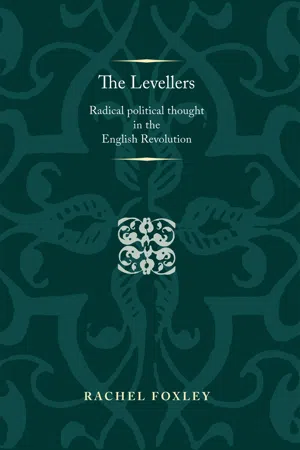
The Leveller movement of the 1640s campaigned for religious toleration and a radical remaking of politics in post-civil war England. This book, the first full-length study of the Levellers for fifty years, offers a fresh analysis of the originality and character of Leveller thought. Challenging received ideas about the Levellers as social contract theorists and Leveller thought as a mere radicalisation of parliamentarian thought, Foxley shows that the Levellers' originality lay in their subtle and unexpected combination of different strands within parliamentarianism. The book takes full account of recent scholarship, and contributes to historical debates on the development of radical and republican politics in the civil war period, the nature of tolerationist thought, the significance of the Leveller movement and the extent of the Levellers' influence in the ranks of the New Model Army.
Information
Publisher
Manchester University PressYear
2016Print ISBN
9780719096600
9780719089367
eBook ISBN
9781526112088
Chapter 1

Consent and the origins of government
The Levellers are often credited with a ground-breaking social contract theory: believing that England’s civil wars and political conflicts had reduced the nation to a state of nature, they devised an entirely new means of reconstituting a polity out of the mass of newly ungoverned individuals. They did this by drawing up an ‘Agreement of the People’, to be subscribed by individuals, setting out the extent and nature of the powers which the people agreed to transmit to their future governors. On this view, the Levellers not only produced the first proposed written constitution for England (albeit one which was never implemented), but did so by bringing out of the fictive past the original act of consent which, in parliamentarian theory, was the foundation of all legitimate government. The Levellers, the story goes, not only embraced the most alarming consequences of parliamentarian consent theory by appealing beyond Parliament to the ultimate authority of the people, but took the theory to its logical conclusion by seeking to reconstitute a polity from scratch through the actual, written consent of its members.
The Levellers did, of course, appeal beyond Parliament to the people; and they did seek settlement (at some points) through successive versions of the ‘Agreements of the People’, which would be validated by popular subscription rather than simple implementation by the parliamentary authorities. The parliamentarian consent theory derived from the natural law tradition was indeed the foundation of these elements of Leveller thought. But the nuts and bolts of consent theory could be used to build theories which were markedly different in character, and this was not simply a question of some being bolder or more radical than others. Parliamentarian thought was not monolithic, and it is only by unpicking the divergent strands within parliamentarian thought that we can really see the distinctiveness of the Levellers’ contribution. Wootton has argued that all the essential positions articulated by the Levellers were prefigured in earlier ‘radical’ parliamentarian tracts, and there is some truth in this.1 The individual elements of Leveller thought were all at least hinted at in earlier parliamentarian writing. What was original about the Levellers was their synthesis of two positions which had previously belonged to different, often mutually exclusive, tendencies within parliamentarian thought.
In these first two chapters, I will explore the particular character of the Levellers’ thought about the origins and nature of government, challenging some of the grander claims which have been made for the Levellers as theorists, while trying to give a fuller sense of their refashioning of the parliamentarian materials, and of the distinctive and powerful view of political life that their theory expressed. The Agreements of the People may not have been ‘social contracts’, and the Leveller appeal to the people was not intended either to return the nation to, or rescue the nation from, a state of nature: but they were both powerful expressions of the Levellers’ troubled but insistent emphasis on the underlying political power of the people. Again, the Leveller theory was not a simple ‘radicalization’ of parliamentarian theory; but in its attempt to combine the sovereignty of an elected chamber with the ongoing political engagement of the people outside Parliament, it was an expression of the complicated impulses and allegiances of passionate parliamentarians who came to fear the tyranny of parliaments as much as that of kings. This was what led to the Levellers’ attempt to meld two largely separate streams of parliamentarian thought: parliamentary sovereignty and the appeal to the people.
THE ORIGINS OF POLITICAL POWER
Early modern thinking about the state of nature is perhaps most familiar to us from Hobbes’s grim picture of ‘continuall feare, and danger of violent death; And the life of man, solitary, poore, nasty, brutish, and short’. The state of nature, the condition of humans before or without government, had been discussed by both Catholic and Protestant thinkers in the natural law tradition, and had come to be a crucial building-block in theories of government by consent. Hobbes’s desperate reading of it had its antecedents, but it was also highly polemical, justifying the people’s willing surrender of freedom and rights in favour of the protection offered by the ‘Mortall God’ Leviathan, the sovereign power.2
In spite of Hobbes’s royalist tendencies, however, the theory of an original state of nature in which people were free and equal was far more employed by parliamentarians than by royalists. Hobbes had found a mechanism for transmuting freedom and equality into a robustly absolutist state, but many royalists avoided such suggestive starting-points altogether. Parliamentarians were much more likely to exploit these ideas, but, like Hobbes, they used them as a starting-point for drawing their desired conclusions about the current constitution. The people, when they consented to government, must have built in a protection for themselves, in the form of some right of resistance against the king, to be exercised by their lesser magistrates. Like Hobbes’s people, they gave up much of their freedom and equality when they entered the governed state; they just drove a harder bargain.
Parliamentarians were thus in agreement on two crucial shared principles: that legitimate political authority was only originally established by the consent of its subjects; and that in that process of consent, restrictions might be placed on the exercise of power. However, the immediate source of political power was not a matter of complete agreement among parliamentarians. Many (sometimes called the ‘Presbyterian’ thinkers) insisted on ‘designation theory’: the view that political power itself was derived directly from God, only its form or location being subject to human consent. These authors were careful not to locate the power in the people themselves even at the point before they had determined the form of their government. If the people had consented to government by kings, then, the power passed directly from God to those kings; political power was not actually derived from the people, but the people simply ‘designated’ their ruler. While designation theory was perfectly compatible in theory with a people’s choice of democracy or aristocracy rather than monarchy, the English constitution was clearly a monarchy, whether mixed or unmixed, limited or absolute. Designation theory had the consequence that the power the monarch held within the English constitution must be understood to be derived immediately from God, not simply transferred from the people. This meant that the monarch had an independent and divinely sanctioned power which could not be reduced to the rights or power of the people, and effectively excluded any possibility of parliamentary sovereignty.3
A very different emphasis is seen in those writers who did place power originally in the people, and saw the people as not just consenting to the use of power over them, but actually consenting to the use of their own power over them – effectively transferring their own power to their rulers. Henry Parker was a key exponent of this view, arguing that ‘Power is originally inherent in the people, and it is nothing else but that might and vigour which such or such a societie of men containes in it selfe.’4 More radical parliamentarian works challenging the constitutional place of the king and moving towards parliamentary sovereignty also used this theory of the people’s ‘constituent authority’. The authors of Remonstrans Redivivus asserted that ‘originally the Supreme power being in the whole people, Parliaments were by them constituted to manage the same’.5 These theorists of original popular power did not, of course, deny that power ultimately derived from God; but they saw that power as divinely implanted in the people as part of the natural order. God ‘hath originally founded all authority in the people’; the people then delegated it for its right use. So, concluded the anonymous pamphlet Touching the Fundamentall Lawes, the ‘universall and popular authority, that is in the body of the people’ could be exercised by Parliament.6
The Levellers were unequivocal believers in the original political power of the people. For them, political power was simply that power which was inherent in the people, now exercised on their behalf by government. Parliament’s power was ‘the same Power that was in our selves, to have done the same’.7 They had no truck with the designation theorists’ belief in the king’s possession of political power immediately from God, and were correspondingly willing to follow parliamentarian theorists of constituent authority in the direction of an assertion of parliamentary sovereignty. However, this did not mean that their thinking about the people’s original power was of exactly the same nature or led them to exactly the same conclusions as the arguments of men like Parker.
We can start to see the particular quality of the Levellers’ thinking about the people’s power if we look at the glimpses the Levellers give us of an original state of humankind. The Levellers did not use the term ‘state of nature’,8 but Overton and Lilburne, in the early phase of Leveller cooperation in 1646, did both include passages in their works which sketched out the natural state or moral progress of humanity. The two men were profoundly different thinkers, and their narratives here are very different in tone. Overton almost equated the divine with ‘nature’, and certainly read divine intentions through nature, whereas for Lilburne the presence of God as the only legitimate absolute ruler was crucial. This makes the similarities in their views even more striking, and it is those similarities which I will explore here.
The postscript to Lilburne’s Free-man’s Freedom Vindicated of June 1646 laid out that God – by his ‘unlimited’ and ‘soveraign will’ – had given to his creature mankind ‘the soveraignty (under himselfe) over all the rest of his Creatures’, and made him a rational creature. However this sovereignty certainly did not extend to fellow human beings: all human beings since Adam and Eve ‘are, and were by nature all equall and alike in power, digni[t]y, authority, and majesty, none of them having (by nature) any authority, dominion or majesteriall power, one over or above another’.9 The equality of individuals and their lack of political power over each other are unsurprising: they are standard elements in discussions of the state of nature in the natural law tradition. But Lilburne also suggested a very positive picture of the attributes of life in a state of nature in that list of equally distributed qualities: ‘power, dignity, authority, and majesty’. People may not be able to exercise their natural authority and power over each other, but they possess these qualities in and over themselves, and perhaps in relation to the rest of creation.
In An Arrow Against All Tyrants, dating from October 1646, Overton gave a similarly positive picture of the attributes of natural man. The primary purpose of the passage was to set out principles which demonstrated that parliamentary power could never have been unlimited; but within this context, the exposition was ambitious, covering (as the title page glossed it) ‘the originall rise, extent, and end of Magisteriall power, the naturall and Nationall rights, freedomes and properties of Mankind’. While Overton’s picture was set out in a more technical language of ‘self-propriety’, in many ways it meshed rather well with Lilburne’s view of the dignity and majesty of people in a state of nature. For Overton, ‘every man by nature [is] a King, Priest and Prophet in his owne naturall circuite and compasse’.10 While he emphasized the boundaries of each natural person’s ‘selfe propriety’, which meant that no one must be ‘an encroacher & an invader upon an other mans Right’, the picture of each person enjoying their own ‘naturall, innate freedom and propriety’ was a very positive one, and the insistence on the language of ‘propriety’ as well as that of freedom connoted a certain power that each person has over their own little domain. Like Lilburne’s, Overton’s natural people seem to have dignity, authority, and majesty. These hints that some kind of power is a natural attribute of all people are reinforced by Overton’s comments about the source of the power which the House of Commons exercises: it is the ‘natural Sovereignity’ of the people, their ‘naturall rights and powers’.11
This state of nature is poles apart from the pessimistic visions of those rare royalists (such as Hobbes and also Dudley Digges) who were prepared to work from the same premise of original equality and liberty. Naturally, they emphasized the brutality of the state of nature in order to show that the break from it needed to be absolute and irrevocable. But among parliamentarians, too, the terms on which people agreed to leave the state of nature were as crucial as the original liberty and equality which they enjoyed before that point, and those terms would similarly depend on what was a rational bargain to make so as to escape a particular version of the state of nature. Lilburne and Overton, however, said little to indicate what the disadvantages of this original state were, and presented it a...
Table of contents
- Cover Page
- Half Title Page
- Title Page
- Copyright Page
- Contents
- ACKNOWLEDGEMENTS
- LIST OF ABBREVIATIONS
- NOTE ON CONVENTIONS
- Introduction: Levellers and historians
- 1 Consent and the origins of government
- 2 The appeal to the people
- 3 The laws of England and the ‘free-born Englishman’
- 4 Religion, politics, and conscience
- 5 Levellers and the army: England’s freedom, soldiers’ rights
- 6 Levellers into republicans
- Conclusion
- BIBLIOGRAPHY
- INDEX
Trusted by 375,005 students
Access to over 1.5 million titles for a fair monthly price.
Study more efficiently using our study tools.
Frequently asked questions
Yes, you can cancel anytime from the Subscription tab in your account settings on the Perlego website. Your subscription will stay active until the end of your current billing period. Learn how to cancel your subscription
No, books cannot be downloaded as external files, such as PDFs, for use outside of Perlego. However, you can download books within the Perlego app for offline reading on mobile or tablet. Learn how to download books offline
Perlego offers two plans: Essential and Complete
- Essential is ideal for learners and professionals who enjoy exploring a wide range of subjects. Access the Essential Library with 800,000+ trusted titles and best-sellers across business, personal growth, and the humanities. Includes unlimited reading time and Standard Read Aloud voice.
- Complete: Perfect for advanced learners and researchers needing full, unrestricted access. Unlock 1.5M+ books across hundreds of subjects, including academic and specialized titles. The Complete Plan also includes advanced features like Premium Read Aloud and Research Assistant.
We are an online textbook subscription service, where you can get access to an entire online library for less than the price of a single book per month. With over 1.5 million books across 990+ topics, we’ve got you covered! Learn about our mission
Look out for the read-aloud symbol on your next book to see if you can listen to it. The read-aloud tool reads text aloud for you, highlighting the text as it is being read. You can pause it, speed it up and slow it down. Learn more about Read Aloud
Yes! You can use the Perlego app on both iOS and Android devices to read anytime, anywhere — even offline. Perfect for commutes or when you’re on the go.
Please note we cannot support devices running on iOS 13 and Android 7 or earlier. Learn more about using the app
Please note we cannot support devices running on iOS 13 and Android 7 or earlier. Learn more about using the app
Yes, you can access The Levellers by Rachel Foxley in PDF and/or ePUB format, as well as other popular books in History & British History. We have over 1.5 million books available in our catalogue for you to explore.