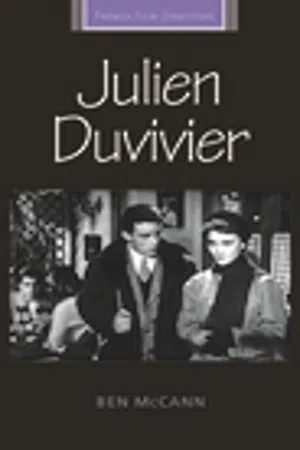
This book is the first ever English-language study of Julien Duvivier (1896-1967), once considered one of the world's great filmmakers. It provides new contextual and analytical readings of his films that identify his key themes and techniques, trace patterns of continuity and change, and explore critical assessments of his work over time.
His career began in the silent era and ended as the French New Wave was winding down. In between, Duvivier made over sixty films in a long and at times difficult career. He was adept at literary adaptation, biblical epic, and film noir, and this groundbreaking volume illustrates in great detail Duvivier's eclecticism, technical efficiency and visual fluency in works such as Panique (1946) and Voici le temps des assassins (1956). It will particularly appeal to scholars and students of French cinema looking for examples of a director who could straddle the realms of the popular and the auteur.
- 254 pages
- English
- ePUB (mobile friendly)
- Available on iOS & Android
eBook - ePub
Julien Duvivier
About this book
Information
Publisher
Manchester University PressYear
2017Print ISBN
9781526139559
9780719091148
eBook ISBN
9781526107626
Subtopic
Film & Video
The ‘impure’ auteur
Je ne suis qu’un artisan consciencieux.1
(Duvivier, in Leprohon 1968: 203)
Ferdinand: Je dirais c’est comme Pépé le Moko.
Marianne: Qui?
Ferdinand: Pépé le Moko.
Marianne: Qui est-ce?
Ferdinand: Décidément, tu ne connais rien!2
Pierrot le Fou (Jean-Luc Godard, 1965)
Accounts of Duvivier’s life usually go along the following lines. He was a talented director in the early days of sound cinema who luckily managed to marshal around him teams of actors and technicians to create a set of films that tapped into a particular mindset of 1930s pre-war France. Duvivier was then invited to Hollywood, where he churned out a series of forgettable B-movies before returning to France in the mid-1940s to a much-changed landscape. By this time, his noir sensibilities and penchant for literary adaptation were deemed out of sync with the need for cinematic renewal championed by the critics of Cahiers du cinéma, and so he spent the rest of his career as a director for hire, trudging across Europe making nondescript versions of pot-boiler French fiction and irking everyone in the process, from Vivien Leigh to Brigitte Bardot to Jacques Rivette.
There are fragments of truths here, but the reality is far more complex, and needs unpacking. Much of this book will examine the key themes and recurring visual patterns and formal properties of Duvivier’s films and identify a particular worldview that emanates from the silent films right through to Diaboliquement vôtre (1967). In short, the book will answer the following question: what makes a Duvivier film a Duvivier film?
Beginnings
Very little is known about Duvivier’s early life, not least because of his extreme reticence to talk about his past. We do know that he was born in Lille, in northern France, on 8 October 1896 and grew up in the Catholic area of the city. Later, he was sent over the border to Froyennes, in Belgium, for a strict Jesuit education. His father was a travelling salesman who ran a photographic development lab at the back of the house; his mother was pianist at the Lille Conservatoire and inculcated into Duvivier an early love of poetry. His friend Maurice Bessy – a film journalist who later worked with Duvivier as a screenwriter – traced the root of Duvivier’s future shyness and prickliness back to this petit bourgeois upbringing, where meals were eaten in silence and any show of intimacy discouraged.
Exempted from fighting in the First World War, Duvivier and his father left Lille in late 1914 to escape the invading German army and headed to Paris. It was here that Duvivier’s passion for the theatre was developed. He joined the Théâtre de l’Odéon (his first role was in March 1915, in Frédéric Soulié’s La Closerie des genêts). Much has been made of Duvivier’s stage fright – it appears that in November 1915, during a matinee performance of a Molière play for war-wounded soldiers, Duvivier forgot his lines and suffered a mild panic attack, causing the stage curtains to be prematurely lowered. The incident is often recounted in recollections of Duvivier’s early career (there is a similar scene in La Fin du jour [1939] when Michel Simon’s ageing actor forgets his lines and is whistled off the set: for Simon, read Duvivier), but it did not finish off his theatrical career, as many claimed. He returned to the stage in the summer of 1916 in the Belgian comedy Le Mariage de Mademoiselle Beulemans (which Duvivier later adapted for the screen in 1927).
Unlike Marcel Carné or René Clair, who entered the film industry as journalists and theoreticians, Duvivier set foot in the profession almost by chance. In late 1915, he met André Antoine. A key figure in the Duvivier story, Antoine was the pioneering theatre director of the Théâtre-Libre (1888–97) and the Théâtre-Antoine (1897–1906) and had integrated naturalist practices across the company’s output. After seeing Duvivier on stage, Antoine offered Duvivier work as his assistant at the newly formed Société Cinématographique des Auteurs et Gens de Lettres (SCAGL), the film d’art branch of Pathé, whose remit was to produce high-level literary adaptations designed to entice a more elite audience to the cinema. Duvivier assisted Antoine on several SCAGL productions – Les Frères corses (1917), Le Coupable (1917), Les Travailleurs de la mer (1918), La Terre (1921, an early film version of a Zola novel), and L’Arlésienne (1922) – which all stayed true to Antoine’s aesthetic preoccupations.
As a theatre director now turning to film, Antoine believed that cinema’s key objective was ‘to convince the spectator of the verisimilitude of the spaces and actions represented on the screen’ (Abel 1988: 105). Influenced as much by nineteenth-century traditions of Impressionist painting and literary naturalism as by the technical possibilities of film, Antoine formulated a set of filmic practices that would assist in creating and maintaining this verism. He formed a cohort of actors who would work from film to film; used multiple camera set-ups and movements to create a set of dynamic, fluid visual compositions; and, most importantly, insisted, wherever possible, on filming on location. The new-found portability of lighting and recording equipment and the accessibility of natural surroundings led to an upsurge in ‘pictorialist-naturalist’ films, including L’Homme du large (1920), L’Appel du sang (1920), Jocelyn (1922), and La Brière (1925), in which directors such as Marcel L’Herbier, Louis Mercanton, Léon Poirier, and Jacques de Baroncelli, as well as Antoine’s aforementioned output, each placed non-professional actors within real landscapes and offered up stories within the social realism field advocated by Antoine. Writing about Antoine’s theories of film while he worked for SCAGL, Susan Hayward notes his vital influence on French realist cinema: ‘location shooting […] multi-camera point of view […] an editing style that would involve the spectator in the narrative […] the importance of the scenario […] and the need for professional writers who would transpose the literary classics’ (2005: 86). Hayward might just as easily be describing Duvivier here.
Indeed, these diverse working practices would soon be adopted by Duvivier, most notably in the juxtaposition of location and studio shooting. Across his career, we see constant examples of sequences shot on location, whether in the teeming mass of Les Halles in Voici le temps des assassins (1956), the nocturnal streets of pre-wall Berlin in La Grande vie (1960), or the Moroccan desert of Les Cinq gentlemen maudits (1931). All of these spaces might just as well have been meticulously reconstructed in a Joinville studio, as Marcel Carné and Alexandre Trauner, the great director–designer team of 1930s and 1940s French cinema, frequently did. But Duvivier was convinced that Antoine’s approach was more cinematic. He absorbed his mentor’s revolutionary approach to film realism in all areas – acting, subject matter, narrative technique, and style – and returned to it again and again over his career.
Duvivier’s next step was to graduate to full-blown director – at the end of the war, he found himself in Marseille, where he was invited by Gaston Haon, from the Army’s Cinema Service, to come with him to Bordeaux to direct a feature film for his recently established film company. This would eventually lead, in 1919, to Duvivier’s debut feature, Haceldama ou le prix du sang, and the start of an extraordinarily fruitful period of work. As we shall see, Haceldama was an accomplished piece of work for a first-time director, and it foreshadowed a number of the director’s future preoccupations with style and form.
Restoring a reputation
Duvivier has long been airbrushed out of French cinema for three reasons. Firstly, a critical consensus that dates back to at least the mid-1950s has marginalised him to the point of obliteration. For these critics, Duvivier was a journeyman director, without a signature style or personal approach, bereft of invention, and reliant upon the scripts of others. In short, he was not Jean Renoir, or Robert Bresson, or Jean Cocteau. Even before Cahiers du cinéma had published François Truffaut’s infamous 1954 article/assassination, ‘Une certaine tendance du cinéma français’ (Truffaut 1954), in which the world of the auteur and the metteur en scène were forever separated, critics were in the habit of condemning Duvivier as representative of the old guard of film-making. Jean-Pierre Vivet (1951) lambasted him in a review of Sous le ciel de Paris (‘[Il] me fait penser à ces octogénaires qui pour se mettre au goût du jour vont danser le be-bop […] seulement M. Duvivier n’a plus ses jambes’3), while Michel Dorsday singled him out in his 1952 Cahiers review of Christian-Jacque’s Adorables créatures, entitled ‘Le cinéma est mort’. Dorsday (1952: 55) criticised Duvivier, as well as Jacques Becker and Jean Delannoy, for creating cinema that was ‘mort sous la qualité, l’impeccable, le parfait’. 4 Reviewing Duvivier’s Marianne de ma jeunesse (1955), Truffaut (1955: 5) ranked the film among those ‘qui naissent démodés’ and ‘arrivent, dans le cinéma français, avec quinze ans de retard’.5 Because his ‘personality’ did not shine through, Duvivier was regarded as a mere metteur en scène, a ‘stager’. Duvivier has been trapped in this echo chamber for six decades.
Secondly, Duvivier was regarded as undiscerning; he made too many films, and was unable to discriminate between the assignments he was offered. Maurice Bessy (1977: 49) described Duvivier’s favoured working method as follows: ‘créer pour lui, c’était tenter. C’était aussi se tromper pour mieux réussir ensuite’.6 Such working practices – efficient, fast, adept – are highly sought after in today’s film culture, but French critics have sometimes viewed Duvivier’s resourcefulness with suspicion. At a time when Duvivier was regularly acclaimed in domestic critical circles, Roger Leenhardt (1935: 332), critic for L’Esprit, reproached him for making too many films between 1933 and 1935:
La production d’un cinéaste n’est valable que si une unité de ton, de style, d’atmosphère […] exprime une direction de pensée, une vision personnelle du monde. Aussi, quoi qu’il en soit de ...
Table of contents
- Cover
- Half Title
- Series Information
- Title Page
- Copyright Page
- Dedication
- Contents
- List of plates
- Series editors’ foreword
- Acknowledgements
- Introduction: we need to talk about Julien
- 1 The ‘impure’ auteur
- 2 Duvivier’s silent films
- 3 Sound, image, Gabin: Duvivier and the 1930s
- 4 ‘Piloting with concentration’: Julien goes to Hollywood
- 5 1946–56: darkness and light
- 6 Late style
- Conclusion
- Filmography
- Select bibliography
- Index
Trusted by 375,005 students
Access to over 1.5 million titles for a fair monthly price.
Study more efficiently using our study tools.
Frequently asked questions
Yes, you can cancel anytime from the Subscription tab in your account settings on the Perlego website. Your subscription will stay active until the end of your current billing period. Learn how to cancel your subscription
No, books cannot be downloaded as external files, such as PDFs, for use outside of Perlego. However, you can download books within the Perlego app for offline reading on mobile or tablet. Learn how to download books offline
Perlego offers two plans: Essential and Complete
- Essential is ideal for learners and professionals who enjoy exploring a wide range of subjects. Access the Essential Library with 800,000+ trusted titles and best-sellers across business, personal growth, and the humanities. Includes unlimited reading time and Standard Read Aloud voice.
- Complete: Perfect for advanced learners and researchers needing full, unrestricted access. Unlock 1.5M+ books across hundreds of subjects, including academic and specialized titles. The Complete Plan also includes advanced features like Premium Read Aloud and Research Assistant.
We are an online textbook subscription service, where you can get access to an entire online library for less than the price of a single book per month. With over 1.5 million books across 990+ topics, we’ve got you covered! Learn about our mission
Look out for the read-aloud symbol on your next book to see if you can listen to it. The read-aloud tool reads text aloud for you, highlighting the text as it is being read. You can pause it, speed it up and slow it down. Learn more about Read Aloud
Yes! You can use the Perlego app on both iOS and Android devices to read anytime, anywhere — even offline. Perfect for commutes or when you’re on the go.
Please note we cannot support devices running on iOS 13 and Android 7 or earlier. Learn more about using the app
Please note we cannot support devices running on iOS 13 and Android 7 or earlier. Learn more about using the app
Yes, you can access Julien Duvivier by Ben McCann in PDF and/or ePUB format, as well as other popular books in Media & Performing Arts & Film & Video. We have over 1.5 million books available in our catalogue for you to explore.