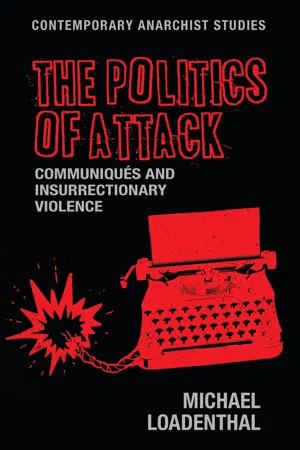
Since the early 2000s, global, underground networks of insurrectionary anarchists have carried out thousands of acts of political violence. This book is an exploration of the ideas, strategies, and history of these political actors that engage in a confrontation with the oppressive powers of the state and capital. This book challenges the reader to consider the historically ignored articulations put forth by those who communicate through sometimes violent political acts-vandalism, sabotage, arson and occasional use of explosives. These small acts of violence are announced and contextualized through written communiqués, which are posted online, translated, and circulated globally. This book offers the first contemporary history of these digitally-mediated networks, and seeks to locate this tendency within anti-state struggles from the past.
- 272 pages
- English
- ePUB (mobile friendly)
- Available on iOS & Android
eBook - ePub
About this book
Information
1
Concerning method and the study of political violence
Ah hell. Prophecy's a thankless business, and history has a way of showing us what, in retrospect, are very logical solutions to awful messes … Things are certainly set up for a class war based on conveniently established lines of demarcation, and I must say that the basic assumption of the present set up is a grade A incitement to violence. (Vonnegut 1999, chap. IX)
When asked about anarchism's association with violence, I often reply by inquiring whether one would ask the same thing of a retail clerk, a stockbroker, a lawyer, a priest, an engineer, a taxpayer, a consumer, a liberal, a conservative – or any other identity attribute associated with mainstream society. Most assuredly, the scale of violence perpetuated by the day-to-day operations of capital and the state is grossly disproportionate to anything in the anarchist lexicon, with upwards of 100 million deaths from wars alone during the twentieth century. I daresay that the sum total of people killed or physically injured by anarchists throughout all of recorded history amounts to little more than a good weekend in the empire … Are anarchists violent? Sometimes, but more so when they are participating in the casual, invisible, structural violence of modern life than when they are smashing its symbols of oppression. (Amster 2012, 43–44)
An anarchist group has claimed responsibility for an arson attack on North Avon Magistrates’ Court … police are investigating the on-line claims but say they do not have the evidence to link it to other attacks carried out on buildings owned by “establishment” bodies, including the police, the Army and various banks. In a post on the 325.nostate website, people naming themselves as the Informal Anarchist Federation, said: “10 camping gas canisters were enough to devastate the front lobby, with a homemade napalm mixture as the detonator. We chose the early hours to avoid any injuries.” (The Bristol Post 2014a)
Introduction
Throughout the past decade and a half, scholarship focused upon the study of political violence, specifically that which can clearly be labeled as terrorism, has rapidly increased (Ranstorp 2007; Silke 2009). With the powerful aftereffects of the 9/11 attacks, interest in those pursuing political, social, and religious objectives through violence found an obvious place in the academy. Largely, this scholarship was dealt with through the fields of Terrorism Studies and Social Movement Studies, as well as interrelated disciplines such as Criminology, Security Studies, and Sociology. While these fields have often overlapped through interdisciplinary pursuits, each has its own epistemological presumptions, methodological tendencies, and canonical truths.
For the study of political violence, and especially clandestine political violence which is the subject herein, one is often positioned at the crossroads between interpreting the subject as a terrorist or a social movement and, as such, is led towards those corresponding disciplines, literatures, and presumptive groundings. Keeping in mind the poststructuralist assertion that the production of knowledge – especially that which is involved in the formation of political policy – is never a neutral endeavor (Foucault 1980, 98), the collection of evidence and the construction of arguments is inherently the culmination of intentional decisions. When faced with these choices, held up against the subject of post-millennial, anti-authoritarian, insurrectionary networks, such concerns are paramount. Those who choose to pursue study through the literature of Terrorism Studies, are likely to be burdened with not only the state-centric bias of background literature, but also the field's lack of theorization and its focus on counterterrorism (della Porta 2013, 282) and other securitization implementations. Those who choose to examine such networks as social movements,1 a field that bases its focus on manifestations of social protest, also face difficulties as this field has often remained apart from radical politics within militant and violent protest, and has a corresponding theorization abyss regarding these borderlands.
Since the end of the twentieth century, an explosion of anti-state networks of clandestine militancy have emerged throughout the world. Through thousands of attacks, revolutionaries have been constantly at war with the status quo, targeting localized manifestations of state and capital in an attempt to create a venue of conflict that can bring about system-level change. Though distributed globally and irregularly active, these networks attack with frequency and vigor, making them a top priority for law enforcement. In one locale, Bristol, England, a city of around half a million residents, insurrectionary anarchist networks have been responsible for “over a hundred offensives dating [from] 2010 [to December 2014]” (Bevan 2014, pts. 00:44–00:50) according to the lead investigating officer. According to sympathetic activists, this number may be far higher, as those compiling local communiqués were able to locate more than 60 attacks in a two-and-a-half year period (Bevan 2014). These attacks, many of which involve arson, are said to have caused approximately £20 million (~$31 million) in damage. The vast majority of these attacks have been claimed via online communiqués through anonymous monikers such as the Informal Anarchist Federation (FAI). The FAI moniker has been adopted so frequently that, despite not having a centralized structure or “members,” the entity was declared to be a terrorist organization by the European Union in 2009.
In only a few years, in the city of Bristol alone, the clandestine political networks under examination were responsible for the £18 million arson of a police firearms training center, the burning of UK Border Agency vehicles and personal vehicles belonging to a Mayor and other local politicians, sabotage targeting a local commuter rail service, and the arson of industrial infrastructure, which resulted in a loss of radio and TV service to more than 80,000 homes (Channel 4 News 2013; Malik 2012; 2013). Other Bristol-area targets struck in the last few years include private security company G4S and the zoo. This brief look at Bristol is meant to provide insight as to the scale of the subject. The international, insurrectionary milieu – the subject of this book – is deserving of attention even if one only judges them on the basis of their destructive capabilities. Though modern attackers are not successfully assassinating heads of state, as was somewhat commonplace in late nineteenth and early twentieth century, they are dispatching bombs to European Prime Ministers, burning down Mexican Walmarts, and carrying out thousands of costly attacks targeting governmental, financial, commercial, and other sites. Furthermore, since there have been very few arrests of this movement, we know relatively little about the participants. Because of this reality, in order to understand the insurrectionary arsonists, bomb makers, and saboteurs, we must examine their frequent articulations of critique – the communiqué.2 Despite often failing to do this, the need for such forms of analysis have been expressed in mainstream press reporting, for example this article from The Bristol Post which states:
To understand why these attacks are happening, for what reason, and how these individuals identify politically, it's recommended to read their words and statements for clarity. Each attack is by a unique established group of individual/s, with a diversity of anonymous cloaks, presenting varying ideological viewpoints. The beauty of the insurrectionist movement you might say. (2014b)
While these attacks, and the communiqué/claims of responsibility that accompany them, have received nominal attention in the (counter) Terrorism Studies literature, very little focus has been paid to their political ideology and socio-political critique. Moreover, the interaction between “radical social movements” (Koehler 2014, 2) and their broader contexts (e.g. social, political, ideological) is under researched.
The following introductory chapter will examine a number of key issues of central importance to the book. First it will discuss the object of analysis – the communiqué – as a method for delivering critical analysis typically reserved for more formalized texts. This approach begs the question: “Can one read a claim of responsibility (i.e. a communiqué) in the same formalized manner as one would read The Communist Manifesto or The Federalist Papers?” This discussion will also survey the available literature that focuses on the study of communiqués, identifying weaknesses and necessary corrections to this reading. Second, this chapter identifies some initial difficulties arising from the study of these objects, specifically problems relating to verifiability, triangulation, determining credible authorship, and the inherent subjectivity in historical interpretation. Finally, this chapter discusses the limitations and scale of the study, establishing two key questions, which are pursued throughout the remaining chapters. These questions aim to guide the reader to evaluate two central claims: (1) Modern insurrectionary networks are informed by, and act to, constitute an “insurrectionary canon,” and (2) Due to the poststructural influence on the modern insurrectionary critique, the milieu will resultantly carry forth an expanded understanding of structural violence and inequality.
A feminist method for studying violence
While a more complete discussion of ethically-embedded, critical modes of inquiry is pursued at the conclusion of this chapter, a brief discussion of ethics is warranted before proceeding. A methodological positioning informed by feminist ethics permeates the proceeding discussions. The feminist methodology and ethic of research (Mies 1983; Cook and Fonow 1986; 1991; Maguire 1987; Harding 1988; Lather 1988; Kirby and Kate 1989; Collins 1991; Reinharz 1992) adds a great deal, including a reading of identity politics, standpoint theory, action-orientated research, and embedded, emotive and sincere participatory involvement. From among these tendencies, this inquiry seeks to maintain a single goal, namely that research generates a reciprocally positive impact for the subject (Oakley 1981), and in this manner, the respondent community is not seen as a vessel containing knowledge to be taken, but rather as a partner in a collaborative endeavor to engage in knowledge building, not knowledge production. In the present discussion of insurrectionary anarchism, this involves the construction of knowledge for social action and not further criminalization, and remaining accountable to the community of activists and scholars whom the movement is based around.
Feminist methodology seeks to subvert t...
Table of contents
- Cover
- Series page
- Title page
- Copyright page
- Contents
- Figures
- Preface
- Acknowledgments
- Abbreviations
- 1 Concerning method and the study of political violence
- 2 Insurrection as history from Guy Fawkes to black blocs
- 3 Insurrection as a post-millennial, clandestine, network of cells
- 4 Insurrection as warfare, terrorism, and revolutionary design
- 5 Insurrection as theory, text, and strategy
- 6 Insurrection as values-driven theory and action
- 7 Insurrection as anti-securitization communication
- References
- Index
Trusted by 375,005 students
Access to over 1.5 million titles for a fair monthly price.
Study more efficiently using our study tools.
Frequently asked questions
Yes, you can cancel anytime from the Subscription tab in your account settings on the Perlego website. Your subscription will stay active until the end of your current billing period. Learn how to cancel your subscription
No, books cannot be downloaded as external files, such as PDFs, for use outside of Perlego. However, you can download books within the Perlego app for offline reading on mobile or tablet. Learn how to download books offline
Perlego offers two plans: Essential and Complete
- Essential is ideal for learners and professionals who enjoy exploring a wide range of subjects. Access the Essential Library with 800,000+ trusted titles and best-sellers across business, personal growth, and the humanities. Includes unlimited reading time and Standard Read Aloud voice.
- Complete: Perfect for advanced learners and researchers needing full, unrestricted access. Unlock 1.5M+ books across hundreds of subjects, including academic and specialized titles. The Complete Plan also includes advanced features like Premium Read Aloud and Research Assistant.
We are an online textbook subscription service, where you can get access to an entire online library for less than the price of a single book per month. With over 1.5 million books across 990+ topics, we’ve got you covered! Learn about our mission
Look out for the read-aloud symbol on your next book to see if you can listen to it. The read-aloud tool reads text aloud for you, highlighting the text as it is being read. You can pause it, speed it up and slow it down. Learn more about Read Aloud
Yes! You can use the Perlego app on both iOS and Android devices to read anytime, anywhere — even offline. Perfect for commutes or when you’re on the go.
Please note we cannot support devices running on iOS 13 and Android 7 or earlier. Learn more about using the app
Please note we cannot support devices running on iOS 13 and Android 7 or earlier. Learn more about using the app
Yes, you can access The politics of attack by Michael Loadenthal in PDF and/or ePUB format, as well as other popular books in History & World History. We have over 1.5 million books available in our catalogue for you to explore.