- 253 pages
- English
- ePUB (mobile friendly)
- Available on iOS & Android
eBook - ePub
About this book
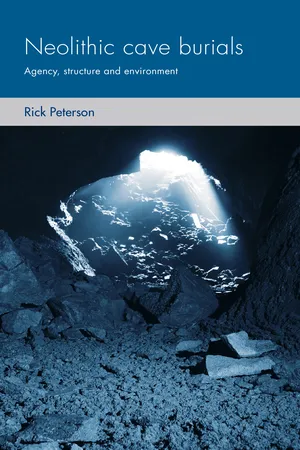
This is the first book-length treatment of Neolithic burial in Britain to focus primarily on cave evidence. It interprets human remains from forty-eight caves and compares them to what we know of Neolithic collective burial elsewhere in Britain and Europe. It reviews the archaeology of these cave burials and treats them as important evidence for the study of mortuary practice. Drawing on evidence from archaeology, anthropology, osteology and cave science, the book demonstrates that cave burial was one of the earliest elements of the British Neolithic. It also shows that Early Neolithic cave-burial practice was highly varied, with many similarities to other burial rites. However, by the Middle Neolithic, a funerary practice which was specific to caves had developed.
Information
1
The body in the cave
During the Neolithic period in Europe, caves and other underground spaces were used for burial. The evidence for this practice is reasonably well understood but, with certain exceptions such as the Belgian Middle and Late Neolithic (Cauwe 2004), cave burial has usually been regarded as something tangential to the broader narrative of the European Neolithic. Caves are often treated as places for simple expedient burial, perhaps for less socially favoured members of society, when compared to an assumed norm of burial in monuments (see, for example, Schulting and Richards 2002a, 1021). In this book, I will discuss the human remains from British Neolithic caves on their own terms. They were part of a wider European tradition of cave burial. They were also an important strand in the overall diversity of funerary practice in the British Neolithic. By understanding cave burial in the period, we get a much clearer understanding of attitudes to death in all contexts.
One way of describing this book would be to say that it is an exploration of the archaeology and agency of natural places. However, it could also be described as a book about burial in British caves during the Neolithic period. Both of these descriptions are apt, but they reflect different traditions of research in archaeology. Research may be generalising and thematic and address globally applicable topics of past human existence – in this case, the archaeology of natural places and of human and environmental agency. Or it may be a particularising, locally situated investigation of the remains of a particular past time and place – in this case, cave burial in the British Neolithic. Both of these research traditions are important parts of how archaeology works. In this case, I hope that I have integrated general and particular research in a coherent way. This is not a book about agency with a case study about cave burial, nor a catalogue of cave burials with an interpretive conclusion based on actor-network theory. This is a discussion of some different conceptions of agency which I feel are particularly relevant and useful in trying to interpret the archaeology of Neolithic cave burial in Britain. It is not a complete review of the many different archaeological and anthropological uses of the term agency, and it certainly does not contain archaeological evidence from every known cave with Neolithic activity.
Of course, the idea that archaeology has something to say about natural places and the idea that animals, places and objects can be thought of as agents are not new. There is an extensive discussion of both of these topics from a range of different perspectives (e.g. Bradley 2000; Ingold 2000; Latour 2005). Similarly, Neolithic human remains from British caves have been reviewed by a number of writers (e.g. Barnatt and Edmonds 2002; Chamberlain 1996; Leach 2006; Schulting 2007). In excavating and researching Neolithic human remains from caves, I have consistently found myself addressing two problems which have provided a link between the general themes of agency and natural places and particular bodies in particular caves.
Neolithic burial and cave burial
The first of these questions is the problem of the relationship between these burials and other practices around human remains in the British Neolithic. Collective disarticulated burial in monuments is a particularly well-studied aspect of Neolithic studies (see, e.g., discussions in Wysocki and Whittle 2000 and Whittle et al. 2007), and two main interpretations of the burial process have been offered. Disarticulation may have been achieved through a multi-stage rite which involved some significant circulation of human bone away from burial monuments. This is often referred to in the literature as secondary burial; see Chapter 3 for a fuller discussion. Alternatively, the disarticulated state of bodies may be largely the result of taphonomic processes following the successive inhumation of bodies at burial sites. I will return to the details of this debate in Chapter 3, but it is clear that very similar arguments can be made about human remains from caves. It should also be borne in mind that Neolithic burial is not confined to cairns, long barrows and caves. From the Middle Neolithic onwards, there is a well-defined tradition of single burial, often associated with large round barrows (e.g. Gibson and Bayliss 2010, 101). Schulting (2007) has also pointed out the diversity of non-monumental burial. Human remains recovered from caves are usually discovered in an extremely fragmentary state. A very careful examination of the possible taphonomic processes is needed before we can draw parallels between cave burial and the range of other documented burial rites in the British Neolithic.
Do caves have agency?
The second question has arisen from a consideration of the nature of caves as spaces. Both Barnatt and Edmonds (2002) and, for Irish caves, Dowd (2008) have discussed the similarities of caves and chambered cairns as spaces. This provides another link between the monuments and caves beyond any possible similarities of burial rite. It is assumed that both caves and chambered tombs would have been thought of as conceptually similar places because they shared an architecture of passages and chambers. Barnatt and Edmonds (2002, 127) suggest that the practice of separating geological and architectural spaces into contrasting classes of natural and cultural entities is itself modern. This is a distinction which we cannot assume was made in the Neolithic, although, it should be noted that, more recently, Dowd (2015, 110) has suggested that caves and monuments were perceived as different to one another during the Irish Neolithic. She points to the different ways that human remains were disposed of in the two types of sites as evidence that they were not perceived as equivalent spaces.
More broadly, Barnatt and Edmonds (2002, 125–127) and Dowd (2008, 311–312) both provide a wider consideration of the phenomenological impact of these constricted spaces. This is an area which has been particularly explored by European scholars: for example, in Mlekuž ’s (2011) work on the Italian and Slovenian karst. Mlekuž studies the impact of physically inhabiting caves and rock shelters on the bodies of both sheep and shepherds. The cave walls cease to be something which is merely a passive arena within which human and animal actions take place. The walls themselves ‘push back’. In a similar vein, Bjerck (2012) has examined how darkness and constriction influenced the placing of Bronze Age rock art in Norwegian caves. These discussions of the power of cave spaces to act on people lead us to a wider debate about whether inanimate objects like caves have agency. It is clear that caves can do things to people; the question is really about whether it is enlightening or convincing to describe this effect as agency. I have explored this debate about the agency of caves previously in relation to later prehistory (Peterson 2018). In that work, I argued that caves would have been understood in the past as possessing agency and that it is helpful to think of them in these terms. However, we also need to be aware of the dangers of treating agency unreflectively. If we reify ‘agency’ as a social force to the point where it becomes the explanation, then the idea ceases to have any value as a conceptual tool. For this reason, I have suggested, in this book and in the aforementioned work, that we re-phrase the question around cave agency to ask ‘how did caves act on people?’
Therefore, this book will attempt to tackle two problems. Firstly, how do cave burials relate to other Neolithic burials? Secondly, how do caves act on people? These two questions belong together because of the way that burial practice links society and environment. If we return to the division of burial practices into either secondary burial rites or successive inhumation, then one of the ways of distinguishing between them is to look at the agent of disarticulation. A secondary burial rite involves repeated interventions from living people. Bodies must be laid out and transported, and often they are physically broken up. Bones must be recovered, sorted and ultimately placed in a final burial site. Through all of these processes, the agency of living humans – the mourners or descendants – is the main driver of the physical process of disarticulation. By contrast, when bodies are placed successively in either a tomb or a cave, then the main agent of disarticulation is a combination of time, the physiological properties of the decaying corpse and the physical properties of the space of burial. This is not to suggest that time and environment are not important in many multi-stage rites, or that people could not interact with successively inhumed bodies during decomposition if they wished. However, human agency is necessary for secondary burial rites, and natural agency is an essential part of successive inhumation. Thinking about the relative contributions of society and the environment to the burial process gives us a common thread to our answers to both of the problems I posed at the start of this paragraph. Cummings (2017, 94) has argued that the ‘normal’ fate of human remains in the Neolithic was a rite of transformation primarily driven by natural agents such as scavenging animals and bodily decomposition processes. She postulates that most bodies were exposed and scavenged to the point where they were completely broken down and destroyed. From this perspective, what is distinctive about secondary burial or successive inhumation, whether it took place in a cave or a monument, is that it removed a body from this complete transformation and allowed some traces of it to survive. Within Chapter 3, I examine not only the anthropological evidence for the social customs and structures which may have surrounded secondary burial and successive inhumation but also the detail of the processes of bodily decay and cave sedimentation which would have been the natural agents of change. In Chapter 4, I have tried to further draw out the implications of treating inanimate objects as having agency. Caves, material culture, bodies and time are all considered from the standpoint that it is unhelpful to maintain a strict division between living subjects and inanimate objects.
Dated Neolithic human remains from British caves
If we want to analyse burial practices in caves in the Neolithic, our first requirement is data: a selection of cave sites where we know human remains were deliberately deposited during the period. There are many cave sites where Neolithic artefacts have been found alongside human remains; for example, Barnatt and Edmonds (2002, Table 1) list twenty-five such sites from Derbyshire alone. However, the analysis of Neolithic cave burial practice would not be possible without the radiocarbon dates on human bone provided by many different research projects over the past 20 years. These dates are absolutely essential. Previous studies of caves and human bone taphonomy, particularly by Leach (2006, 2008), have shown that radiocarbon dating is the only reliable guide to determining the date of a cave burial. Conventional archaeological assumptions about the integrity of sealed contexts and associations between artefacts and human bone cannot always be relied upon in cave environments. The open texture of many scree deposits and the highly active geological processes within cave systems mean that it is extremely common for artefacts and human bone to be moved, re-deposited and combined in complex ways.
Some of the burials I discuss can be used as examples to reinforce this point. As has been previously noted (Schulting 2007, 586), many of the bones were originally sampled as part of projects investigating the Palaeolithic use of caves. They were submitted for dating because they were thought to be securely stratified in Pleistocene contexts. For example, the burials from Cattedown Cave in Devon have Neolithic dates but were discovered in a breccia deposit beneath a stalagmitic floor (Worth 1887, 110), and they were dated on the understandable assumption that both the breccia and the flowstone above it were in situ Pleistocene deposits (Higham et al. 2007, S28–S29). Therefore, if we are to study Neolithic cave burial, only those sites with direct dates on human bone should be considered. While this undoubtedly excludes some caves which were used in the period, a clear comparison with the European data, with burial in monuments and with other cave burials requires the use of absolute dating.
Forty-eight directly dated Neolithic cave sites in Great Britain have been used in this study (see Appendix 1 for the complete list). All of these sites have at least one published radiocarbon date on human bone which, when calibrated to two standard deviations, falls into the Neolithic period. For the purposes of this book, I have taken the view that any date which has part of its calibrated range between 4000 and 2400 BC should be included in the table. There are a further nine sites where Neolithic radiocarbon dates were obtained from the Oxford AMS facility but which were subject to problems caused by ultrafiltration contamination (Bronk Ramsey et al. 2004; Rick Schulting, personal communication). These sites are Carsington Pasture Cave and Fox Hole Cave, both in Derbyshire; Gop Cave, Flintshire; Happaway Cave, Devon; Ifton Quarry Rock Shelter, Monmouthshire; Ogof Pant-y-Wennol, Llandudno; Red Fescue Hole and Pitton Cliff Cave, both on Gower; and Priory Farm Cave, Pembrokeshire. I have given a full list of these sites here, as some have already featured in published discussions of Neolithic cave burial (e.g. Barnatt and Edmonds 2002, 114–116). Indeed, it is highly likely that burial took place at most of these sites during the Neolithic. However, in view of the problematic nature of the dates, they were not included in this study. During the final revisions of the text of this book new dates became available as a result of ongoing aDNA studies (Brace et al., in preparation) which confirmed an Early Neolithic date for Carsington Pasture Cave and identified further sites with directly dated Neolithic human remains at Aveline’s Hole and Ogof-yr-Ychan.
The time range of 4000–2400 BC for this book has been chosen to ensure that the study covers the processes around the beginning of the Neolithic. Andrew Chamberlain was the first to point out (1996, Figure 1) that there was a substantial increase in the deposition of human bone in caves around 4000 BC. This data has subsequently been refined by Schulting (2007, Figure 2), and both authors agree that there is evidence for a significant new practice of cave burial in the centuries a...
Table of contents
- Cover
- Half-Title
- Series
- Title
- Copyright
- Contents
- List of figures
- List of tables
- Acknowledgements
- 1 The body in the cave
- 2 In praise of limestone
- 3 Gestures and positions
- 4 How do caves act?
- 5 Origins
- 6 Written on the body
- 7 Deep time
- 8 Temporality, structure and environment
- Appendix 1
- Appendix 2
- References
- Index
Trusted by 375,005 students
Access to over 1.5 million titles for a fair monthly price.
Study more efficiently using our study tools.
Frequently asked questions
Yes, you can cancel anytime from the Subscription tab in your account settings on the Perlego website. Your subscription will stay active until the end of your current billing period. Learn how to cancel your subscription
No, books cannot be downloaded as external files, such as PDFs, for use outside of Perlego. However, you can download books within the Perlego app for offline reading on mobile or tablet. Learn how to download books offline
Perlego offers two plans: Essential and Complete
- Essential is ideal for learners and professionals who enjoy exploring a wide range of subjects. Access the Essential Library with 800,000+ trusted titles and best-sellers across business, personal growth, and the humanities. Includes unlimited reading time and Standard Read Aloud voice.
- Complete: Perfect for advanced learners and researchers needing full, unrestricted access. Unlock 1.5M+ books across hundreds of subjects, including academic and specialized titles. The Complete Plan also includes advanced features like Premium Read Aloud and Research Assistant.
We are an online textbook subscription service, where you can get access to an entire online library for less than the price of a single book per month. With over 1.5 million books across 990+ topics, we’ve got you covered! Learn about our mission
Look out for the read-aloud symbol on your next book to see if you can listen to it. The read-aloud tool reads text aloud for you, highlighting the text as it is being read. You can pause it, speed it up and slow it down. Learn more about Read Aloud
Yes! You can use the Perlego app on both iOS and Android devices to read anytime, anywhere — even offline. Perfect for commutes or when you’re on the go.
Please note we cannot support devices running on iOS 13 and Android 7 or earlier. Learn more about using the app
Please note we cannot support devices running on iOS 13 and Android 7 or earlier. Learn more about using the app
Yes, you can access Neolithic cave burials by Rick Peterson in PDF and/or ePUB format, as well as other popular books in Social Sciences & Ancient Religion. We have over 1.5 million books available in our catalogue for you to explore.