- 304 pages
- English
- ePUB (mobile friendly)
- Available on iOS & Android
eBook - ePub
About this book
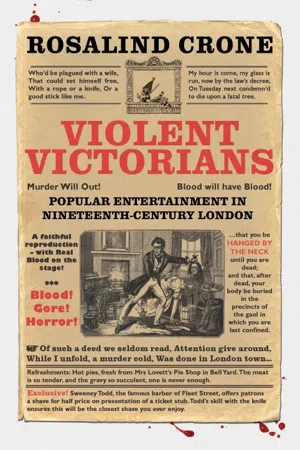
By drawing attention to the wide range of gruesome, bloody and confronting amusements patronised by ordinary Londoners this book challenges our understanding of Victorian society and culture. From the turn of the nineteenth century, graphic, yet orderly, 're-enactments' of high level violence flourished in travelling entertainments, penny broadsides, popular theatres, cheap instalment fiction and Sunday newspapers. This book explores the ways in which these entertainments siphoned off much of the actual violence that had hitherto been expressed in all manner of social and political dealings, thus providing a crucial accompaniment to schemes for the reformation of manners and the taming of the streets, while also serving as a social safety valve and a check on the growing cultural hegemony of the middle class.
Information
Publisher
Manchester University PressYear
2013Print ISBN
9780719086854
9780719086847
eBook ISBN
9781847794703
Table of contents
- Cover Page
- Title Page
- Copyright Page
- Dedication
- Contents
- List of figures, tables and diagrams
- Acknowledgements
- Prologue
- 1 London 1800–1850: coping with change, expressing resistance
- 2 About town with Mr Punch
- 3 From scaffold culture to the cult of the murderer
- 4 The ‘Blood-Stained Stage’ revisited
- 5 Selling Sweeney Todd to the masses
- 6 The rise of modern crime reporting
- Epilogue: 1870 – the civilising moment?
- Bibliography
- Index
Trusted by 375,005 students
Access to over 1.5 million titles for a fair monthly price.
Study more efficiently using our study tools.
Frequently asked questions
Yes, you can cancel anytime from the Subscription tab in your account settings on the Perlego website. Your subscription will stay active until the end of your current billing period. Learn how to cancel your subscription
No, books cannot be downloaded as external files, such as PDFs, for use outside of Perlego. However, you can download books within the Perlego app for offline reading on mobile or tablet. Learn how to download books offline
Perlego offers two plans: Essential and Complete
- Essential is ideal for learners and professionals who enjoy exploring a wide range of subjects. Access the Essential Library with 800,000+ trusted titles and best-sellers across business, personal growth, and the humanities. Includes unlimited reading time and Standard Read Aloud voice.
- Complete: Perfect for advanced learners and researchers needing full, unrestricted access. Unlock 1.5M+ books across hundreds of subjects, including academic and specialized titles. The Complete Plan also includes advanced features like Premium Read Aloud and Research Assistant.
We are an online textbook subscription service, where you can get access to an entire online library for less than the price of a single book per month. With over 1.5 million books across 990+ topics, we’ve got you covered! Learn about our mission
Look out for the read-aloud symbol on your next book to see if you can listen to it. The read-aloud tool reads text aloud for you, highlighting the text as it is being read. You can pause it, speed it up and slow it down. Learn more about Read Aloud
Yes! You can use the Perlego app on both iOS and Android devices to read anytime, anywhere — even offline. Perfect for commutes or when you’re on the go.
Please note we cannot support devices running on iOS 13 and Android 7 or earlier. Learn more about using the app
Please note we cannot support devices running on iOS 13 and Android 7 or earlier. Learn more about using the app
Yes, you can access Violent Victorians by Rosalind Crone in PDF and/or ePUB format, as well as other popular books in History & British History. We have over 1.5 million books available in our catalogue for you to explore.