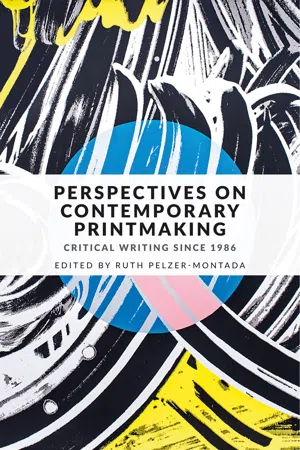
- 348 pages
- English
- ePUB (mobile friendly)
- Available on iOS & Android
eBook - ePub
About this book
This anthology, the first of its kind, presents thirty-two texts on contemporary prints and printmaking written from the mid-1980s to the present by authors from across the world. The texts range from history and criticism to creative writing. More than a general survey, they provide a critical topography of artistic printmaking during the period. The book is directed at an audience of international stakeholders in the field of contemporary print, printmaking and printmedia, including art students, practising artists, museum curators, critics, educationalists, print publishers and print scholars. It expands debate in the field and will act as a starting point for further research.
Information
Topic
ArtSubtopic
Art TechniquesGenealogy
Introduction to Part I
Part I is titled ‘Genealogy’ instead of the more conventional ‘history’. It signals the insight, following Michel Foucault, that historical accounts, far from being ‘objective’, exist as the result of discourses and are hence subject to change. In a recent essay, the eminent American Renaissance print scholar and curator Peter Parshall (2016) examined – across the course of several centuries – the changing focus of the discourses on prints and printmaking. His condensed overview of the historiography of print illuminated focal points, as well as exclusions, and demonstrated how discourses constitute, rather than simply describe their subject. Parshall noted the dominance – in art historical writing on print since the eighteenth century – of a connoisseurial approach, which focused on masterpieces, individual print techniques and individual artist monographs, accompanied by the quest for rare pieces or particular ‘states’ of certain prints. While this largely market-driven methodology still persists, it has also undergone changes. Yet Parshall emphasised that there is a continued necessity for a broader approach to prints that considers their historical significance ‘as embedded in society and politics’ as well as their cross-medial properties.1 The texts in Part I allow the reader to gain an overview of such broader historical changes as played out in the wider field of prints and printmaking. All three texts approach their subject from the perspective of media history and ‘print culture’, rather than of connoisseurial art history. This is not to deny the relevance of aesthetics. The term ‘print culture’ here serves to highlight print's function as a mode of communication rather than aesthetics alone.
As the title of his chapter indicates, Swiss art historian and media theorist Beat Wyss suggests that specific technologies correspond to certain modes of cultural thought. According to media theorist Vilém Flusser, the invention of writing in the middle of the second millennium BCE and the invention of the technical image, i.e. photography, in the middle of the nineteenth century are to be considered the major cultural factors in media history. Wyss uses the analogy of a finer, ‘halftone mesh’ to bring into focus the economic, social, religious, political and artistic changes that occurred through the advent of the printing press, especially engraving, the medium of the book and reproducible images. He vividly outlines print's impact on religion, art and society – above all on the power structures associated with them.
The text by German art historian Ernst Rebel links the seemingly self-generative propensity of the new visual technology of photography in the early nineteenth century to earlier graphic processes. These exhibited a similar, if less comprehensive ‘automatism’ as photography did later. Rebel then traces the development of photography during the nineteenth century which he identifies as ‘the second transmedialisation’. If the first transmedialisation is associated with an equality between painting and printmaking around 1500, the second transmedialisation is linked to industrial image production and reproduction at the turn of the twentieth century. Aesthetic forms and media that had previously been separate are made commensurate with each other through the technology of halftone printing. Computer technology is responsible for the third, current transmedialisation. It is characterised by the transmutation of multiple forms, phenomena and signs into binary code. Contemporary printmaking as an art form incorporates elements of this transmedialisation through its adoption of digital technologies. Hence, it can be argued to be supremely ‘up-to-date’, but there is a simultaneous focus by some artists on printmaking as an ‘outdated’ mode of technology. As Rebel argues, it can in this respect – as do other art forms – offer some resistance to the competitive drive of mere image innovation through ever newer technologies.
In the last chapter of her book Print Culture, Frances Robertson asks whether the widespread assertion of the ‘death of print’, that is, its displacement by digital technologies and media forms, is accurate. Indeed have the texts and images that we encounter daily become as dematerialised as is constantly argued? The chapter is included here to widen the scope of the notion of print beyond fine art and to explore some of the different material, social, economic and creative practices that have encompassed print in the last two hundred years. Robertson focuses especially on changes to everyday print practices in domestic, commercial and administrative contexts. Amongst other print forms she considers the role and format of the book and the use of paper in the office. She also touches on changes in graphic design, the issue of copyright and the creative commons. Robertson ends with the persuasive conclusion that it is premature to diagnose the ‘death’ of print culture.
References
Ivins, William M. Jr. 1953. Prints and Visual Communication. Cambridge, MA: Harvard University Press.
Parshall, Peter. 2016. ‘Why Study Prints Now? Or, the World according to Bartsch’. Art in Print, 6 (3): 5–12.
Weisberg, Ruth. 1990. ‘The Absent Discourse: Critical Theories and Printmaking’. The Tamarind Papers, 13: 8–10.
Notes
1 Of course, William Ivins (1953) had famously regarded prints in terms of their communicative rather than merely aesthetic properties. See also Weisberg (1990).
Fragments for an art history of media: electr(on)ic thinking*
The task is to think up a technological history of thought. It would match appropriate technologies with corresponding intellectual developments: imagine a kind of technical ‘index fossil’ in which contemporary modes of thinking are prefigured. During much of the modern age, clockwork was the dominant technology; its intellectual equivalent is thinking in terms of cause and effect, type and picture – the philosophy of Wilhelm Leibniz. Then the steam engine ploughed through the nineteenth century; its matching philosophy being that of Karl Marx who explains changes in society in terms of the dialectics of compression and rotation. At the end of the same century, electricity's invisible lightning replaced the heavy clouds of steam power. This unfathomable evanescence which is, simultaneously, energy could be linked to Nietzsche's ideas. His ‘Gay Science’ (German: Die fröhliche Wissenschaft) was published in 1882 when the first transformer station was built in New York. Without it no computer can function; electricity is the precondition for the digital image.
The mechanical power in clockwork is visible from the springs, cog wheels and axles that keep it running and transfer energy. The workings of electric power, by contrast, are not represented within the means by which it is produced and distributed. The invisible flow of energy, captured in a system of copper wires and silicon chips, expresses itself only as a fait accompli – destructively, if I bring my finger into contact with the electric current; productively, if I connect a hairdryer or a blender. As with the hairdryer and blender, the computer, dependent on the electric current, redirects a highly energised nothing into a useful expression of power. On a computer screen, apparently aimless energy is channelled into a meaningful task.
The past as seen through the halftone image
In his Philosophy of Photography Vilém Flusser identifies two revolutions that have shaped our cultural behaviour: the invention of writing in the middle of the second millennium before Christ, and the invention of the technical image in the mid-nineteenth century. Different modes of thinking correspond to these two profoundly important time thresholds. This is because, according to Flusser, thought follows formally the conditions of its technical possibilities of expression. Despite the fact that it invents its own symbolic and technical media, thought adapts itself ever more perfectly to them in a virtual process of self-reproduction. While writing expresses the world through signs in a linear fashion, the technical image generates the world in a zigzag between black and white. A staccato of binary information of ‘yes’ and ‘no’, ‘0’ and ‘1’, the basis of all digital technologies, creates the image.
Since the invention of photography, according to Flusser, we have thought in binary terms; hence our notion of history is binary too: leaping from ‘writing’ to ‘image’. Without wishing to change this grid pattern, let us – metaphorically speaking – intensify the image resolution, by increasing the enormous shadow dropped between the invention of writing and photography. Let us zoom in on the developments of the last six hundred years. If we view the grid under the magnifying glass, we recognise that although image and writing are two different sign systems for encoding the world, they do not simply follow one another historically, but rather occupy a parallel history, at least for the time period under consideration. Since my own mode of thinking can also only be represented in grids, it is to be marked by three tones of grey, as it were.
At the first level there is handwriting and the ‘imago’: emanations of a god or law giver that represents the divine. ‘Imago’ designates the concept of the image derived from the image traditions of antiquity and the Middle Ages that Hans Belting has developed in his book Image and Art. ‘Imagines’ – statues of gods and emperors, icons and portraits of the ancestors – are images before the advent of art. Writing and imago are produced by the hand of humans, but can also have materialised as a miracle of divine revelation. Writing and imago are manually reproduced and, wherever they are placed, represent the will of the gods and the lawmakers. Writing and imago were invented as an act of enlightenment against magic animism, which detected the divine and the law in the numinous itself. The cultural achievement of writing and imago lies in the separation of signifier and signified. However, populist fervour and awe thwart this imposed enlightenment by venerating established symbols as fetishes. From a theological point of view, the Black Madonna of a pilgrim church is merely the pictorial symbol of the ‘mother of God’, but the popular inclination towards animism recognises in this piece of dark wood a divine force that brings luck and healing. The animist reinterpretation of the symbol from below clashes with rational domination from above, vacillating between repression and tolerance.
Just as the first step was a reaction against primary animism, so the second step is an act of instruction against that secondary animism which misuses the symbol as a fetish. From the fourteenth century onwards the Renaissance starts to distance itself from the confusion between sign and signified by affirming the visual message unmistakably as an illusionistic representation. A pinnacle is reached in the generation of artists, such as Masaccio, Masolino und Mantegna, who turn space into a language according to mathematical rules, namely the system of central perspective by linear projection. At the same time, between 1434 and 1455, Johannes Gutenberg experiments with letterpress printing as a means to reproduce writing by setting movable type into lines. Writing, manually set in this way, becomes the technically reproducible text. At this point a possible objection can be easily defused, namely that writings other than holy scriptures on divine revelation or the law did exist in antiquity. Of course, there were wordly poets and thinkers such as Vergil, Horace and Cicero. But their work in text form only existed for such a miniscule audience that they are invisible under the broad lens that I am employing here. Vergil, Horace and Cicero only ‘become visible’ when texts begin to spread and determine the humanistic climate of the modern age. This makes it possible to disseminate an author's written ideas. If writing and imago appeared as emanations of the divine and its representatives, text and the reproduced image are created by au...
Table of contents
- Cover
- Title page
- Copyright page
- Contents
- List of figures
- Notes on contributors
- Acknowledgements
- A note on sources and copyright materials
- Introduction
- Part I: Genealogy
- Part II: Debates
- Part III: Keywords
- Part IV: The field
- Index
Trusted by 375,005 students
Access to over 1.5 million titles for a fair monthly price.
Study more efficiently using our study tools.
Frequently asked questions
Yes, you can cancel anytime from the Subscription tab in your account settings on the Perlego website. Your subscription will stay active until the end of your current billing period. Learn how to cancel your subscription
No, books cannot be downloaded as external files, such as PDFs, for use outside of Perlego. However, you can download books within the Perlego app for offline reading on mobile or tablet. Learn how to download books offline
Perlego offers two plans: Essential and Complete
- Essential is ideal for learners and professionals who enjoy exploring a wide range of subjects. Access the Essential Library with 800,000+ trusted titles and best-sellers across business, personal growth, and the humanities. Includes unlimited reading time and Standard Read Aloud voice.
- Complete: Perfect for advanced learners and researchers needing full, unrestricted access. Unlock 1.5M+ books across hundreds of subjects, including academic and specialized titles. The Complete Plan also includes advanced features like Premium Read Aloud and Research Assistant.
We are an online textbook subscription service, where you can get access to an entire online library for less than the price of a single book per month. With over 1.5 million books across 990+ topics, we’ve got you covered! Learn about our mission
Look out for the read-aloud symbol on your next book to see if you can listen to it. The read-aloud tool reads text aloud for you, highlighting the text as it is being read. You can pause it, speed it up and slow it down. Learn more about Read Aloud
Yes! You can use the Perlego app on both iOS and Android devices to read anytime, anywhere — even offline. Perfect for commutes or when you’re on the go.
Please note we cannot support devices running on iOS 13 and Android 7 or earlier. Learn more about using the app
Please note we cannot support devices running on iOS 13 and Android 7 or earlier. Learn more about using the app
Yes, you can access Perspectives on contemporary printmaking by Ruth Pelzer-Montada in PDF and/or ePUB format, as well as other popular books in Art & Art Techniques. We have over 1.5 million books available in our catalogue for you to explore.