This volume brings together insights which look at the intersection of governance, culture and conflict resolution in India and the European Union. Two very different but connected epistemic, cultural and institutional settings, which have been divided by distance, colonialism and culture; yet have recently been brought closer together by ideas and practices of what is known as liberal peace, neoliberal state and development projects. The differences are obvious in terms of geography, culture, the nature and shape of institutions, and historical forces: and yet the commonalities between the two are surprising.
This is the first book to compare contemporary Indian and European Union approaches to peace and is based on strong case studies and rigorous analysis. Postgraduate students, peace and conflict researchers, policy-makers and practitioners will benefit immensely from insights provided in this book.
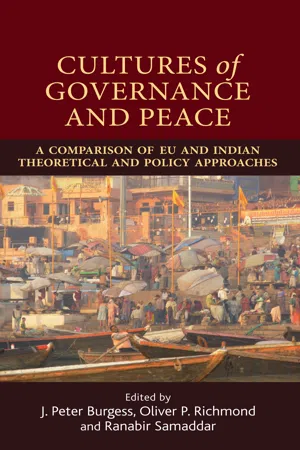
eBook - ePub
Cultures of governance and peace
A comparison of EU and Indian theoretical and policy approaches
- 194 pages
- English
- ePUB (mobile friendly)
- Available on iOS & Android
eBook - ePub
Cultures of governance and peace
A comparison of EU and Indian theoretical and policy approaches
About this book
Information
1
Investigating the relationship between governance and conflict resolution in India and the EU
Introduction
With the rise of India's economic and political power there has emerged a growing interest among analysts, political leaders and civil society organisations in the implications of India's international footprint. On the one hand, it is the world's largest democracy, and has followed many Western policies on development, peacebuilding and democratic consolidation. On the other hand, it is a state with a colonial past that takes pride in creating its autonomous political path, shaped by its ethnic, socio-economic and cultural diversity. At present India is dogged by a range of internal and border conflicts, some state-centric, some ethno-religious, and some arising from socio-economic discrepancies and land or resource distribution problems. Yet, how does the state balance its aspirations as an exemplar in global, regional and local conflict resolution and peacebuilding, given that it is both a donor and recipient?1 Does India's policy profile in peacebuilding, statebuilding and development challenge or complement the Western consensus on the liberal peace or neo-liberal state?
The EU has been trying to refine and reinforce its international profile through consecutive treaty revisions, the deployment of twenty-six Common Security and Defence missions in crisis or post-conflict areas and more recently with the establishment of the External Action Service. The EU has a long-standing, though ill-defined interest in peacebuilding and conflict resolution. Its peacebuilding strategy is shaped by its historical experience as an integration-as-peace model, based on which it tries to project its ‘normative’ power through a range of association, integration and donor practices. The EU intends to maintain and induce peace by reinforcing its domestic state and regional architecture, as can be seen from Bosnia-Herzegovina (BiH) to Georgia among many others.2
This chapter examines whether distinct cultures of governance in conflict environments have emerged in India and the EU and whether the practice of conflict resolution or peacebuilding adds up to a strategy that strives for more than conflict management or ‘governmentality’.3 A direct comparison between these two major international players helps to highlight the particularities as well as the common features of their approaches. More in detail, the chapter elaborates on whether there is sufficient consistency in either actor's peacebuilding practices in different conflict contexts to even speak of a distinct ‘strategy’ or ‘governance culture’.4 In order to operationalise the Indian and EU governance strategy we examine their practices in development policies, statebuilding and their attempts to use political institutions5 for peacebuilding. Conceivably, this tripartite analytical framework could be expanded to include other categories for comparison, such as diplomacy or negotiations, but these categories remain outside of the scope of this chapter. The focus of the chapter is on the use of governance tools as a peacebuilding strategy, and its effectiveness in achieving pacification, containment, or something more ambitious such as conflict transformation. Unpacking and comparing the intricacies of negotiation processes in India and the EU as required for the analysis of diplomatic approaches would amount to a different research project. Instead our focus is on governance cultures in the EU and India in relation to conflict. Empirically, we refer to the Indian engagement in Bihar, North-East India and Jammu and Kashmir and the EU's involvement in cases such as Cyprus, Georgia and Bosnia. Rather than presenting in-depth case studies, this chapter uses empirical findings from a multinational research consortium working on governance and conflict resolution approaches of the EU and India.6
This chapter proceeds as follows: first, it discusses the problems and opportunities of comparing India and the EU. It then compares the two entities' approaches to development policies, statebuilding and political institutions. Moreover, the comparative sections analyse whether distinctive governance cultures have emerged in each area and how far these contribute to conflict resolution as opposed to merely conflict management or pacification of ‘unruly’ populations. We argue that both India and the EU are similar in that their governance strategies achieve a certain level of governmentality rather than conflict resolution. So while they represent functional governance systems – albeit according to a different hybrid system, rationality and culture – their effectiveness in terms of conflict resolution has so far been extremely limited.
Comparing peacebuilding in India and the European Union
Any comparison between India and the European Union with regard to their cultures of governance and conflict resolution must be swathed in caveats. Both entities have developed vastly different institutional set-ups as a consequence of divergent political and socio-economic path dependencies and contain a good deal of heterogeneity. One is a massive unitary state with a geographically differentiated approach to decentralisation, the other a large federation in which competences have been transferred upwards and unevenly across policy fields. Interesting nuances are thrown up by their respective differences – size, internal architecture (state or regional organisation plus state), development, histories, types of conflicts they host or engage with – as well as their similarities, relating mainly to their involvement in the liberal peace architecture (in particular democracy and human rights), their embrace of neo-liberalism, identification of internal and external threats, concern about development and civil society, and their widely perceived diverse and different mixes of cultures and social systems.
EU conflict responses range from military interventions to long-term conflict transformation strategies in the areas of development policy, statebuilding and the creation of political institutions. Different aspects of those policies involve the cooperation of different institutions. While security measures are the responsibility of the Council of the European Union, long-term development approaches are often part and parcel of regional strategies, in which the European Commission has some scope in the allocation of funds and thus shapes policies in their implementation stage.7 Hence, the formation of EU conflict resolution strategies is primarily a member state's prerogative dispersed with supranational components. Within this overarching institutional framework policies have been created, which differ in their geographical range, resource commitment and the policy tools deployed. The parameters for EU interventions in the pre-accession country BiH, for instance, have been laid down in the Stabilisation and Association Agreement8 and the Interim Agreement on Trade and Trade-related Issues.9 EU engagement in Georgia is regulated by the Partnership and Cooperation Agreement10 and the European Neighbourhood Policy (ENP) with the National Indicative Programme11 and the ENP Action Plan12 as their main documents; the Republic of Cyprus is a full member state in contrast to the Turkish Republic of Northern Cyprus, which lacks international recognition and thus does not have official ties to the EU. Institutionally, the EU maintains delegations on the ground, whose monitoring of local policy implementation feeds back into decision-making processes in Brussels. If EU High Representatives are deployed – like in Bosnia and Palestine – they can be endowed with decision-making authorities or act purely in diplomatic capacity.
India's responses to conflict defy easy categorisation. The state-making process involved the violent secession of Pakistan and Bangladesh, a border war with China, and a Cold War context. This has resulted in bursts of military spending and domestic political pressure to maintain military prowess. Beyond maintaining territorial integrity, the state has also faced serious dissent from within. Groups in Kashmir and in the North-Ea...
Table of contents
- Cover
- Title page
- Copyright page
- Table of Contents
- Contributors
- Abbreviations
- Introduction: Cultures of governance and conflict resolution in the EU and India
- 1 Investigating the relationship between governance and conflict resolution in India and the EU
- 2 Government of peace and resistive subjectivities: autonomy, ethnicity and gender in North-East India and Bosnia-Herzegovina
- 3 Political economy of conflict and peace: governmentality of participation and strategic veto in Bihar and Jharkhand, India
- 4 Agency, autonomy and compliance in (post-)conflict situations: perspectives from Jammu and Kashmir, Cyprus and Bosnia-Herzegovina
- 5 Peace via social justice and/or security
- 6 The local is everywhere: a post-colonial reassessment of cultural sensitivity in conflict governance
- 7 Everyday resistance to conflict resolution measures and opportunities for systemic conflict transformation
- 8 Peacebuilding in India: Meghalaya’s experience
- Index
Trusted by 375,005 students
Access to over 1.5 million titles for a fair monthly price.
Study more efficiently using our study tools.
Frequently asked questions
Yes, you can cancel anytime from the Subscription tab in your account settings on the Perlego website. Your subscription will stay active until the end of your current billing period. Learn how to cancel your subscription
No, books cannot be downloaded as external files, such as PDFs, for use outside of Perlego. However, you can download books within the Perlego app for offline reading on mobile or tablet. Learn how to download books offline
Perlego offers two plans: Essential and Complete
- Essential is ideal for learners and professionals who enjoy exploring a wide range of subjects. Access the Essential Library with 800,000+ trusted titles and best-sellers across business, personal growth, and the humanities. Includes unlimited reading time and Standard Read Aloud voice.
- Complete: Perfect for advanced learners and researchers needing full, unrestricted access. Unlock 1.5M+ books across hundreds of subjects, including academic and specialized titles. The Complete Plan also includes advanced features like Premium Read Aloud and Research Assistant.
We are an online textbook subscription service, where you can get access to an entire online library for less than the price of a single book per month. With over 1.5 million books across 990+ topics, we’ve got you covered! Learn about our mission
Look out for the read-aloud symbol on your next book to see if you can listen to it. The read-aloud tool reads text aloud for you, highlighting the text as it is being read. You can pause it, speed it up and slow it down. Learn more about Read Aloud
Yes! You can use the Perlego app on both iOS and Android devices to read anytime, anywhere — even offline. Perfect for commutes or when you’re on the go.
Please note we cannot support devices running on iOS 13 and Android 7 or earlier. Learn more about using the app
Please note we cannot support devices running on iOS 13 and Android 7 or earlier. Learn more about using the app
Yes, you can access Cultures of governance and peace by J. Peter Burgess,Oliver Richmond,Ranabir Samaddar, J. Peter Burgess,Oliver P. Richmond,Ranabir Samaddar in PDF and/or ePUB format, as well as other popular books in Politics & International Relations & European Politics. We have over 1.5 million books available in our catalogue for you to explore.