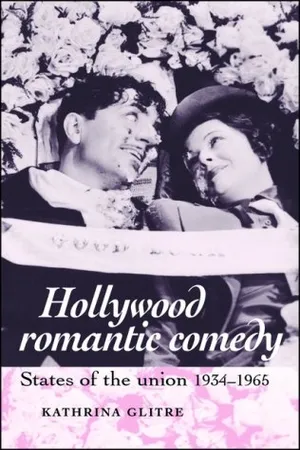
This book explores the changing representation of the couple, focusing on themes of marriage, equality and desire. Kathrina Glitre moves beyond the usual screwball territory to consider cycles of production from 1934-65. The central concern with the representation of the couple is distinctive and includes discussion of three star couples: Myrna Loy and William Powell, Katharine Hepburn and Spencer Tracy, and Doris Day and Rock Hudson.
Glitre offers explanations of genre, as well as detailed analysis of screwball comedy, career woman comedy and sex comedy. Each cycle is placed into context to analyse cultural discourses around heterosexuality, gender, romance and love. This structure also enables a more sophisticated understanding of such conventions as masquerade, gender inversion and the happy ending.
The book will appeal to university students and academics working on genre, gender, culture and representation, and anyone with a keen interest in Hollywood romantic comedy.
- 199 pages
- English
- ePUB (mobile friendly)
- Available on iOS & Android
eBook - ePub
About this book
Information
Publisher
Manchester University PressYear
2013Print ISBN
9780719070792
9780719070785
eBook ISBN
9781847796226
Subtopic
English Literary CriticismPart I
Hollywood romantic comedy

Clark Gable and Claudette Colbert in It Happened One Night (1934).
Courtesy of Columbia Tristar.
Courtesy of Columbia Tristar.
1
Genre, cycles and critical traditions
How do we know a romantic comedy when we see one? According to Brian Henderson, ‘definition, even delimitation, is difficult or impossible because all Hollywood films (except some war films) have romance and all have comedy’ (2001: 312). While the pervasive presence of romance and comedy is undeniable, Henderson is conflating different levels of representational convention. All Hollywood genres implicitly belong to the broader traditions of American narrative film (Pye 1975: 31); romance and comedy are common narrative conventions, hence their ubiquity. Romance and comedy can also be understood as fictional modes – that is, as ways of treating the narrative or, more precisely, as particular ways of imagining the diegetic world. However, these various functions do not preclude the existence of a recognisable genre, ‘romantic comedy’. The quickest indication is to consider the use of descriptive terms. Star Wars (1977) has both romance and comedy, but no one would call it a ‘romantic comedy’, while When Harry Met Sally (1989) is unlikely to be described as anything else. The reason is simple: in Star Wars romance and comedy are secondary concerns; in When Harry Met Sally they are integral and interdependent.
The Russian formalist concept of the ‘dominant’ is useful here. According to Roman Jakobson, the dominant is ‘the focusing component of a work of art: it rules, determines, and transforms the remaining components. It is the dominant which guarantees the integrity of the structure’ (1978: 81). As Steve Neale explains, ‘on this basis, particular genres can be characterized not as the only genres in which given elements, devices, and features occur, but as the ones in which they are dominant, in which they play an overall organizing role’ (1995: 179). Thus, the formation of a couple takes place in many fictional texts as a narrative convention, but it plays the dominant, organising role in two genres: romance and romantic comedy. While romance treats the affair seriously, romantic comedy is more light-hearted. The romance, Love Story (1970), wishes to evoke tears; the romantic comedy, Love Crazy (1941), aims for laughter.
In other words, ‘genres do not consist only of films: they consist also, and equally, of specific systems of expectation and hypothesis that spectators bring with them to the cinema and that interact with films themselves during the course of the viewing process’ (Neale 1995: 160). Genre expectations are based on convention – our mutual understanding that certain things happen in certain ways in certain kinds of texts. Thus, one of our expectations when watching a romantic comedy is that the film will end with the union of a couple. This expectation may be frustrated, as in Annie Hall (1977), but this forms part of the film’s conscious engagement with the genre. This frustration is very different, then, to a film such as Titanic (1997), in which we expect the couple to meet a tragic end. These genre expectations are partly about such elusive things as tone and mood. The world of Hollywood romantic comedy is brightly lit, and accompanied by upbeat music in major keys. We have the sense of a benevolent world, in which destiny (rather than fate) may play a magical part and coincidence has positive results (whereas in melodrama it is the harbinger of doom).
These moods have much to do with the Hollywood modes of romance and comedy, as outlined by Deborah Thomas. She compares the comedic and melodramatic modes, arguing, ‘it is a central aspect of comedic films […] that the social space within them is transformable into something better than the repressive, hierarchical world of melodramatic films, so that fantasies of transformation within this space replace fantasies of escape to a space elsewhere’ (2000: 14). Thomas identifies the romantic mode as being structured around the fantasy of mutual erotic desire (2000: 22), but feels this mode is less autonomous than comedy and melodrama and is necessarily intertwined with one or the other. She also makes a distinction between ‘comic’ and ‘comedic’, using the former to refer to the ‘intention to make us laugh’ (2000: 17) and the latter to refer to the specific structure of fantasy found in the mode of comedy (a usage I will maintain). Thus, the comedic mode is not necessarily funny, and comic genres may be treated in a melodramatic mode. While most romantic comedies involve the comedic fantasy of transformation and the romantic fantasy of mutual desire, neither mode is essential to the genre, and individual films may also shift between different modes. However, irrespective of which modes operate across which films, romantic comedy is still a comic genre: it always aims to make us laugh.1
For the purposes of this book, then, I take the dominant, organising element of the romantic comedy genre to be the comic formation of a (heterosexual) couple2: dominant – but not definitive. The vast majority of romantic comedies fit this pattern, but there is always room for variation and hybridisation. Most importantly, to seek to define a genre mistakes the processes of genre development, which work through repetition and difference. Genres change over time.
Theories of genre
Genre theorists have become increasingly critical of transhistorical approaches to the subject. Such approaches have treated genres as stable and discrete. They focus on identifying and defining exclusive limits, and treat the development of genres as teleological, evolving from a ritual archetype towards a final point of decay or collapse. This is part of the source of Henderson’s difficulty. Despite recognising that ‘a workable subset “romantic comedy” might refer to those films in which romance and comedy are the primary components’ (2001: 312), he feels unable to pin this down categorically enough to fix or define the genre. However, the problem is not (as he suggests) that romantic comedy is too pervasive to be a genre, but that any definition of a genre is inherently temporal and transitory.
Genre development is better understood as a dynamic process, rather than a linear evolution of a stable type. While genre recognition undoubtedly depends upon the repetition of easily comprehended conventions, mere repetition is pointless (negating the need for more than one text). Each new genre text will repeat some elements, but vary others; individual texts will even introduce new elements which will in turn become conventionalised. ‘In this way the elements and conventions of a genre are always in play rather than being simply replayed’ (Neale 1995: 170). Thus, genre operates in (at least) two temporal dimensions: there must be a synchronic sense of continuity, produced by the repetition of conventions; but there must also be a diachronic sense of change, produced by history.
One way of visualising this model is to think of a genre as a family. Alistair Fowler draws on Wittgenstein’s idea of ‘family resemblances’ to theorise genre: ‘representatives of a genre may then be regarded as making up a family whose septs and individual members are related in various ways, without necessarily having any single feature shared in common by all’ (1982: 41). Thus, while still sharing many commonalities, each individual member will also be unique; and while the possibilities of cross-breeding are abundant, each generation will still bear some connection to the last.
What is particularly useful about this analogy is the cultural existence of such resemblance: descendants may look like their ancestors, but they are unlikely to behave like them. Even when conventions do continue or reoccur across a period of time, this is no guarantee that their function and meaning remain unchanged. While genre variation may simply involve challenging the audience’s expectations to offer new pleasures, it may also be a response to shifting cultural ideology. This is crucial to a genre such as romantic comedy, which foregrounds social and sexual mores. Even the dominant is not immune to this process. The ‘union’ used to mean marriage; it now implies monogamy, but this too may change (in fact, since the 1990s, the wedding has again become central to contemporary Hollywood romantic comedy). The heterosexuality of the couple used to be assured, but there are now numerous romantic comedies with gay and lesbian couples. There is even the possibility that the genre may move beyond the couple altogether. For these reasons, among others, I refer to generic tendencies throughout this book, not hard and fast rules.
Critical traditions I: dramatic ancestry
Transhistorical approaches privilege synchronic time, assuming a stable, unified tradition. In terms of romantic comedy, this tradition has been backdated to the New Comedy plays of Menander, Plautus and Terence (fourth, third and second centuries BC, respectively).3 It has become a critical commonplace to identify Hollywood romantic comedy with the structures of New Comedy (for example, see Horton 1991: 10–11, Karnick and Jenkins 1995: 73–5 and Rowe 1995: 108–9), but there are a number of problems with this formulation. Northrop Frye defines the plot structure of New Comedy as formulaic: ‘what normally happens is that a young man wants a young woman, that his desire is resisted by some opposition, usually paternal, and that near the end of the play some twist in the plot enables the hero to have his will’ (1990: 163). Or, as Gerald Mast summarises the structure, ‘boy meets girl; boy loses girl; boy gets girl’ (1979: 4). The patriarchal gender assumptions contained within the New Comedy structure are misleading in relation to studio-era Hollywood romantic comedy. The girl in New Comedy often plays such a minor role that she has little or no dialogue (in Menander’s Dyskolos (The Grouch) she does not even warrant a name). In Hollywood romantic comedy, the girl’s role is central: it is more commonly she who meets the boy and, whether she has immediate designs on him or not, she often initiates the narrative at the very least. It is also quite common for the hero and heroine to know each other already (most obviously in comedies of remarriage). Neither does the rest of the clichéd pattern fit most Hollywood romantic comedies: the ‘boy’ and ‘girl’ are adults, not adolescents, and they do not lose each other, but rather resist, frustrate, battle and ignore each other. Consequently, the opposition is rarely paternal; it comes from within the couple themselves.
In this respect, Hollywood romantic comedy is more intimately related to the battling sexes tradition of Shakespearean comedy (The Taming of the Shrew, Much Ado about Nothing, A Midsummer Night’s Dream), but this is where a further problem arises: a number of critics conflate Shakespearean comedy with New Comedy.4 Where New Comedy is formulaic, Shakespearean comedy moves towards a ‘profounder pattern, the ritual of death and revival’ (Frye 1984: 80) developed from the English folk tradition – a tradition which Frye calls ‘the drama of the green world’ (1984: 80). For Frye, the green world represents a structural principle of Shakespearean comedy, and involves a movement from the tyranny of the everyday social world, to a magical natural realm (usually a forest) in which festive play renews society. Kathleen Rowe is mistaken, therefore, to associate the green world with New Comedy (1995: 108); as Frye argues, the green world is precisely what distinguishes Shakespeare’s The Two Gentlemen of Verona from the New Comedy tradition (1984: 80).
While this may seem like pedantic nit-picking, my point is that this confusion and conflation of terms not only misrepresents Hollywood romantic comedy, but also reinforces generalised assumptions of romantic comedy as an unchanging, transhistorical tradition. There is a critical tendency to rely on the perceived similarities between the dramatic tradition and the Hollywood genre, at the expense of recognising developments. The structures of comedy may have remained relatively consistent, but their functions and meanings have shifted with changing circumstances. The green world is a good example. Rather than addressing the specificities of this space, recent critics have tended to treat it as a broad convention, conflating the green world with the carnivalesque and liminality.5 While these elements have things in common, the differences are lost in the mix. The importance of distinguishing between different kinds of spaces becomes clearer if we consider Celestino Deleyto’s 1998 analysis of Alice (1991): ‘in a film in which the characters never move out of Manhattan “physically”, the “other” space of romantic comedy – the forest or foreign city of Shakespearean comedy in which inhibitions are lifted and a new identity is found – is represented, on the one hand, by Alice’s interior space and, on the other, by Dr Yang’s apartment in Chinatown’ (1998: 135). Here the complexity and diversity of historically, geographically and culturally specific spaces are reduced to the neat and tidy binary logic of the ‘other’. There are two things to clarify: how often does the green world (as opposed to any ‘other’ space) occur? and what is its function? In fact, a movement into a green world is found in only a few Hollywood romantic comedies, and these are almost all screwball comedies. For this reason, I will return to the function of the green world in Chapter 3, once a clearer understanding of screwball comedy has been reached.
I should clarify, I am not claiming Shakespearean comedy as the ‘true’ progenitor of Hollywood romantic comedy, but recognising multiple and diverse antecedents; the genre’s development is not unilinear.6 There is a need to distinguish the broad genre ‘romantic comedy’ from the historically specific forms of that genre produced by the studio system; there is also a need to distinguish Hollywood romantic comedy from the critical paradigms of classical Hollywood narrative.
Critical traditions II: ‘classical’ Hollywood narrative
Classical Hollywood narrative has been repeatedly characterised as linear, goal-oriented and dependent on psychologically motivated, causal action. The neoformalist model articulated by David Bordwell and his collaborators relies most heavily on the concept of a ‘cause-and-effect’ chain of events, leading to a logical and complete resolution. The spectator’s part in this process is formulated in terms of posing hypotheses and receiving knowledge: ‘each sequence, every line of dialogue, becomes a way of creating or developing or confirming a hypothesis; shot by shot, questions are posed and answered’ (Bordwell, Staiger and Thompson 1988: 39). By the end of the film the range of hypotheses has narrowed to one likely outcome, which is invariably confirmed; the high degree of closure places the spectator in a reassuring position of omniscience. This is indeed a ‘classical’ model of narrative. According to Aristotle, plot action ‘ought to be both unified and complete, and the component events ought to be so firmly compacted that if any one of them is shifted to another place, or removed, the whole is loosened up and dislocated’ (1983: 32).
The discourses of unified action reduce narrative complexity to the constant linear structure of beginning–middle–end as representing stability–disruption– stability. Ideologically, this structure has been understood in terms of the conservative reaffirmation of order after a period of transgression and disorder. What is most striking about such discourses is the privileging of the teleological project. As Richard Neupert asserts, ‘the ending is the final product of all the narrative’s labors – the end is privileged both during and after the viewing as a source of validation of the reading process’ (1995: 32). According to the neoformalist model, ‘The End’ is the meaning.
However, this model cannot account for a variety of elements typical of Hollywood film. As Dirk Eitzen argues, elements such as spectacle, emotional intensity and comedy have very little to do with answering hypothetical questions of causal motivation; on the contrary, they seem ‘to be tied up with a more visceral, less cerebral sort of pleasure’ (1999: 398). Hollywood cinema is above all a commercial entity: mass-produced texts intended for mass consumption. To maximise profits, its pleasures must be diverse, and the pleasurable meanings of stars, mise-en-scène, special effects and so on (hereon referred to as ‘spectacle’) all tend to function in excess of causal motivation. By containing meaning within ‘The End’, the neoformalist model not only privileges the traditional unity of high art, but also cognitive processes over emotional responses, and ‘classical’ narrative at the expense of mass entertainment.
Comedy provides a particularly clear example of the limitations of the classical model. Comic meaning is rarely stable or unified; it depends instead upon double meanings and mistaken identities. Moreover, the process of ‘getting the joke’ tends to involve looking backward to reassess what just happened, rather than projecting forward to hypothesise what will happen next. Thus, comic elements interrupt the linear movement of narrative. Far from a straightforward chain of causal events, the structure of narrative comedy tends to be associated with the convolutions of accident, coincidence, repetition, reversal and surprise. In other words, the comic effect is the unexpected outcome of an inconsequential cause; hypothetical logic has nothing to do with it.
For these reasons, I reject the description ‘classical’ to refer to Hollywood romantic comedy of the studio era. In contrast to the unified trajectory of cause-and-effect, ending in the victory (or death) of an individual, Hollywood romantic comedy (like the Hollywood musical) tends to involve a ‘dual-focus’ narrative (Altman 1987: 16–27). Such a narrative places equal emphasis on the hero and heroine, alternating between their points of view, leading to patterns of simultaneity, repetition, parallelism and comparison, rather than cause-and-effect progression. The dual focus usually works to articulate the conflict between male and female, but there is invariably a ‘seco...
Table of contents
- Front Cover
- Title Page
- Copyright Page
- Contents
- Preface
- Introduction
- Part I: Hollywood romantic comedy
- Part II: Marriage
- Part III: Equality
- Part IV: Desire
- Conclusion: the extraordinary couple
- Appendix: the cycles
- References
- Index
Trusted by 375,005 students
Access to over 1.5 million titles for a fair monthly price.
Study more efficiently using our study tools.
Frequently asked questions
Yes, you can cancel anytime from the Subscription tab in your account settings on the Perlego website. Your subscription will stay active until the end of your current billing period. Learn how to cancel your subscription
No, books cannot be downloaded as external files, such as PDFs, for use outside of Perlego. However, you can download books within the Perlego app for offline reading on mobile or tablet. Learn how to download books offline
Perlego offers two plans: Essential and Complete
- Essential is ideal for learners and professionals who enjoy exploring a wide range of subjects. Access the Essential Library with 800,000+ trusted titles and best-sellers across business, personal growth, and the humanities. Includes unlimited reading time and Standard Read Aloud voice.
- Complete: Perfect for advanced learners and researchers needing full, unrestricted access. Unlock 1.5M+ books across hundreds of subjects, including academic and specialized titles. The Complete Plan also includes advanced features like Premium Read Aloud and Research Assistant.
We are an online textbook subscription service, where you can get access to an entire online library for less than the price of a single book per month. With over 1.5 million books across 990+ topics, we’ve got you covered! Learn about our mission
Look out for the read-aloud symbol on your next book to see if you can listen to it. The read-aloud tool reads text aloud for you, highlighting the text as it is being read. You can pause it, speed it up and slow it down. Learn more about Read Aloud
Yes! You can use the Perlego app on both iOS and Android devices to read anytime, anywhere — even offline. Perfect for commutes or when you’re on the go.
Please note we cannot support devices running on iOS 13 and Android 7 or earlier. Learn more about using the app
Please note we cannot support devices running on iOS 13 and Android 7 or earlier. Learn more about using the app
Yes, you can access Hollywood romantic comedy by Kathrina Glitre in PDF and/or ePUB format, as well as other popular books in Media & Performing Arts & English Literary Criticism. We have over 1.5 million books available in our catalogue for you to explore.