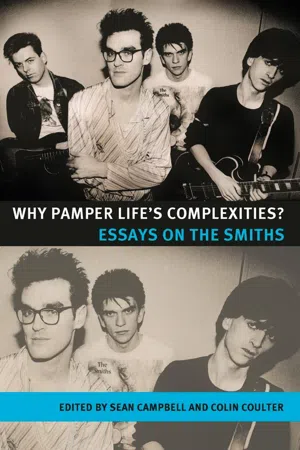
For five short years in the 1980s, a four-piece Manchester band released a collection of records that had undeniably profound effects on the landscape of popular music and beyond. Today, public and critical appreciation of The Smiths is at its height, yet the most important British band after The Beatles have rarely been subject to sustained academic scrutiny. Why pamper life's complexities?: Essays on The Smiths seeks to remedy this by bringing together diverse research disciplines to place the band in a series of enlightening social, cultural and political contexts as never before.Topics covered by the essays range from class, sexuality, Catholicism, Thatcherism, regional and national identities, to cinema, musical poetics, suicide and fandom. Lyrics, interviews, the city of Manchester, cultural iconography and the cult of Morrissey are all considered anew. The essays breach the standard confines of music history, rock biography and pop culture studies to give a sustained critical analysis of the band that is timely and illuminating. This book will be of interest to scholars and students in the fields of sociology, literature, geography, cultural and media studies. It is also intended for a wider audience of those interested in the enduring appeal of one of the most complex and controversial bands. Accessible and original, these essays will help to contextualise the lasting cultural legacy of The Smiths.
eBook - ePub
Why pamper life's complexities?
Essays on The Smiths
- 272 pages
- English
- ePUB (mobile friendly)
- Available on iOS & Android
eBook - ePub
Why pamper life's complexities?
Essays on The Smiths
About this book
Information
1
‘WHY PAMPER LIFE’S COMPLEXITIES?’:
AN INTRODUCTION TO THE BOOK
There are certain moments when the winds of popular cultural appraisal shift with a pace and in a direction that few could have anticipated. The radical reevaluation of The Smiths that has occurred in recent years marks an especially striking case in point. It might seem odd to recall now, but there was a time not so long ago when the cultural stock of the band was at a low. Amid the ascent and ubiquity of dance music in the early 1990s, The Smiths – who had disbanded acrimoniously in 1987 – appeared to have become deeply unfashionable. The literate, melodic songs of Morrissey and Marr appeared to be viewed in many quarters as embarrassing relics of a previous, ostensibly more baleful age.1 The subsequent flowering of Britpop might reasonably have been expected to have revived the reputation of The Smiths. After all, many of the bands associated with the period were quick to acknowledge their debt to the Manchester quartet. Nonetheless, the resurgence of British guitar-based music in the mid-1990s served little to alter the location of The Smiths on the margins of popular cultural memory. The fragile introspection that defined many of the compositions that Morrissey and Marr wrote together was clearly out of step with the ‘laddish’ ethos of the time. Moreover, the resolutely independent2 disposition of The Smiths stood in stark contrast to the brash commercialism that marked Britpop at its peak. As ‘Country House’ and ‘Roll With It’ whipped up a feeding frenzy among the record buying public, it was hard to hear ‘Hand In Glove’ as other than the sound of the spectre at the feast.3
As the 1990s drew to a close, therefore, The Smiths appeared to exist solely on the fringes of the popular imagination and had come increasingly to be rendered through a sequence of well-worn pejoratives such as ‘miserable’ and ‘depressing’.4 The scorn that was quite often heaped upon the band was typically embodied in a caricature of the early stage persona of their vocalist. As the millennium turned, it appeared that The Smiths had come to be remembered only dimly as that strange band with the eccentric singer – the one with the quiff and the flowers and the hearing aid.
Even devotees of The Smiths seemed unable to avoid pandering to some of the more disabling perceptions of the band that existed in the public mind. In the summer of 1999, the high-profile comedian Harry Hill made an appearance on a popular British television programme in which members of the public and, occasionally, celebrities assume for the night the voice and persona of a famous singer of their choice. The contestants who appear on Stars in Their Eyes invariably select to perform familiar hits by fairly uncontroversial figures in popular music. The particular persona that Hill elected to adopt for the evening, in contrast, had the potential to be distinctly contentious. The comedian chose to mark his status as a fan of The Smiths by offering a rendition of the band’s breakthrough single. As Hill disappeared offstage to get into character, the show’s cloyingly anodyne host Matthew Kelly sought to frame the performance to come by informing the audience that they were about to hear a song by a band that had made ‘miserable fashionable’. The screens then parted to reveal Hill dressed up as an early version of Morrissey and prepared for a hearty rendition of ‘This Charming Man’. The song selected for the programme had the potential of course to be deeply transgressive. It is not that often that you get to hear a tale of rustic homoerotic desire rendered quite so lustily in front of a teatime family audience.5 The subversive potential of the song was inevitably defused, however, by the context and style of its rendition. The radical intent of the lyrics simply dissipated in the face of the performance of a tiresomely familiar cultural caricature. The sight of Hill with his prosthetic quiff and flailing gladioli clearly met with the approval of the studio audience. As the final bars of ‘This Charming Man’ faded out, the performance was greeted with the kind of rapturous applause that people in attendance at light entertainment shows reserve for moments when they have had their prejudices confirmed with the minimum of discomfort.6
The fading reputation of The Smiths during the 1990s might, therefore, be attributed to the actions of fans and critics alike. It should also be acknowledged, however, that the band were at times the architects of their own misfortune. During their brief period together, The Smiths had no consistent or adequate management. The chaos that inevitably ensued was instrumental of course in the untimely demise of the band and would also spark a sequence of events that would land the four erstwhile friends and colleagues in court a decade later. In December 1996, the former drummer Mike Joyce successfully sued Morrissey and Marr for recording royalties that he claimed were owed to him. The acrimonious proceedings – in which Judge Weeks famously castigated Morrissey as ‘devious, truculent and unreliable’ – appeared to have done irreparable damage not only to relations between the former members of The Smiths but also to the very reputation of the band itself.7 The dispute became the major lens through which accounts of the band would, for a while, be filtered.8 Perhaps the most notable aspect of the court case was not, however, the verdict but rather the absence of any real popular interest in the proceedings. There are today a great many people willing to part with large sums of cash for the privilege of seeing The Smiths together in the same room.9 Back in 1996, however, only one fan was sufficiently interested to take the opportunity to see free of charge the compelling spectacle of the four former band-mates facing one another across an open court.10
As the 1990s came to a close, then, the standing of The Smiths appeared to be at an all-time low. Even some of the most ardent supporters of the band seemed to find it difficult to imagine a time when The Smiths would be afforded the attention and respect that their work evidently deserved. Articles penned during this period by the band’s admirers often had a distinctly valedictory tone.11 Within a few short years, however, the course of popular cultural memory would begin to turn in ways that few could have anticipated.
The return of the repressed
The advent of the twenty-first century has signalled a remarkable reversal in the fortunes of The Smiths. The resurgence of guitar-based music, heralded by bands like The Strokes and The Libertines, has ensured that the Manchester group is now deeply fashionable – even more so perhaps than in their 1980s heyday. Since about the beginning of the 2000s, it has become commonplace for successful young bands to identify The Smiths as a major influence on their work.12 Much of this praise has come from expected sources, not least ‘alternative’ rock acts like Arcade Fire, who frequently covered ‘Still Ill’ on their 2007 tour. In addition, though, the very dance scene that seemed to have rendered The Smiths obsolete has also played a part in their rehabilitation. In 2007, the in-vogue producer Mark Ronson recorded a dance floor ‘re-version’ of the band’s 1987 track ‘Stop Me If You Think You’ve Heard This One Before’, which reached number two in the UK charts – the highest ever chart position for a Smiths song. Two years later, a synth-pop rendition of ‘This Charming Man’ by the female singer V.V. Brown underlined The Smiths’ resonance. By 2010, mainstream pop stars such as Lady Gaga would heap praise on the group in interviews.
The increasing influence of The Smiths has stretched of course well beyond the parameters of popular music. The songs that the band recorded have, for instance, provided the inspiration for work in the fields of contemporary dance, video art and literature.13 In addition, the lyrics that Morrissey crafted back in the mid-1980s have gradually percolated into wider popular discourse. In this context, it is remarkable how frequently phrases from The Smiths’ songbook appear in print and on air. There is a marked tendency for journalists and authors to adapt or rework one of the band’s distinctive song titles, for instance, even when commenting on matters that have nothing whatsoever to do with popular music. Thus, a 2009 article on the British politician William Hague was entitled ‘William, It Was Really Nothing’, while a review of Monty Python star Michael Palin’s diary was called ‘This Charming Man’s Charmed Life’.14 Perhaps the most bizarre illustration of this trend appeared in a BBC natural history programme that follows the fortunes of various species struggling to emerge from the hardships of winter. The 2009 instalment of Springwatch entailed the engaging spectacle of presenter Chris Packham striving to cram as many, usually utterly gratuitous, Smiths song titles as possible into his commentary. This peculiar quest made for compulsive and hilarious viewing and by the final episode of the series a presumably largely unsuspecting viewing audience had been treated to no fewer than thirty references to The Smiths.15
There are of course countless other instances of the practice of citing Morrissey and Marr song titles that exist outside the unlikely setting of natural history programmes.16 A couple of further examples will perhaps help to illustrate the more specifically literary influence that The Smiths’ songs have come to exert. In the summer of 2006, the superbly fractious online political commentary spiked featured an article concerned with the terrorist attacks on London the previous year. The essay by Neil Davenport offered the distinctly questionable interpretation that the 7/7 suicide bombers were not driven by political zeal but rather by the kind of adolescent petulance that he discerns as the natural idiom of popular music. In a doomed attempt to square the circle of his own twisted logic, the author selected a resonant title to frame the piece: ‘Heaven Knows I’m an Islamist Now’.17 The appearance of a reworked Smiths song title on the libertarian space marked out by spiked does not of course come as a complete surprise. It would, after all, be expected that at least some of the playful iconoclasts that produce the weekly blog have more than a passing acquaintance with 1980s indie. What is rather more remarkable is that the lyrics of The Smiths have gradually moved beyond the exclusive and marginal spaces defined by the hipster vernacular of the lapsed left and have begun to appear in the realm of other, rather less fashionable but infinitely more popular, literary forms.
The spring of 2008 saw the latest publication by the hugely popular Irish novelist Marian Keyes. While Keyes ordinarily deals in a romantic genre often sniffily dismissed as ‘chick lit’, this latest slice of fiction sees her delve into the rather darker territory of domestic violence. The novel is also noteworthy because of its resonant and deliberate choice of title.18 As we write, in 2009, This Charming Man sits aloft the bestseller lists on both sides of the Irish Sea. It is hard to know whether many of Keyes’ readers are familiar with The Smiths’ song of the same name but this is perhaps immaterial in any case. The very existence of a romantic bestseller entitled This Charming Man arguably attests to the sheer breadth of the cultural influence of the band. Over time, the songs of The Smiths have slipped their moorings and gradually begun to appear in the most unlikely of places. Even people who may not be aware of the band are repeatedly introduced to phrases that first appeared in Morrissey’s lyrics. The title of one of the romantic blockbuster novels of 2008 and 2009 suggests then that the work of The Smiths has over time left an indelible inscription on the deep tissue of popular culture.
Perhaps the most striking affirmation of the revival of The Smiths, however, was that offered by the music weekly that was the major champion of the band in their heyday. In the spring of 2002, the New Musical Express (NME) scoured their own back issues in a bid to establish the most influential recording artists of the previous fifty years. While most observers presumed that The Beatles would emerge triumphant from the survey of the magazine’s cover stories, features and letters, it was in fact another Northern English four-piece that was duly anointed.19 In naming The Smiths as the most important band of all time, the NME confirmed the group’s changing fortunes since the late 1990s.
The unanticipated anointment of The Smiths by the NME might be considered emblematic of a growing and much wider recognition of the achievements of the band in the post-2000 period. Throughout the opening decade of this century, there has been a slew of special issues of music magazines dealing with the legacy of The Smiths, as well as a...
Table of contents
- Cover Page
- Title Page
- Copyright Page
- Contents
- Notes on contributors
- Acknowledgements
- 1 ‘Why pamper life’s complexities?’: an introduction to the book
- 2 ‘Has the world changed or have I changed?’: The Smiths and the challenge of Thatcherism
- 3 ‘Irish blood, English heart’: ambivalence, unease and The Smiths
- 4 ‘Heaven knows we’ll soon be dust’: Catholicism and devotion in The Smiths
- 5 ‘Sing me to sleep’: suicide, philosophy and The Smiths
- 6 ‘A boy in the bush’: childhood, sexuality and The Smiths
- 7 ‘This way and that way’: toward a musical poetics of The Smiths
- 8 ‘I don’t owe you anything’: The Smiths and kitchen-sink cinema
- 9 ‘A double bed and a stalwart lover for sure’: The Smiths, the death of pop and the not so hidden injuries of class
- 10 Last night we dreamt that somebody loved us: Smiths fans (and me) in the late 1980s
- 11 ‘When we’re in your scholarly room’: the media, academia, and The Smiths
- 12 ‘So much to answer for’: what do The Smiths mean to Manchester?
- 13 ‘Take me back to dear old Blighty’: Englishness, pop and The Smiths
- 14 Guantánamo, here we come: out of place with The Smiths
- Index
Trusted by 375,005 students
Access to over 1.5 million titles for a fair monthly price.
Study more efficiently using our study tools.
Frequently asked questions
Yes, you can cancel anytime from the Subscription tab in your account settings on the Perlego website. Your subscription will stay active until the end of your current billing period. Learn how to cancel your subscription
No, books cannot be downloaded as external files, such as PDFs, for use outside of Perlego. However, you can download books within the Perlego app for offline reading on mobile or tablet. Learn how to download books offline
Perlego offers two plans: Essential and Complete
- Essential is ideal for learners and professionals who enjoy exploring a wide range of subjects. Access the Essential Library with 800,000+ trusted titles and best-sellers across business, personal growth, and the humanities. Includes unlimited reading time and Standard Read Aloud voice.
- Complete: Perfect for advanced learners and researchers needing full, unrestricted access. Unlock 1.5M+ books across hundreds of subjects, including academic and specialized titles. The Complete Plan also includes advanced features like Premium Read Aloud and Research Assistant.
We are an online textbook subscription service, where you can get access to an entire online library for less than the price of a single book per month. With over 1.5 million books across 990+ topics, we’ve got you covered! Learn about our mission
Look out for the read-aloud symbol on your next book to see if you can listen to it. The read-aloud tool reads text aloud for you, highlighting the text as it is being read. You can pause it, speed it up and slow it down. Learn more about Read Aloud
Yes! You can use the Perlego app on both iOS and Android devices to read anytime, anywhere — even offline. Perfect for commutes or when you’re on the go.
Please note we cannot support devices running on iOS 13 and Android 7 or earlier. Learn more about using the app
Please note we cannot support devices running on iOS 13 and Android 7 or earlier. Learn more about using the app
Yes, you can access Why pamper life's complexities? by Sean Campbell,Colin Coulter, Sean Campbell, Colin Coulter in PDF and/or ePUB format, as well as other popular books in Social Sciences & Anthropology. We have over 1.5 million books available in our catalogue for you to explore.