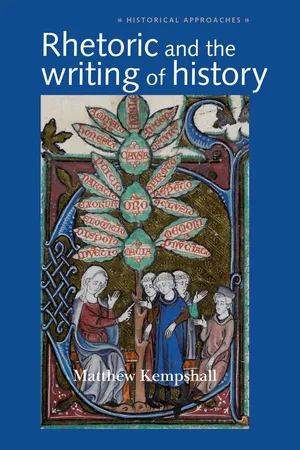
This book provides an analytical overview of the vast range of historiography which was produced in western Europe over a thousand-year period between c.400 and c.1500. Concentrating on the general principles of classical rhetoric central to the language of this writing, alongside the more familiar traditions of ancient history, biblical exegesis and patristic theology, this survey introduces the conceptual sophistication and semantic rigour with which medieval authors could approach their narratives of past and present events, and the diversity of ends to which this history could then be put. By providing a close reading of some of the historians who put these linguistic principles and strategies into practice (from Augustine and Orosius through Otto of Freising and William of Malmesbury to Machiavelli and Guicciardini), it traces and questions some of the key methodological changes that characterise the function and purpose of the western historiographical tradition in this formative period of its development.
The writing of history in the Middle Ages cannot be reduced to one single formula or definition. Instead, it straddled a huge variety of genres, covering – and often combining – world chronicles, annals, histories of communities, deeds of individuals, hagiographies, biographies, autobiographies and epic poems.1 Medieval historiography therefore does not correspond to any fixed genre, in terms of either its form or its style – it could be written in prose, in verse or sometimes as both; it could be sung as a chanson de geste; it could be sculpted or painted or presented in tableaux; in the case of the ‘estorie’ of Richard of Haldingham it could even be recorded schematically as a ‘map’ of the world.2 To do justice to such heterogeneity whilst at the same time isolating what might still justify the identification of such complex material as ‘historiography’ accordingly presents very real difficulties of classification. Of the various ways in which categorisation might be tackled, the most straightforward, perhaps, and conventional, is to identify three major determinants of historical writing in this period: the transmission and influence of classical texts; the impact of the books of the Bible; and the development of a distinctively medieval ‘chronography’ once the formal compilation of annals began to emerge from the calculation and composition of the liturgical calendar within the Church. Before any generalisations are made about ‘classical’, ‘Christian’ or ‘ecclesiastical’ traditions in the Middle Ages, it is essential to grasp exactly what, and whom, they represented and, equally importantly, just how they interrelated.
The classical tradition
The writing of history in the Middle Ages took as one of its fundamental reference points a series of works by classical historians which had survived in, or were copied from, manuscripts of the late antique period. This process of transmission means that, whereas a modern conception of a ‘classical’ corpus of historical works might give prominence to, say, texts by Thucydides, Polybius, Livy and Tacitus, the medieval canon of what constituted ‘classical’ historiography was rather different, at least until the mid-fifteenth century. First and foremost, it consisted of Sallust and the Latin translation of Josephus; after them, and with varying degrees of availability and dissemination, came Julius Caesar, Livy, Tacitus, Suetonius (including his continuation in the Historia Augusta) and Ammianus Marcellinus.3 All of these works existed in eighth- and ninth-century manuscripts (and it is, in the main, these medieval copies, not the late-antique originals, which were subsequently rediscovered by fourteenth- and fifteenth-century humanists) and, as integral texts, they exerted a profound influence on how the writing of history was understood. Just as, if not more, important, however, was the transmission of these authors in the form of excerpted texts – Livy, for example, could be read in the version distilled by Florus,4 and Pompeius Trogus in the summary provided by Justin.5 Likewise, digests of Roman history had been arranged schematically by Valerius Maximus in his first-century Memorable Deeds and Sayings,6 and chronologically by Eutropius in his fourth-century Abbreviation or Breviarium (a work which was subsequently expanded by Paul the Deacon in the eighth century as the Historia Romana).7 Valerius Maximus makes the intended value of this sort of work quite clear in the prologue to his collection: ‘concerning the city of Rome and external nations I have determined to select and arrange [digerere] the deeds and sayings which are worthy of remembrance but which are too widely scattered in other sources to be briefly comprehended so that those who wish to take examples [documenta] may be spared the labour of a lengthy search’.8 It was the same sort of intention which lay behind William of Malmesbury’s twelfth-century Polyhistor, his own distillation of facta et dicta memorabilia, and the thirteenth-century Gesta Romanorum, a collection of moralised historical exempla which was also translated into the vernacular.9
The primary significance of the transmission of this particular range and selection of classical historians lies in the different models of writing which they provided. Such influence could be generic – whereas Sallust wrote history as the record of recent or contemporary political and military events, Livy conceived of it as the history of a city from its foundation (ab urbe condita), Suetonius as the life and deeds of a single individual and Pompeius Trogus as the history of the world since Ninus, king of Assyria. Or it could be particular – Sallust’s historiography directly shaped the writing of, for example, Widukind of Corvey and Richer of Rheims in the tenth century,10 Wipo and (as Orderic Vitalis readily recognised) William of Poitiers in the eleventh,11 and Suger of Saint-Denis and William of Malmesbury in the twelfth.12 Josephus had a comparable impact on Widukind, Rahewin and Guibert of Nogent,13 Suetonius on Einhard and William of Malmesbury,14 Livy on Lampert of Hersfeld.15 Before tackling medieval historiography in terms of the criteria which it developed for itself, therefore, it is necessary to grasp what was on offer from the writings of those particular classical authors – most notably Sallust and Josephus – who proved so influential on the conception and practice of history-writing in the Middle Ages, both in and of themselves but also as part of a continuous process of transcription.
Sallust’s two surviving works of history, the Jugurthine War and the Catiline (or Catiline War), clearly established that the historian’s primary concern should be with moral judgement, motive, invented speeches, vivid battle scenes, proverbial maxims and, at the most basic level, with a subject-matter which included war and politics but geography and ethnography too.16 Sallust’s accounts of the war with Jugurtha and the conspiracy of Catiline accordingly set striking narratives of significant historical events within much wider interpretative frameworks of moral and political analysis.17 First and foremost, this involved repeatedly denouncing the prevalence of greed and avarice in Roman public life – a corruption born of wealth, luxury and arrogance and which had so infected the conduct of nobility and populace alike that it had left everything in Rome for sale.18 This moral critique was highlighted from the very beginning of both works.19 The opening remarks in the Catiline, for example, tie the process of decline directly to the mutability of human affairs. The life of mortals, Sallust observes, was originally free from cupidity but, once the lust for power started to direct the human mind towards the conduct of war, it was found that the exercise of mental capabilities, rather than physical strength, had a particular effectiveness in military activity. In peace, by contrast, such mental capabilities were less potent, and labour was accordingly replaced by sloth, temperance by lust, and equity by arrogance. The result was instability and constant confusion, as shifts in moral conduct became mirrored by changes in fortune and rule (imperium).20 This overarching historical process furnished Sallust with his primary reason for choosing the conspiracy of Catiline as the particular subject-matter for his writing – not just because it was, in itself, an event worthy of memory, but also because the danger which it represented was unprecedented, as it was the first manifestation of the political consequences of the moral corruption which had recently taken root in the Roman people. In his own political life, Sallust explains, he had seen shamelessness, extravagance and greed, and it was this pernicious combination of luxury and avarice – the worst of all evils – which, in his opinion, had enabled Catiline to secure support for his conspiracy.21
It is from the perspective of a much broader process of moral and political corruption, therefore, that Sallust constructs the background to his history – what was instituted by earlier generations as the means of conducting war and politics, how they maintained the political community, how that res publica had increased in size but how it had then changed from exemplifying the noblest and the best to being the worst and most vicious.22 The turning-point for Rome, as far as Sallust was concerned, was victory in the Punic Wars.23 With greatness secured, other peoples subjugated and Carthage destroyed, wealth and inactivity became burdensome to Rome. The love of money and the lust for power – according to Sallust, the substance of all evils – generated, in their turn, the twin vices of avarice and ambition, spreading like a plague (labes) and transforming Roman rule into something cruel and intolerable.24 Such was the power of this disease (morbum) that Catiline was able to mount his conspiracy without being betrayed. Catiline, in short, exemplified a much deeper moral and political malaise.25 Sallust concluded, after considerable reflection, that what had enabled the Roman people to achieve and sustain their earlier outstanding political and military feats was, not superiority of numbers or resources, nor unremitting good fortune, but the distinction of a few virtuous citizens. However, once Rome was corrupted by luxury and sloth, the res publica was able to overcome the vices of its rulers and magistrates only by virtue of its own greatness. This was the process that Sallust saw represented by the defeat of Catiline and this was why his narrative culminated in the artfully paired speeches, and characters, of Julius Caesar and Cato the Younger. The contrasting virtues of Caesar and Cato represented the two exceptions to the luxury, arrogance and avarice which had supplanted those very qualities of mind which had originally created and maintained the Roman res publica. It is Cato who delivers the devastating indictment of the degeneracy of the Roman nobility and populace, and it is his counsel to the Senate which accordingly prevails.26
The Jugurthine War picks up and develops the same broad themes as the Catiline. The character and conduct (mores) of Rome, Sallust admits, have made him sad and weary at a time when the route to public office was no longer provided by virtue but by robbery and deception. He had chosen to write about the war in north Africa not only because of its scale, its atrocity and its fluctuating successes, but also because it marked the first occasion within Rome when there was political opposition to the arrogance of the nobility – a struggle which was ultimately to reach such a peak of frenzy that it resulted in civil war and the devastation of the Italian peninsula.27 It is thus the avarice of the Roman nobility in which Jugurtha places his hopes for success and it is the luxury, fecklessness and arrogance of the Roman nobility which provide him with great assistance throughout the course of the subsequent conflict.28 Once again, it is the destruction of Carthage which Sallust holds responsible for the inactivity and abundance of resources which, in turn, had precipitated the growth of such corruption in Rome. On this occasion, however, Sallust gives this ‘plague’ of avarice a directly political manifestation, in the development of factional politics. As soon as fear of the enemy had disappeared, he writes, the res publica was torn in two by the effects of arrogance and licence in the nobility and the populace. Rapacity and self-interest replaced concern for the common good; unrestrained power and avarice attacked everything until they brought about their own downfall in the ‘earthquake’ of civil dissension.29 Once again, Sallust chooses to personify these failings, in this case in the form of the flawed characters of two Roman generals, Metellus and Marius, the former virtuous except for the arrogance that was characteristic of his noble rank, the latter distinguished and illustrious as a non-noble ‘new man’ (novus homo) but whose hatred had left him under the guidance of the worst of all counsellors, namely desire (cupido) and anger (ira).30 Once again, it is left to a carefully staged speech, in this case by the tribune Memmius, to deliver a damning indictment of the venality and self-indulgence which would ultimately see the freedom enjoyed by the Roman people replaced by tyranny and slavery.31
If the influence of Sallust’s approach to historiography was dominated by its overarching moral critique, then its impact also extended to the series of self-conscious reflections on the nature of writing history with which he chose to introduce both works. Sallust opens the Catiline, for example, by juxtaposing rule by the mind (ingenium) with rule by bodily strength or physical force (vis) – the former is characteristic of human beings, the latter of animals. Since life is short, Sallust continues, its remembrance (memoria) must be made as long as possible. Since the glory of the body or of material wealth is fleeting and fragile whereas the glory of mental virtue is shining and eternal, it is the remembrance of moral worth which should be rewarded, not with the silence that attends...
Table of contents
Cover Page
Title Page
Copyright Page
Dedication
Contents
Acknowledgments
Introduction
1 History and historiography
2 Rhetoric and history
3 Invention and narrative
4 Verisimilitude and truth
5 Historiography and history
Conclusion
Bibliography
Index
Footnotes
Backcover
Trusted by 375,005 students
Access to over 1.5 million titles for a fair monthly price.
Study more efficiently using our study tools.
Frequently asked questions
Yes, you can cancel anytime from the Subscription tab in your account settings on the Perlego website. Your subscription will stay active until the end of your current billing period. Learn how to cancel your subscription
No, books cannot be downloaded as external files, such as PDFs, for use outside of Perlego. However, you can download books within the Perlego app for offline reading on mobile or tablet. Learn how to download books offline
Perlego offers two plans: Essential and Complete
Essential is ideal for learners and professionals who enjoy exploring a wide range of subjects. Access the Essential Library with 800,000+ trusted titles and best-sellers across business, personal growth, and the humanities. Includes unlimited reading time and Standard Read Aloud voice.
Complete: Perfect for advanced learners and researchers needing full, unrestricted access. Unlock 1.5M+ books across hundreds of subjects, including academic and specialized titles. The Complete Plan also includes advanced features like Premium Read Aloud and Research Assistant.
Both plans are available with monthly, semester, or annual billing cycles.
We are an online textbook subscription service, where you can get access to an entire online library for less than the price of a single book per month. With over 1.5 million books across 990+ topics, we’ve got you covered! Learn about our mission
Look out for the read-aloud symbol on your next book to see if you can listen to it. The read-aloud tool reads text aloud for you, highlighting the text as it is being read. You can pause it, speed it up and slow it down. Learn more about Read Aloud
Yes! You can use the Perlego app on both iOS and Android devices to read anytime, anywhere — even offline. Perfect for commutes or when you’re on the go. Please note we cannot support devices running on iOS 13 and Android 7 or earlier. Learn more about using the app
Yes, you can access Rhetoric and the Writing of History, 400–1500 by Matthew Kempshall in PDF and/or ePUB format, as well as other popular books in History & British History. We have over 1.5 million books available in our catalogue for you to explore.