- 119 pages
- English
- ePUB (mobile friendly)
- Available on iOS & Android
eBook - ePub
The never-ending <i>Brief Encounter</i>
About this book
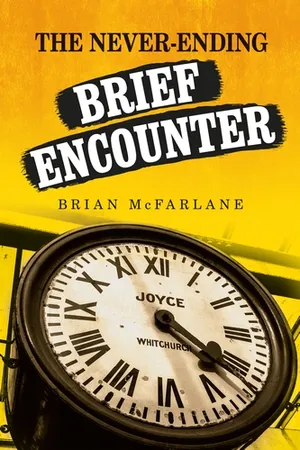
This is a book for all those who have been absorbed and moved by Brief Encounter in the seventy or so years since its first appearance. It explores the central relationship of the film, where two people who fall unexpectedly in love come to realise that there is more to life than self-gratification. Mores have undoubtedly changed, for better or worse, but that essential moral choice has never lost its power. While acknowledging this, the book goes further in an effort to account for the way the film has passed into the wider culture. People born decades after its first appearance are now adept at picking up references to it, whether a black-and-white scene in a much later film or a passing joke about a bald man in a barber's shop.
Information
Publisher
Manchester University PressYear
2019Print ISBN
9781526124401
9781526124401
eBook ISBN
9781526124425
Subtopic
Film & Video1
Predecessors
If the chief interest of the present study is in the film’s successors, this is not to suggest that its narrative or thematic concerns lacked predecessors. In a novel such as George Eliot’s The Mill on the Floss, the heroine, Maggie Tulliver, comes to accept that she cannot make her happiness out of the unhappiness of others when she falls in love with her cousin’s fiancé. ‘O God is there any happiness in love that could make me forget their pain?’ she anguishes.1 Or in Edith Wharton’s The Age of Innocence, superbly filmed by Martin Scorsese in 1995, Newland Archer, in love with the revenant Ellen, Countess Olenska, cannot destroy his marriage to gratify his own desires. Ellen herself, planning to return to her European husband, asks: ‘What else is there? I can’t stay here and lie to people who have been good to me.’2 This is echoed in Scorsese’s film when Ellen (Michelle Pfeiffer) asks: ‘Is there anywhere we can be happy behind the backs of people who trust us?’ In fact, in the film, ‘there is a sense of its turning Brief Encounter inside out to centre on the man [Newland (Daniel Day-Lewis)] who has a glimpse of passion when it is too late to do more than turn down a glove and kiss a white wrist.’3 And of course Tolstoy’s Anna Karenina, caught in a not wholly dissimilar conflict, takes the final step that Brief Encounter’s Laura seems about to take and from which she just pulls back.
In the Introduction, I referred to Casablanca, and when Humphrey Bogart surrenders Ingrid Bergman so that she can return to her brave Resistance-worker husband, Victor (Paul Henried), something similar is at stake – but, of course, they’ll ‘always have Paris’; whereas ‘Paris’, in metaphorical form, is resisted in the other two mentioned predecessors and, indeed, in Brief Encounter. Also, the sheer star power of the Bogart–Bergman combination means that the iconic ordinariness of the Brief Encounter scene and its protagonists is not part of the emotional charge of Casablanca. We expect major stars to be caught up in life-changing passion; it comes as more of a shock to find ‘ordinary’ lives reacting to unsought emotional complexity. At the time of Brief Encounter, neither Celia Johnson nor Trevor Howard was such a film star: she had had a stage career and had appeared in but three films, with a leading role in This Happy Breed (1944), but was by no means a household name of the Bogart or Bergman kind; while Howard had had only a small role in The Way to the Stars (1945) and an uncredited bit in The Way Ahead (1944). It was, then, likely that as they were not trailing clouds of starry glory, they might more readily convey the ‘ordinary’ aspect of the lives of Laura and Alec in Brief Encounter. Johnson combined film and theatre for the next several decades as a highly respected actress rather than a traditional ‘star’, and Howard became a key figure of British cinema, in such notable films as The Third Man (1949), both always seeming to display recognisable personae – albeit at the service of individually different roles.
As for other films that may be thought to foreshadow Brief Encounter, two that in part focus on the emergence of desire in situations where its indulgence is seriously complicated by marriage are Edmond Gréville’s Brief Ecstasy and Jean Renoir’s La Bête Humaine (both 1938). The former involves a man returning from India after four years and hoping to resume the affair with the woman he left behind and who is now married; the second complicates matters further with a murder but makes brilliant use of trains – as does its 1945 successor.
The film’s immediate antecedent – immediate in the sense that the film is derived from it – is Noël Coward’s one-act play, Still Life, one of nine such in the compendium, Tonight at 8.30, first performed at the Phoenix Theatre, London, in 1936. Re-reading the original play, I am struck by how much more imaginative David Lean’s treatment of its plot is in the film. The play, confined to the single setting of the railway buffet, is entirely linear in its approach, beginning with some rather patronisingly presented class-based comedy in the lower-orders exchanges between members of the railway staff: the ‘refained’ Myrtle Bagot in charge of the buffet, keeping the ticket inspector Albert Godby and her assistant Beryl in their places. Their badinage is interrupted when middle-class Laura, who has been quietly sitting over her cup of tea and has then gone out to the platform to check the train times, comes back into the buffet with a piece of grit agonisingly in her eye. After unhelpful suggestions from Bagot and Godby, a doctor comes to her rescue and removes the grit. His name is Alec Harvey, and from this brief encounter the rest of the play unfolds.
‘Still Life’ seems in fact a more appropriate title for the play because it feels utterly devoid of the quotidian facts of the lives of either Laura or Alec and how these facts interact with the emotional upheaval they are supposedly undergoing. It now seems merely stiff with restraint, and its confinement to the railway buffet gives off a kind of airlessness at odds with the emotional resonance of the film. Unpredictable US critic, Pauline Kael, wrote of Brief Encounter, which she mostly admired, that ‘There’s not a breath of air in it’.4 If this is not true of the film, it could well be argued to be so of the play.
Two of the crucial ways in which the film reconstructs the play to its immense emotional advantage, and the credit is of course due to Coward for reconceiving it as a film, are as follows. First, the film begins near the end of Laura and Alec’s relationship and invites the audience to ponder what has brought them to this unhappy seeming situation; and second, it allows us to see something of Laura’s home life and, especially, of her kind, decent husband Fred. Fred may not be exciting but in the characterising of this role, and in Cyril Raymond’s quietly sympathetic playing, he makes no small contribution to the film’s emotional texture and its power to move us.
In his Introduction to Volume IV of his collected plays, Coward wrote of Still Life, which he regarded as ‘the most mature play of the whole series [i.e., of Tonight at 8.30]’: ‘Later it was made into an excellent film and retitled Brief Encounter. I am fond of both the play and the film with, as usual, a slight bias in favour of the former’, and ‘reading with detachment after so many years, I am proud to have written it’.5 By November 1945, two of his other plays, also directed by David Lean, had won a measure of praise: they were This Happy Breed (1944) and Blithe Spirit (released in May 1945), and it is at least arguable that both, like Still Life, benefited from the screen’s greater fluidity in matters of time and place. Coward wrote the screenplay for all three, but it is perhaps understandable that a playwright might tend to ‘favour’ the original work over the more broadly collaborative filmmaking processes. It might have been interesting to know in more detail why he retained ‘a slight bias in favour of’ Still Life: to the viewer, the film offers more insight into the lives of Laura and Alec and the movement out of the railway buffet provides different testing grounds for what is happening between them. By this I mean such settings as Laura’s home or the restaurant where they are seen by friends of Laura, who is then forced into minor subterfuge – or, most important of all, Stephen Lynn’s flat, scene of the about-to-be consummation of their ‘affair’.
By strange coincidence, as I began writing this book, the Malvern Theatre Company, Melbourne, staged a double bill of two of Coward’s one-act plays from Tonight at 8.30. The more lightweight of the two, We Were Dancing, though stylishly enough performed, seemed irredeemably dated. The other play was entitled Brief Encounter, and was in fact Coward’s original Still Life. There was clearly a recognition factor involved here: whereas Still Life as a title might not have meant much to audiences in 2017, the changed title did and there were large audiences throughout the duration of the plays’ season. The programme contained this sentence: ‘The original title of our first play was Still Life. It was filmed in 1945 as Brief Encounter. The film has been regarded as a classic ever since and we thought it appropriate to use this title for our production.’6 Another example of this title change occurred when Coward himself and Margaret Leighton, in 1957, made a recording entitled Brief Encounter. This was the name on the recording, which consisted of short extracts from Blithe Spirit and Present Laughter – and ‘a complete adaptation’ of Brief Encounter.7 In other words, by this time, Coward himself had obviously acknowledged the greater pulling power of the film’s title as compared to that of the original play. The Malvern Theatre Company was thus following in the steps of the master, as would later play versions.
The play, extremely well acted, still succeeded in holding audience attention, but it does throw into relief some of the ways in which the film is a more accomplished piece of work than its antecedent. For instance, those intimate conversations between Laura and Alec gain from the camera’s way of homing in on them, separating them from the buffet staff and other customers. Speaking of other customers, though, the production struck a note of authenticity not suggested in the original play by having several ‘extra’ performers simply taking their place at various tables. And the use of two of Coward’s most famous songs – ‘I’ll See You Again’ and ‘Someday I’ll Find You’ – as bridges between scenes proved a discreetly satisfying device, giving a fluidity to the proceedings as cast members came and went and changes to setting and lighting were effected.
In other matters, though, the play, however well performed, still misses the chance to take the lovers into the other settings which here they can merely refer to; the absence of Laura’s husband, Fred, from the cast is a major loss from the emotional texture the film has taught audiences to appreciate; and the linear approach to the narrative seems a good deal less potent than the film’s use of flashback. To sum up, the film’s techniques unarguably make for a richer experience on so many levels, however accomplished the play’s performance may be.
Notes
1 George Eliot, The Mill on the Floss (1860), Harmondsworth: Penguin, 1981, p. 635.
2 Edith Wharton, The Age of Innocence (1920), New York: Charles Scribner’s Sons, 1968, p. 312.
3 Brian McFarlane, ‘The Age of Innocence: Scorsese Meets Edith Wharton’, Metro, No. 105, 1995, p. 41.
4 Pauline Kael, 5001 Nights at the Movies, London: A Zenith Book, 1984, p. 78.
5 Noël Coward, ‘Introduction’, Play Parade: Volume Four, London: William Heinemann, 1954, p. xiii,
6 ‘About the Plays’, programme notes, Malvern Theatre Company, Melbourne, August–September 2017.
7 ‘Brief Encounter’, Caedman, New York, audio recordings, 1956.
2
Brief Encounter in 1945
Made during the last days of the Second World War, and (in the biography of Celia Johnson by her daughter Kate Fleming) it is clear that this was much on Johnson’s mind at the time – especially in her letters to husband Peter Fleming, then on war service in India – Brief Encounter has no hint of wartime.1 At least, not in any overt way. The preceding play was of course pre-war, first performed in 1936, and it is interesting to reflect on what the film – made after six years of Britain at war – gains (or loses?) as a result of its lack of specificity about the particular period. People better versed than I in matters, say, of costume or of British eating habits may well be able to locate the film temporally with more precision, but there is a timeless quality about it that maintains a grip long ...
Table of contents
- Cover
- Half Title
- Title Page
- Copyright
- Dedication
- Contents
- List of figures
- Acknowledgements
- Introduction
- 1 Predecessors
- 2 Brief Encounter in 1945
- 3 In the wake
- 4 Descendants – on radio, stage and screen
- 5 Quotations
- 6 Echoes
- 7 From big screen to small – and elsewhere
- 8 Odds and ends
- 9 What is it about railway stations?
- Conclusion
- Cast and credits
- Select bibliography
- Index
Trusted by 375,005 students
Access to over 1.5 million titles for a fair monthly price.
Study more efficiently using our study tools.
Frequently asked questions
Yes, you can cancel anytime from the Subscription tab in your account settings on the Perlego website. Your subscription will stay active until the end of your current billing period. Learn how to cancel your subscription
No, books cannot be downloaded as external files, such as PDFs, for use outside of Perlego. However, you can download books within the Perlego app for offline reading on mobile or tablet. Learn how to download books offline
Perlego offers two plans: Essential and Complete
- Essential is ideal for learners and professionals who enjoy exploring a wide range of subjects. Access the Essential Library with 800,000+ trusted titles and best-sellers across business, personal growth, and the humanities. Includes unlimited reading time and Standard Read Aloud voice.
- Complete: Perfect for advanced learners and researchers needing full, unrestricted access. Unlock 1.5M+ books across hundreds of subjects, including academic and specialized titles. The Complete Plan also includes advanced features like Premium Read Aloud and Research Assistant.
We are an online textbook subscription service, where you can get access to an entire online library for less than the price of a single book per month. With over 1.5 million books across 990+ topics, we’ve got you covered! Learn about our mission
Look out for the read-aloud symbol on your next book to see if you can listen to it. The read-aloud tool reads text aloud for you, highlighting the text as it is being read. You can pause it, speed it up and slow it down. Learn more about Read Aloud
Yes! You can use the Perlego app on both iOS and Android devices to read anytime, anywhere — even offline. Perfect for commutes or when you’re on the go.
Please note we cannot support devices running on iOS 13 and Android 7 or earlier. Learn more about using the app
Please note we cannot support devices running on iOS 13 and Android 7 or earlier. Learn more about using the app
Yes, you can access The never-ending <i>Brief Encounter</i> by Brian McFarlane in PDF and/or ePUB format, as well as other popular books in Media & Performing Arts & Film & Video. We have over 1.5 million books available in our catalogue for you to explore.