This book is the first definitive history of the Northern Ireland Labour Party (NILP), a unique political force which drew its support from Protestants and Catholics and became electorally viable despite deep-seated ethnic, religious and national divisions. Formed in 1924 and disbanded in 1987, the NILP succeeded in returning several of its members to the locally-based Northern Ireland parliament in 1925–29 and 1958–72 and polled some 100,000 votes in both the 1964 and the 1970 British general elections. As British Labour's 'sister' party in the province from the late 1920s until the late 1970s, the NILP could rely on substantive fraternal and organisational support at critical junctures in its history. Despite its political successes the NILP's significance has been downplayed by historians, partly because of the lack of empirical evidence and partly to reinforce the simplistic view of Northern Ireland as the site of the most protracted sectarian conflict in modern Europe.
For the first time this book brings together important archival sources and the oral testimonies of former NILP members to explain the enigma of an extraordinary political party operating in extraordinary circumstances. The book situates the NILP's successes and failures in a broad historical framework, providing the reader with a balanced account of twentieth-century Northern Irish political history.
This book will appeal to students and scholars of labour movements, as well as non-specialists who wish to learn more about the NILP's brand of democratic socialism, its ideological and logistical ties to British Labour and the character of its cross-sectarian membership.
eBook - ePub
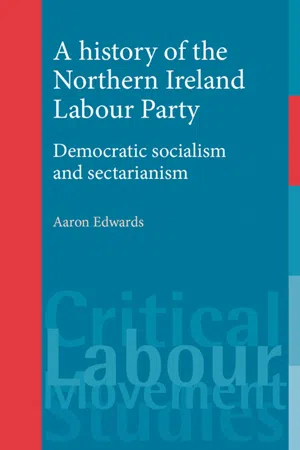
A history of the Northern Ireland Labour Party
Democratic socialism and sectarianism
- 240 pages
- English
- ePUB (mobile friendly)
- Available on iOS & Android
eBook - ePub
About this book
Information
Publisher
Manchester University PressYear
2013Print ISBN
9780719086380
9780719078743
eBook ISBN
9781847797322
1
Democratic socialism and sectarianism, 1924–45
No party, proceeded Mr. Midgley, could serve the interests of the people better than a party of their own creation and kind. The Labour party did not appeal to them on the ground of religion, and their message to every creed in society was to cease to dwell on the things that were of no importance and remember the things that were of importance, at least on six days of the week. If Belfast, and indeed Northern Ireland, were not careful there was a danger that they would be left hopelessly behind in the march of working class emancipation.1
Introduction: the crisis of state formation
The birth of the Northern Ireland state in 1920–21 coincided with the rapid return of thousands of soldiers from front-line service in the British military campaign during the First World War. Their homecoming laid bare an early challenge to the newly-constituted Unionist regime in Belfast in relation to its ability to absorb these demobilised troops back into the local workforce. Although Ireland had been traumatised by the war, with whole towns and villages decimated by the slaughter of their sons along the Western Front, nothing could prepare the country for the impact of partition. Partition had hitherto been piloted by the British as a conflict management device in the Middle Eastern colonial outposts of Iraq, Transjordan and Palestine, which were soon given the status of ‘mandates’.2 In 1918, despite Home Rule legislation being suspended, the rise of Sinn Féin continued unabated and the violence of the Irish Republican Army (IRA) in the South eventually intensified, leading to the Anglo-Irish war of independence between 1919 and 1921. The conflict had placed tremendous pressure on the British state to free itself from the problem of Ireland and it soon found itself in political negotiations with plenipotentiaries from Dáil Éireann to negotiate a truce and, to a lesser extent, to streamline the handing over of power.3
The violent transition from one institutional arrangement to another was keenly felt elsewhere in Europe, as revolution and civil unrest continued to grip defeated powers like Germany and Hungary. In the wake of the Great War radical communist and fascist groups contributed to ‘a new brutalization of public life, a routinization of violence and authoritarianism, and a heightening of nationalist conflict and ambition’.4 In Germany the new-fangled Weimar Republic was moving from one crisis to another, while in Russia the clatter of Soviet guns during the October revolution in 1917 sounded the death knell of an ancien regime built on generations of an autocratic Tsarist dynasty. Radical political forces also began to take root in the fabric of democratic societies convulsed by chronic economic instability, poverty and high unemployment. In short, liberal regimes were in crisis.5
Amidst these cataclysmic events Northern Ireland was experiencing its own difficulties, as the Unionist regime took over the reins of power from the British in the wake of the Government of Ireland Act (1920). Like most of the rest of Europe the province had suffered irreparably for its role in the war, as well as from the high stakes of political diplomacy which presided over the partitioning of the island. Despite its commitment to alleviate unemployment, the Unionist administration struggled to meet the basic needs of the working classes and failed in its self-proclaimed quest to ‘treasure those heroes who fought in the Great War’.6 The historian Brian Follis has detailed how the Unionist administration set about the huge and unrewarding task of laying state foundations. In his words:
Isolated and alienated from the policymakers in London, and threatened by the ambitions of Irish nationalism, the new Government of Northern Ireland took office uncertain of its future and unsure of its friends.7
On the other hand Bew et al. are a little more circumspect. As they make clear the hand-over of power was perhaps a little more forthright and deliberate: ‘The strategy of class alliance pursued by the Unionist middle class, together with the diplomatic strategies of the British government, were responsible for the establishment of a Northern Ireland state with a sectarian-populist flavour.’8 For these scholars Unionism had reluctantly grasped the nettle of Home Rule for the six north-east counties, an option it had hitherto resisted, though one that it would soon come to master. Furthermore, the new state’s unique demographic imbalance, favouring the majority Protestant community, fed directly into the Unionist Party’s quick-paced decision to strengthen its hand both politically and militarily.
Yet it was by no means absolutely guaranteed that Unionist authority would go unchallenged. Intra-ethnic fissures did exist and these were met by and large with the determination on the part of the local regime to play up the dangers of ‘socialism’, which they frequently equated with its Bolshevik variant in Russia, and rather oddly, with the conservative Catholic regime in the Irish Free State.9 Indeed, political and electoral competition threatened the ruling party’s hegemony to such an extent that the messiness of state formation allowed it to exploit the ethnic enmities – existing between Protestants and Catholics – for its own ends. One means by which the Unionist regime could maintain its power-base was to grant patronage to those with a proven loyalty to the new state. As a consequence the locally-raised security apparatus – consisting of the Royal Ulster Constabulary (RUC) and the Ulster Special Constabulary – became almost exclusively Protestant, despite it being envisaged that one-third of the RUC should be made up of Roman Catholics.10 Paul Bew reminds us that Unionism’s ‘highly controversial line of thinking’ was based on the incremental loss of control over the Protestant working class, which began to slip, ‘as the challenge from the IRA became more intense and British irresolution was all too visible’.11
Believing itself to be fighting a rear-guard action, the Unionist regime set about preparing further bulwarks to disloyal Catholic Nationalist and left-wing opinion. The reality behind such imperatives was complex and, in large part, remained for the Unionist leadership ‘the product of exaggerated fears of the other side’s unity of resources and objectives, and a pessimistic appraisal of its own collective strength and political stamina’.12 The strategy of circumventing working-class disgruntlement, while emitting the appearance of unity (rather than its actuality) was sustained by making popular appeals along sectarian lines. Thus, in the first election to the Northern Ireland House of Commons, where ‘loyalty’ became the foremost watchword, the Unionist Party polled comfortably, amassing some 343,347 votes (66.9% of the total vote) and winning 40 seats; the remaining 12 seats going evenly to the Nationalists and Sinn Féin, who immediately boycotted the new parliament.13 Disastrously, the five Independent Labour candidates received only 4,001 votes and lost their deposits.14
James Craig, Northern Ireland’s first Prime Minister, claimed in his opening remarks to the newly established Belfast Parliament that ‘we have nothing in our view except the welfare of the people’.15 Nonetheless, the Unionist regime’s position was precarious and prone to fissures, and was not monolithically ‘Orange’ as some commemorators have claimed.16 More reflective commentators have reminded us that ‘in reality, while there was agreement on the fundamental issues of the constitution and Ulster’s right to self-determination, unionism was a coalition of personalities, and classes’.17 Thus a plurality of oppositional voices did exist outside of the official Unionist camp, often manifesting themselves in distinctly class terms. Indeed one is struck when reading contemporary newspaper reports from the time just how ‘shot through by conflicts’18 the regime actually was in the 1920s. Furthermore, Unionism remained deeply divided over issues of social service expenditure and the adoption of welfare legislation emanating from Westminster. Christopher Norton has emphasised how keeping in step with Great Britain was a calculated political decision, taken by the Unionist leadership to ‘guarantee to its Protestant working class supporters that devolution would not mean the lowering of standards’.19 Needless to say, this deliberate strategy did leave the door open to future challenge should the government default on its commitment to implement welfarist legislation.20
Unionism recognised the danger of the labour interests harboured by a significant portion of working-class Protestants and set about meeting these by establishing its own trade union organisation. The Ulster Unionist Labour Association (UULA) was formed in 1918 and actively sought out ways to placate the Protestant working class in industrialised parts of Belfast. Above all the UULA was an elite-driven venture designed to maintain the constitution and preserve Unionist unity by providing a controlled outlet for loyalist-labour interests.21 In a speech to a large social gathering of 2,000 UULA members in 1923 the organisation’s honorary patron Sir James Craig articulated the need for unity at a time of deep-seated unease brought about by the impending report from the Boundary Commission. He said:
We are only on the stage for a certain time, sympathetically to endeavour to interpret the will and the wish of the people, and with any commonsense we may possess to endeavour to guide them along what we consider will be the path that will lead to the improvement of all – not one class, not one interest in one particular section of the people, but that the whole people may benefit and benefit by trade, by bringing in work to our yards and factories, and to endeavour to make everybody swing along as they used to do in the good old times before the...
Table of contents
- Cover Page
- Title Page
- Copyright Page
- Contents
- Series editors’ foreword
- Acknowledgements
- List of abbreviations
- List of figures and tables
- Introduction
- 1 Democratic socialism and sectarianism, 1924–45
- 2 Re-appraising the origins of the ‘consensus-forming strategy’, 1945–58
- 3 The Labour Opposition of Northern Ireland, 1958–65
- 4 The failure of the ‘consensus-forming strategy’, 1965–69
- 5 The NILP in retreat, 1969–72
- 6 The fall of the NILP, 1972–75
- 7 Squeezing the moderates, 1975–87
- Conclusion
- Index
Trusted by 375,005 students
Access to over 1.5 million titles for a fair monthly price.
Study more efficiently using our study tools.
Frequently asked questions
Yes, you can cancel anytime from the Subscription tab in your account settings on the Perlego website. Your subscription will stay active until the end of your current billing period. Learn how to cancel your subscription
No, books cannot be downloaded as external files, such as PDFs, for use outside of Perlego. However, you can download books within the Perlego app for offline reading on mobile or tablet. Learn how to download books offline
Perlego offers two plans: Essential and Complete
- Essential is ideal for learners and professionals who enjoy exploring a wide range of subjects. Access the Essential Library with 800,000+ trusted titles and best-sellers across business, personal growth, and the humanities. Includes unlimited reading time and Standard Read Aloud voice.
- Complete: Perfect for advanced learners and researchers needing full, unrestricted access. Unlock 1.5M+ books across hundreds of subjects, including academic and specialized titles. The Complete Plan also includes advanced features like Premium Read Aloud and Research Assistant.
We are an online textbook subscription service, where you can get access to an entire online library for less than the price of a single book per month. With over 1.5 million books across 990+ topics, we’ve got you covered! Learn about our mission
Look out for the read-aloud symbol on your next book to see if you can listen to it. The read-aloud tool reads text aloud for you, highlighting the text as it is being read. You can pause it, speed it up and slow it down. Learn more about Read Aloud
Yes! You can use the Perlego app on both iOS and Android devices to read anytime, anywhere — even offline. Perfect for commutes or when you’re on the go.
Please note we cannot support devices running on iOS 13 and Android 7 or earlier. Learn more about using the app
Please note we cannot support devices running on iOS 13 and Android 7 or earlier. Learn more about using the app
Yes, you can access A history of the Northern Ireland Labour Party by Aaron Edwards in PDF and/or ePUB format, as well as other popular books in History & French History. We have over 1.5 million books available in our catalogue for you to explore.