Reflecting on the evolution of Russia studies since the end of the Cold War, this study offers a robust critique of the mainstream view of Russia and offers a more dynamic and complex model for interpretation.
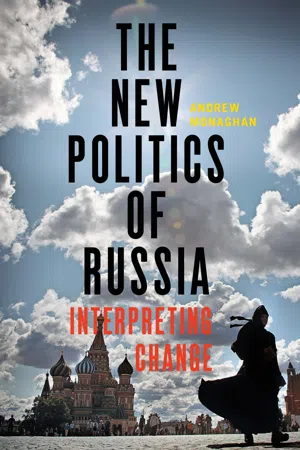
- 176 pages
- English
- ePUB (mobile friendly)
- Available on iOS & Android
eBook - ePub
About this book
Information
1
Russia: the state of surprise
Rude awakenings
The eruption of war in Ukraine in 2014 illustrated the strong and prevailing sense of surprise, even astonishment, that has pervaded post-Cold War Western public policy and mainstream media commentary in response to Russian actions. Perhaps the sharpest point was Russia’s unexpected annexation of Crimea: one US observer suggested that the US administration was ‘not prepared for the contingency that Putin would act so brazenly’.1 William Hague, then British Foreign Secretary, had reassured the House of Commons that Russia was unlikely to intervene militarily in Crimea. Reflecting on Russian military actions, Breedlove stated that the Russians had demonstrated ‘unexpected flexibility’ in handling their forces in the Ukraine crisis.2 Swedish analysts thus captured the sense of surprise perfectly as a ‘rude awakening’.3 Yet if the military surprises were widely acknowledged, others, even when the tension of the already aggravated situation should have sharpened awareness of Russian actions, escaped much mention: Russia’s retaliatory imposition of sanctions on Western agricultural produce, for instance, was also largely unanticipated, as for many was the Russian military deployment to Syria in autumn 2015.
More precisely, however, it is another rude awakening. Since the ‘founding surprise’ of the collapse of the USSR – still for many the exemplary failure of expert political prediction4 – Western officials and observers have been repeatedly surprised by developments in Russian domestic politics and Russian actions on the international stage, as expectations have been confounded and unanticipated developments emerged. They include a mix of longer-term trends and sudden developments, including Russia’s economic recovery after the financial crisis of 1998, the Russian ‘dash to Pristina’ airport in June 1999, which created panic in NATO, Vladimir Putin’s rise to the leadership in 1999/2000, the gas disputes in 2006 and (again) in 2009, the Russo-Georgia war in 2008 (which David Miliband, then British Foreign Secretary, called a ‘rude awakening’),5 and the eruption of protest demonstrations in 2011.
Surprises can be attributed to cultural differences and the difficulties of political prediction, especially for outside observers of an environment such as Russia’s in which institutions are weak and informal networks render decision-making processes and factional interests opaque, and in which there is simultaneously a lack of important information and a ‘scarcely comprehensible overflow’ of often deceptive and misleading information.6 Indeed, one of the reasons why interpreting Russia has proved so difficult is the increasingly obvious inability to distinguish between information which is important and that which is irrelevant, or between what may be called ‘the signal and the noise’.7
Similarly, those who are trying to interpret the actions of others can fall prey to deliberate deception. Deception and surprise are consequences of a culture of opacity and a deliberate feature of Russian life – in politics, but particularly, of course, in terms of military affairs. So central to Soviet thinking was it, that one observer concluded in the mid 1980s that ‘NATO’s senior commanders would do well to plan on the basis that they will (not may) be the victims of strategic surprise’.8 This is still relevant, as illustrated by the infiltration and occupation of Crimea during the war in Ukraine in 2014. This we might separate from ‘surprise’ by calling ‘shock’, in that it is intended to achieve mental paralysis in opponents. If the Crimea operation was a ‘surprise’, since Western officials and observers were not paying attention to Russia more broadly and did not know what to expect, it was also a ‘shock’, since the surprise was deliberate.
But such an extensive list of surprises suggests that there are problems in how senior Western decision-makers, politicians and observers interpret Russia. Three related groups of more ‘culpable’ surprise stand out. The first might be called ‘unknown knowns’:9 the necessary information was available, and appropriate warnings given to senior decision-makers by officials and experts, but then went unheeded in the final analysis either because it was poorly understood or interpreted, or because it was ignored. Many of the surprises noted above fall into this category. Prior to the outbreak of the Russo-Georgia War, for instance, experts and officials were advising senior leaders of the increasingly tense situation in the South Caucasus. The Organization for Security and Cooperation in Europe (OSCE) had provided early warning in and around the conflict zone, and in the days before the conflict, the OSCE mission provided ‘clear early warning of the escalation of hostilities’.10 One Western official observed that all the relevant information was there, but senior decision-makers refused to believe that the Russians would resort to war – because they themselves would not have conceived of doing so. A similar situation prevailed in 2013 and 2014.
The second group may be called ‘unknown unknowns’, which are contingencies that have not been considered. These are the consequences of the serious decline in resources allocated to understanding Russia since the early 1990s. This has led to the degradation of institutional memory and a narrowed focus to only specific issues, and an inability to explore the wider picture beyond an often superficial grasp of the day’s urgent headline. Again, this degradation can be illustrated by the war in Ukraine: only a very small handful of people had either the detailed and specific subject matter knowledge required to understand Russian military operations and thinking, particularly about Russian special operations forces, or evolving Russian threat perceptions that stretched back to the 1990s and through the Colour Revolutions in 2003 and 2004.
The third group of culpable surprises might be called ‘assumed knowns’. These relate to the prevalence in the mainstream Western discussion of Russia of flawed predictions based on wishful thinking about Russia, the desire to see ‘progress’ and Russia’s transition to democracy and acceptance of Western values. This created the basis for the orthodoxy of the ongoing ‘crisis’ of Putinism, with its corollaries of, for instance, the long-term misreading of the Putin–Medvedev tandem, especially the ongoing suspense over the anticipated split between the ‘conservative’ Putin and the ‘liberal’ Medvedev, and when Putin would fire Medvedev, and the repeated anticipations of the end of the Putin era.
This chapter explores the reasons for this state of surprise, sketching them out from the starting point of the significant (and ongoing) impact of the collapse of the USSR on Western understandings of Russia. First, it explores the practical ramifications for the decline of Russia as a political priority on the wider political stage: the West has not paid attention to developments in Russia unless they were part of an urgent and immediate crisis; in effect, the West ‘moved on’ from Russia, and since it was no longer a political (or security) priority, attention and resources were redirected elsewhere, and much of the practical capacity for understanding Russia has been dispersed. It then turns to look more specifically at Russia studies. Buoyed by a confidence in the ‘end of history’, many of those in the West who continued to focus on Russia and the former Soviet space believed that Russia was in transition from communism to democracy and the acceptance of Western values: it would ‘move on’ from the political ruins of the USSR to return to the Western family of nations and become a partner on the international stage. This progressive, transitional paradigm broadly replaced a more classical area studies style approach to understanding Russia. This provides the basis for the final part of the discussion which outlines some of the problems of the current mainstream discussion of Russia, which is drowning in a discourse of speculation and rumour, ‘Putinology’ and historical analogies. This creates a great deal of additional noise that blocks the signal.
Moving on from Russia
Russia has been prominent in a flood of editorials, media interviews and think tank publications first on the Sochi Winter Olympics and then the developing crises in Ukraine and Syria. There has been much debate about Vladimir Putin, his plans and goals, and his mental and physical health, as well as wider debates about corruption in Russia, the failings of the Russian economy, and Russian neo-imperial aggression.
As some observers suggested in spring 2014, however, this prominence has only obscured the ‘slow death of Russian and Eurasian studies’,11 one that can be traced back to the collapse of the USSR. This argument that there is a lack of Russia expertise in the West has some merit, and was revisited in late December 2015 and January 2016.12 Even in the early 1990s, Western governments were already looking beyond Russia and Eurasia to other priorities, such as the first Gulf War and Japan’s rise. This sense that the West had ‘moved on’ from Cold War era priorities and the problems with which post-Soviet Russia is associated subsequently accelerated in the late 1990s and early 2000s for two main reasons. First, there was increasing disappointment at the highest political levels in the West about the problematic nature of Russia’s transformation. This, combined with the Russian financial crisis in 1998, meant that, as one American observer suggested, ‘by late 2000 the “forget Russia” school was in the ascendency’ in the highest US official circles. Russia, weak at home and abroad, was no longer seen to matter, even as virtually irrelevant and not ‘worth worrying about’.13
Second, the trend accelerated as a result of problems elsewhere. The conflicts in the Middle East, the terrorist attacks on the USA on 11 September 2001 and the subsequent protracted wars in Afghanistan and Iraq, and the rise of China: these have been the major themes dominating the Western political and security agenda since 2001. Even during the war in Ukraine, attention to Russia was diluted by the Ebola virus, the civil wars in Syria and Libya and migration across the Mediterranean Sea, and the emergence of the Islamic State, which most NATO member states asserted was the most serious threat to the West. This process was further accelerated by the wider conditions of economic austerity since the financial crisis of 2008 which have seriously affected state budgets, foundations and the media.14
Despite the numerous questions it poses, therefore, resources dedicated to understanding Russia were directed to other priorities and sharply decreased. Consequently, expertise on Russia across much of the Euro-Atlantic and ‘G7’ countries has either been redirected to other priorities or has atrophied and become both limited and fragmented as research centres have been wound down or closed.
As a result of this shift of attention, government support for Russia and Eurasia studies in the USA began a prolonged decline from the early 1990s. This continued into the 2000s, when the Bush administration conducted a review of Russia policy and reorganised the State Department, abolishing the Russia desk and sweeping it into the Bureau of European and Eurasian Affairs (which included 54 countries).15 In late 2013, the State Department announced that it would withhold the budget for its Title VIII programme which provided support for policy relevant research and training on Eastern European and former USSR matters. One official suggested that ‘in this fiscal climate, it just did not make it’ (though Title VIII was resuscitated in 2015, it was at less than half its previous funding level and with its future unclear).16 This has directly affected those institutions responsible for Russia-related research and teaching. Private funding for Russia-related research by grant making foundations has also considerably shrunk.
Russia expertise in the UK go...
Table of contents
- Cover
- Half Title
- Title Page
- Copyright Page
- Epigraph
- Contents
- Preface: Russia matters
- Acknowledgements
- List of abbreviations
- Introduction: ‘we’ve moved on’
- 1 Russia: the state of surprise
- 2 Towards strategic dissonance: Russia as ‘a Europe apart’
- 3 ‘Reflexive transitionology’ and the ‘end of Putin’
- 4 Beyond Putin? Deciphering power in Russia
- Conclusion: reinterpreting Russia in the twenty-first century
- Index
Trusted by 375,005 students
Access to over 1.5 million titles for a fair monthly price.
Study more efficiently using our study tools.
Frequently asked questions
Yes, you can cancel anytime from the Subscription tab in your account settings on the Perlego website. Your subscription will stay active until the end of your current billing period. Learn how to cancel your subscription
No, books cannot be downloaded as external files, such as PDFs, for use outside of Perlego. However, you can download books within the Perlego app for offline reading on mobile or tablet. Learn how to download books offline
Perlego offers two plans: Essential and Complete
- Essential is ideal for learners and professionals who enjoy exploring a wide range of subjects. Access the Essential Library with 800,000+ trusted titles and best-sellers across business, personal growth, and the humanities. Includes unlimited reading time and Standard Read Aloud voice.
- Complete: Perfect for advanced learners and researchers needing full, unrestricted access. Unlock 1.5M+ books across hundreds of subjects, including academic and specialized titles. The Complete Plan also includes advanced features like Premium Read Aloud and Research Assistant.
We are an online textbook subscription service, where you can get access to an entire online library for less than the price of a single book per month. With over 1.5 million books across 990+ topics, we’ve got you covered! Learn about our mission
Look out for the read-aloud symbol on your next book to see if you can listen to it. The read-aloud tool reads text aloud for you, highlighting the text as it is being read. You can pause it, speed it up and slow it down. Learn more about Read Aloud
Yes! You can use the Perlego app on both iOS and Android devices to read anytime, anywhere — even offline. Perfect for commutes or when you’re on the go.
Please note we cannot support devices running on iOS 13 and Android 7 or earlier. Learn more about using the app
Please note we cannot support devices running on iOS 13 and Android 7 or earlier. Learn more about using the app
Yes, you can access The new politics of Russia by Andrew Monaghan in PDF and/or ePUB format, as well as other popular books in Politics & International Relations & Comparative Politics. We have over 1.5 million books available in our catalogue for you to explore.