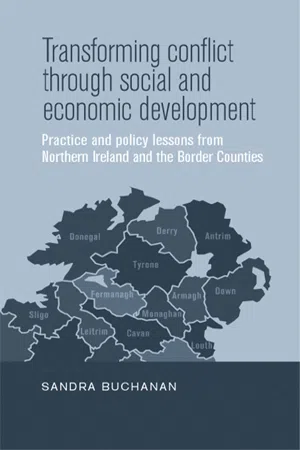
Transforming conflict through social and economic development examines lessons learned from the Northern Ireland and Border Counties conflict transformation process through social and economic development and their consequent impacts and implications for practice and policymaking, with a range of functional recommendations produced for other regions emerging from and seeking to transform violent conflict. It provides, for the first time, a comprehensive assessment of the region's transformation activity, largely amongst grassroots actors, enabled by a number of specific funding programmes, namely the International Fund for Ireland, Peace I, II and III and INTERREG I, II and IIIA. These programmes have been responsible for a huge increase in grassroots practice which to date has attracted virtually no academic analysis; this book seeks to fill this gap.
In focusing on the politics of the socioeconomic activities that underpinned the elite negotiations of the peace process, key theoretical transformation concepts are firstly explored, followed by an examination of the social and economic context of Northern Ireland and the border counties. The three programmes and their impacts are then assessed before considering what policy lessons can be learned and what recommendations can be made for practice. This is underpinned by a range of semi-structured interviews and the author's own experience as a project promoter through these programmes in the border counties for more than a decade.
The book will be essential reading for students, practitioners and policymakers in the fields of peace and conflict studies, conflict transformation, peacebuilding, post-agreement reconstruction and the political economy of conflict and those interested in contemporary developments in the Northern Ireland peace process.
eBook - ePub
Transforming conflict through social and economic development
Practice and policy lessons from Northern Ireland and the Border Counties
- 291 pages
- English
- ePUB (mobile friendly)
- Available on iOS & Android
eBook - ePub
Transforming conflict through social and economic development
Practice and policy lessons from Northern Ireland and the Border Counties
About this book
Information
PART I
Setting the context
1
Conflict transformation – towards a theoretical framework
In view of the theoretical confusion and associated definitional morass surrounding conflict transformation, it is necessary to preface this book with some conceptual clarification. This will enable an appropriate assessment of conflict transformation through social and economic development, specifically through the impacts of the tools under consideration here, loosely pertaining to a peace and conflict impact assessment. Accordingly, this chapter examines the place of conflict transformation within the conflict management discourse and conflict cycle and explores a number of existing definitions, all serving to highlight its distinctiveness. The wider but related areas of citizen empowerment, development aid and economic development are also explored. Understanding key transformational characteristics will shape the formation of a theoretical framework comprising a working definition and five criteria against which the impacts of the three programmes will later be assessed. First an understanding of conflict would be useful.
Conflict can be viewed simply as ‘the pursuit of incompatible goals by different groups’.1 Lederach’s view of conflict as ‘a socially constructed cultural event [which] do[es] not “just happen” to people, [but rather] people are active participants in creating situations and interactions they experience as conflict’2 means that a key component of conflict is ‘social knowledge, the meaning that people attach to events and issues, and what, correspondingly, is appropriate response and action to take’.3 Thus, Northern Ireland’s paramilitaries saw their actions as the appropriate response to the wrongs as they defined them and, as the conflict progressed, as a means of protecting their own communities. Conflict is often viewed destructively as ‘primarily a problem of political order’4 and consequently a negative occurrence to be avoided at all costs. More radically it is, constructively, ‘a catalyst for social change or … a non-violent struggle for social justice’5 and hence very much a positive occurrence, bringing about necessary changes in the structural and cultural make-up of society. These themes of positive and negative peace are important: structural violence is central to the concept of positive peace as it denies social justice or economic equity, since ‘conflict often grows in the seedbed of deprivation and exclusion’.6 Thus, Azar viewed protracted social conflict as ‘the progressive effort to satisfy human needs that sustains development (broadly defined to include political and human development as well as economic), which in turn sustains peace’.7 Moreover:
to respond to these grievances … structural development is essential. This may include reducing structural inequalities (political, economic and social), altering development strategies to focus on correcting regional, sectoral and communal imbalances, and progressive reforms in socio-political structures … Peace, as a sustainable end-process … requires balanced economic and political development.8
Despite criticisms that structural violence is sometimes seen as independent of the perceptions of the participants in conflict or that such a broad definition makes ‘violence ubiquitous and therefore meaningless’,9 it was clearly a central component of the Northern Ireland conflict, indicating the need to acknowledge social and economic development in the transformation process.
Conflict: to settle, resolve or transform?
Conflict transformation has received increasing attention in recent years. However, as Ryan notes, ‘the growth in the use of the term has not always been matched by greater precision and clarity’.10 Its emergence from a number of pre-existing traditions within the broad field of conflict management has created a definitional morass: in most of the academic literature, ‘the terms conflict management, conflict resolution and conflict transformation are often used loosely and interchangeably, in many cases referring to the same strategies’.11
While no single conflict transformation model can be identified, some conceptual clarification can be provided if the overall conflict management framework of conflict settlement, resolution and transformation is considered. Within this framework12 conflict settlement implies that conflict is a zero-sum game and peace is viewed in purely negative terms, with no set objective of longer-term positive peace or social justice. The ultimate aim is a cessation of violence that will lead to some sort of political settlement, involving top-level (Track I) actors such as political, military and religious leaders. As a strategy purely concerned with a final result or settlement of the conflict and not with its underlying root causes it is problematic, presenting a conflict of interest – if the root causes are not resolved the final result with which conflict settlement is concerned will not be sustainable.
Conflict resolution aims not to eliminate conflict as such but to eliminate the violent and destructive manifestations of conflict that can be traced back to the unmet needs and fears of the conflicting parties. It is primarily concerned with the promotion of horizontal relationships between actors of relatively equal status, principally mid-level (Track II) actors. However, this strategy is also problematic: being mainly concerned with the elimination of the causes of conflict rather than with the actual conflict itself, while only involving one level of society, will not ensure sustainability. A sustainable strategy is required that eliminates both the root causes of conflict and the conflict itself while involving all levels of society.
Conflict transformation builds upon these strategies through its concern to address the root causes of conflict over the long-term and, more particularly, to promote conditions that create cooperative horizontal and vertical relationships, principally by furthering vertical relationships between conflicting actors of relatively unequal status. Its particular focus on empowering grassroots (Track III) actors sets it apart from other conflict management methods. A sense of local ownership is critical to any long-term sustainment of peace, achieved ‘by local people, with “outsiders” taking a supporting or facilitating role’.13 Viewed this way, protracted violent conflicts are primarily the result of unequal and suppressive social and political structures (structural violence) and conflict is therefore seen as a positive agent for fundamental social change; conflict transformation occurs ‘when violent conflict ceases and/ or is expressed in non-violent ways and when the original structural sources (economic, social, political, military and cultural) of the conflict have been changed in some way or other’.14 It is about the challenge of:
devising ways and means of empowering citizens and societies so that they can transform violent relationships. At the same time it is necessary to ensure that economic, political and social institutions are developed (or changed when they are demonstrably incapable of achieving their purposes) in order to minimize the prospects of violence in future and guarantee these processes through time.15
Thus the Berghof Handbook comprehensively views transformation as:
a generic, comprehensive concept referring to actions that seek to alter the various characteristics and manifestations of conflict by addressing the root causes of a particular conflict over the long-term with the aim to transform negative ways of dealing with conflict into positive constructive ways. The concept of conflict transformation stresses structural, behavioural and attitudinal aspects of conflict. It refers to both the process and the structure of moving towards ‘just peace’.16
Galtung’s groundbreaking categorisation of violence as direct, structural and cultural provides a clear understanding of three separate and dynamic but interrelated forms of violence. He notes that ‘much direct violence can be traced back to vertical structural violence, such as exploitation and repression, for liberation, or to prevent liberation. In the background is cultural violence legitimising both the structural violence and direct violence to undo it and to maintain it.’17 This expanded categorisation was necessary because of the incorrect assumption that if there is no visible direct violence, then there is no conflict, resulting in a lack of recognition of other forms of violence such as structural and cultural. However, each will continually enable and reinforce the other providing ‘recognition that there are different ways of dealing with conflicts and that violence is only one possible approach … vital if we are to search and find more creative, more constructive and more viable approaches to dealing with conflict’.18 In distinguishing conflict from violence, Galtung developed the conflict triangle consisting of A – attitudes (feelings and thinking about the conflict), B – behaviour (actions in conflict) and C – contradictions (issue(s) and what the conflict is all about).
If contradiction is at the root of conflict, conflict transformation requires contradictions/issues to be ‘identified and addressed in a way that leaves all parties feeling included in the solution and which doesn’t deny, ignore or reject the basic needs of any involved’.19 This requires involvement from all such that ‘sustainability has to be … rooted inside the formation. If outside parties … use carrots and sticks … then there is no real acceptability or sustainability, unless one assumes that the “mediators” are parts of the conflict formation, not outside, and certainly not “above”.’20 For Galtung ‘all conflicts are equal’,21 but as confli...
Table of contents
- Cover
- Half Title Page
- Title Page
- Copyright Page
- Contents
- List of figures and tables
- Acknowledgements
- List of abbreviations
- Introduction
- Part I Setting the context
- Part II Examining the impacts
- Part III Learning and recommendations
- Appendix 1 Peace II – funding delivery mechanisms
- Appendix 2 Peace I – priorities and measures
- Appendix 3 Peace II – priorities and measures
- Appendix 4 INTERREG I (1991–1993) – sub-programmes and measures
- Appendix 5 INTERREG II (1994–1999) – sub-programmes and measures
- Appendix 6 INTERREG IIIA (2000–2006) – priorities and measures
- Bibliography
- Index
Trusted by 375,005 students
Access to over 1.5 million titles for a fair monthly price.
Study more efficiently using our study tools.
Frequently asked questions
Yes, you can cancel anytime from the Subscription tab in your account settings on the Perlego website. Your subscription will stay active until the end of your current billing period. Learn how to cancel your subscription
No, books cannot be downloaded as external files, such as PDFs, for use outside of Perlego. However, you can download books within the Perlego app for offline reading on mobile or tablet. Learn how to download books offline
Perlego offers two plans: Essential and Complete
- Essential is ideal for learners and professionals who enjoy exploring a wide range of subjects. Access the Essential Library with 800,000+ trusted titles and best-sellers across business, personal growth, and the humanities. Includes unlimited reading time and Standard Read Aloud voice.
- Complete: Perfect for advanced learners and researchers needing full, unrestricted access. Unlock 1.5M+ books across hundreds of subjects, including academic and specialized titles. The Complete Plan also includes advanced features like Premium Read Aloud and Research Assistant.
We are an online textbook subscription service, where you can get access to an entire online library for less than the price of a single book per month. With over 1.5 million books across 990+ topics, we’ve got you covered! Learn about our mission
Look out for the read-aloud symbol on your next book to see if you can listen to it. The read-aloud tool reads text aloud for you, highlighting the text as it is being read. You can pause it, speed it up and slow it down. Learn more about Read Aloud
Yes! You can use the Perlego app on both iOS and Android devices to read anytime, anywhere — even offline. Perfect for commutes or when you’re on the go.
Please note we cannot support devices running on iOS 13 and Android 7 or earlier. Learn more about using the app
Please note we cannot support devices running on iOS 13 and Android 7 or earlier. Learn more about using the app
Yes, you can access Transforming conflict through social and economic development by Sandra Buchanan in PDF and/or ePUB format, as well as other popular books in Politics & International Relations & International Relations. We have over 1.5 million books available in our catalogue for you to explore.