Swedish crime fiction became an international phenomenon in the first decade of the twenty-first century, starting first with novels but then percolating through Swedish-language television serials and films and onto English-language BBC productions and Hollywood remakes. This book looks at the rich history of 'Scandinavian noir', examines the appeal of this particular genre and attempts to reveal why it is distinct from the plethora of other crime fictions.
Examining the popularity of Steig Larsson's international success with his Millennium trilogy, as well as Henning Mankell's Wallander across the various media, Peacock also tracks some lesser-known novels and television programmes. He illustrates how the bleakness of the country's 'noirs' reflects particular events and cultural and political changes, with the clash of national characteristics becoming a key feature.
It will appeal to students and researchers of crime fiction and of film and television studies, as well as the many fans of the novels and dramatic representations.
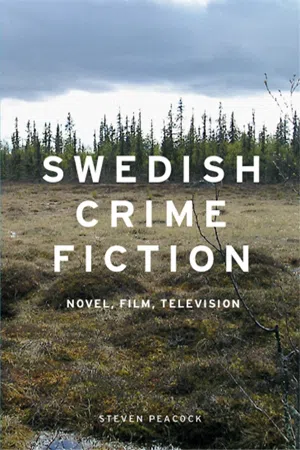
- 218 pages
- English
- ePUB (mobile friendly)
- Available on iOS & Android
eBook - ePub
About this book
Information
Publisher
Manchester University PressYear
2015Print ISBN
9780719090691
9780719086953
eBook ISBN
9781526101556
Subtopic
English Literary CriticismTable of contents
- Cover
- Half Title Page
- Title Page
- Copyright Page
- Contents
- Acknowledgements
- Introduction: a post-Millennium phenomenon
- 1 Nation, genre, institution
- 2 Community and the family
- 3 Space and place
- 4 Bodies
- 5 Interview transcripts
- Afterword
- Notes
- Bibliography
- Index
Trusted by 375,005 students
Access to over 1.5 million titles for a fair monthly price.
Study more efficiently using our study tools.
Frequently asked questions
Yes, you can cancel anytime from the Subscription tab in your account settings on the Perlego website. Your subscription will stay active until the end of your current billing period. Learn how to cancel your subscription
No, books cannot be downloaded as external files, such as PDFs, for use outside of Perlego. However, you can download books within the Perlego app for offline reading on mobile or tablet. Learn how to download books offline
Perlego offers two plans: Essential and Complete
- Essential is ideal for learners and professionals who enjoy exploring a wide range of subjects. Access the Essential Library with 800,000+ trusted titles and best-sellers across business, personal growth, and the humanities. Includes unlimited reading time and Standard Read Aloud voice.
- Complete: Perfect for advanced learners and researchers needing full, unrestricted access. Unlock 1.5M+ books across hundreds of subjects, including academic and specialized titles. The Complete Plan also includes advanced features like Premium Read Aloud and Research Assistant.
We are an online textbook subscription service, where you can get access to an entire online library for less than the price of a single book per month. With over 1.5 million books across 990+ topics, we’ve got you covered! Learn about our mission
Look out for the read-aloud symbol on your next book to see if you can listen to it. The read-aloud tool reads text aloud for you, highlighting the text as it is being read. You can pause it, speed it up and slow it down. Learn more about Read Aloud
Yes! You can use the Perlego app on both iOS and Android devices to read anytime, anywhere — even offline. Perfect for commutes or when you’re on the go.
Please note we cannot support devices running on iOS 13 and Android 7 or earlier. Learn more about using the app
Please note we cannot support devices running on iOS 13 and Android 7 or earlier. Learn more about using the app
Yes, you can access Swedish crime fiction by Steven Peacock in PDF and/or ePUB format, as well as other popular books in Media & Performing Arts & English Literary Criticism. We have over 1.5 million books available in our catalogue for you to explore.