- 201 pages
- English
- ePUB (mobile friendly)
- Available on iOS & Android
eBook - ePub
About this book
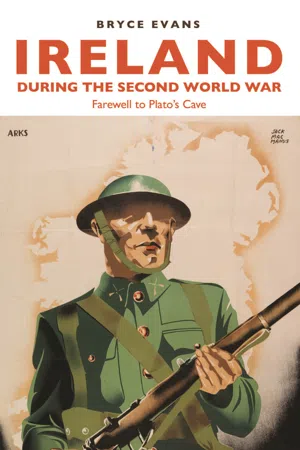
In the first book detailing the social and economic history of Ireland during the Second World War, Bryce Evans reveals the real story of the Irish emergency. Revealing just how precarious the Irish state's economic position was at the time, the book examines the consequences of Winston Churchill's economic war against neutral Ireland. It explores how the Irish government coped with the crisis and how ordinary Irish people reacted to emergency state control of the domestic marketplace. A hidden history of black markets, smugglers, rogues and rebels emerges, providing a fascinating slice of real life in Ireland during a crucial period in world history. As the first comparison of economic and social conditions in Ireland with those of the other European neutral states – Spain, Sweden, Switzerland and Portugal – the book will make essential reading for the informed general reader, students and academics alike.
Information
Publisher
Manchester University PressYear
2016Print ISBN
9781784992491
9780719089510
eBook ISBN
9781526111302
Topic
HistoireSubtopic
Histoire de la Grande-Bretagne1
Introduction: farewell to ‘Plato’s Cave’
Introduction: farewell to ‘Plato’s Cave’
And here Neutrality, harps, art exhibitions, reviews, libels, back-chat, high-tea, cold, no petrol, no light, no coal, no trains; Irish language, partition, propaganda, propaganda, propaganda, rumour, counter-rumour, flat Georgian facades, Guinness, double Irish, single Scotch, sherry, Censors, morals, rain home to all.
John Betjeman, 10 January 1941
The military and economic expansion of the state
At 11 am, on 3 September 1939, British Prime Minister Neville Chamberlain declared war on Germany. When the Irish government responded later that day, declaring the Emergency Powers Act, Ireland’s independence was just seventeen years old, its constitution two years old and its control of the strategic ports barely a year old. The Ireland that appeared in the letters of the poet John Betjeman, press attaché to the British delegation in Dublin during the war, was a place of charm but hardship, anxiously asserting its neutrality as Britain and Europe burned. The political and economic crisis of the Second World War not only provided the acid test of this fledgling independence. Just as significantly, the war marked the high point of centralised state intervention in Ireland.1 The Emergency Powers Act – from which the Irish vernacular for the war originated – enabled the Fianna Fáil cabinet to pass orders without the need for specific legislation or detailed scrutiny in Dáil Éireann. In these extraordinary conditions, the government hastily formed a cabinet emergency committee, composed of Taoiseach Éamon de Valera and a handful of key ministers, streamlining decision-making and marking the transfer of power from local government to the executive.2
In taking these measures, the government’s immediate priority was security. In January 1939, the Irish Republican Army (IRA) declared itself at war with Britain and affirmed its non-recognition of the Irish state. On 19 January 1939, Neville Chamberlain’s son escaped a bomb attack in Tralee, County Kerry.3 Between then and March 1940, the IRA carried out a bombing campaign in Britain and just three months into the Emergency pulled off the audacious Magazine Fort arms raid.4 Moving quickly to neutralise the security threat, the government reintroduced internment and increased its surveillance of the IRA and suspected communist groups.5 The state also expanded its military capability. Under Frank Aiken, the new Minister for the Coordination of Defensive Measures, there was a massive growth in the armed forces. After the initial recruitment drive of September 1939, the number of men under arms in independent Ireland increased from 7,000 to 19,000.6 After the fall of France in June 1940, de Valera wrote in his diary: ‘Good to organise quickly. We try to avoid sacrifice’.7 There followed a steep rise in recruitment with 41,000 men in the army by March 1941 and a total of 180,000 in the twin auxiliary bodies the Local Security Force (LSF) and Local Defence Force (LDF) by October 1941.8 Domestic surveillance was assumed by the army’s intelligence wing ‘G2’, which cooperated closely with the Gardaí. An omnipresent slogan – ‘Step Together!’ – encouraged both recruitment to the Defence Forces and a wider unifying national élan.9
While the security of the Irish state during the Emergency has produced racy narratives complete with Nazi espionage,10 the economic and social history of the period sits rather timidly beside it. Yet the priority of economic survival was just as pressing for the nascent state as its security. The rushed exercise of state centralisation impacted hardest in the economic realm. The trade disruption that war threatened prompted the government to form a unique new arm of state: the Department of Supplies (1939–1945). Minister for Industry and Commerce Seán Lemass was appointed Minister for Supplies in September 1939, empowered to control the prices and import and export of all commodities, dictating the methods of ‘treatment, keeping, storage, movement, distribution, sale, purchase, use and consumption’ of all goods.11 The state’s meticulous censorship network kept Supplies informed of profiteering and the evasion of ministerial orders12 as this new department gradually assumed dominance over economic life.
Other government departments also undertook wide-ranging interventionist projects. The Department of Agriculture introduced an unprecedented degree of state control to Ireland’s agricultural sector, evicting unproductive farmers from their land. A huge effort to produce domestic fuel through turf took place under the Department of Local Government and Public Health and later the Department of Supplies. The Customs Service dealt with the increase in volume of items smuggled across Ireland’s frontiers. Meanwhile, the Department of Justice and the Gardaí, assisted by the LSF and LDF and a cohort of Department of Supplies Inspectors, addressed the upsurge in crime and black marketing that accompanied the introduction of rationing in Ireland.
The narrative of absence
Despite this, the social and economic history of the Emergency is the subject of a largely deficient historiography which provides little indication of the manner in which Irish people survived the shortages wrought by war. Much responsibility for this rests with one of Ireland’s great historians: F.S.L. Lyons. In his majestic Ireland Since the Famine (1973), Lyons used Plato’s allegory of the cave to claim that Emergency Ireland was ‘almost totally isolated from the rest of mankind’.13 Ireland as ‘Plato’s Cave’ was born: Lyons’s lapidarian, sweeping analogy supplanting the short edited collection on the Emergency published by Kevin B. Nowlan and T. Desmond Williams in 1969.14 Lyons’s synopsis of the Irish Emergency echoed accounts of neutrality elsewhere. British diplomat Clifford Norton, stationed in Berne during the conflict, compared the Swiss people to ‘passengers on an air-conditioned ocean liner’: they ‘could see through the portholes the storm and stress of the weather or the heat of the tropics’ but failed to appreciate ‘the conditions which the captain and crew were facing and by which they were hardened and influenced’.15 Lyons’s invocation of the archetypal cave was a slicker articulation of the neutral condition. The analogy heavily influenced the historiography which followed it.
A noticeable historiographical tendency subsequently took shape in works about the Emergency written in the 1970s and 1980s. These works focused on the diplomatic construction of neutrality, exploring the realpolitik that underlay de Valera’s diplomacy. Considerations of everyday life and the state’s increased domestic presence were placed to one side as the release of state papers illuminated the neutrality debate. Even the best general survey of the Emergency (published a decade after Lyons) extended ‘Plato’s Cave’ backwards to the 1920s and 1930s, describing independent Ireland as suffering a ‘postcolonial blackout’.16 In this study, Robert Fisk’s excellent In Time of War (1983), the focus remained almost unfalteringly on political elites. In other publications from this period, any thoroughgoing analysis of Irish economy and society was conspicuous by its absence.17
Outside the minutiae of the neutrality debate, Irish society was described in rather puritanical, isolationist terms. Invariably, the widespread popular support for neutrality was presented as indicative of a mute ‘bottom-up’ consensus in Irish society. The first perceptible charge out of ‘Plato’s Cave’ was signalled by Bernard Share who, in his The Emergency: Neutral Ireland, 1939–45 (1978), argued that Lyons had exaggerated the stagnation of Irish society.18 Yet in this study, as in other early histories of the period, the mass of the Irish people appeared in a narrative that was, as Clair Wills puts it, ‘all about absence – of conflict, of supplies, of social dynamism, of contact with the outside world’.19 If Share displayed recognition of the poverty of ‘the narrative of absence’, he offered little by way of alternative analysis.
By the late 1980s, the historiography of the Emergency was starting to edge away from the marble halls of high political accounts towards ‘bottom-up’ considerations of life in Ireland. But these early revisions of ‘Plato’s Cave’ tended to dilute the economic impulses driving government action and its impacts by trivialising the narrative of absence. During the Emergency, the widely quoted Myles na gCopaleen contributed some of his most biting satire in the column ‘Cruiskeen Lawn’ in the Irish Times, but his references to the ‘plain people of Ireland’ sat too long as a waggish substitute for an analysis of social and economic conditions at the time. Leaning heavily on the golden age of Dublin journalism, much of Tony Gray’s The Lost Years (1988) substituted diplomatic history with semi-whimsical reminiscence.20 By the late 1980s, the narrative of absence had gained acceptance at the popular level, offering a survey of social life akin in its depiction of boredom to Patrick Kavanagh’s Maguire, subject of his 1942 poem The Great Hunger, whose only antidote to the tedium of rural life was to occasionally ‘sin’ over the warm ashes of the cottage fire. The Irish people of the Emergency, when mentioned at all, resembled the inhabitants of Plato’s Cave: metaphorically, they were placed closer to Maguire’s cottage fire than ‘the fire of life’.
Deprivation and periodisation: the exceptionality of the Emergency
Terence Brown’s Ireland: A Social and Cultural History (1985) briefly considers whether Irish people were conscious of the cultural stagnation portrayed in much literature of the period. Instead of advancing the more abstract judgments of cultural history, Brown finds ‘the economic depredations of the war years all too evident’.21 Even for those like John Betjeman, who moved in elite literary circles, Dublin may have been gossipy fun, but it was also painfully ‘cold, no petrol...
Table of contents
- Cover
- Half Title Page
- Title Page
- Copyright Page
- Contents
- Acknowledgements
- 1 Introduction: farewell to ‘Plato’s Cave’
- 2 Anglo-Irish trade and business relations
- 3 Moral policemen of the domestic economy
- 4 Conditions in town and country
- 5 Smuggling
- 6 Church and state
- 7 Coercion in the countryside
- 8 The state and the small man
- 9 Conclusions
- Bibliography
- Index
Trusted by 375,005 students
Access to over 1.5 million titles for a fair monthly price.
Study more efficiently using our study tools.
Frequently asked questions
Yes, you can cancel anytime from the Subscription tab in your account settings on the Perlego website. Your subscription will stay active until the end of your current billing period. Learn how to cancel your subscription
No, books cannot be downloaded as external files, such as PDFs, for use outside of Perlego. However, you can download books within the Perlego app for offline reading on mobile or tablet. Learn how to download books offline
Perlego offers two plans: Essential and Complete
- Essential is ideal for learners and professionals who enjoy exploring a wide range of subjects. Access the Essential Library with 800,000+ trusted titles and best-sellers across business, personal growth, and the humanities. Includes unlimited reading time and Standard Read Aloud voice.
- Complete: Perfect for advanced learners and researchers needing full, unrestricted access. Unlock 1.5M+ books across hundreds of subjects, including academic and specialized titles. The Complete Plan also includes advanced features like Premium Read Aloud and Research Assistant.
We are an online textbook subscription service, where you can get access to an entire online library for less than the price of a single book per month. With over 1.5 million books across 990+ topics, we’ve got you covered! Learn about our mission
Look out for the read-aloud symbol on your next book to see if you can listen to it. The read-aloud tool reads text aloud for you, highlighting the text as it is being read. You can pause it, speed it up and slow it down. Learn more about Read Aloud
Yes! You can use the Perlego app on both iOS and Android devices to read anytime, anywhere — even offline. Perfect for commutes or when you’re on the go.
Please note we cannot support devices running on iOS 13 and Android 7 or earlier. Learn more about using the app
Please note we cannot support devices running on iOS 13 and Android 7 or earlier. Learn more about using the app
Yes, you can access Ireland during the Second World War by Bryce Evans in PDF and/or ePUB format, as well as other popular books in Histoire & Histoire de la Grande-Bretagne. We have over 1.5 million books available in our catalogue for you to explore.