eBook - ePub
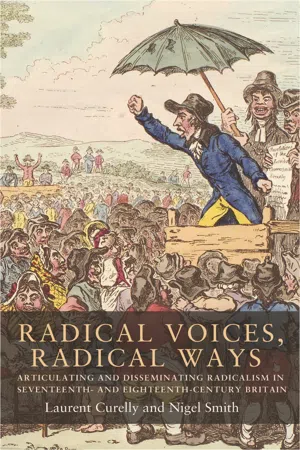
Radical voices, radical ways
Articulating and disseminating radicalism in seventeenth- and eighteenth-century Britain
- 273 pages
- English
- ePUB (mobile friendly)
- Available on iOS & Android
eBook - ePub
Radical voices, radical ways
Articulating and disseminating radicalism in seventeenth- and eighteenth-century Britain
About this book
This collection of essays studies the expression and diffusion of radical ideas in Britain from the period of the English Revolution in the mid-seventeenth century to the Romantic Revolution in the early nineteenth century. The essays included in the volume explore the modes of articulation and dissemination of radical ideas in the period by focusing on actors ('radical voices') and a variety of written texts and cultural practices ('radical ways'), ranging from fiction, correspondence, pamphlets and newspapers to petitions presented to Parliament and toasts raised in public. They analyse the way these media interacted with their political, religious, social and literary context. This volume provides an interdisciplinary outlook on the study of early modern radicalism,with contributions from literary scholars and historians, and uses case studies as insights into the global picture of radical ideas. It will be of interest to students of seventeenth- and eighteenth-century literature and history.
Information
Publisher
Manchester University PressYear
2016Print ISBN
9781526134325
9781526106193
eBook ISBN
9781526106216
PART I
Radical language and themes
1

Community of goods: an unacceptable radical theme at the time of the English revolution
Jean-Pierre Cavaillé
The puropose of this chapter is not to provide a thorough exploration of the condemnation of private property and the promotion of common property as feature in the works of English radical writers of the seventeenth century, such as those of Gerrard Winstanley or Abiezer Coppe. Instead, a reflection is proposed upon the conditions underpinning the use in public debate of the community of goods theory, one of the most provocative and dangerous ideas that appeared in the literature of many radical writers of the time.
This idea and the political ideal it expressed were perceived as so much of a threat that, by condemning them, contemporary critics seem to have been pursuing imaginary enemies and have often been said to have produced the community of goods theory the better to combat it. The few sources that provide evidence of the existence of this theory are of little value. Marxist historians, chief among whom Christopher Hill,1 have been charged with imparting a political dimension to what were primarily spiritualist and millenarian religious positions.2 Thus, as they rely on texts which condemned the community of goods theory, these historians are often regarded as the inventors of ‘radicalism’, understood here as a political doctrine foreshadowing communism. They are accused of overinterpreting Leveller pamphlets and the writings of ‘visionaries’ and ‘deranged minds’ such as Winstanley and Coppe. The revisionist approach to early modern radicalism will be challenged through an examination of the conditions of production, distribution and transmission of what is one of the most radical social ideas in seventeenth-century England. A useful conceptual tool in attempting to account for the persistence of radical ideas in European culture is the notion of acceptability, as opposed to unacceptability. Here it is not a matter of ideas floating in the Platonic Empyrean, but rather ideas that were publicised by individuals and groups operating clandestinely and the diffusion of which, as a result, mostly relied on oral transmission. These ideas are typically only known from the repeated condemnations they provoked, though at certain times they did seem to have enjoyed positive expression and public visibility.
In such instances, they may have shaped collective practices and possibly penetrated the space of public controversy and political action. The concepts of acceptability and unacceptability are helpful tools to offer a practical description of a certain amount of underground popular culture whose public expression was judged unacceptable. The very presence of such cultural factors points to the existence of what may be called ‘restricted acceptability’ – that is to say a form or acceptability limited to certain social groups, whether they be fringe groups or not. In addition, these are useful concepts to analyse the constant shifting of boundaries that allowed, in certain circumstances, ideas previously considered wholly unacceptable to be uttered in public and to become acceptable without being necessarily accepted; at most, it became acceptable – at least for a time – to discuss them publicly. This approach challenges the so-called revisionist readings that tend to deny real relevance or even a historical existence to radical phenomena, but also criticises the historical determinism of the Marxist tradition, which understands radical self-fashioning as foreshadowing revolution and advanced modernity. That ideas should be given publicity and hence become, to some degree, publicly acceptable in particular historical circumstances does not imply that they are accepted, that is to say, recognised as generators of change beyond the small groups that produce them. On the other hand, their effective removal from the public sphere, the fact that they become unacceptable again, does not exclude their persistence and their transmission in restricted spaces of acceptability where they operate ‘under the radar’.
In this chapter, the approach to radical egalitarianism and common property in England between 1648 and 1652 is based on three assumptions: the first being that the common property theme was of a radical nature, as it was used by some individuals and radical groups from a political and an eschatological perspective in England in the late 1640s and early 1650s within the context of the rise and fall of the Leveller movement; the second, that this radical egalitarian and libertarian theme did not come out of thin air, nor was it a figment of critics’ imaginations, but had been circulating in England and throughout Europe for a long time, in the oral culture of the lower classes as well as in the most elitist of written culture; the third, post-regicide England witnessed changing attitudes towards the community of goods theme, from the Levellers’ denial of the charges that they intended to level private property and that they pursued a communistic agenda to the emergence of groups who embraced ‘levelling’ practices openly, especially the Diggers, the Ranters and some of the first Quakers – a sect that is known to have attracted former Levellers, Diggers and Ranters. All these names initially carried denunciatory overtones and caused whole groups of people to be stigmatised, but such categorisation should be taken with a pinch of salt, if only because it was the doing of adversaries.3 The aim of this chapter is to reflect upon the polemical names of groups identified as unacceptable ‘sects’, and on how these groups responded to accusations in an attempt to defend themselves, but also appropriated and redefined the names and picked up on the accusations linked to these names, thus promoting as acceptable principles ideas that had previously been held to be unacceptable, at least in the domain of public expression, a strategy which presupposed the existence of spaces of restricted and clandestine acceptability.
One of the striking features of the writings of such radicals as Gerrard Winstanley and Abiezer Coppe is the extreme strength, consistency and, arguably, theoretical maturity of their authors’ positions regarding the issue of property. The use of the term ‘radicals’ is justified here by the presence of a radical challenge – understood as the desire to return to the ontological and historical root of things – to social and economic inequalities as well as to power relations based on the appropriation of land and goods by a few to the detriment of the many. Property as appropriation – the concept of property carries significant meaning in the literature of the time, as will be discussed below – is most clearly identified by Winstanley as the major source of domination, together with all the excuses given by clerical and political authorities to legitimise their seizing of goods and their oppression of the people. Winstanley’s criticism is grounded in a vision of the state of nature – identified with the paradisiacal state of Adam and Eve4 – in which freedom, equality and community of goods are one and the same.
The topic of property understood as the appropriation of land ranks first in Winstanley’s writings because property creates inequality and destroys freedom. For the Digger leader, freedom was incompatible with property, for the very notion of property implies that landowners necessarily dominate the landless who are made to serve their landed masters. By seizing the earth and its fruits for their own benefits, owners establish a de facto power relation with those who are excluded from property. This is what Winstanley calls the ‘government of highwaymen’, because all that owners actually possess is stolen property and they endlessly rob the community of those who now depend on them for their survival. Winstanley describes the historical process of alienation thus: ‘In the beginning of time the great Creator Reason made the earth to be a common treasury.’ But as they are abused by a ‘selfish imagination’ and by ‘covetousness’, men choose one among themselves to teach them and to supply them with rules; therefore, ‘man was brought into bondage, and became a greater Slave to such of his own kind, then the Beasts of the field were to him. And hereupon, the earth … was hedged into enclosures by the teachers and rulers, and the others were made servants and slaves.’5
This theory is similar to the one produced contemporaneously by ‘libertine’ naturalists, whose eclectic philosophical background included Epicurean, Stoic and Cynical ideas.6 Winstanley was undoubtedly influenced by some form of Stoicism, notably through the identification of God with reason and nature.7 But his millenarian beliefs show that he viewed the political struggle for a restoration of freedom and community as an ethical and spiritual necessity, inseparable from a process of regeneration of the individual and of all mankind.
The goal was freedom, but ‘there cannot be a universal liberty till this universal community be established’.8 Only the universal community of goods, as expressed in this phrase ‘the earth shall be made a common treasury of livelihood to whole mankind, without respect of persons’,9 allows the establishment of freedom for all. It is the only escape from the endless struggle of individuals for possession and power, which Winstanley viewed as the degeneration of humanity. Contemporaneous with Winstanley’s writings was Hobbes’s theory that possessive individualism was part of the natural condition of man, and his view that the state of nature led to the war of all against all. Hobbes therefore highlighted the need to establish a contract-based sovereign power capable of maintaining civil peace, that is to say neutralising the harmful effects of individual competition, or rather taking advantage of it for the benefit of all.10 For Winstanley, the restoration of the state of community, freedom and equality guaranteed the sovereignty of reason and freed humanity from the yoke of domination. Establishing equality, indeed, implied giving power to reason – indissolubly divine, natural and human – in a world where covetousness, competition and the unbridled desire for possession still prevailed.
Winstanley’s pamphlets and the ephemeral experience of collective land occupation and common digging in which he himself was the leading light undoubtedly left a mark on an unquantifiable but probably not insignificant number of Levellers or their followers who were especially sensitive to the issue of property. It may even be argued that some of them had reached similar conclusions by themselves.
This at least can be inferred from the unique testimony of Lawrence Clarkson who, recalling his years as a Ranter when he was nicknamed the ‘Captain of the rant’, tells about the interaction between his Antinomian theological speculations and their expression in his own life, as he was confronted with the Diggers’ active challenging of property:
The ground of this my judgment was, God made all things good, so nothing evil but a man judged it; for I apprehended there was no such thing as theft, cheat, or a lie, but as man made it so; for if the creature had brought thi...
Table of contents
- Cover
- Half Title
- Title Page
- Copyright
- Contents
- List of contributors
- Introduction – Laurent Curelly and Nigel Smith
- PART I Radical language and themes
- PART II Radical exchanges and networks
- PART III Radical media and practices
- PART IV Radical fiction and representation
- Select bibliography
- Index
Trusted by 375,005 students
Access to over 1.5 million titles for a fair monthly price.
Study more efficiently using our study tools.
Frequently asked questions
Yes, you can cancel anytime from the Subscription tab in your account settings on the Perlego website. Your subscription will stay active until the end of your current billing period. Learn how to cancel your subscription
No, books cannot be downloaded as external files, such as PDFs, for use outside of Perlego. However, you can download books within the Perlego app for offline reading on mobile or tablet. Learn how to download books offline
Perlego offers two plans: Essential and Complete
- Essential is ideal for learners and professionals who enjoy exploring a wide range of subjects. Access the Essential Library with 800,000+ trusted titles and best-sellers across business, personal growth, and the humanities. Includes unlimited reading time and Standard Read Aloud voice.
- Complete: Perfect for advanced learners and researchers needing full, unrestricted access. Unlock 1.5M+ books across hundreds of subjects, including academic and specialized titles. The Complete Plan also includes advanced features like Premium Read Aloud and Research Assistant.
We are an online textbook subscription service, where you can get access to an entire online library for less than the price of a single book per month. With over 1.5 million books across 990+ topics, we’ve got you covered! Learn about our mission
Look out for the read-aloud symbol on your next book to see if you can listen to it. The read-aloud tool reads text aloud for you, highlighting the text as it is being read. You can pause it, speed it up and slow it down. Learn more about Read Aloud
Yes! You can use the Perlego app on both iOS and Android devices to read anytime, anywhere — even offline. Perfect for commutes or when you’re on the go.
Please note we cannot support devices running on iOS 13 and Android 7 or earlier. Learn more about using the app
Please note we cannot support devices running on iOS 13 and Android 7 or earlier. Learn more about using the app
Yes, you can access Radical voices, radical ways by Laurent Curelly,Nigel Smith, Laurent Curelly, Nigel Smith in PDF and/or ePUB format, as well as other popular books in History & British History. We have over 1.5 million books available in our catalogue for you to explore.