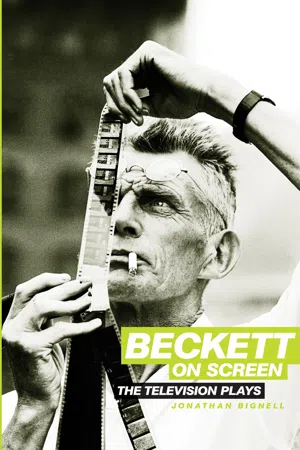
This ground-breaking study analyses Beckett's television plays in relation to the history and theory of television. It argues that they are in dialogue with innovative television traditions connected to Modernism in television, film, radio, theatre, literature and the visual arts.
Using original research from BBC archives and manuscript sources, the book provides new perspectives on the relationships between Beckett's television dramas and the wider television culture of Britain and Europe. It also compares and contrasts the plays for television with Beckett's Film and broadcasts of his theatre work including the recent Beckett on Film season. Chapters deal with the production process of the plays, the broadcasting contexts in which they were screened, institutions and authorship, the plays' relationships with comparable programmes and films and reaction to Beckett's screen work by audiences and critics.
This book is a major contribution to Beckett scholarship and to studies of television drama. It will be essential reading in literature and drama studies, television historiography and for devotees of Beckett's work.
- 230 pages
- English
- ePUB (mobile friendly)
- Available on iOS & Android
eBook - ePub
About this book
Information
Publisher
Manchester University PressYear
2013Print ISBN
9780719064210
9780719064203
eBook ISBN
9781847795649
1
Production
Introduction
This chapter examines the significance of the production technologies used in making the five dramas written by Beckett for television and compares and contrasts these production technologies with those used in realising Film and television adaptations of theatre texts by Beckett. The British television plays were recorded in television studios and were shot on film, with the exception of Eh Joe (1966), which was a videotape production. The German productions of Beckett’s plays in the 1980s were also made on videotape. The plays were not transmitted live, but Beckett’s insistence on long takes, with little post-production editing, associates them both with the continuous time of theatre performance and with the live broadcast of drama on television, which was the established means of making television drama in Britain until the late 1950s. When videotape editing and film cameras were introduced in drama production from the early 1960s, edited ‘cinematic’ narrative increasingly supplanted ‘theatrical’ form, and filmed social realist television drama gained a high public and critical profile. Filmed television drama had formal and thematic similarities with realist New Wave cinema, the social engagement of post-1956 British theatre, and television and film documentary. Production technologies for Beckett’s work partially determined its cultural significance by separating it from this emergent nexus and associating it with an avant-garde tradition in television and a history of ‘literary’ or ‘theatrical’ television and radio drama. This chapter explores and evaluates the aesthetic significance of the filmed and videotaped studio production of Beckett’s television plays in this range of contexts.
Some awareness of developments in television technology is needed in order to understand the significance of the television forms in Beckett’s television plays. Each of the plays was recorded in a studio, resulting in a high-quality videotape or film for later broadcast. There are few examples in existing scholarship that examine Beckett’s television plays in the light of their use of particular technical resources (see Homan 1992), though there are several analyses that focus on the ‘essentials’ of vision and sound in the medium. Linda Ben-Zvi’s essay (1985) on All That Fall, Film and Ghost Trio is one of the few examples in its period of scholarship which stress the significance of their medium of transmission. Nevertheless, the works are still considered independently of other dramas in their respective media, and the essay pays little attention to their institutional and social contexts. Catherine Russell (1989) describes the television plays as ‘videotapes’ rather than broadcasts, which are to be understood via analogies with Lacanian models of language and subjectivity. Russell’s analysis of the formal relations between sequences of each play, and relationships between the plays, maps Lacanian insights onto particular moments and sequences. While the audio-visual forms and textures of the plays are important to Russell, her essay is not concerned with the plays’ situation in the medium of television as a cultural form. It is this specific relationship between aesthetics, technology and production practice that forms the core of this chapter.
Television and video aesthetics
Since television drama inherited theatre’s and literature’s mantle of quality and authorial creativity (often via radio drama), it offered, paradoxically, an opportunity to consider the essential aesthetic of the medium. The Langham Group, working at the BBC in 1958–60, for example, were interested in the connections between the aesthetics of television and of avant-garde film (see Cooke 2003: 53–4). On one hand, by using single-camera shooting and takes of unusually long duration, for example, television could explore the anti-conventional forms being developed in European art cinema by the New Wave directors in France. On the other, the use of video feedback (pointing the electronic studio camera at its own video monitor, producing strobing patterns of interference), overlay of one camera’s shot on top of another, and split-screen for example, offered television-specific visual effects that could be integrated in a range of ways into fantasy, science fiction and avant-garde productions. The Langham Group’s experiments occurred just as television drama moved away from a focus on adaptations of stage drama or literature, favouring instead the work of dramatists writing specifically for television like Alun Owen or Clive Exton (Hill 2007: 25). So although the Group’s notable productions included, for example, Torrents of Spring and Mario in 1959, based loosely on short stories, their work looked anomalous both because of its experimental visual design and because of its conservative tendency to perpetuate a ‘literary’ television drama rather than a specifically televisual one. That kind of experimentation did not last long as an organised initiative, but it enabled BBC producer–directors like James MacTaggart and writers like Troy Kennedy Martin to make television plays that cut visual sequences to music scores and used montages of still images in plays in the early 1960s that contrast strongly with naturalistic forms of storytelling. The aesthetic of Beckett’s Eh Joe draws on this strand of television production practice and takes some of its innovations in studio drama to an exceptional extreme.
Eh Joe was written in 1965, and begins with a wide shot of a set representing a room with door, windows and a simple bed. Joe examines the room and checks that its door and window are sealed and curtained, before sitting on the bed. A female voice, V, speaks to him accusingly as the camera moves across the set towards him and frames him in an increasingly tight series of close-ups, until at the end of the play only Joe’s face can be seen. As Stan Gontarsky (1983: 425) and others have pointed out, the fact that the play begins in a room connects it to the earlier Film (1964) which is also substantially set in a simple city apartment. Beckett’s script for Eh Joe refers to the opening sequence as a ‘pursuit’ (Beckett 1986: 361), and this also connects it to Film’s pursuit of the male figure O by E, the camera’s point of view, which ultimately confronts O and is revealed to be the gaze of a man who exactly resembles O, an apparent double. The figure seeking refuge alone in a room is also reminiscent of many of Beckett’s dramatic and prose works, for example the novel Molloy (1959) and the short play Rockaby (1982, see Beckett 1986). The enclosed space has also often been regarded as a representation of the mind, yet it is significant to note its connections with the room of naturalistic theatre and the rooms in which many of the studio television dramas of the 1960s took place. While the relationship of these motifs to Beckett’s prose and drama are revealing in biographical and intratextual terms, they reveal little about how the space and tone of Eh Joe work as television.
The original manuscript and typescript versions of Eh Joe describe the opening sequence in which Joe checks the windows and door of his room as comprising separate shots connected by cuts: the direction ‘Cut to’ introduces each action on the set (Beckett undated b, c, e). The original structure using cuts would have brought the camera into the room in a series of leaps across space, and positioned it as a close witness of Joe’s actions, anticipating its closing in on him in the later part of the play. But when the opening sequence is shot as a single long take, as it is in both the 1966 British and 1988 German versions as broadcast, the camera seems removed from the space, at the edge of the set, leaving Joe a certain freedom from it as he moves around the room. This freedom is then cut short when the camera begins its series of moves towards him, breaking the play into two quite distinct parts. Long takes produce the impression of temporal continuity, and allow the camera to follow characters in a space with which they interact. The aim of using the long take is usually to reveal character and the relationship between characters and environment, where that environment may also include their dealings with other characters. The long take suggests a generosity with time in which there is the opportunity to consider what can be seen, thus handing interpretive authority to the audience. The extended look at the character places pressure on that character by enforcing the viewer’s concentration on the detail of how he or she acts and reacts across a sustained passage of action. At the same time, the use of long shot where the camera takes in a wide field of vision shows the character moving in a spatial context, and this is seen at the opening of Eh Joe and in Beckett’s subsequent television work. Long shot permits the camera to have a physical and emotional distance from the character, so that an analytical and critical understanding can be gained by revealing body movements, gesture, costume and so on, and the action is embedded in the represented world. This is a distinctly different visual system from the use of rapid alternations of shot–reverse–shot and close-up, which cut up space, person, body and relationships between characters, and determine how the viewer can perceive action. Rapid cutting and extensive close-up can be analytical in that they segment and select, presenting directorial interpretations of character and action, but the long-take long shot allows the viewer to make sense of space and character in a different way, similar to a Brechtian notion that the audience can choose where to look and has to work to bring frameworks of interpretation to the images they see. This visual style empowers the audience and draws on the theatrical convention of space energised by action that privileges performance and is designed for it, whereas segmented shooting and close-up seem more filmic since there is no ‘dead space’ that can open up additional meanings.
The visible space at the opening of Eh Joe is in long shot and contains unusually large set elements such as over-long curtains and large bare walls that are much taller than they would be in any conventionally ‘real’ room. Joe’s movements in checking the room are also large-scale gestures. This concern with size contrasts strongly with the later restriction of camera movement to small incremental steps, and the focus on Joe’s restricted range of gestures and facial expressions which are observed in increasingly concentrated close-up. The exaggerated movement of the opening connects with silent cinema, pantomime and puppet theatre, while the restricted movement of the second part of the play has much more in common with television representations of psychological states using close camera shots and an acting style developed in cinema and television in the days of live broadcasting in the 1950s and before. The large theatrical movement and the open theatrical set in the first half as distinct from the restricted framing and limited expression of the second half represent a shift in the representational codes of the play and necessitate different responses from the audience. Indeed, the expectations on the audience’s part of what kind of drama this is must change radically. The first part might lead the viewer to believe that this is a non-naturalistic, theatrical drama in which the action must be read through a symbolic code rather than a naturalistic or psychological one. By contrast, the second part conforms more easily to the conventions for the television representation of internal states and emotions through largely non-verbal codes and the assumption of the revelation of psychology through minimal gestural movement. In television, this emphasis on small but significant gesture and expression, often without directive shaping by dialogue, was refined especially by the Method acting styles of actors like Paul Newman, who began their screen careers in live studio drama on American television (see Bignell 1996). But this American tradition remained marginal to the British practice, at least until the late 1960s, for television plays to be driven by speech rather than movement or gesture. So for British audiences of this BBC production of Eh Joe, the contrasting styles of theatricality in the first part of the play and close-ups suggesting wordless psychological revelation in the second would raise questions of categorisation and interpretation.
The play invites the audience to consider it as the representation of Joe’s guilt over the death of his beloved, since the female voice, V, castigates Joe for his apparent neglect of a woman who is later said to have killed herself. Voice, in this reading, would be the voice of his own conscience. Jack MacGowran’s performance as Joe in the BBC’s 1966 production certainly fulfils Beckett’s stage direction (1986: 362) that the face should represent a ‘mounting tension of listening’. On one hand, the low lighting and strong shadow of both the BBC and the later German SDR productions (see Kalb 1989: 109) produce an increased focus on the minute detail of Joe’s face and are used to connote dramatic intensity and psychological complexity. At the same time, the strong shadows cast by the lighting make it more difficult for the viewer to determine the interpretation of Joe’s expressions. In contrast to the opinion of John Fletcher and John Spurling (1985: 95), television conventions of close-up and lighting increase rather than reduce the play’s ambiguity. The play was recorded at a time when the visual detail in the image was nowhere near as clear as it would be today, since the video cameras used had less tonal depth and capacity for contrast than film cameras. The television image on BBC2 was broadcast using 625 lines of visual information, while BBC1 and ITV used only 405 lines, but the strong shadow and low lighting in the video production of Eh Joe did not exploit this greater picture quality. These technical and production factors add to the play’s problematic invocation of different and ambiguous schemas of interpretation.
Furthermore, the ambiguity about how to read Joe’s facial expression and its relationship to Voice’s words is enhanced by the duration of the camera shot that moves increasingly closer to his face. Historically, television drama has used gradually shorter camera shots, and a brief comparison between Eh Joe’s average lengths of shot and those of some other dramas made in comparable ways at different dates can illuminate just how different Eh Joe is from television norms. The whole play is one long take, uninterrupted by cutting away to another camera or by editing that would introduce time ellipses into the narrative. The play’s duration is eighteen minutes. Thus, although the shot is divided into steps whereby the camera moves physically across the set and then stops, only to resume movement again, it is experienced by the audience as a single sequence of extraordinary duration. In the second part of the play, the camera’s position moves from the approximate centre of the set in a series of nine movements towards Joe, and the duration of the periods when the camera is still varies since these periods of stillness correspond to Voice’s words, which take varying lengths of time to deliver. Taken as a whole, the periods of camera stillness average a little less than two minutes each. Even if these periods of stillness had been made as a series of separate shots to be edited together, their length individually would be much longer than shots in other dramas, even those of much earlier date. As a brief comparison, Lez Cooke (2003: 47) has calculated the average shot length in Alun Owen’s 1960 studio-recorded play Lena, O My Lena in the ABC company’s Armchair Theatre strand, coming up with a figure of 12.5 seconds. The viewer would have experienced the shots as less long than that since the camera was often in motion around the set and offered zooms in and away from the actors and set components within individual shots. So the rough figure of two minutes of still image in Eh Joe is very much longer than the norms of the period, and also feels much longer because of the lack of change in camera focus or directional alignment. In fact an average shot length of two minutes is the same figure as for a live 1938 BBC costume drama production, Clive of India, at a time when techniques of directing drama on television were still in their infancy (Jacobs 2000: 52–3) and shot lengths were very long by today’s standards. The effect of such lengthy periods of camera stillness is to offer nothing else for the audience to see than the close-ups on Joe’s face, and thus to focus visual attention on them. While attention to sound becomes more significant for this reason, since Voice is speaking while the camera is still, the opportunity to look for interpretations of Joe’s face through Jack MacGowran’s generally understated performance leaves plenty of room for hypotheses, alternatives and uncertainties.
Looking at Eh Joe’s structure and the peculiarity of its camerawork provides some evidence for considering the play as an instance of explicitly reflexive television that draws attention to its means of technological and formal articulation. This has been argued by specialists in Beckett criticism, though generally from an essentialist and author-centred perspective, and has been said of his later television work as well. Enoch Brater’s (1985, see also Brater 1987: 74–110) precise descriptions of Beckett’s television later plays Nacht und Träume and Quad lead to a fascinating series of displacements between language and image, authorial ‘message’ and medium, but tend towards a formalist and essentialist conception of television. Of Nacht und Träume, Brater (1985: 51) concludes that: ‘Writing with the basic material of television, video images, Beckett makes us sense the verbal potential of all that he renders so palpably visual … The video image says more precisely because it says less, and in saying less it says everything in the way this medium can be made to say it.’ Brater’s argument is premised on the value given to Beckett’s alleged search for a ‘poetics’ of television: an essence of the communication principles of the medium. Beckett’s paring down of dramatic form, his gradual reduction of verbal and spatial textures, and concentration on geometrical, mathematical forms and music, are regarded as Modernist experiments in medium-specificity. For Brater, ‘writing’ with images produces the verbal polysemia of the visual icon. The television image’s plenitude comes from its stark spareness as an articulation, and this reduction to an essence paradoxically reveals the shared generic qualities of all audio-visual forms. Brater’s argument positions the plays firmly as meta-commentary on their medium, as avant-garde works that have more in common with video art (like the works of Bruce Nauman, himself strongly influenced by Beckett) than with broadcast drama. The plays produced for television in Germany were shot on video, so that Brater’s argument connects with other theoretical discussions of video as the ‘essential’ technology that underlies television aesthetics (see Chapter 4). I am not arguing that Brater’s point is wrong, but simply that the reflexive and experimental qualities of Eh Joe need to be understood in a broader television context. The use of the long take and still camera both mark the play as exceptional in its own time and link it anachronistically to a long history of developments in editing rhythms that connect it with much earlier drama broadcasts. If Eh Joe is medium-specific and reflexive, it is so by virtue of television drama’s ongoing struggle to assimilate to and differentiate itself from other media and to develop rhetorical strategies and production techniques for studio drama.
Recording Eh Joe in one long take was a considerable feat, but there were advantages as well as disadvantages in the technique from a production point of view. A long and detailed memo of May 1964 (BBC WAC T5/2239/7) from the BBC’s television recording engineers explained the process of assembly editing and dubbing sound on the Ampex and RCA videotape that the BBC used at this time. The expensive Ampex tape was very cumbersome and lacked the facility to pause the tape during a recording. It had a tape life of only 60 plays, and high internal charges were levied by BBC technical departments for editing time and tape storage. This made it preferable to shoot on video in long takes ‘as if live’, to avoid any editing of tape sequences after the shoot, and to avoid keeping taped performances for later broadcast and instead to immediately re-use the tape for another programme. Because tape could not be cued up to a precise start point (it took ten seconds for the picture to appear after starting to play it) it was impossible to make precise edits by playing a tape on one player and recording the desired sequences from it on another (the practice of assembly editing). Editors had to physically cut the tape, but tape with physical cuts was impossible to re-use and it was recommended that programmes needing numerous edits were shot on 35mm film instead. The internal BBC charge for using a tape in 1964 was £28 per hour, plus £60 per hour if the tape was physically cut. If a tape was kept in store for more than six months an internal charge of £60 per hour’s worth of tape was levied against the producer’s budget. Because of these high costs, until the mid-1960s the recording of programmes was done in continuous tranches of time like live performances wherever possible, and when mistakes were made scenes would be performed again after winding the tape back to a previous start point, rather than editing the mistakes out. With Beckett’s characteristic long takes, as in Eh Joe, there was no need to make numerous edits within the play as a whole, and so no need to physically cut the videotape or to assemble separately-shot sequences together. While this meant that Jack MacGowran would have been forced to repeat his performance if a mistake was made, the technical strictures of using videotape suited Beckett’s play rather than causing production difficulties. It is a testament to the BBC’s sense of Eh Joe’s importance that the other major problem with tape – namely the desirability of reusing it and wiping programmes made on it rather than keeping them – was avoided and the play survives to this day. This contrasts with popular mass-audience programmes of the time that were routinely wiped, such as the long-running science fiction drama Doctor Who, of which more than one hundred 25-minute episodes from the mid-1960s have been lost because their tapes were wiped and re-used. All of Beckett’s later plays for television in Britain were made on film, at gre...
Table of contents
- Cover Page
- Title Page
- Copyright Page
- Contents
- Acknowledgements
- Introduction
- 1 Production
- 2 Broadcasting contexts
- 3 Institutions and authorship
- 4 Intertexts
- 5 Evaluations
- 6 Afterword: the lessons of history
- Bibliography
- Index
Trusted by 375,005 students
Access to over 1.5 million titles for a fair monthly price.
Study more efficiently using our study tools.
Frequently asked questions
Yes, you can cancel anytime from the Subscription tab in your account settings on the Perlego website. Your subscription will stay active until the end of your current billing period. Learn how to cancel your subscription
No, books cannot be downloaded as external files, such as PDFs, for use outside of Perlego. However, you can download books within the Perlego app for offline reading on mobile or tablet. Learn how to download books offline
Perlego offers two plans: Essential and Complete
- Essential is ideal for learners and professionals who enjoy exploring a wide range of subjects. Access the Essential Library with 800,000+ trusted titles and best-sellers across business, personal growth, and the humanities. Includes unlimited reading time and Standard Read Aloud voice.
- Complete: Perfect for advanced learners and researchers needing full, unrestricted access. Unlock 1.5M+ books across hundreds of subjects, including academic and specialized titles. The Complete Plan also includes advanced features like Premium Read Aloud and Research Assistant.
We are an online textbook subscription service, where you can get access to an entire online library for less than the price of a single book per month. With over 1.5 million books across 990+ topics, we’ve got you covered! Learn about our mission
Look out for the read-aloud symbol on your next book to see if you can listen to it. The read-aloud tool reads text aloud for you, highlighting the text as it is being read. You can pause it, speed it up and slow it down. Learn more about Read Aloud
Yes! You can use the Perlego app on both iOS and Android devices to read anytime, anywhere — even offline. Perfect for commutes or when you’re on the go.
Please note we cannot support devices running on iOS 13 and Android 7 or earlier. Learn more about using the app
Please note we cannot support devices running on iOS 13 and Android 7 or earlier. Learn more about using the app
Yes, you can access Beckett on Screen by Jonathan Bignell in PDF and/or ePUB format, as well as other popular books in Literature & World War II. We have over 1.5 million books available in our catalogue for you to explore.