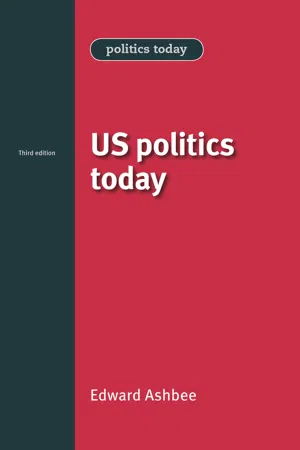
The third edition of US Politics Today provides a concise, up-to-date and accessible introduction to US government and politics. It offers a survey of core institutions such as the Presidency, Congress and the US Supreme Court, assesses the electoral system and considers the part played by organised interests and political parties. The book includes coverage of the 2008 presidential election and the Obama administration's record in office.
The book also introduces some of the most important debates and arguments within American political science. These include theories of voting behaviour, different approaches to presidential power, competing perspectives on the changing nature of the political parties, and contrasting representations of the lobbying process.
The book is of particular relevance to undergraduate and A-level students but is also valuable for the general reader.
- 202 pages
- English
- ePUB (mobile friendly)
- Available on iOS & Android
eBook - ePub
About this book
Information
1
Elections and campaigns
There are countless elections in the United States. They include contests to choose those who serve at federal, state, and local level (such as school or library boards). Positions that in other nations would be assigned through an appointments process, such as judgeships, are contested and voted upon. Furthermore, party candidates are chosen by the voters themselves in primaries, not by party leadership bodies or committed activists alone. Indeed, any citizen can run for office, as neither previous party membership nor a record of political activity is required. During 2011, it appeared for example that Donald Trump, the wealthy property developer and entertainment tycoon, might seek the Republican Party’s presidential nomination. For a period, Herman Cain, former head of a pizza company, was a credible candidate. Furthermore, in some states, issues may be decided directly by the voters themselves through referendums.
Despite the frequency and extent of electoral contests, the US electoral system has, however, been subject to sustained criticism. Money and the media, it is said, play too much of a role in federal elections. The length, complexity, and demands of the presidential electoral system dissuade qualified candidates and contribute to low levels of turnout.1 This chapter considers and assesses these questions.
Electing the president
The president is elected every four years. Since the Twenty-second Amendment was adopted in 1951, no president can be elected to serve more than two full terms. Candidates for the office face a two-stage system structured around the race to secure their party’s nomination and the general election contest.
Candidates
Article II of the US Constitution establishes three basic requirements for those who serve as president. An individual must be at least 35 years old, born in the US (the ‘Birther’ movement contended that Barack Obama had been born in Kenya and therefore challenged his legitimacy as presidency on this basis), and a resident for 14 years or more. In practice, however, a further ‘qualification’ is required. Despite frequent talk of a minor party breakthrough (see below), a winning candidate must be a major party nominee. Since March 1853, presidents have been drawn from either the Democratic or the Republican Party. In 2007–8, eight credible Democrats sought their party’s nomination in the presidential race. Six were, or had been, members of the US Senate. Another was a state governor (although he had also served at federal level in the Clinton administration) while one sat in the House of Representatives. There were also eight contesting the Republican presidential nomination (a further four withdrew in 2007 before the formal selection process began). One was a senator and another was a former senator. Two were former state governors. Two served in the US House of Representatives. One had served as mayor of New York City while another (who was, in reality, a fringe candidate) had served as a US ambassador to the United Nations. In the contest for the 2012 Republican nomination, there were (by December 2011) seven credible candidates including Texas governor Rick Perry, the former Massachusetts governor Mitt Romney, and Newt Gingrich, who served as Speaker in the House of Representatives between 1995 and 1999.
In recent years, there may have been a shift. Those who have served in the Senate appear to have secured an advantage. Until 2009, four of the past five presidents had served as governors before being elected to the White House. Yet, in 2004, the incumbent president (George W. Bush) was challenged by a serving senator (John Kerry). Then, in 2008, both the Democratic and the Republican parties chose serving senators as their candidates (Barack Obama and John McCain respectively). Arguably, the shift took place because, in the wake of the 11 September 2001 attacks on New York City and the Pentagon, defence policy and ‘homeland security’ acquired much more importance. Members of Congress, particularly those in the Senate, have some experience of foreign policy deliberations and are thereby more credible candidates. State governors will customarily have a record of involvement only in domestic policymaking. Although 2012 appeared to buck the trend in so far as only one senator was in the race for the Republican nomination, the party’s supporters were by the end of 2011 edging towards candidates who had substantial political experience and away from the more radical outsiders.
A president who is seeking re-election may well be unopposed within his own party. Incumbents hold important advantages in terms of status, authority, and funding. In July 2011, well ahead of the 2012 presidential election, it was reported that President Obama had, in addition to his many small donors, recruited about 150 ‘bundlers’ who had each raised half a million dollars for his re-election campaign (Confessore, 2011: 8). At the end of their first terms, Ronald Reagan, Bill Clinton, and George W. Bush faced no serious or credible challengers at the primary stage. However, this is not assured. In 1968, Eugene McCarthy and Bobby Kennedy ran against President Lyndon Johnson, before he withdrew, in the race to become the Democratic Party’s nominee. In 1976, Ronald Reagan almost took the Republican nomination from President Gerald Ford. In 1980, President Jimmy Carter faced a sustained challenge from Senator Edward Kennedy.
The ‘invisible primary’
The one- or two-year period preceding a presidential election year has been dubbed the ‘invisible primary’. Although it does not have a formal or well-defined status, it is the informal race to secure campaign funds, build a campaign team, attract press coverage, and establish a lead in the public opinion polls. It can be thought of as a process of ‘jostling’ and has often played a critical role in determining who will eventually secure the party’s nomination. As William Mayer, who coined the term, observes: ‘In seven of the 10 cases … the nominee-to-be had opened up a sizable lead over every other eventual candidate by, at the latest, one month after the preceding midterm election – more than a year, in other words, before the start of the actual delegate selection activities’ (quoted in Schneider, 2002) In other words, although the formal selection procedure begins only in January or February of election year, the identity of the parties’ most likely presidential nominees is often becoming evident over twelve months before this. (In the 2012 Republican race, however, the ‘invisible primary’ seemed inconclusive. While those in the party elites and about a quarter of the Republican electorate appeared to back Mitt Romney, many believed that he was not a consistent conservative and had ‘flip-flopped’ on core issues too frequently.)
How can candidates build up the ‘sizable lead’ in the polls to which Mayer refers? Observers stress the initial winning of name recognition, the creation of an exploratory committee, the process of attracting campaign teams and strategists (sometimes dubbed the ‘talent primary’), participation in candidate debates, courting the different groupings and organisations that are allied with the party, the gaining of endorsements from well-known supporters, and inclusion in lists of credible presidential hopefuls considered by newspaper ‘oped’ columnists and television commentators. The ‘straw polls’ organised by some of the state parties and organisations such as the Conservative Political Action Conference, have acquired growing importance. The straw poll held in Ames, Iowa, has a particular place in the race for the Republican presidential nomination. This is partly because the Iowa caucuses play a pivotal role at the beginning of election year. Although the result has no formal status it gives ‘bragging rights’, can boost (or deflate) a campaign and determine a candidate’s fundraising prospects. Its structure and character are however reminiscent of premodern electoral systems. Tickets, allowing participation, cost $30 in the 2011 poll. For the most part, this was paid by one of the campaigns, nearly all of which brought in supporters by bus with the promise of food and entertainment. 16,892 votes were cast. The results were victories for Congresswoman Michele Bachmann, a social conservative closely associated with the radical Tea Party movement and Congressman Ron Paul, a veteran libertarian, who came second. Both were ‘outsider’ candidates who defied the odds and the Republican Party leadership. The outcome was, however, a major setback for Tim Pawlenty, the former governor of Minnesota, who had been seen at an earlier stage as a very strong contender. On the day after the Ames straw poll, Pawlenty announced his withdrawal from the race. Some candidates, including those regarded as frontrunners for the 2012 Republican nomination (most notably the former Massachusetts governor, Mitt Romney), decided not to compete in the poll (although he was listed on the ballot).
During 2007, the year preceding the 2008 presidential election, Democrat presidential hopefuls devoted much of their time to attending forums and debates organised by interest groups, such as the National Association for the Advancement of Colored People (NAACP), NARAL Pro-Choice America, and the Human Rights Campaign (a gay and lesbian organisation), that are closely aligned with the party. The Washington Post reported on a forum for the Democrats’ presidential candidates organised by the NAACP in July 2007:
Presidential hopeful Barack Obama drew the loudest cheers of the eight Democratic candidates at a civil rights forum Thursday as he assailed the Bush administration’s record on race relations … Black voters are a core party constituency. Candidates are in a fierce struggle to capture their support and are refusing to cede it to Obama. Hillary Rodham Clinton, the front-runner, enjoys strong support in the black community and is married to former President Clinton, who was wildly popular among black voters. John Edwards has won praise from black leaders for his commitment to fighting poverty. (Runk, 2007)
However, as Mayer emphasises, a candidate’s financial resources are as important as the process of political positioning. A campaign cannot be sustained nor can a candidate secure credibility without a financial ‘war chest’. Indeed, its importance is such that some commentators refer to the ‘invisible primary’ as the ‘money primary’. Primary candidates can, if they can demonstrate that they have a credible number of supporters and are ready to be bound by overall expenditure limits, obtain matching funds from the Federal Election Commission (FEC). These funds, which provide dollar-for-dollar assistance, are taken from those taxpayers who have agreed, on their annual income tax returns, that a proportion of the tax that they have paid may be used for this purpose. To qualify for matching funds, and deter marginal candidates, a candidate must raise a total of at least $100,000 in twenty or more states (Congressional Quarterly, 1997: 46). In recent years, however, growing numbers of candidates have decided not to seek matching federal funds. In the 2008 Democratic primaries, Barack Obama and Hillary Clinton relied instead on their own fundraising abilities. Amongst the Republicans, John McCain, Rudy Giuliani, Mitt Romney, and Ron Paul made the same decision. This not only allowed them to spend without limit but was also a demonstration of political and organisational strength. Indeed, the acceptance of federal funding in the primaries increasingly seems to mark a candidate out as being perceived as ‘second tier’.
How important is the ‘invisible primary’? Much has been made of it by commentators over the past twenty years. However, the 2008 presidential election suggests that its importance may be overstated. Efforts to establish models or ‘laws’ often founder on the unpredictability and uncertainty of the US electoral process. At the end of 2007, opinion polls conducted amongst likely Democratic primary voters gave Senator Hillary Clinton a clear lead. Barack Obama was a distant second. Among Republicans, the frontrunner was the former Arkansas governor Mike Huckabee. He was followed by the former New York mayor Rudy Giuliani. The former Massachusetts governor Mitt Romney was in third place. So far as fundraising was concerned, Federal Election Commission returns for the period up until the end of 2007 show that Hillary Clinton had a narrow lead amongst the Democratic contenders while Rudy Giuliani and Mitt Romney held the lead in the Republican race. It is worth noting that Senator John McCain, who went on to win the Republican Party’s presidential nomination, was far behind in terms of both the opinion polls and fundraising.
Primaries (January-June)
The presidential candidate is formally chosen by majority vote amongst delegates at each party’s national convention. Candidates therefore seek to maximise the number of their supporters among the state delegations. Traditionally, convention delegates were chosen by party ‘bosses’ (who held sway in cities such as Chicago) and factions at a state party convention. However, although there are significant procedural differences between states (and caucuses as well as county and state party conventions can continue to play a role), the primary election has become the norm. The primary allows members of the public, who are registered supporters of a particular party, to participate in the nomination process. By picking a particular candidate to be the party’s presidential nominee, primary votes in effect mandate or bind the state party delegates to back that candidate when the national nominating convention is held. The primary ‘season’ is therefore a race by those seeking the nomination to win national convention delegates.
The proportion of convention delegates chosen on the basis of the primary results in their states grew during the course of the twentieth century. By 1996, 65.3 per cent of Democratic national convention delegates and 84.6 per cent of Republican national convention delegates were selected in primaries (Congressional Quarterly, 1997: 141). Of these, some were closed primaries that restricted voting to those who had registered earlier in the year as Democrats or Republicans. Others were open primaries that do not require pre-registration. In some states, voters are allowed to register as a party voter on the day that the primary is held. In others, they are offered a choice of ballots.
The growth of the direct primary is closely associated with the progressive movement at the beginning of the twentieth century. It sought to modernise the political process by breaking the power of the party ‘bosses’. Some states still, however, use caucuses and state party conventions. Caucuses are small-scale meetings. In Iowa, for example, although there are differences between the Democratic and the Republican procedures, meetings (or ‘gatherings of neighbours’) are held in each of the state’s 1784 precincts. They allow discussion of the different candidates’ strengths and weaknesses. Participation inevitably tends to be limited to the more committed party activists. On the basis of deliberations in the caucuses, delegates are sent to county conventions, which, in turn, elect delegates to congressional district and state conventions which are held at later dates. These choose the national convention delegates.
In the Democratic Party, the national convention delegates are elected on a proportional basis. Candidates receiving a minimum of 15 per cent of the vote obtain a share of national convention delegates in that congressional district that is proportional to the vote they received (Polsby and Wildavsky, 1996: 120). Among the Republicans, some states adopt proportionality (and in 2012 many of the states holding early primaries had to use a proportional system), while others employ a ‘winner takes all’ system whereby the candidates with the most votes win all the delegates from that state. The electoral system that is used can have consequence for the character of the primary race. The long and bruising battle between Barack Obama and Hillary Clinton for the Democrats’ presidential nomination in 2008 was in part a consequence of proportionality. Each primary victory provided only a relatively small lead in terms of convention delegates. In contrast, Senator John McCain won the Republican presidential nomination by the beginning of March because primary victories in winner-take-all states quickly gave him large numbers of convention delegates.
The overall size of a state party’s delegation depends upon factors such as the state’s population, its past support for that party’s candidates in federal elections, and the number of elected officials belonging to the party. The Democratic convention is significantly larger in terms of delegate numbers.
Although preceded by the Iowa caucuses from 1972 onwards, the first state to hold a primary is, by tradition, New Hampshire. In the past, it was described as pivotal. By winning New Hampshire, it was said, candidates could gain a sense of momentum that would enable them to win in the later primaries. However, the state has rarely chosen the eventual winner. The 1992 Democratic primary was won by the late Paul Tsongas. It was Bill Clinton who secured the presidential nomination. In 1996, the maverick conservative commentator Patrick J. Buchanan won in the New Hampshire Republican primary, but was decisively beaten in the race for the nomination by the former Senate Majority Leader, Bob Dole. In 2000, the New Hampshire Republican primary was won by the Arizona Senator John McCain. Later primaries, however, gave victory to George W. Bush. However, although perhaps not pivotal, New Hampshire should not be dismissed. In 2008, victory in the ‘Granite State’ allowed Hillary Clinton to continue her campaign after a disappointing third place finish in Iowa. Had she lost New Hampshire her bid to win the nomination would almost certainly have finished there and then. Amongst the Republicans, John McCain’s win in New Hampshire established him as the frontrunner.
The primary ‘season’ traditionally lasts between the beginning of election year and June. There are often t...
Table of contents
- Cover Page
- Title Page
- Copyright Page
- Contents
- List of tables
- Preface
- 1 Elections and campaigns
- 2 Political parties and voting behaviour
- 3 Organised interests, lobbying, and advocacy
- 4 The US Constitution
- 5 Congress and the passage of legislation
- 6 The president and the executive branch
- 7 The US Supreme Court, jurisprudence, and rights
- 8 Theories, perspectives, and concepts
- Index
Trusted by 375,005 students
Access to over 1.5 million titles for a fair monthly price.
Study more efficiently using our study tools.
Frequently asked questions
Yes, you can cancel anytime from the Subscription tab in your account settings on the Perlego website. Your subscription will stay active until the end of your current billing period. Learn how to cancel your subscription
No, books cannot be downloaded as external files, such as PDFs, for use outside of Perlego. However, you can download books within the Perlego app for offline reading on mobile or tablet. Learn how to download books offline
Perlego offers two plans: Essential and Complete
- Essential is ideal for learners and professionals who enjoy exploring a wide range of subjects. Access the Essential Library with 800,000+ trusted titles and best-sellers across business, personal growth, and the humanities. Includes unlimited reading time and Standard Read Aloud voice.
- Complete: Perfect for advanced learners and researchers needing full, unrestricted access. Unlock 1.5M+ books across hundreds of subjects, including academic and specialized titles. The Complete Plan also includes advanced features like Premium Read Aloud and Research Assistant.
We are an online textbook subscription service, where you can get access to an entire online library for less than the price of a single book per month. With over 1.5 million books across 990+ topics, we’ve got you covered! Learn about our mission
Look out for the read-aloud symbol on your next book to see if you can listen to it. The read-aloud tool reads text aloud for you, highlighting the text as it is being read. You can pause it, speed it up and slow it down. Learn more about Read Aloud
Yes! You can use the Perlego app on both iOS and Android devices to read anytime, anywhere — even offline. Perfect for commutes or when you’re on the go.
Please note we cannot support devices running on iOS 13 and Android 7 or earlier. Learn more about using the app
Please note we cannot support devices running on iOS 13 and Android 7 or earlier. Learn more about using the app
Yes, you can access US politics today by Edward Ashbee in PDF and/or ePUB format, as well as other popular books in Politics & International Relations & Medical Theory, Practice & Reference. We have over 1.5 million books available in our catalogue for you to explore.