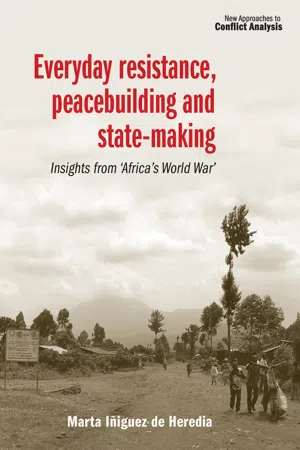
Everyday resistance, peacebuilding and state-making addresses debates on the liberal peace and the policies of peacebuilding through a theoretical and empirical study of resistance in peacebuilding contexts. Examining the case of 'Africa's World War' in the DRC, it locates resistance in the experiences of war, peacebuilding and state-making by exploring discourses, violence and everyday forms of survival as quotidian acts that attempt to challenge or mitigate such experiences. The analysis of resistance offers a possibility to bring the historical and sociological aspects of both peacebuilding and the case of the DRC, providing new nuanced understanding on these processes and the particular case. The book also makes a significant contribution to the theorisation of resistance in International Relations.
eBook - ePub
Everyday resistance, peacebuilding and state-making
Insights from 'Africa's World War'
- 252 pages
- English
- ePUB (mobile friendly)
- Available on iOS & Android
eBook - ePub
Everyday resistance, peacebuilding and state-making
Insights from 'Africa's World War'
About this book
Information
1
Legitimacy, violence and extraction in the practice of building states
[T]o govern men as to produce and collect goods is inseparable from the specific modes of the distribution and modulation of violence. (Mbembe 1991a: 7)
Ruling over people
Whatever other challenges peacebuilding faces, whether administrative reform, economic reactivation or the stabilisation of conflicts, it poses peacebuilders with the basic question of how to assert state rule. Peacebuilding has a state-making ethos and, as Weber argues, states are ‘associations of rule’ (1978: 51). Since 1945, a significant quantitative and qualitative development in the doctrines of intervention and conflict management has made state–society relations the sphere of international intervention.1 These operations have included programmes for economic, security sector and civil administration reform, as well as for promoting certain civil society activities. Since 2001, when so-called failed states were designated as the major cause of conflicts, interventions have aimed at the transformation of the state apparatus, supporting governments and the central administration, in so far as the state is considered the cornerstone for the end of conflict and for the establishment of a long-lasting peace. Operations such as those in Bosnia, East Timor, Afghanistan and Kosovo heralded an era in which peacebuilding is statebuilding, by whatever other name it is called (Chesterman 2004). Current policy indicates that statebuilding has survived other aspects of the liberal peace agenda (Bliesemann de Guevara 2010; Hameiri 2014), and, in fact, it has a wide consensus from Western and non-Western governments (Curtis 2013).
These processes have generally been studied under a global governance framework. The very few historical-sociological approaches demonstrate that little is known about how the reconstruction of state authority impacts on peacebuilding (Bliesemann de Guevara 2012, 2015; Jung 2008; Migdal and Schlichte 2005). As Newman argues,
In historical perspective statebuilding has generally been a coercive and often a violent process. Statebuilding involves imposing a unified, centralised state and subjugating peripheral regions, securing border areas and imposing regulation, institutions, taxation and control. This has been a violent process because it threatens the interests of recalcitrant actors and it encounters outlying resistance which must be suppressed. […] In stark contrast, in the twenty-first century scholars and policy analysts interested in peacebuilding portray peacebuilding and statebuilding as complementary or even mutually dependent. (2013: 141)
However, Newman himself falls short of fully developing a historical-sociological approach. This chapter analyses statebuilding from the practices and patterns that constitute it presently and historically. It argues that peacebuilding as statebuilding is based on the same practices of coercion, extraction and claims to legitimacy that define state-making, and that these practices are the ground for resistance. Resistance reflects not just issues of bad governance, or a rejection of internationally led agendas that impinge on a local culture. It reflects the experience of war, poverty, and political processes as intolerable and humiliating. However, as Eric Wolf states, social science cannot be restricted to the study of ‘self-contained’ societies (1982: 385). Resistance needs to be seen as an expression of an experience that is historical and inseparable from global political and economic processes.
Peacebuilding shares with state-making the claims to legitimate authority to distribute rights, privileges, violence and economic resources. It is based on a high-modernist discourse of peace, democracy and development that promises to be the solution to the problems (post-)conflict states and societies face; it is based on the support of a strong winning party or a power-sharing agreement, in a way that militarises government; and it continues or establishes new ways of extraction that tend to reinforce patterns of accumulation and dispossession.
These three elements (coercion, capital and legitimacy), which relate to the legacy of Max Weber, are part and parcel of a widely embraced tradition about what states are and how they came into being. As Hintze pointed out, Weber's insight is to have revealed the state as an ‘institutional enterprise possessing coercive force’, tearing down ideological conceptions of the state as a neutral and collective good (cited in Anter 2014: 40). But this approach has its limitations.
Hannah Arendt criticised Weber for having merged violence and power. She argued that violence does not create power, but destroys it (1970: 35–8). For Arendt, the issue is not to have linked violence with the exercise of state violence but to have established a causal and ontological link. Weber is also at the root of the ‘bellicist’ account, which, although it establishes what Teschke calls the ‘core hypothesis constitut[ing] the dominant paradigm of state formation theory in contemporary scholarship’, does not fit the formation of all states (2003: 119).2 The ‘bellicist’ account entails a process which Norbert Elias (1982) saw as having ‘two phases’. In the first phase, the threat and preparation for war provides the momentum to recruit men and taxes, simultaneously creating the incentives to centralise and develop institutions for the securing of the territory. A second phase takes place when this institution is democratised. The problem of this account is that it is focused on the process of power concentration and later democratisation that ultimately reflects the unfolding of the modern European nation-state.
The benefit of the Weberian tradition is to offer a relatively simple formula that allows us to sharpen the perspective about the continuities, changes, specificities and generalities of different states and different past and contemporary state-making processes. In this book, state-making (and peacebuilding/statebuilding) is a process of asserting, consolidating and exercising rule through the management of violence and wealth that has both national and international elements. This simple formula fits a wide range of states, and in particular African states, which have been forged out of processes marked by violence and extraction, with claims to legitimacy. For Achille Mbembe, rule and states in Africa were consolidated during colonisation through two different forms of violence, one of conquest under a claim of ‘right to rule’ and another of ‘domestication’ under the discourse of civilising the natives (2001: Ch. 1). The particularities of peacebuilding come from the contexts and international structure in which they are embedded. The contemporary reconstruction of state authority after conflict has not represented an authority resting on popular consent, but the political compromises of different parties through power sharing which international actors have advocated for. The discourse of peacebuilding informs these strategies and underpins the need for these compromises, also affording a platform for legitimising international actors. Recognising common practices as longer patterns of state-making that link different kinds of states with different historical developments allows us to depathologise ‘failed’ states.
The chapter starts with a discussion of Weberian historical sociology in order to analyse not only coercion, extraction and claims to legitimacy as constitutive practices of states, but also how informal and plural forms of governance do not make the DRC pathological; in fact, they characterise the nature of peacebuilding as a plural and improvised form of ruling. This is illustrated with some empirical examples in the fourth section of the chapter. Before that, a third section analyses both Africa's normality and exceptionalism. It first discusses the main critiques that Weberian historical sociology has received in making African states a ‘shadow’ of the ideal European states (cf. Ferguson 2006) and then goes on to analyse particularities of African states through the work of Achille Mbembe. The section highlights the need to take Africa's historicity into account in order to understand its politics and its interconnected nature with global politics. The chapter facilitates an analysis of the object of resistance beyond international actors, while also pointing to several challenges of theorising resistance in this context. These will be more fully developed in the following chapters.
Practices and patterns of state-making
Historical sociology has provided some of the most extensive research and theorisation on state theory and state formation. It is not unitary, as there have been different approaches within it, nor does it necessarily provide the best account. It suffers from important critiques, since it is underpinned by Weber and his Eurocentric approach. Other theories have also added important insights. Michel Foucault, post-structuralism and feminism have identified the constitutive links between the private and public arenas, the plural and decentralising exercise that power relations within states give rise to and the important relationship between formal and informal processes (Ashley 1988; Foucault 2008, 1991; Wilmer 2009). Some of these features, explored below, are synthesised in Achille Mbembe's theory of the African political space.
Historical sociology, and some elements of Weberian theory, are still useful to observe not the specificities of the European state but the broader patterns through which states assert rule. Historical sociology is a corrective to three misunderstandings commonly made in peacebuilding literature and policy, which are that: (1) statebuilding, as an internationally led enterprise, is external to the actual practice of ruling and is a solution to the problems of war; (2) the state is a naturally, and not historically, occurring institution, and its problems can be solved by changing its internal dynamics, without addressing the inequalities and dynamics of the global political economy; and (3) the state is the ‘hero’, able to harmonise competing interests inside and outside (cf. Ashley 1988). This form is an ideal version of the state as a service provider, with a central and coherent administration based on routinised bureaucratic practices and with high levels of legitimacy to distribute and manage wealth and violence, based on the rule of law. Peacebuilding thus exposes an ideal version of the Weberian state, which not only sanitises its history and disregards the constraints that the international context imposes, but ascribes to it features that do not belong to even the most organised and consolidated states.
By contrast, (post-)conflict states and, in particular, African states are characterised by neopatrimonial practices. As discussed below and in Chapter 3, the sources of state failure and of conflict come down to how violence, wealth, rig...
Table of contents
- Cover
- Series page
- Title page
- Copyright page
- Dedication
- Contents
- Figures, maps and tables
- Acknowledgements
- Abbreviations
- Chronology
- Introduction
- 1 Legitimacy, violence and extraction in the practice of building states
- 2 Patterns and practices of everyday resistance: a view from below
- 3 The history and present of ‘Africa’s World War’
- 4 Claims to legitimate authority and discursive attacks
- 5 Everyday violence and Mai Mai militias in Eastern DRC
- 6 Creative survival as subversion
- 7 Everyday resistance and everyday order in world politics
- References
- Index
Trusted by 375,005 students
Access to over 1.5 million titles for a fair monthly price.
Study more efficiently using our study tools.
Frequently asked questions
Yes, you can cancel anytime from the Subscription tab in your account settings on the Perlego website. Your subscription will stay active until the end of your current billing period. Learn how to cancel your subscription
No, books cannot be downloaded as external files, such as PDFs, for use outside of Perlego. However, you can download books within the Perlego app for offline reading on mobile or tablet. Learn how to download books offline
Perlego offers two plans: Essential and Complete
- Essential is ideal for learners and professionals who enjoy exploring a wide range of subjects. Access the Essential Library with 800,000+ trusted titles and best-sellers across business, personal growth, and the humanities. Includes unlimited reading time and Standard Read Aloud voice.
- Complete: Perfect for advanced learners and researchers needing full, unrestricted access. Unlock 1.5M+ books across hundreds of subjects, including academic and specialized titles. The Complete Plan also includes advanced features like Premium Read Aloud and Research Assistant.
We are an online textbook subscription service, where you can get access to an entire online library for less than the price of a single book per month. With over 1.5 million books across 990+ topics, we’ve got you covered! Learn about our mission
Look out for the read-aloud symbol on your next book to see if you can listen to it. The read-aloud tool reads text aloud for you, highlighting the text as it is being read. You can pause it, speed it up and slow it down. Learn more about Read Aloud
Yes! You can use the Perlego app on both iOS and Android devices to read anytime, anywhere — even offline. Perfect for commutes or when you’re on the go.
Please note we cannot support devices running on iOS 13 and Android 7 or earlier. Learn more about using the app
Please note we cannot support devices running on iOS 13 and Android 7 or earlier. Learn more about using the app
Yes, you can access Everyday resistance, peacebuilding and state-making by Marta Iñiguez de Heredia in PDF and/or ePUB format, as well as other popular books in Política y relaciones internacionales & Política africana. We have over 1.5 million books available in our catalogue for you to explore.