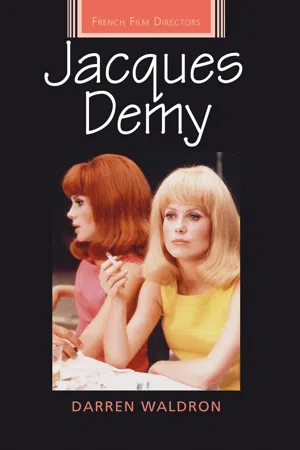
Saccharine for some, poignant for others, Jacques Demy's 'enchanted' world is familiar to generations of French audiences accustomed to watching Christmas repeats of his fairytale Peau d'âne (1970) or seeing Catherine Deneuve and Françoise Dorléac prance and pirouette in Les Demoiselles de Rochefort (1966). Demy achieved international recognition with Les Parapluies de Cherbourg (1963), which was awarded the Palme d'Or at Cannes. However, beneath the apparently sugary coating of his films lie more philosophical reflections on some of the most pressing issues that preoccupy Western societies, including affect, subjectivity, self/other relations and free will.
This wide-ranging book addresses many of the key aspects of Demy's cinema, including his associations with the New Wave, his unique approach to musicals, his adaptations of fairytales, his representations of gender and sexuality and his legacy as an iconic director for generations of audiences and filmmakers.
- 196 pages
- English
- ePUB (mobile friendly)
- Available on iOS & Android
eBook - ePub
Jacques Demy
About this book
Information
Publisher
Manchester University PressYear
2016Print ISBN
9781526106995
9780719087394
eBook ISBN
9781526111340
Subtopic
Film & Video
Jacques Demy, the Nouvelle Vague and beyond
Film scholars have struggled to place Demy in relation to the Nouvelle Vague. Richard Neupert describes him as ‘one particularly important figure from the era who has never fit in comfortably with everyone’s definition of the New Wave’ (2002: 360). Similarly, Naomi Greene positions him within a peripheral group of what Michael Witt and Michael Temple describe as ‘“satellite” figures’ (Greene, 2007: 4; Witt and Temple, 2004: 183). Demy’s preoccupation with musicals and fairytales distinguishes him from his Nouvelle Vague contemporaries and, while he did not eschew their transformative strategies, his associations with them are the product of happenstance. He encountered Jacques Rivette, Alain Resnais and Godard at the Tours Film Festival in 1956 at which he presented Le Sabotier du Val de Loire (Taboulay, 1996: 19). He joined them at the offices of Cahiers du Cinéma in Paris where he met Chabrol, Truffaut and Eric Rohmer, among others from the movement. They watched films at cinemas on the Champs-Elysées and the Cinémathèque and discussed them afterwards. In 1958, Godard introduced Demy to Georges de Beauregard who agreed to finance Lola and, later, Truffaut aided Demy in securing the funds for Les Parapluies de Cherbourg (Hill, 2008a: 27).
This chapter nonetheless discusses Lola and La Baie des Anges in the light of Nouvelle Vague techniques and concerns, plus the aesthetics and themes that are specifically associated with Demy’s personal filmmaking. It then examines how Demy’s sequel to Lola, Model Shop, exported some of the iconic practices of the movement to Hollywood in a remarkable act of singular vision that countered the expectations of his Universal Studios financiers.
Contemporary fairytale: Lola
Lola is often perceived as an archetypal Nouvelle Vague film since it is the product of a filmmaker involved in all aspects of its construction and who wrote the original screenplay (Hill, 2008b: 385). Demy worked with a small crew, including set designer Evein, director of photography Raoul Coutard, and Michel Legrand who composed the score.1 Lola is also partly autobiographical: it was shot on location in Nantes; Jeanne (Margo Lion) and Claire (Catherine Lutz), who work in the Café Naval, are inspired by Demy’s aunts; Lola (Anouk Aimée) is modelled on a fusion of a friend of the same name2 and a neighbour called Reine; while Roland Cassard (Marc Michel) is, according to some critics, Demy’s alter-ego (Berthomé, 1996: 122). Lola is also read as a condensed version of Demy’s oeuvre as a whole, containing all the elements – stylistic and thematic – that would return throughout his cinema.
Congruent with many Nouvelle Vague films, Lola pays homage to cinematic antecedents, particularly Max Ophüls to whom it is dedicated. Lola’s name and profession recall the main protagonist of Lola Montes (1955), while the belle époque interior of the Eldorado club and Lola’s costume allude to Le Plaisir (1952). The narrative structure evokes the cyclical form of La Ronde (1950), although, as Berthomé remarks, in Lola the circle is not closed, but opens outwards (1996: 126). Beyond Ophüls, the central theme of fidelity in the absence of a lover recalls Luchino Visconti’s Le Notti Bianche (1957) while Bresson’s Les Dames du Bois de Boulogne is conjured in the figure of Elina Labourdette, recast from the young dancer Agnès to the single mother Madame Desnoyer. Furthermore, the MGM musical On the Town (Stanley Donen and Gene Kelly, 1949) is referenced in the sailors who roam the streets. Allusions to filmgoing are also part of the self-reflexivity that characterises Nouvelle Vague productions. Roland watches the Gary Cooper classic Return to Paradise (Mark Robson, 1953). Moreover, the self-referentiality that links Nouvelle Vague films emerges as Roland tells Claire about his friend Poiccard who had turned bad and was shot dead, thus recounting the demise of Godard’s hero (Jean-Paul Belmondo) in A bout de souffle (1960).
Yet, like much of the Nouvelle Vague output, Lola’s fresh and casual tone is the result of limited finances. Demy’s original vision bore little resemblance to the grittiness of the movement’s staple output. He intended to make an exuberant musical, entitled Un billet pour Johannesbourg, and asked Beauregard for a budget of 250,000,000 old French Francs.3 He was only offered 38,000,000 and was thus forced to discard colour, elaborate costumes, all musical numbers bar one and had to film in silence before adding the voices in post-synchronisation. Moreover, although Lola embraces the modernity cherished by the Nouvelle Vague directors, it also conveys a fondness for the past.
Lola rehabilitates a classic form: the fairytale. Single mother Lola works in the Eldorado club as an erotic dancer. After a seven-year absence, her lover Michel (Jacques Harden) returns and drives them off in his white Cadillac convertible, this icon of post-War Americana an updated version of the classic steed of medieval knights. However, Lola is far more than a boy-saves-girl story. It offers a fictional insight into the lives and aspirations of a group of individuals in a provincial city at a time when history, society and culture are evolving at breakneck speed. Lola sleeps with American sailor Frankie (Alan Scott) because he reminds her of Michel. Roland dreams of relocating abroad, but lacks self-determination. Desnoyer suffers from loneliness and seeks Roland’s affections, while her daughter Cécile (Annie Dupéroux) runs away in search of Frankie who has left for the United States. Lola is thus a snapshot of a town in transition, the present within the film constituting the confluence of longstanding customs and aspirations (romance, affection and fidelity) with modern values and lifestyles (adventure, materialism and freedom).
Lola’s narrative is structured around a complex series of chance encounters and missed connections. Michel almost runs over a group of sailors, including Frankie. Jeanne informs Claire and Roland that she has just seen her son Michel. The sailors casually pass Roland outside the Katorza cinema. He encounters Desnoyer and Cécile in a bookshop and tells Cécile that she reminds him of a Cécile he had known ten or fifteen years earlier, whom we later discover is Lola. Lola bumps into Roland in the Passage Pommeraye and, later, recounts her love for Michel. Roland enters the Café des Caboteurs without knowing that the diner dressed in white is Michel. Lola leans against Michel’s white Cadillac, unaware that its owner is her absent lover just a few metres away. Michel sees a poster of Lola outside the Eldorado and drives off seconds before she and Frankie exit. Cécile meets Frankie when she buys her favourite comic, Meteor. Roland spots Lola returning home with Frankie and enters the Café Naval just after Michel has left to find Lola. Lola notices Roland walking along the road as she leaves with Michel and her son Yvon (Gérard Delaroche).
While each encounter is depicted as coincidental, collectively they constitute a reflection on the themes of chance, fate and free will. As the story develops, we learn that Desnoyer and Cécile are possible derivations of Lola. Cécile symbolises what Lola used to be. She aims to be a dancer and goes to the fairground with Frankie on her fourteenth birthday as Lola had with Michel. Desnoyer represents what Lola may become, a single mother raising her teenage child alone. By suggesting that Cécile is Lola’s past and Desnoyer her future, Lola nods to the idea of fatalism: while time may be boundless, our options are not. This sense of predestiny and repetition is extended into the film’s structure. Scenes depicting Desnoyer berating Cécile or Cécile enjoying her date with Frankie are preceded or succeeded, moments earlier or later, by those portraying Lola dancing in the club, running around town and lamenting Michel’s absence. Lola’s past, present and future thus appear alongside each other, like the retentions and portensions witnessed in Le Sabotier du Val de Loire. Such pre-destiny is humorously reflected through rhyming dialogue when Lola is offered a dancing contract in Marseille: ‘on sait ce que c’est, on part pour Marseille et on se retrouve en Argentine’ (‘everyone knows what it’s like. You leave for Marseilles and you end up in Argentina’), a line Roland repeats during his last meeting with Lola.
And yet, Lola reveals that, although similar, all three characters differ significantly. Lola and Desnoyer are marked by: their divergences in attitudes (Desnoyer is conservative and considered while Lola is free and spontaneous); their experiences (Desnoyer fled from Cécile’s father, Aimé, a hairdresser from Cherbourg, to raise her daughter alone whereas Lola brings up her son in the absence of his father); and their status (Desnoyer has become relatively affluent, while Lola dances for a living). Consequently, Lola, Desnoyer and Cécile symbolise the impossibility of repeating the experiences of the other, which is reinforced by the extra-diegetic associations that connect and misconnect the characters to and from other films. The photograph Cécile shows Roland of Desnoyer as a young dancer – an occupation she denies – is a still of Labourdette as Agnès in Bresson’s film, while Lola wears a version of Labourdette’s costume when she performs La Chanson de Lola. Such disruptive associations extend further back; Lola’s name and occupation although based on Demy’s childhood friends, also recall those of Lola Lola (Marlene Dietrich), in Der blaue Engel (Josef von Sternberg, 1930), whose costume, with top hat, strappy top and stockings, is a precursor of that of both Agnès and Lola. These nods also provide an early indication of Demy’s concern with portraying the falseness and contingency of memory; recollections of Agnès/Labourdette in the earlier film are elicited when Lola performs, which extend back to Lola Lola/Dietrich, but the character we now see is Lola/Aimée.
While Lola posits the possibility of pre-destiny, it also emphasises the importance of self-determination in mapping out our life paths. Despite their seemingly limited options, Lola and Desnoyer strive to control their present and determine their future. Such agency eludes Roland, a dreamer who complains about his life rather than resolving to change it. He is chided for his inactivity in his first dialogue with Claire. After declaring, ‘moi, ce que j’aime par dessus tout, c’est la liberté’ (‘what I like more than anything else is freedom’), Roland complains ‘les gens m’ennuient’, ‘tout m’écoeure’, ‘je suis désespéré’ (‘people bore me’, ‘I’m sick of everything’, ‘I’m without hope’), and the following exchange ensues:
Claire: Un bien grand mot. Réagissez. Je réagis. Est-ce que je me laisse abattre moi?
Roland: Je me laisse pas abattre, je pense.
Claire: Pensez un peu moins et agissez davantage.4
This short extract illustrates how Lola engages with the existentialist philosophy that captured popular consciousness in the post-war years and which is mobilised in key Nouvelle Vague films, including Truffaut’s Tirez sur le pianiste (1960) and Varda’s Cléo de 5 à 7. According to its most famous proponent, Jean-Paul Sartre, because there is no divine power to guide our actions, we are condemned to be free (1946: 295). Our ‘abandonment’ implies that we determine our being (1946: 297–8). Sartre famously declared that existence precedes essence (1946: 290); what we are is achieved when we have purposed to be what we are (1946: 291). And yet, as William C. Pamerleau notes, awareness of our freedom can cause anguish about the choices we make and will make, and despair about the choices we have made (2009: 17). Existentialism sees humans as ‘being-in-situation’, which emphasises a being-in-the-present, although we remain aware that what we are now is informed by our past decisions and the choices we make in projecting ourselves in the future. We become situated beings when our freedom intersects with the facts of our lives that we have not selected and cannot be altered (referred to as facticity). As human beings, we have consciousness; we differ from the immanent object that only exists in and of itself (être-en-soi) and can exist for ourselves (être-pour-soi). Existentialists refer to this as transcendence – our capacity to step back and contemplate ourselves, to negotiate the facts of our existence.
For Sartre in L’Etre et le néant, facticity and transcendence constitute the double property of the human condition (1943: 91). In Existentialisme est un humanisme, he urges us to choose freedom (1946: 297–8). Not acknowledging our freedom and ability to make creative choices is to act in ‘bad faith’. Sartre identifies two forms of ‘bad faith’: to allow the facts of our lives to control our present and future existences or to live for the benefit of others (‘être-pour-autrui’), and to exist in a fantasy world and deny our facticity (1943: 89–101). Sartre states ‘l’ambiguité nécessaire à la mauvaise foi vient de ce qu’on affirme […] que je suis ma transcendance sur le mode d’être de la chose’ (1943: 92; emphasis in original).5 Such bad faith is portrayed through Roland who claims he can have freedom, but does nothing practically to achieve it, behaviour that alienates him from his existential reality.6
The scene depicting Roland being dismissed by his boss provides further evidence of his bad faith. Roland admits that he is late because he is reading André Malraux’s La Condition humaine about the plotting of a communist uprising in Shanghai in 1927. He passes it to his boss, citing his favourite excerpt from page 55: ‘il n’y a pas de dignité possible, pas de vie réelle pour un homme qui travaille douze heures par jour sans savoir pourquoi il travaille’ (‘there is no possible dignity, no true life for a man who works twelve hours a day without knowing why he works’). La Condition humaine combines an awareness of the absence of a metaphysical reason for existence with a belief in self-determination. Yet, Roland fails to put such self-making into practice. Again, he is transcendence in the mode of facticity; he proclaims that he can be so much more than he is, but fails to prove it. This is underlined later in that he is forced to rely on the help of others; Claire and Jeanne inform him of a trip organised through their friend M. Favigny, the shoe shop owner, which involves transporting a briefcase containing diamonds to Johannesburg.
Roland’s inability to seize his freedom has ethical repercussions for those around him. Sartre argues that ‘man’ is responsible for all ‘men’: that is, in choosing freedom for himself, ‘he’ chooses for all ‘men’ (1946: 291). In complaining rather than acting, Roland denies the transcendence so fundamental to human existence, not only for himself, but also fo...
Table of contents
- Cover
- Half Title Page
- Title Page
- Copyright Page
- Dedication
- Contents
- LIST OF PLATES
- SERIES EDITORS’ FOREWORD
- ACKNOWLEDGEMENTS
- Introduction– ‘Un demi, Jacques, bien frais, avec de la mousse’: background and early filmmaking
- 1 Jacques Demy, the Nouvelle Vague and beyond
- 2 Melodic reconfigurations: Demy’s musicals
- 3 Fantasy and its disenchantments: fairytale, fable and myth in the Demy-monde
- 4 Gender and sexuality in the Demy-monde
- 5 Mythologising Demy
- Concluding remarks
- FILMOGRAPHY
- SELECT BIBLIOGRAPHY
- INDEX
Trusted by 375,005 students
Access to over 1.5 million titles for a fair monthly price.
Study more efficiently using our study tools.
Frequently asked questions
Yes, you can cancel anytime from the Subscription tab in your account settings on the Perlego website. Your subscription will stay active until the end of your current billing period. Learn how to cancel your subscription
No, books cannot be downloaded as external files, such as PDFs, for use outside of Perlego. However, you can download books within the Perlego app for offline reading on mobile or tablet. Learn how to download books offline
Perlego offers two plans: Essential and Complete
- Essential is ideal for learners and professionals who enjoy exploring a wide range of subjects. Access the Essential Library with 800,000+ trusted titles and best-sellers across business, personal growth, and the humanities. Includes unlimited reading time and Standard Read Aloud voice.
- Complete: Perfect for advanced learners and researchers needing full, unrestricted access. Unlock 1.5M+ books across hundreds of subjects, including academic and specialized titles. The Complete Plan also includes advanced features like Premium Read Aloud and Research Assistant.
We are an online textbook subscription service, where you can get access to an entire online library for less than the price of a single book per month. With over 1.5 million books across 990+ topics, we’ve got you covered! Learn about our mission
Look out for the read-aloud symbol on your next book to see if you can listen to it. The read-aloud tool reads text aloud for you, highlighting the text as it is being read. You can pause it, speed it up and slow it down. Learn more about Read Aloud
Yes! You can use the Perlego app on both iOS and Android devices to read anytime, anywhere — even offline. Perfect for commutes or when you’re on the go.
Please note we cannot support devices running on iOS 13 and Android 7 or earlier. Learn more about using the app
Please note we cannot support devices running on iOS 13 and Android 7 or earlier. Learn more about using the app
Yes, you can access Jacques Demy by Darren Waldron in PDF and/or ePUB format, as well as other popular books in Media & Performing Arts & Film & Video. We have over 1.5 million books available in our catalogue for you to explore.