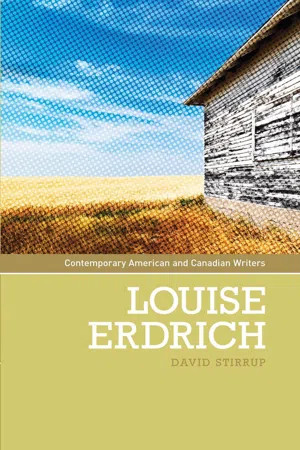
Louise Erdrich is one of the most critically and commercially successful Native American writers. This book is the first fully comprehensive treatment of Erdrich's writing, analysing the textual complexities and diverse contexts of her work to date. Drawing on the critical archive relating to Erdrich's work and Native American literature, Stirrup explores the full depth and range of her authorship.
Breaking Erdrich's oeuvre into several groupings - poetry, early and late fiction, memoir and children's writing - Stirrup develops individual readings of both the critical arguments and the texts themselves. He argues that Erdrich's work has developed an increasing political acuity to the relationship between ethics and aesthetics in Native American literatures. Erdrich's insistence on being read as an American writer is shown to be in constant and mutually-inflecting dialogue with her Ojibwe heritage.
This sophisticated analysis is of use to students and readers at all levels of engagement with Erdrich's writing.
- 246 pages
- English
- ePUB (mobile friendly)
- Available on iOS & Android
eBook - ePub
Louise Erdrich
About this book
Information
1
Native American literature: authorship and authority
A review of Louise Erdrich’s Four Souls (2004) in the Christian Science Monitor speaks, albeit somewhat glibly, to the centrality of her position in the general public’s reception of modern Native American issues: ‘[f]or better or for worse, most white people have two popular avenues of contact with Native Americans: casino gambling or Louise Erdrich. My money’s on Erdrich, with whom the odds of winning something of real value are essentially guaranteed’ (Charles 2004).1 Carelessly, perhaps unconsciously, Charles rehearses one of the major controversies surrounding Erdrich’s work. He elides the stock of questions and anxieties that accompany its popularity. The notion that the Native American ‘experience’, however this might be constituted or perceived, is ‘diluted’ and unrealistic, for instance, or that the Native American ‘angle’ is thematised – a conceit, a device, or a token to attract a particular readership – are common concerns around Erdrich’s work. So too is the sense that the accessibility and/or popularity of the work (comparable to Toni Morrison, Amy Tan, or Anne Tyler) either causes, or illustrates, its apoliticism, making it ‘unuseful’ to Native American political issues. Clearly these anxieties cannot be ignored, and I will return to them at the end of this chapter. But Charles’s emphasis on questions of race and ‘access’ to culture overshadow a far simpler yet significant point: that in reading Erdrich, ‘something of real value is essentially guaranteed’.
That ‘something of value’ is, fundamentally, literary. In his provocative Native American Fiction David Treuer closes his searching – and at times scathing – critique of critical approaches to Love Medicine (1984; 1993) by asserting that Erdrich’s first novel is ‘so beautiful, so powerful, and so new, it is hard not to try and beatify it. But to make it divine … is to destroy its humanity. To treat it as culture is to destroy it as literature’ (2006: 67–68). The power of Erdrich’s writing is, ultimately, what has garnered her numerous awards, including the National Book Critics Circle Award (for Love Medicine, 1984); an honorary doctorate from her alma mater, Dartmouth College (2009); the Anisfield-Wolf Book Award and a shortlisting for the Pulitzer Prize (for The Plague of Doves, 2009); and, most recently, the Kenyon Review Award for Literary Achievement (2009). In conjunction with the latter, Love Medicine became the subject of a number of events around The Big Read Knox County in October and November 2009. This culminated in numerous seminars and lectures on and around the book at the Kenyon Review Literary Festival, 4–7 November 2009, at which Erdrich gave the Denham Sutcliffe Memorial Lecture.
That kind of currency – the continuing significance of Love Medicine and others of Erdrich’s works – is also demonstrated in the critical archive, which continues to devote a deal of attention to her work. A glance at the programmes for the 2009 Native American Literature Symposium (Chicago, 26–28 February) and the 2009 meeting of the Native American and Indigenous Studies Association (Minnesota, 21–23 May), records five individual papers, more than any of the other ‘majors’ in Native American literature – N. Scott Momaday, Leslie Marmon Silko, James Welch, Gerald Vizenor (whose work was the subject of a special panel at NAISA), Louis Owens, or Sherman Alexie. There are many reasons why critics might be choosing to stay away from any of the more widely written about figures, of course, and two conferences in a single year hardly provides persuasive statistics. My point is simply this: that Erdrich’s writing has commanded, and continues to command, an abundance of critical and scholarly, not to mention commercial, interest.
Beyond the problematic layers of appeal implicit in Charles’s comments, Erdrich’s prose in particular has long elicited abundant praise. A recent review of The Plague of Doves declares: ‘Of all the fictional hamlets American writers have planted, from William Faulkner’s Yoknapatawpha County to Garrison Keillor’s Lake Wobegon, the most complex, luminous place yet might be a little town called Argus, North Dakota’ (Freeman). Comparisons with Faulkner in particular are common and, although Erdrich’s prose can be prone to decadence at times, not unwarranted. Her fiction’s lyrical qualities and richly textured characters and textual landscapes are the dominant objects of praise, in recognition that here is a body of literature that combines irony and pathos, complexity of plot and sophistication of language, deft narrative turns and searching philosophical and ethical conundrums. Many critics have declared her to be among the most important late twentieth-/early twenty-first-century Native American writers, while P. Jane Hafen (Taos Pueblo) comments that her work manifests ‘a Chippewa experience in the context of the European American novelistic tradition’ (1999b). It is ultimately that ability to depict what many understand as ‘Chippewa experience’, while innovatively embracing the ‘European American novelistic tradition’ – to successfully navigate the ‘betwixt and beween’ – that is at the root of her success.
It is, however, not simply Erdrich’s prose that impresses, and not merely the subject matter of her work that crosses ‘boundaries’. Indeed there are few prominent Native American writers who have confined themselves to single genres within their writing. James Welch (Blackfoot) springs initially to mind, but then he, a highly significant novelist who inspired many including Erdrich, was also a poet. D’Arcy McNickle (Flathead) is as renowned for his political work as his fiction. N. Scott Momaday (Kiowa) and Leslie Marmon Silko (Laguna Pueblo) are well known for combining genres. The intermixing of poetry and prose, oral tales, fiction, autobiography, and photography enhances the essential drama of their work. Sherman Alexie (Spokane/Coeur d’Alene) is as prolific a poet as he is a successful prose writer, and has more recently ventured into screenplay and film direction. Paula Gunn Allen (Taos Pueblo) and Elizabeth Cook-Lynn (Dakota) are poets and, along with Louis Owens (Choctaw), academics and novelists; fellow scholar Craig Womack (Creek/Cherokee) followed up his incisive study of tribal literary nationalism, Red on Red (1999), with a novel, Drowning in Fire (2001), dramatising at least some of the critical work’s key concerns.
Erdrich is comfortably at home in this list. She is also situated in a rich and vibrant tradition of Anishinaabe writing. Like a number of fellow Anishinaabeg – Gerald Vizenor, Kimberly Blaeser, David Treuer, Gordon Henry, Jr. to name a few – she is equally productive, her output impressively diverse, although unlike them she has not ventured into the world of scholarly criticism. In her novels, in the stories that were their genesis, and through her poetry, children’s fiction, memoirs, and prose essays, Erdrich has been both commercially and critically successful since the first publication of Love Medicine.2 Just as she refuses to be confined to genre in her practice, the critical domain seems equally at ease approaching Erdrich’s fiction from a variety of angles, and with multiple perspectives and conclusions. This book is an attempt to engage with the full span of that output. Drawing out historical and culturally specific readings through the theoretical methodologies offered by both indigenous and postcolonial theories; the apparatus of feminism, postmodernism, and, in a minor way, regionalism, this chapter will very briefly map out the critical platform upon which the scholarly archive relating to Erdrich’s work is built. In doing so, it will consider Erdrich’s work in relation to Native and American concerns, and in relation to the multiple influences Erdrich has both drawn from and created in her own writing. These various themes and contexts are often inextricable; to take them together is invariably to consider what it means to understand Erdrich, in her own words, as an American author.
A ‘Chippewa landscape’?
Legally designated as Chippewa in the United States, the word ‘Ojibwe’ is a term that has been used at least since the early nineteenth century and is variously interpreted as referring to the ‘peculiar sound of the Anishinabe voice’ according to Henry Rowe Schoolcraft (Vizenor 1993: 133); to the puckered seam of the Ojibwe moccasin (Vizenor 1998a: 18, qty Copway); to the practice of torturing enemies with fire – literally, roasting until puckered (Warren 1984: 36); and to the practice of lodge building (Pheasant 2007). Both Vizenor and Warren recount the first three possibilities, while the former also suggests ‘Chippewa’ is, ironically, a mishearing by a US official of that first misnomer. The historical term of self-definition among the Ojibwe is Anishinaabe, true also of their close allies the Ottawa and the Pottawattamii.
Much criticism focuses on those geographical, cultural, and environmental factors that most clearly and vividly inform Erdrich’s ideas. In this respect, a consideration of Erdrich as a Midwestern writer is a striking absence in Erdrich scholarship, and will be touched on in later chapters. Native ‘reinvestment’ of territories resists and even unbinds the archetypical narratives of the Midwestern canon, challenging its pastoral nostalgia with a far deeper sense of emplacement.3 Importantly, Foster (Anglo-Creek) defends the possibility of reading both within tribal specific and regional frameworks, particularly where that combination stands to alter those conventional concepts of region that serve the US national narrative (2008). Through most of Erdrich’s oeuvre, the converging and conflicting historical and contemporary narratives of Natives and settlers are played out against the localised landscape of the Great Plains. As Foster argues: ‘historically and theoretically astute regionalism … allows us to mediate and engage the claims of … very different speakers and their positions against and in dialogue with one another. Thus engaged, we can understand the relation between Native and America in a way that privileges the local and the tribal’ (2008: 268). The Chippewa Landscape of Louise Erdrich (Chavkin 1999), in title and in spirit, gestures towards such tribal, regional, and national paradigms. However, such treatments often seem to forget the constructedness of that ‘Chippewa landscape’, presenting a limiting, at times phantasmal, view of tribal culture and skirting around the transposed cartography of its evolution. Beyond avoiding their own function in the abstraction of cultural material to mapped space, they often also fail to take account of the historical processes that differentiate the Plains Ojibwe (or Bungee) from other groups, while ignoring the fact that Erdrich’s reservation is not, for instance, a singular representation of the Turtle Mountain Reservation (see e.g. Maristuen-Rodakowski 2000). It is in fact an amalgamation of the geography, demographics, and histories of several North Dakotan and Minnesotan reservations (including Turtle Mountain, White Earth, and Leech Lake), while the landscape Erdrich describes is highly evocative of the landscape of western Minnesota, around Little Falls, where she was born. Foster’s model surely demands the full exploration of such nuances.
A number of critics explicitly make this connection between the landscapes, peoples, and memories portrayed in Erdrich’s work and the work itself. Hafen, for instance, writes that ‘Erdrich has created a vision of the Great Plains that spans the horizon of time and space and ontologically defines the people of her heritage’ (2001a: 321). This ‘vision’ is one that finds its origins in the ‘Ojibwe country’ of the Great Lakes region, particularly in Madeline Island on Lake Superior (The Birchbark House, The Game of Silence, The Porcupine Year and Books and Islands) before tracing the remapping of Ojibwe territories on the plains through serial political historical processes. Not the least of these was the appropriation of land and the corralling of Native peoples on reservations, throughout the course of the eighteenth and nineteenth centuries.
Larson refers to the ‘eighty-six million acres of North American real estate’ appropriated by successive US governments, particularly through the Dawes Severalty (or General Allotment) Act (1887), described by Theodore Roosevelt as ‘a mighty pulverizing engine to break up the tribal mass’ (Larson 1997: 567, 573). Allotment was one of the most effective post-reservation mechanisms for containing the threat of tribal sovereignty and delivering land to settlers. Hastened by the Nelson Act (1889), it divided Native lands into parcels of up to 160 acres handed out to individual enrolled members of reservation bands and initially placed in government trust for twenty-five years. The general aim – to encourage individuals to farm, eventually removing the need for reservations and smoothly assimilating these communities into hegemonic society – also created vast areas of unattributed land ripe for settlement. Adding insult to injury, the Clapp Rider, Steenerson Act (1904) and second Clapp Rider (1906) removed many of the trust restrictions on sale of resources for mixed-bloods, especially timber.
Erdrich’s chronologies begin in Tracks in the post-reservation moment at the close of the nineteenth century, thrusting us into the consumption epidemic of 1912. Following on from ‘spotted sickness’ (smallpox) this episode of ‘sweating sickness’ (consumption, or tuberculosis) coincides precisely with the end of the initial twenty-five-year allotment period and its varied legacy (Onion 2006). From the liquidation of forestland, a modern history of timber scandals on reservations, through the wholesale loss of tribal landholdings (from 138 million acres to 47 million acres across the US between 1887 and 1934), to factionalism and displacement, allotment tore great holes through already severely diminished homelands (Debo 1995: 330). The White Earth Land Settlement Act (WELSA) of 1986, which retroactively approved what many activists such as Winona LaDuke still hold to be illegal land sales, merely ensures the persistence of White Earth members’ struggles to reclaim reservation lands (see Suzack 2008).
The outcome of a treaty of March 1867, White Earth is the most notorious of Ojibwe reservations in relation both to its establishment and historical conflict within its population. Serious opposition to the desire to concentrate Minnesota Ojibwe at White Earth came, among others, from the Pillagers of Leech Lake, a conservative people who, in 1898, instigated the last uprising against government policies (Vecsey 1983: 18).4 They did eventually relocate, settling on the outer edges of the landbase, but factionalism indirectly became characteristic of the early reservation, with widely dispersed and relatively disparate communities forming throughout the territory (Meyer 1994). Adaptation of cultural practices included the influence of Christianity, and with the establishment of missions and churches in the area, the most influential of which were the Roman Catholics and the Episcopalians, denominational conflict was initially a characteristic of the developing factionalism. While councils democratically made decisions, there existed no coercive control on the reservation:
ethnic differences marked the genesis of community relationships at White Earth as reflected in settlement patterns, social and religious affiliations, household sizes, and surname frequency. The terms ‘mixed-blood’ and ‘full-blood’ were used to distinguish between ethnic groups and became politicized as disagreement over management of reservation resources escalated. (Meyer 1994: 5)5
Complicit in reinforcing ‘ethnic’ difference, allotment provided the test case for the development of blood quantum, a means of assessing validity of individuals’ claims to tribal membership. McNally notes:
A particularly insidious aspect of White Earth’s dispossession was the prominent role played in it by the nation’s leading physical anthropologists. In the 1910s, Ales Hrdlicka and Albert Jenks were summoned to settle investigations of fraud in land sales by scientifically determining the blood quantum of White Earth residents … Equipped with samples of hair and calliper measurement of skulls, the scientists dismissed half the fraud claims, determining that four hundred claimants had been of ‘mixed blood’ after all and therefore were unprotected by the trust clause of the legislation. In many cases, these findings completely disregarded the testimony that claimants themselves made concerning their family trees. (2000: 85–86)
Successful mixed-blood farmers and merchant traders such as Gus Beaulieu were set to make a fortune at the expense, many thought, of the conservative Anishinaabeg who began making moves to remove mixed-bloods, and their trade, from the reservation.6
Dispossession also came to the Turtle Mountain Band of Chippewa. Having already ceded 10 million acres of wheat land to the federal government, the reservation was ‘cut in 1884 to two six-mile square townships of untillable brush-covered hills’ (Debo 1995: 354). Allotment led to serious overcrowding and poverty: despite the dispersal of lands throughout the Dakotas and in Montana the people did not want to leave. Movement to the plains occurred around the turn of the eighteenth century when, benefiting from their close relationship with French and British fur traders, the Ojibwek were able to use guns and horses in the taking of territories and monopolising of trade in these areas. From the Pembina settlement on the Red River (North Dakota), large groups of Ojibwe hunters used the river network to clear the land of game. By around 1807, the land depleted, most of these Ojibwek returned eastward, with the exception of the Mikinak-wastsha-anishinabe, a band that chose instead to remain in the Pembina area and eventually to settle in the Turtle Mountains.
Turtle Mountain Reservation was established as a community of Ojibwe, Cree, and Métis, already in turmoil, and already suffering from poverty and harsh conditions:
In the mid 1880’s, there were severe winter storms and summer droughts. This harsh weather caused many pioneer farms to fail in the Great Plains areas. The influx of Métis from Canada following the second Riel Rebellion caused an overcrowding of the two townships. These circumstances took their toll and in the winter of 1887–88, 151 members of the Turtle Mountain Band of Chippewa starved to death. (Turtle Mountain Chippewa 1997)7
Undermining the hereditary chief, Little Shell III, the McCumber commission of 21 September 1892 oversaw the cession of land at 10 cents an acre with insufficient provision made for food and education; the result of a power struggle between Little Shell and the government-appointed Red Thunder (Turtle Mountain Chippewa 1997).8 The residents of Turtle Mountain were also as susceptible to national and international events as any rural community. Despite its isolation, the reservation provided soldiers in the First World War, for instance. Under Franklin Roosevelt’s presidency the Indian Reorganization Act (1934) restored a certain level of self-governance to tribes, while the Works Progress Administration (1935), established to rebuild communities stricken by the Great Depression, brought renewed hope:
Accustomed to continuous poverty, struggle, and hunger, the impact [of the depression] on Turtle Mountain was not as severely felt. Hard-working and resourceful people, the Chippewa adopted farming and gardening. … [The WPA] program offered many economic options for the Turtle Mountain Band of Chippewa. … Some felt the depression was a blessing for tribal members because it opened up job opportunities through the WPA. (Turtle Mountain Chippewa 1997)
Among other effects, the Indian New Deal and the WPA brought many of the tribal members who had left after allotment back to the reservation, although the seasonal nature of t...
Table of contents
- Cover Page
- Title Page
- Copyright Page
- Contents
- Series editors’ foreword
- Acknowledgements
- Abbreviations
- 1 Native American literature: authorship and authority
- 2 ‘I thought I would be sliced in two’: towards a geocultural poetics
- 3 Spatial relations: the Love Medicine tetralogy and Tales of Burning Love
- 4 From the cities to the plains: recent fiction
- 5 The writer’s brief: collaboration, (auto)biography, and pedagogy
- 6 Conclusion? Tradition, translation, and the global market for Native American literatures
- Bibliography
- Index
Trusted by 375,005 students
Access to over 1.5 million titles for a fair monthly price.
Study more efficiently using our study tools.
Frequently asked questions
Yes, you can cancel anytime from the Subscription tab in your account settings on the Perlego website. Your subscription will stay active until the end of your current billing period. Learn how to cancel your subscription
No, books cannot be downloaded as external files, such as PDFs, for use outside of Perlego. However, you can download books within the Perlego app for offline reading on mobile or tablet. Learn how to download books offline
Perlego offers two plans: Essential and Complete
- Essential is ideal for learners and professionals who enjoy exploring a wide range of subjects. Access the Essential Library with 800,000+ trusted titles and best-sellers across business, personal growth, and the humanities. Includes unlimited reading time and Standard Read Aloud voice.
- Complete: Perfect for advanced learners and researchers needing full, unrestricted access. Unlock 1.5M+ books across hundreds of subjects, including academic and specialized titles. The Complete Plan also includes advanced features like Premium Read Aloud and Research Assistant.
We are an online textbook subscription service, where you can get access to an entire online library for less than the price of a single book per month. With over 1.5 million books across 990+ topics, we’ve got you covered! Learn about our mission
Look out for the read-aloud symbol on your next book to see if you can listen to it. The read-aloud tool reads text aloud for you, highlighting the text as it is being read. You can pause it, speed it up and slow it down. Learn more about Read Aloud
Yes! You can use the Perlego app on both iOS and Android devices to read anytime, anywhere — even offline. Perfect for commutes or when you’re on the go.
Please note we cannot support devices running on iOS 13 and Android 7 or earlier. Learn more about using the app
Please note we cannot support devices running on iOS 13 and Android 7 or earlier. Learn more about using the app
Yes, you can access Louise Erdrich by David Stirrup in PDF and/or ePUB format, as well as other popular books in Literature & Literary Biographies. We have over 1.5 million books available in our catalogue for you to explore.