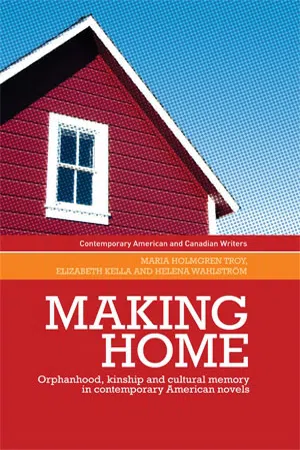
Making home explores the figure of the orphan child in a broad selection of contemporary US novels by popular and critically acclaimed authors Barbara Kingsolver, Linda Hogan, Leslie Marmon Silko, Marilynne Robinson, Michael Cunningham, Jonathan Safran Foer, John Irving, Kaye Gibbons, Octavia Butler, Jewelle Gomez and Toni Morrison.
The orphan child is a continuous presence in US literature, not only in children's books and nineteenth-century texts, but also in a variety of genres of contemporary fiction for adults. Making home examines the meanings of this figure in the contexts of American literary history, social history and ideologies of family, race and nation. It argues that contemporary orphan characters function as links to literary history and national mythologies, even as they may also serve to critique the limits of literary history, as well as the limits of familial and national belonging.
eBook - ePub
Making home
Orphanhood, kinship and cultural memory in contemporary American novels
- 254 pages
- English
- ePUB (mobile friendly)
- Available on iOS & Android
eBook - ePub
Making home
Orphanhood, kinship and cultural memory in contemporary American novels
About this book
Information
1
Orphans and American literature: texts, intertexts, and contexts
The word ‘orphan’ suggests being cut off from society, abandoned and alone; its opposite conjures visions of family, connectedness, roots, belonging – all subsumed in the image of home. (Porter, 2003: 101)
Orphans in contemporary US novels gain significance in relation to earlier American literature and the history of orphanhood in the USA. This chapter therefore situates our study in both literary and socio-historical contexts, focusing on earlier discussions of the American orphan figure in literary and social history and elaborating especially on literature as cultural memory. We trace the central position of orphans in nineteenth-century American literary history as it has been constructed in the twentieth century; orphans have played major roles in a dominant white male tradition in criticism, but also in gendered and ethnic challenges to that tradition. Previous critical discussion of orphans typically focuses on children’s literature, or on nineteenth-century literature, but nevertheless offers useful insights into the historically shifting roles and cultural work of orphan characters, linked to social and political developments in the USA. We also address ideas of the orphan, childhood, and family, and how these ideas operate in social and academic debates over multiculturalism, the US canon, and national belonging. These contexts are an important basis for our subsequent analyses of orphanhood, kinship, and cultural memory in contemporary American novels featuring Native American, Euro-American, and African American orphans.
Orphans, literature, and cultural memory
‘[R]emembering the past’ is not just a matter of recollecting events and persons, but often also a matter of recollecting earlier texts and rewriting earlier stories. (Erll and Rigney, 2006: 112)
Novels are multifaceted sites of cultural memory – through their employment of genres, their relation to a national literary canon, and their intertextuality. Pierre Nora’s concept of ‘sites of memory’ is useful for examining how textual and material places become a focus of collective remembrance as well as of historical meaning. Such an emphasis on processes in the constitution, maintenance, development, and shifts in these sites of memory supports our view of individual novels as dynamic arenas for the transmission of cultural images and knowledge, for creative revisions of history and identity, and for visions for the future.
As a carrier and shaper of dominant cultural memory as well as counter-memory,1 literature both reflects and influences constructions of national and group identities. Following the new social movements of the 1970s and subsequent changes in the academic and cultural fields, scholars and intellectuals have criticized ‘official’ US history as a skewed (mis)representation of the past, serving to characterize particular groups as inferior, insignificant, or making them invisible. The work of recovering, restoring or (re)creating ‘alternative’ histories has become a priority. Literature plays a pivotal role in these endeavors, as can be seen, for instance, in the works of Linda Hogan, Jewelle Gomez, and Toni Morrison that we examine here. In this context, novels may help shape the collective memory of groups, and also challenge or renegotiate the collective memory of the nation. Indeed, as Barbara Misztal summarizes, ‘Collective memory is not only what people really remember through their own experience, it also incorporates the constructed past which is constitutive of the collectivity … Thus, the notion of collective memory refers both to a past that is commonly shared and a past that is collectively commemorated’ (2003: 13). Importantly then, collective memory consists of historical knowledge as well as ‘experience, mediated by representation of the past, that enacts and gives substance to a group’s identity’ (ibid.: 15, emphasis added), whether this group is conceptualized as the family, the ethnic community, the nation, or a transnational alliance. The term ‘rememory,’ coined by Toni Morrison in Beloved (1987), signals precisely this blend of psychological memory and cultural remembrance, and has since been linked to intertextuality and the ‘replaying of selected images’ to realize ‘an imaginative recovery of the historical past’ (Mitchell, 2002: 12).2
Works of literature instantiate cultural remembrance through the use of intertextuality. As Astrid Erll and Ann Rigney note, the recollection of texts from earlier periods can be an integral part of cultural remembrance and discussions of canon formation can be ‘revisited as exemplifying the ways in which societies squabble over which foundational texts deserve commemoration or not’ (2006: 112). Making Home focuses on the period from the 1980s through the early twenty-first century, a period marked by fierce struggles over the racialized and gendered biases of the literary canon. The novels in this study do engage with canonical works, but also with particular critical traditions. In Chapter 3 we pay specific attention to the development of US literary-critical traditions as a form of cultural memory to which novelists have recourse. Intertextuality – which can be thought of as a means to maintain cultural memory, even when it functions to express criticism of earlier texts – is explored throughout the study. We foreground the ways contemporary novels implicitly or explicitly ‘remember’ earlier texts: critically, nostalgically, or ambivalently. Our investigation also responds to Shelley Fisher Fishkin’s call for criticism that addresses how issues like ‘influence, exchange, appropriation, “homage,” intertextual dialogue, “signifying,” “capping,” borrowing, theft, synergy, and cross-fertilization’ (1995: 455) are used to write contemporary texts across different racial and ethnic categories.
The novels examined in Making Home employ a number of different genres, including the captivity narrative, the bildungsroman, speculative fiction, and the historical novel.3 That these fictions refer to, or revisit, other written texts or oral traditions raises questions about the role of genre as a medium of cultural remembrance. Genres play a crucial part in the mediation of situations and events, as these are remembered over time, and may achieve a near mythical force, as can be seen, for instance, in the case of the captivity narrative in US culture. Bakhtin argued that genres are form-shaping ideologies, with both aesthetic and ideological dimensions. We find that in the genres considered, orphan figures have a strong effect on ideological meanings, but also on aesthetic ones, not least in the manner in which memory is narrated and thematized.
Our selection of novels foregrounds memory and remembrance in the characterization of orphan protagonists and, sometimes, in the structure of the narration. Literary orphans, like real orphans, have different degrees of access to one form of collective memory: familial memory.4 Some of the orphans in the novels that we investigate suffer from lack of knowledge, or from trauma or amnesia, which blocks or limits access to memories of their own or their family’s past, as in Hogan’s Solar Storms, Marilynne Robinson’s Housekeeping, Jonathan Safran Foer’s Extremely Loud and Incredibly Close, Kaye Gibbons’s Ellen Foster novels, Octavia Butler’s Fledgling, and Morrison’s A Mercy. Acts of individual remembrance are arguably most distinctly represented in the novels with a first-person narrator-protagonist, but memory and its links to history are explored in all the novels.5
Orphans in American literary history and criticism
Images of orphanhood have pervaded the American imagination ever since the colonial period … [W]hatever shape the orphan assumes, the figure signals identity formation, not only individual but cultural. (Pazicky, 1998: xi)
Many investigations of orphans in fiction focus on children’s literature, and on white orphan heroines and heroes from Rose Campbell in Louisa May Alcott’s Eight Cousins, or the Aunt-Hill (1875) and Mark Twain’s Tom Sawyer (1876) to Lemony Snicket’s Baudelaire orphans in A Series of Unfortunate Events (1999–2006). Most literary analyses of orphans, though, focus on the late nineteenth and early twentieth century. Scholarship to date demonstrates not only that ‘the displaced child is an omnipresent rhetorical trope in American writing of this period’ (Nelson, 2003: 5), but also that the orphan in children’s literature performs certain kinds of cultural work – emotional, social, political – that shift over time.
In the late nineteenth century, the orphan’s function is often didactic, facilitating the production of lessons about proper middle-class values, or good citizenship. The orphan is an apt figure for teaching moral lessons to the young. Classic American children’s books advocate ‘positive thinking, and redemption through naivitë’ (Griswold, 1992: 19), and orphan protagonists, from Horatio Alger to Superman, ‘exude competence, decency, and a near magical ability to fulfill society’s needs’ (Nelson, 2001: 54–5).6 The positive characteristics of the orphan child – especially the male orphan child – are personality traits that resonate with nationalist myths of individualism and self-creation.
Nevertheless, orphans in children’s literature are not static but flexible, and scholars have linked representations of orphans to shifting cultural perspectives on childhood and dependency. They relate these representations to social reform and institutional concern with child welfare, to the production of responsible citizens, or to shifts in conceptions of the child’s social role.7 Claudia Nelson observes that in the nineteenth century ‘the figure of the self-sufficient orphan who earns by honest toil all the benefits he receives from his parents embodies the sturdy independence and the upward mobility that Victorian America persistently valorized’ (2006: 83). The meanings of orphan figures change between the late nineteenth century, when children helped expand the labor capacity of a family, and the early twentieth century, when they fulfilled the emotional needs of adults. In this latter period, Nelson summarizes, the orphan’s ‘proper “work” was presented as the spiritual and emotional uplift of adults’ (2003: 7), but there was also an ‘increased interest in the desires and feelings of the young’ (2001: 55).8
The orphan in nineteenth-century children’s literature has also been analyzed in terms of the character’s function as social and political critique. Critics have shown how literary orphans underscore society’s failure to provide for parentless and poor children or demonstrate the arbitrary and unequal distribution of the benefits of familial belonging (Harde, 2008: 65–6; Nelson, 2001: 54). In early twentieth-century books, representations of orphans from the past were used to reassure contemporary readers ‘that even when children’s lives are changed in fundamental and dramatic ways, love will be present’ (Nelson, 2006: 81). In her readings of more recent fictions featuring internationally adopted children and children of divorced parents, Nelson foregrounds two major functions of the orphan child character: the emotional work to reassure and love, and the political work to incorporate these children into conceptions of American family.
Orphans have also played a major role in a dominant tradition of literary criticism as well as in challenges to that tradition. In this context, there are two significant strands that feature the Euro-American orphan, with which the contemporary novels that we examine engage. In one strand, the orphan is male; it includes many works by male writers that were canonized at the beginning of the twentieth century. The other strand centers on a female orphan and includes novels written by women writers that were suppressed, forgotten, or disparaged from the end of the nineteenth century until well into the second half of the twentieth when they were re(dis) covered by feminist critics. In both of these literary traditions, the orphan confirms and promulgates pivotal American values such as individual agency and pluck. A greater emphasis often lies, however, on individualism and on escapes from the constraints of middle-class family life in the stories of the male orphan.
The male orphan in nineteenth-century American fiction carries meanings closely linked to ideas about American national identity. In a comparative reading of Great Expectations (1861) and Adventures of Huckleberry Finn (1884), Hana Wirth-Nesher observes that although orphans abound in British fiction, their connotations are different from those of American orphans: ‘While English literature has no shortage of orphans, they are usually on a quest to find a place for themselves in society rather than arranging for a romantic exit’ (1986: 261). Like many critics, then, she links American boy orphans – the epitome being Huckleberry Finn – to resistance against family, and a reinforcement of individualism. From Huck onwards, fictional orphan boys have been positioned in opposition to family as well as ‘sivilization,’ rather than moving towards their ‘right’ family. In Chapters 3 and 4, we explore how Foer’s and John Irving’s boy protagonists challenge this traditional image of the male American orphan.
In Twain’s novel, Huck’s freedom takes shape in direct and telling contrast to Jim’s enslavement, demonstrating how the freedom essential to American identity is a privilege of race as well as gender. Many critics, including Toni Morrison in Playing in the Dark (1992), have demonstrated how American national identity depends upon ideological connections between whiteness and freedom. Hence, in what is considered classic nineteenth-century American literature, the male orphan child is white, and his whiteness is a condition for his representativeness as an archetypal American within the context of a racist culture. Diana Loercher Pazicky highlights and problematizes this connection between male orphanhood, race, and national as well as personal identity, in her discussion of Frederick Douglass’s autobiographies: ‘[these] accounts begin by linking the separation from his family to various forms of dehumanization. Slavery not only made Douglass an orphan but robbed him of a personal and historical identity’ (1998: 180). She characterizes Douglass’s development as one from ‘orphanhood to self-fatherhood’ (ibid.: 186). While separation from family is cast in very different terms for the enslaved black orphan than for his free white literary counterpart, Douglass’s self-fatherhood is an important aspect of American masculinity.
The male orphan thus reinforces ideas about a specifically American masculinity,9 and the white male orphans in the nineteenth-century literary canon can be read as embodying masculine ideals constitutive of national identity. Natty Bumppo, Ishmael, and Huck Finn, although by no m...
Table of contents
- Cover
- Half Title Page
- Title Page
- Copyright Page
- Contents
- Series editors’ foreword
- Acknowledgments
- Introduction
- 1 Orphans and American literature: texts, intertexts, and contexts
- 2 From captivity to kinship: Native American orphans and sovereignty
- 3 Literary kinships: Euro-American orphans, gender, genre, and cultural memory
- 4 Family matters: Euro-American orphans, the bildungsroman, and kinship building
- 5 At home in the world? Orphans learn and remember in African American novels
- Coda
- Bibliography
- Index
Trusted by 375,005 students
Access to over 1.5 million titles for a fair monthly price.
Study more efficiently using our study tools.
Frequently asked questions
Yes, you can cancel anytime from the Subscription tab in your account settings on the Perlego website. Your subscription will stay active until the end of your current billing period. Learn how to cancel your subscription
No, books cannot be downloaded as external files, such as PDFs, for use outside of Perlego. However, you can download books within the Perlego app for offline reading on mobile or tablet. Learn how to download books offline
Perlego offers two plans: Essential and Complete
- Essential is ideal for learners and professionals who enjoy exploring a wide range of subjects. Access the Essential Library with 800,000+ trusted titles and best-sellers across business, personal growth, and the humanities. Includes unlimited reading time and Standard Read Aloud voice.
- Complete: Perfect for advanced learners and researchers needing full, unrestricted access. Unlock 1.5M+ books across hundreds of subjects, including academic and specialized titles. The Complete Plan also includes advanced features like Premium Read Aloud and Research Assistant.
We are an online textbook subscription service, where you can get access to an entire online library for less than the price of a single book per month. With over 1.5 million books across 990+ topics, we’ve got you covered! Learn about our mission
Look out for the read-aloud symbol on your next book to see if you can listen to it. The read-aloud tool reads text aloud for you, highlighting the text as it is being read. You can pause it, speed it up and slow it down. Learn more about Read Aloud
Yes! You can use the Perlego app on both iOS and Android devices to read anytime, anywhere — even offline. Perfect for commutes or when you’re on the go.
Please note we cannot support devices running on iOS 13 and Android 7 or earlier. Learn more about using the app
Please note we cannot support devices running on iOS 13 and Android 7 or earlier. Learn more about using the app
Yes, you can access Making home by Maria Holmgren Troy,Elizabeth Kella,Helena Wahlstrom,Elizabeth Kella,Helena Wahlstrom in PDF and/or ePUB format, as well as other popular books in Literature & Early Modern History. We have over 1.5 million books available in our catalogue for you to explore.