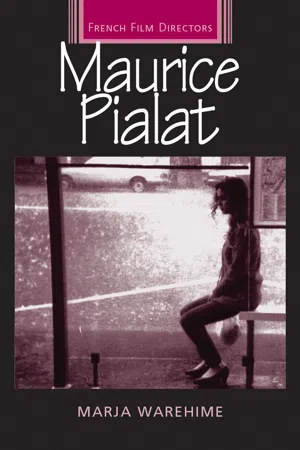
One of the most gifted directors of the post New Wave, Maurice Pialat is frequently compared to such legendary filmmakers as Jean Renoir and Robert Bresson. A quintessentially realist filmmaker, who, like Bresson, was also trained as a painter, Pialat's particular form of realism influenced an entire generation of young filmmakers in the 1990s.
This volume is the first book-length study of Pialat's cinema in English. It provides an introduction to a complex and difficult director, who saw himself as a marginal and marginalised filmmaker, but whose films are deeply rooted in French society and culture. Pialat was long considered the only major filmmaker to portray 'la France profonde', the heart of France - the people who, as he put it, 'take the subway'. Taken as a whole, Pialat's work can be seen both as an oblique autobiography and the portrait of a fundamental institution - the family - over several generations.
- 182 pages
- English
- ePUB (mobile friendly)
- Available on iOS & Android
eBook - ePub
Maurice Pialat
About this book
Information
1
Introduction: Maurice Pialat, the outsider
To call Maurice Pialat a ‘marginal du centre’ (literally a ‘central marginal figure’, a pivotal or influential outsider) – as Cahiers du cinéma did in 1983 – suggests the contradictions of Pialat’s career and sums up the difficulties of categorising the work of one of the most important and idiosyncratic figures of the post New Wave (Bergala 1983: 20). Pialat’s work inspires comparison with such legendary figures as Jean Renoir and Robert Bresson, yet he does not have the international reputation one might expect, given his gifts as a director and his importance in French cinema history. Pialat’s death in 2003 inevitably situated him as a filmmaker of the 1980s, the decade in which his work began to receive serious critical attention and attract a broader public. Yet by 1983, when A nos amours won the prestigious Prix Louis Delluc and the César for best film, he had been making films for over twenty years.
That is not to say that his work has lacked either critical acclaim or official recognition. His first court métrage, the documentary L’Amour existe, won both the Prix Louis Lumière in 1961 and an award at the Venice Film Festival; his first full-length film, L’Enfance nue, won the Prix Jean Vigo in 1969. In 1972, Jean Yanne received the César for best actor in Pialat’s first commercial success, Nous ne vieillirons pas ensemble. After A nos amours came out in 1983, the newspaper Libération proclaimed ‘Pialat est grand’ (Pialat is great). In 1987 Pialat was awarded La Palme d’or (Golden Palm), the ultimate recognition given at Cannes, for his adaptation of Georges Bernanos’s novel Sous le soleil de Satan, starring Sandrine Bonnaire and Gérard Depardieu. His last major film, Van Gogh, was one of only two French entries in competition for the Palme d’or in May of 1991. The film was also nominated in twelve other categories and brought Jacques Dutronc the César for best actor. Joël Magny, who wrote the first (and for many years, only) important book-length appraisal of Pialat’s work in French, judged Van Gogh to be ‘incontestablement une des œuvres majeures du cinéma français des vingt dernières années’1 (Magny 1992: 9).
Nonetheless, Pialat never became a popular director like Renoir or François Truffaut and – despite being of Truffaut’s generation – he was unable to launch his career during the vogue for young directors that followed the early successes of the New Wave. Truffaut came to his rescue and financed the completion of L’Enfance nue in 1968, but Pialat’s difficulties in obtaining adequate financing ultimately limited his ability to make films. His output, for a major director, is far closer to that of Robert Bresson than Truffaut or the even more prolific Chabrol. Pialat’s reputation rests primarily on ten full-length films (although this does not include La Maison des bois, ‘The House in the woods,’ a seven-part television series, unavailable at the time this was written).
Ironically, however, in 1998 when Cahiers du cinéma invited a number of young, gifted, and influential directors (Olivier Assayas, Claire Denis, Cédric Kahn and Noémie Lvovsky) to consider the importance of the Nouvelle Vague in the development of their work, the conversation veered off into a discussion of Maurice Pialat. Cédric Kahn insisted that ‘Ce sont les films de Pialat qui m’ont surtout impressionné. Je ne dois pas être le seul car il exerce une énorme influence sur tous les jeunes cinéastes … Pourquoi ne fait-il pas parti de la Nouvelle Vague, s’en est il toujours senti exclu?’2 (Assayas et al. 1998: 72). Filmmaker Arnaud Desplechin said much the same thing in an earlier interview with Antoine de Baecque and Thierry Jousse of Cahiers: ‘le cinéaste qui a l’influence la plus forte et la plus constante sur le jeune cinéma français, ce n’est pas Jean-Luc Godard mais Maurice Pialat’3 (De Baecque et al. 1996: 100).
Noémie Lvovsky inadvertently suggested one reason why Pialat never achieved the recognition given to New Wave directors when she remarked on the playfulness of New Wave films. The light-hearted moments in Truffaut’s films made her love the experience of seeing movies, going to the theatre, waiting for the lights to go down; seeing the images flickering on the screen. By contrast, Pialat’s films had such an emotional impact that they were intimidating: ‘je n’ai jamais autant eu l’impression de voir du désespoir, de l’amour ou de la haine, comme en bloc. Comme si [Pialat] pouvait vraiment toucher les sentiments que l’on peut connaître dans la vie’4 (Assayas et al. 1998: 72). The wrenching emotional power of Pialat’s work, its intelligence, the seriousness of its moral universe and its uncompromising rejection of conventional aesthetic and dramatic effects are difficult to reconcile with the notion of film as entertainment. In fact, it is one of the profound contradictions of Pialat’s career that he desired to be a truly popular filmmaker, but did not try to please. He made few concessions to popular tastes, deliberately treating difficult, even repellent subjects without glossing over their less attractive aspects, while his often highly fragmented narratives demanded a good deal of his viewer. In fact, despite his antipathy toward the academy, he was in many ways a filmmaker’s filmmaker, at times agonising over the smallest formal details of his work – even though, as an interviewer once reminded him, most people only saw a film once and would not notice them (Pialat 1992: 106). However, Pialat’s status as an outsider in French film history has almost as much to do with the filmmaker’s reputation as man and a director as with his films. As he himself pointed out, ‘quand on fait des œuvres violentes, dérangeantes, comment être sage comme une image?’5 (Pialat 1980: 9).
Pialat changed his image by growing a beard in the 1980s, but a photograph of him taken during the filming of Nous ne vieillirons pas ensemble in 1972 shows a clean-shaven man with strong features beneath a rebellious shock of dark hair, which fell like a fringe over his forehead. He faces the camera but looks away from it, half-scowling, his arms folded across his chest in a gesture both defiant and self-protective. Compactly built, stocky, he fits Gérard Depardieu’s description: ‘ce fils d’Auvergnat au cou de taureau et aux mains de forgeron … un vrai taureau de combat’6 (Depardieu 1988: 75, 94). However, Pialat’s interviews reveal an extremely vulnerable artist, self-critical and endlessly denigrating his work, impossible to reassure, uncertain about his talent and his achievements, but also angry and resentful that his work did not receive greater recognition.
If the name Pialat is not without significance to the French film-going public, it is partly because he acquired the reputation of a singularly difficult and demanding director, or to put it more bluntly, an emmerdeur (pain in the arse) who provoked and psychologically abused his actors and collaborators (De Baecque 1992: 51). ‘Tu avais l’art de toucher là où ça fait mal, d’inciser les névroses à vif, d’éclairer d’une lumière crue les faiblesses les plus soigneusement cachées. Chapeau!’, Gérard Depardieu wrote him some years after the filming of Loulou7 (Depardieu 1988: 7). However, during the filming he was furious with Pialat, declaring openly in an interview that ‘c’est de la merde ce qu’on fait. Quand je pense que les gens vont payer dix-huit mille balles pour voir ça!’8 (Gonzales 1985: 144). Depardieu was by no means the only one to complain, as Pialat frequently clashed with his leading male actors, or at least more frequently than his female leads. Although in the case of Sophie Marceau, the press reported that Pialat tortured her during the filming of Police, and she also adamantly declared that she would never work with him again (De Baecque 1992: 51).
Relationships with his writers and crew were also problematic: Pialat regularly complained about technicians in interviews, and sometimes went through a series of directors of photography and/or film editors on a single film. Four directors of photography were credited for A nos amours, along with seven film editors, and there were several directors of photography for Van Gogh (De Baecque 1992: 51). Pialat’s creative relationship with Arlette Langmann proved both productive and durable, but he ‘courted’ Catherine Breillat’s collaboration during the making of Loulou only to ‘break up’ with her (their differences were settled in court) during the filming of Police. However, Pialat’s reputation as an emmerdeur did not keep major actors and actresses from working with him. Sandrine Bonnaire, whom Pialat discovered while casting A nos amours, remained attached to him, claiming he was more like a member of her family than a director (Bonnaire 2003: 41). Perhaps the most balanced and revealing appraisal comes from Evelyne Ker, whose difficulties in playing the unflattering role of Bonnaire’s mother in A nos amours give her remarks particular credence.
On le présente comme un sadique, un bourreau. On m’avait dit: ‘tu vas vivre un enfer’. En fait, il ne faut pas exagérer. Car sur le tournage on s’amusait souvent beaucoup. Il y avait une grosse complicité et de grosses rigolades. Maurice Pialat, c’est vrai, a aussi besoin de psychodrame, de tension pour créer. Alors il y avait des affrontements. Selon ses angoisses, selon ses jours, il a sa tête de turc. Il faut qu’il se passe ‘quelque chose’ qui vienne des autres pour que le déclic chez lui fonctionne, sinon il s’ennuie, il tourne à vide. Mais quand c’est parti, c’est sans limite, c’est un moment de vie donné, il nous bouffe!9 (Pialat 1984: 152)
If Pialat’s reputation was partly a media creation and a convenient shelter for a complicated artist, his hostility to the film community contributed to his marginalisation, although clearly it did not keep him from commercial or critical success. In fact, as Antoine de Baecque points out, with four films (A nos amours, Police, Sous le soleil de Satan and Van Gogh), Pialat attracted over four million viewers – more viewers than all of the directors of the Nouvelle Vague put together (De Baecque 1992: 56).
The scandal of Cannes 1987
Perhaps one of the most telling moments in Maurice Pialat’s ongoing relationship with film and the French film-going public was the ‘scandal’ at Cannes over the attribution of the Palme d’or in 1987. Viewers watching television coverage of the 40th Festival on Antenne 2 would have seen Yves Montand, who was the head of the jury that year, standing centre stage, looking tired but elegant in a black tuxedo with a red carnation boutonnière. When Montand pronounced ‘la Palme d’or à l’unanimité à Maurice Pialat’ (‘The Golden Palm unanimously goes to Maurice Pialat’) there was applause, but mingled with shouts and whistles. As Pialat rose and made his way to the stage, a man in the audience, apparently too near a microphone, could clearly be heard by the television audience over the noise exclaiming ‘Ah ce salaud!’ (‘Ah that bastard!’) and then in a more resigned ironic tone, ‘c’est Cannes’ (‘that’s Cannes for you’).
Pialat could not have heard this, although he could hardly have been unaware that the audience was not unanimously delighted with the announcement. Yet he was smiling as he moved towards the stage. Dressed very simply in a light beige cardigan over a white shirt and wearing a black bowtie, it was as though he had never expected to be in the spotlight. After he accepted the award, he turned to the audience and said in a low, even tone, with perfect composure: ‘Aujourd’hui vous me donnez l’occasion de parler, je serai très bref. Je vous réponds. Je ne devais pas faillir à ma réputation, je suis surtout content ce soir pour tous les cris et les sifflets que vous m’adressez, et si vous ne m’aimez pas je peux vous dire que je ne vous aime pas non plus’.10 He then raised his right arm and jabbed his fist in the air in a gesture of victory. Given his reputation, it was probably only to be expected that a number of commentators erroneously reported this as an indecent gesture, but the scandal gave ever greater currency to the perception of Maurice Pialat as vulgar and rude, lacking both grace and graciousness. However, it is a prime example of his willingness, even eagerness, to transform his very real success into a rejection that confirmed his position as an outsider.
Pialat may have deliberately cultivated his status as an outsider, unable to see himself as anything other than ‘not one of them’, but the label also accurately reflects the fact that he never sought to associate himself with any group or movement, despite lamenting his solitude as a filmmaker. Nonetheless, in the mid-1970s he was briefly lumped in with a ‘tendency’ dubbed the Le Nouveau Naturel or ‘New Naturalism’ by Télérama, whose critics lauded a constellation of films by younger filmmakers that seemed to herald a fresh approach. Primarily associated with directors such as Pascal Thomas (Les Zozos, 1972, Pleure pas la bouche pleine, 1973); Gérard Guérin (Lo Païs, 1972); Joël Séria (Charlie et ses deux nénettes, 1973); Philippe Condroyer (La Coupe à dix francs, 1974), the critics at Télérama also linked this new tendency to the work of Pialat, Jacques Rozier, Jacques Doillon and Jean Eustache.
Télérama critics saw Le Nouveau Naturel as a cinema that adopted the programme of the Nouvelle Vague – small budgets, reduced film crews, location filming, personal stories rather than literary adaptations – but turned its back on Paris to focus on the lives and problems of ordinary people in the provinces: a cabinet maker, a poster hanger, provincial schoolboys, a baker’s assistant, secretaries looking for work. Télérama praised the apparent spontaneity and improvisational feel of these films as well as the fact that they opened a window into the lives of ordinary people and starred relatively new, young talents. (Trémois 1974: 65). Ultimately, however, Pialat proved to have much more in common with Rozier, Eustache and Doillon in his commitment to auteur cinema. In the case of Rozier and Eustache in particular he also shared an uncompromising approach to filmmaking that discouraged producers from taking on his projects.
Neither a member of a group nor a mentor, as was Truffaut, to a host of aspiring filmmakers, Pialat nonetheless touched a younger generation, as the Cahiers roundtable made clear. Moreover, his early films in particular prefigure the ‘neo-realism’ of the nineties, films (by Dominique Cabréra, Bruno Dumont, Tony Gatlif, Robert Guédiguian, Manuel Poirier, Sandrine Veysset, Eric Zonca, among others) critical of French society, films made on small or limited budgets that focus on ordinary people (many played by nonprofessional actors) who are socially, culturally, geographically or economically marginalised (Beugnet 2003: 351). However, to the degree that Pialat explored his own private universe through his films, gradually developing a very personal approach to filmmaking, he more closely resembles Robert Bresson, despite the profound differences that separate them. Both were trained as painters before becoming filmmakers, both were demanding artists whose uncompromising way of working (and difficulties with financing their work) prevented them from producing a large body of films. Curiously, despite their differences in approach, both decided to adapt the work of novelist Georges Bernanos for the screen. However, the crucial link between them is an obsession with a particular kind of cinematic truth – each representing a different kind of absolute, a cas limite that discourages followers or cinematic ‘offspring’.
Pialat and Bresson
Superficially, nothing could seem further from the ‘naturalism’ (although Pialat rejected the label) of Pialat’s work, where eros, love, hate and death have an overwhelming material reality, than the ‘spiritual style’ of Bresson’s films. Many of the adjectives most frequently applied to Bresson’s work: austerity, rigour, formal perfection, seem totally foreign to that of Pialat, who consistently denounced the carences (deficiencies) of his work and frequently accused himself of laziness and lack of preparation (Pialat 1983: 7). Susan Sontag consider...
Table of contents
- Cover Page
- Title Page
- Copyright Page
- Contents
- List of Plates
- Series Editors’ Foreword
- Acknowledgements
- 1 Introduction: Maurice Pialat, the outsider
- 2 Pialat and the Nouvelle Vague
- 3 A family of works
- 4 Family portraits I: Nous ne vieillirons pas ensemble, a Gueule ouverte and Passe ton bac d’abord
- 5 Family portraits II: Loulou, A nos amours and Police
- 6 The saint and the artist: men apart
- 7 Conclusion: paternity and Le Garçu
- Filmography
- Select Bibliography
- Index
- Footnotes
Trusted by 375,005 students
Access to over 1.5 million titles for a fair monthly price.
Study more efficiently using our study tools.
Frequently asked questions
Yes, you can cancel anytime from the Subscription tab in your account settings on the Perlego website. Your subscription will stay active until the end of your current billing period. Learn how to cancel your subscription
No, books cannot be downloaded as external files, such as PDFs, for use outside of Perlego. However, you can download books within the Perlego app for offline reading on mobile or tablet. Learn how to download books offline
Perlego offers two plans: Essential and Complete
- Essential is ideal for learners and professionals who enjoy exploring a wide range of subjects. Access the Essential Library with 800,000+ trusted titles and best-sellers across business, personal growth, and the humanities. Includes unlimited reading time and Standard Read Aloud voice.
- Complete: Perfect for advanced learners and researchers needing full, unrestricted access. Unlock 1.5M+ books across hundreds of subjects, including academic and specialized titles. The Complete Plan also includes advanced features like Premium Read Aloud and Research Assistant.
We are an online textbook subscription service, where you can get access to an entire online library for less than the price of a single book per month. With over 1.5 million books across 990+ topics, we’ve got you covered! Learn about our mission
Look out for the read-aloud symbol on your next book to see if you can listen to it. The read-aloud tool reads text aloud for you, highlighting the text as it is being read. You can pause it, speed it up and slow it down. Learn more about Read Aloud
Yes! You can use the Perlego app on both iOS and Android devices to read anytime, anywhere — even offline. Perfect for commutes or when you’re on the go.
Please note we cannot support devices running on iOS 13 and Android 7 or earlier. Learn more about using the app
Please note we cannot support devices running on iOS 13 and Android 7 or earlier. Learn more about using the app
Yes, you can access Maurice Pialat by Marja Warehime in PDF and/or ePUB format, as well as other popular books in Medios de comunicación y artes escénicas & Películas y vídeos. We have over 1.5 million books available in our catalogue for you to explore.